Past battle · 2025-12-12 UTC
Agent Development Showdown — December 12, 2025
From the Agent Development category. 39 marks placed across 9 fighters. Flowwise AI took the crown.
Final standings








The line-up
The fighters
Profiles of every tool that competed in this battle, ranked by their final score.

Flowwise AI
Open-source drag-and-drop builder for creating custom LLM apps and agent workflows.
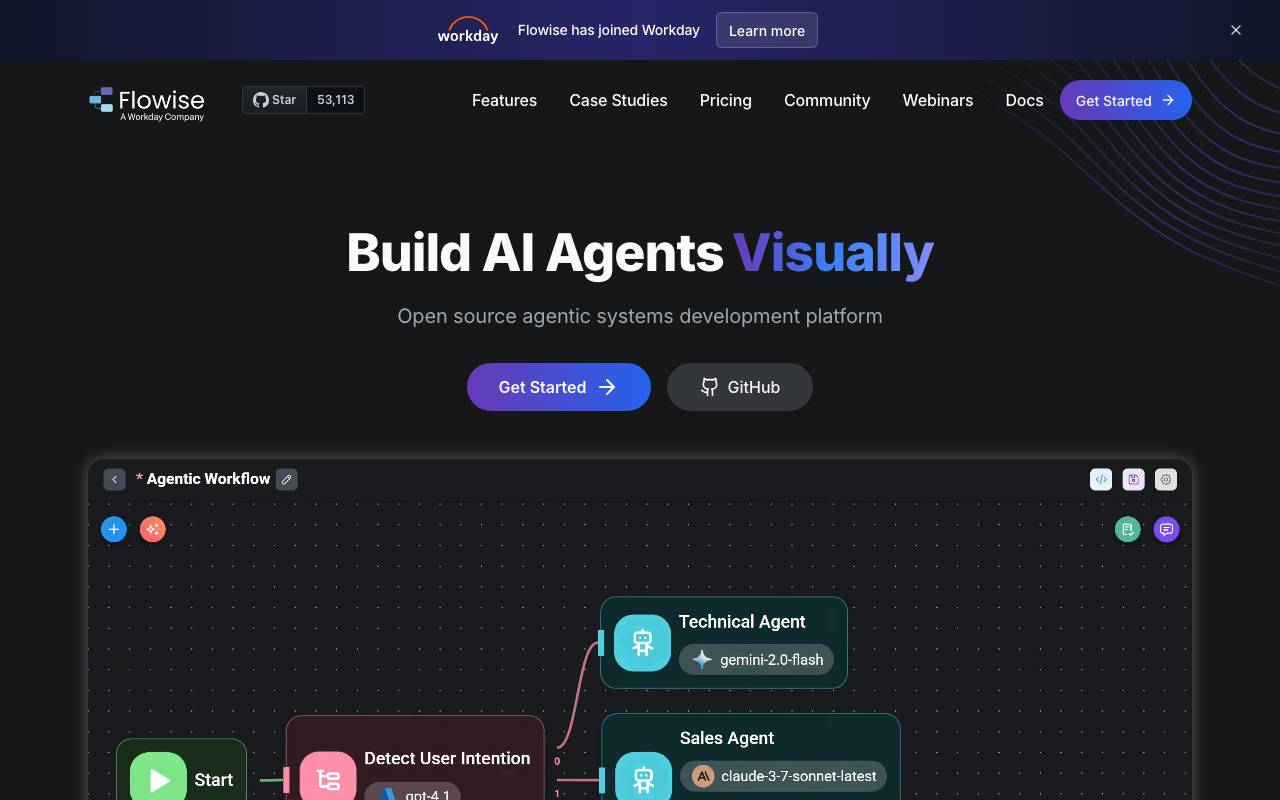
Flowise AI is an open-source low-code platform that lets developers and teams design LLM-powered applications through a visual node-based interface. Instead of writing extensive boilerplate, users connect components like models, prompts, memory, vector stores, and tools on a canvas to assemble chatbots, agents, and retrieval pipelines. Built on top of popular frameworks such as LangChain and LlamaIndex, Flowise supports a wide range of LLM providers, embeddings, and data sources. Finished flows can be deployed as APIs or embedded widgets, making it practical for prototyping internal tools as well as shipping production features. Because the project is self-hostable and community-driven, it appeals to teams that want flexibility, transparency, and control over their AI stack without being locked into a proprietary service.
Criteria breakdown
- Node-based visual editor for LLM workflows
- Support for LangChain and LlamaIndex components
- Built-in agents, memory, and tool integrations
- Connectors for vector databases and embeddings
- API endpoints and chat widget deployment
- Custom credentials and multi-model support

Pdf Redaction
AI-powered redaction tool for removing sensitive information from PDF documents.
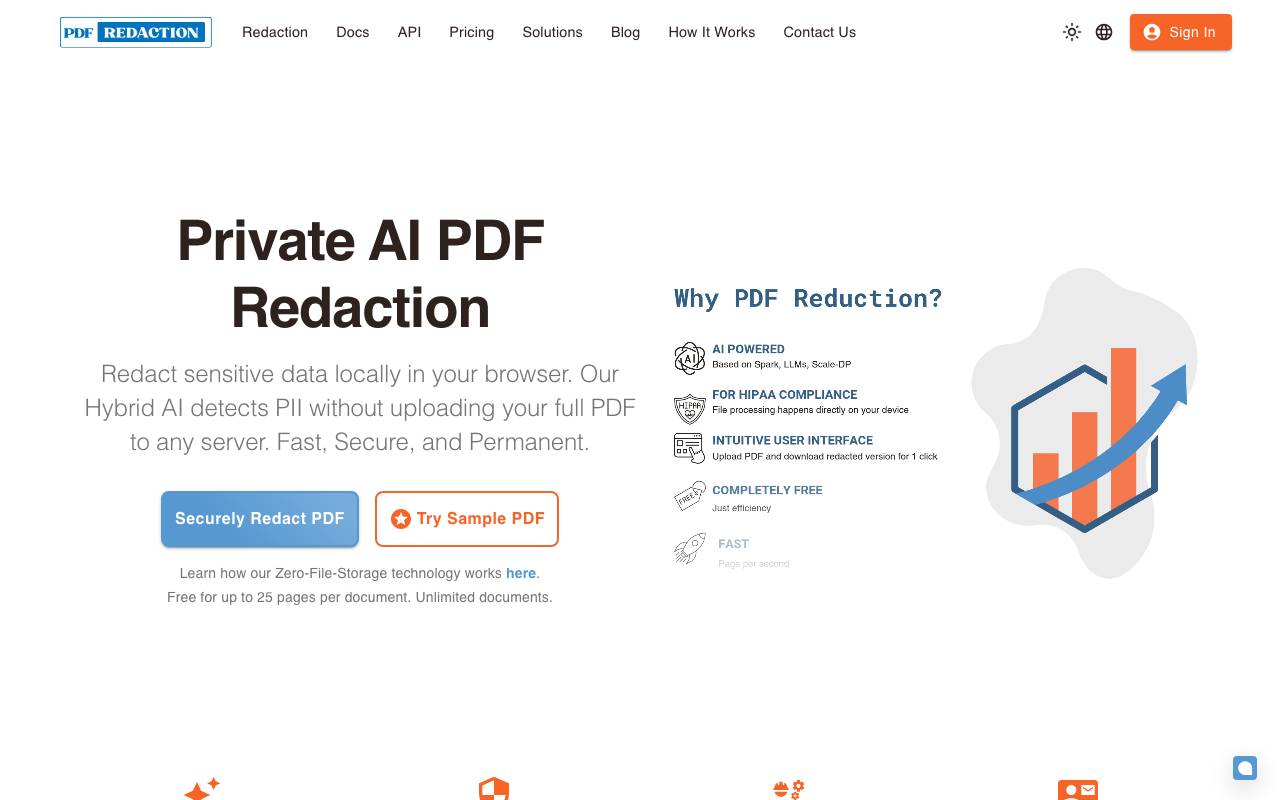
Pdf Redaction is an AI-assisted tool designed to help users identify and permanently remove confidential or sensitive data from PDF files. It automates the detection of personal information, financial details, and other private content that often needs to be hidden before sharing documents externally. By combining machine learning with traditional redaction workflows, the tool aims to reduce the manual effort involved in reviewing lengthy documents. It is suited for legal professionals, healthcare providers, government agencies, and businesses that regularly handle sensitive paperwork and need to comply with privacy regulations. Users can upload PDFs, let the AI scan for sensitive items, review suggested redactions, and export a cleaned version of the document ready for distribution.
Criteria breakdown
- AI-based sensitive data detection
- Permanent redaction of text and content
- Batch processing of PDF files
- Review and approval workflow
- Support for personal and financial data patterns
- Secure document handling

IsMyStoreReady
Instant audit tool for Shopify and WooCommerce stores to spot conversion and setup issues.

IsMyStoreReady is an automated audit tool built for Shopify and WooCommerce store owners who want a quick health check of their online shop. By scanning a store's public pages, it surfaces common issues that can hurt conversions, SEO, trust, and overall readiness for traffic. The tool generates a structured report covering essentials like product page quality, store policies, performance signals, and trust elements. This gives founders and small ecommerce teams a clear, prioritized starting point without needing to hire a consultant or run multiple separate audits. It's aimed at solo sellers, dropshippers, and growing DTC brands who want a fast second opinion before launching ads or scaling marketing spend.
Criteria breakdown
- One-click store audit
- Shopify and WooCommerce support
- Conversion and trust checks
- SEO and performance signals review
- Prioritized issue reporting
- Actionable improvement suggestions

LangChain Agent
Open-source framework for building LLM-powered applications and autonomous agents.
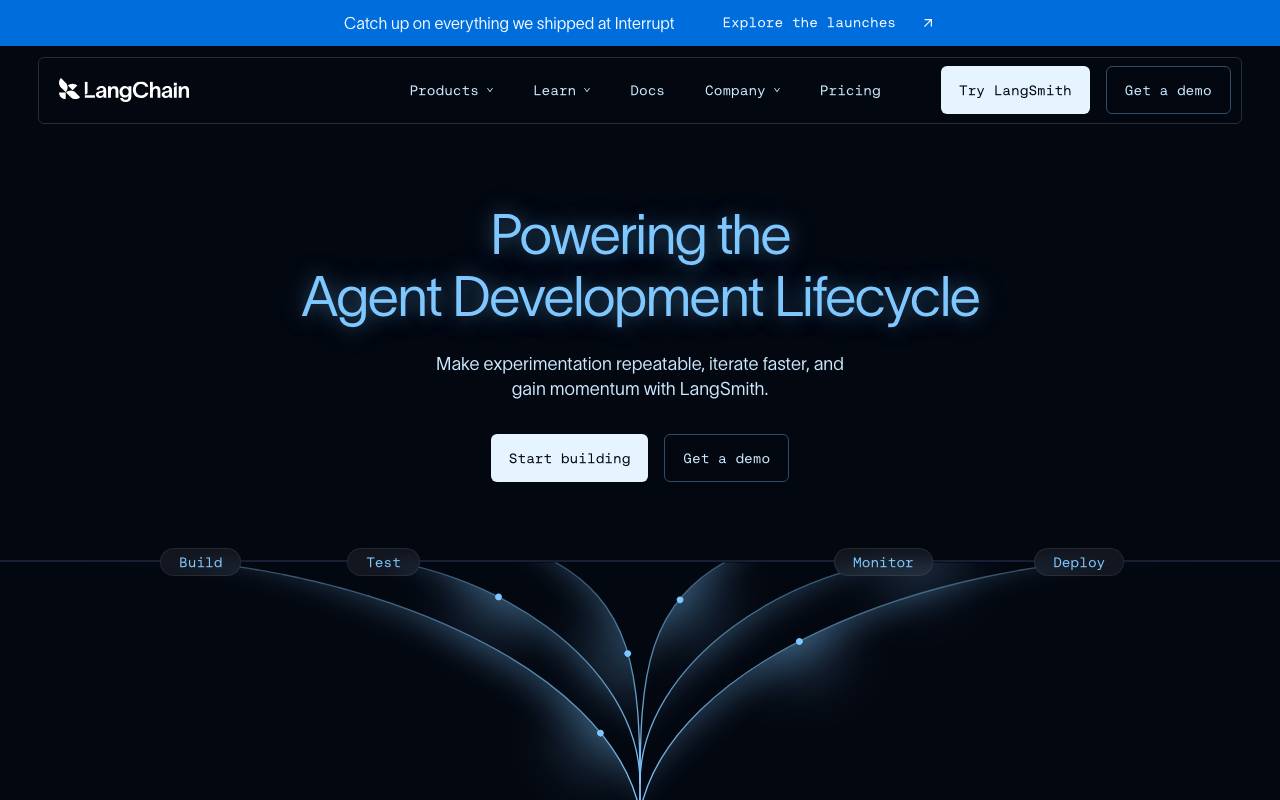
LangChain Agent is part of the broader LangChain framework, designed to help developers build applications where language models can reason, make decisions, and interact with external tools. Agents use an LLM as a reasoning engine to determine which actions to take, in what order, and how to use the results to inform subsequent steps. The framework provides modular components for chaining prompts, integrating data sources, managing memory, and connecting to APIs, databases, and search tools. This makes it well-suited for building chatbots, research assistants, workflow automation, and other dynamic LLM-driven systems. LangChain supports multiple model providers and languages (Python and JavaScript/TypeScript), making it a flexible foundation for both prototyping and production deployments.
Criteria breakdown
- Tool-using LLM agents
- Prompt and chain composition
- Memory and state management
- Integrations with vector stores and APIs
- Support for multiple LLM providers
- Streaming and async execution

LangSmith
Observability, evaluation, and debugging platform for LLM applications from the LangChain team
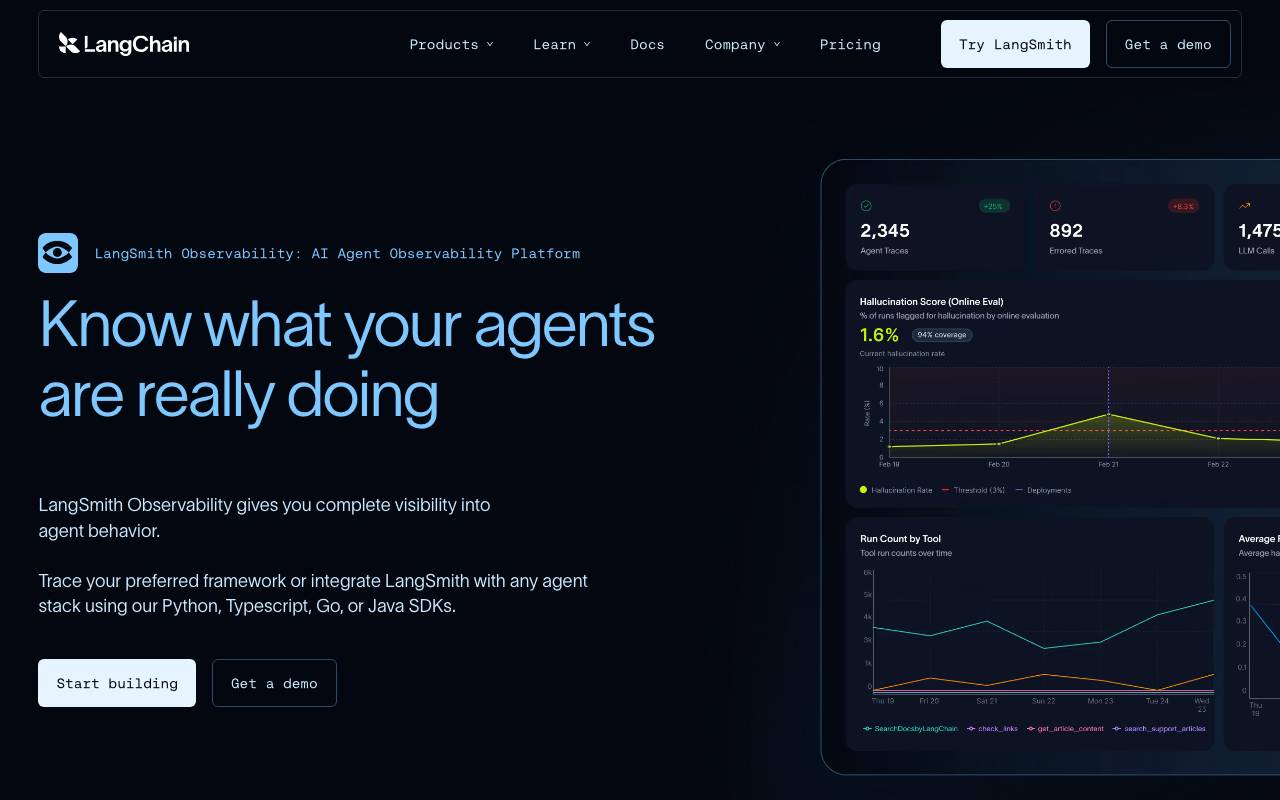
LangSmith is a developer platform built by the team behind LangChain to help teams trace, test, evaluate, and monitor applications powered by large language models. While it integrates tightly with the LangChain and LangGraph frameworks, it is framework-agnostic and can instrument any LLM application through its SDKs and APIs. Its core purpose is to address the inherent unpredictability of LLM-based systems, where outputs are non-deterministic and failures can be subtle, by giving developers visibility into what their chains, agents, and prompts are actually doing at runtime. The platform centers on tracing: each run of an application produces a detailed, nested trace showing every step, including prompts sent, model responses, token usage, latency, tool calls, and intermediate outputs. This makes it easier to debug complex multi-step agents and retrieval-augmented generation pipelines where the source of a bad answer might be buried several layers deep. Developers can inspect individual traces, filter and search across runs, and drill into the exact inputs and outputs at each node. LangSmith also provides evaluation tooling for measuring application quality. Teams can build datasets from production traces or curated examples, run their application against those datasets, and score outputs using built-in evaluators, custom code-based checks, or LLM-as-judge approaches. This supports regression testing when prompts or models change and helps quantify whether changes actually improve results rather than relying on intuition. For production use, it offers monitoring dashboards that track metrics such as latency, cost, error rates, and feedback over time, along with the ability to collect human feedback and user annotations. A prompt management and playground component lets teams iterate on and version prompts, and compare model outputs side by side. LangSmith is aimed primarily at developers and teams shipping LLM features who need to move beyond ad hoc print-statement debugging toward systematic observability and evaluation. Its main strength is the depth of integration with the LangChain ecosystem and the unified workflow connecting tracing, datasets, and evaluation. Honest trade-offs include that the richest experience assumes you are comfortable in the LangChain/LangGraph world, that LLM-based evaluation is itself imperfect and requires careful design, and that it is a hosted commercial product with usage-based pricing, though self-hosting options exist for some plans. It competes with other LLM observability tools such as Langfuse, Helicone, Arize Phoenix, and Weights & Biases Weave.
Criteria breakdown
- Run tracing with step-by-step inputs, outputs, and token usage
- Dataset creation and automated evaluation
- Built-in, code-based, and LLM-as-judge evaluators
- Production monitoring dashboards
- Human feedback and annotation collection
- Prompt management, versioning, and playground

Coval
Simulation and evaluation platform for testing AI voice and chat agents at scale
Coval is a testing and evaluation platform aimed at teams building conversational AI agents, particularly those operating across voice and chat modalities. It addresses a recurring problem in agent development: traditional unit tests and manual spot-checks don't capture the non-deterministic, multi-turn nature of agentic systems, making it hard to know whether a change improves or regresses real-world behavior. The platform's core idea is simulation. Rather than relying solely on static test cases, Coval generates simulated user interactions that exercise an agent across many scenarios and conversational paths. These simulated runs can then be scored against defined metrics and expectations, allowing teams to measure reliability before shipping changes and to catch regressions as agents and prompts evolve. Coval positions itself for both voice and text agents, which is notable because voice introduces additional layers — speech-to-text, latency, and turn-taking — that affect agent quality beyond the underlying language model. The company has drawn comparisons to the way autonomous-vehicle teams use large-scale simulation to validate behavior before deployment, applying a similar testing philosophy to AI agents. In a typical workflow, a team connects their agent, defines scenarios and evaluation criteria, runs simulations, and reviews results across runs to track performance over time. This supports use in development as well as ongoing monitoring and regression testing as part of a CI-style process. As a relatively young product in an evolving category, details of its pricing, integrations, and exact metric coverage are best confirmed directly, and teams should evaluate how well its simulated scenarios reflect their own production traffic. Its main differentiation from general LLM-evaluation tools is the emphasis on multi-turn, multi-modal agent simulation rather than single-prompt scoring.
Criteria breakdown
- Simulated user interactions for testing agents
- Evaluation metrics and scoring across runs
- Support for voice and text agents
- Regression detection across agent versions
- Scenario-based testing of conversational paths

Stagehand
Open-source AI browser automation framework built for simplicity and extensibility.
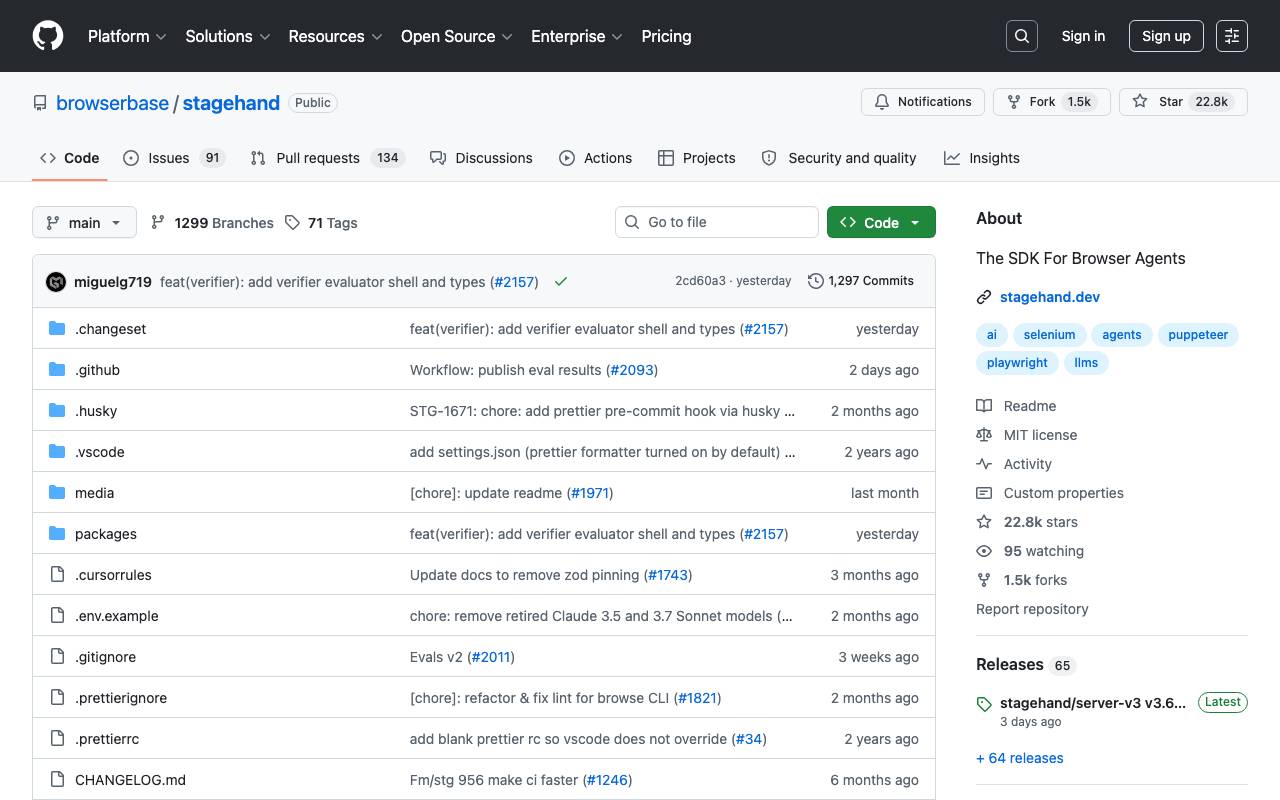
Stagehand is a web browsing framework that lets developers build AI agents capable of navigating, interacting with, and extracting data from websites. It combines deterministic Playwright-style code with natural language instructions, giving teams fine-grained control when they need it and high-level abstractions when they don't. The framework is designed around a small, predictable API focused on actions like observing a page, acting on elements, and extracting structured data. Its extensible architecture supports custom models, caching, and integration into broader agent stacks, making it suitable for everything from quick scraping scripts to production-grade browsing workflows.
Criteria breakdown
- Natural language act, observe, and extract methods
- Structured data extraction with schemas
- Playwright compatibility for low-level control
- Support for multiple LLM providers
- Caching for repeatable browser actions
- Composable with agent frameworks

Vertex AI Agent Builder
A Google Cloud platform that enables developers to create and deploy generative AI agents for enterprise applications.
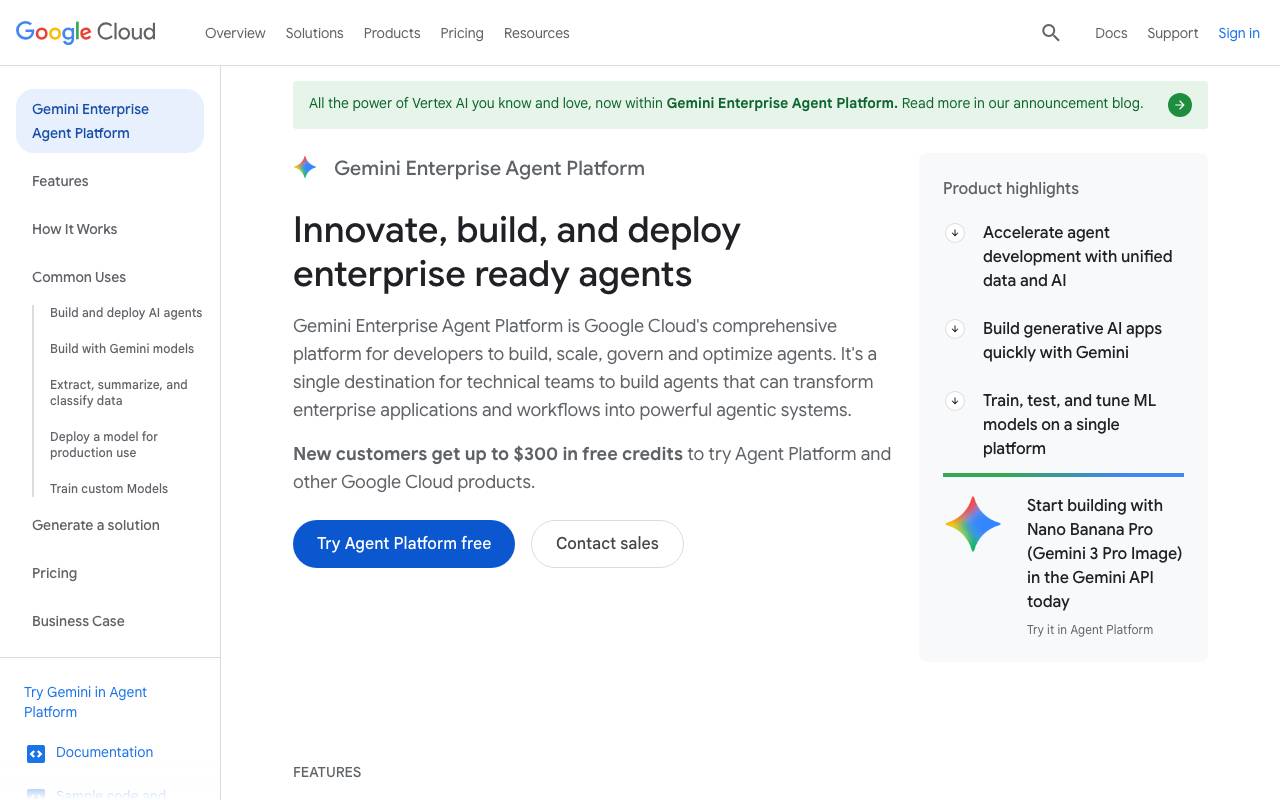
Vertex AI Agent Builder, now part of the Gemini Enterprise Agent Platform within Google Cloud, is a comprehensive platform for developers to build, scale, govern, and optimize enterprise-grade generative AI agents. It allows technical teams to transform enterprise applications and workflows into powerful agentic systems. The platform provides a unified environment for data and AI, enabling quick development of generative AI apps with tools like Gemini. Users can train, test, and tune machine learning models on a single platform. The platform offers an open and comprehensive environment that empowers businesses to rapidly build, scale, govern, and optimize enterprise-grade agents grounded in their enterprise data. It provides a full-stack foundation and extensive developer choice to transform applications and workflows into powerful agentic systems at a global scale. Key features include the ability to choose from over 200 Google and third-party AI models and tools, customize models for specific use cases, and utilize a Model Evaluation service for objective assessment of generative AI models. The platform also supports agent-powered development and workflows through tools like Google Antigravity, which allows for the centralized management and orchestration of agents. The Gemini Enterprise Agent Platform is designed for data scientists and ML engineers, offering tools for training, tuning, and deploying ML models, as well as MLOps for automating, standardizing, and managing ML projects. It provides a range of modular tools to collaborate across teams and improve models throughout the development lifecycle. Overall, Vertex AI Agent Builder within the Gemini Enterprise Agent Platform enables the creation and deployment of sophisticated AI agents for enterprise applications, offering a range of tools and features to support development, scaling, governance, and optimization of these agents.
Criteria breakdown
- Build, scale, govern and optimize enterprise grade AI agents
- Unified data and AI for accelerated agent development
- Gemini Train for building generative AI apps
- Gemini Enterprise app for secure registration, management, and governance of agents
- Google Antigravity for agent-powered development and workflows
- 200+ Google and third-party AI models and tools

Botpress
End-to-end platform for building, deploying and managing AI agents and chatbots.
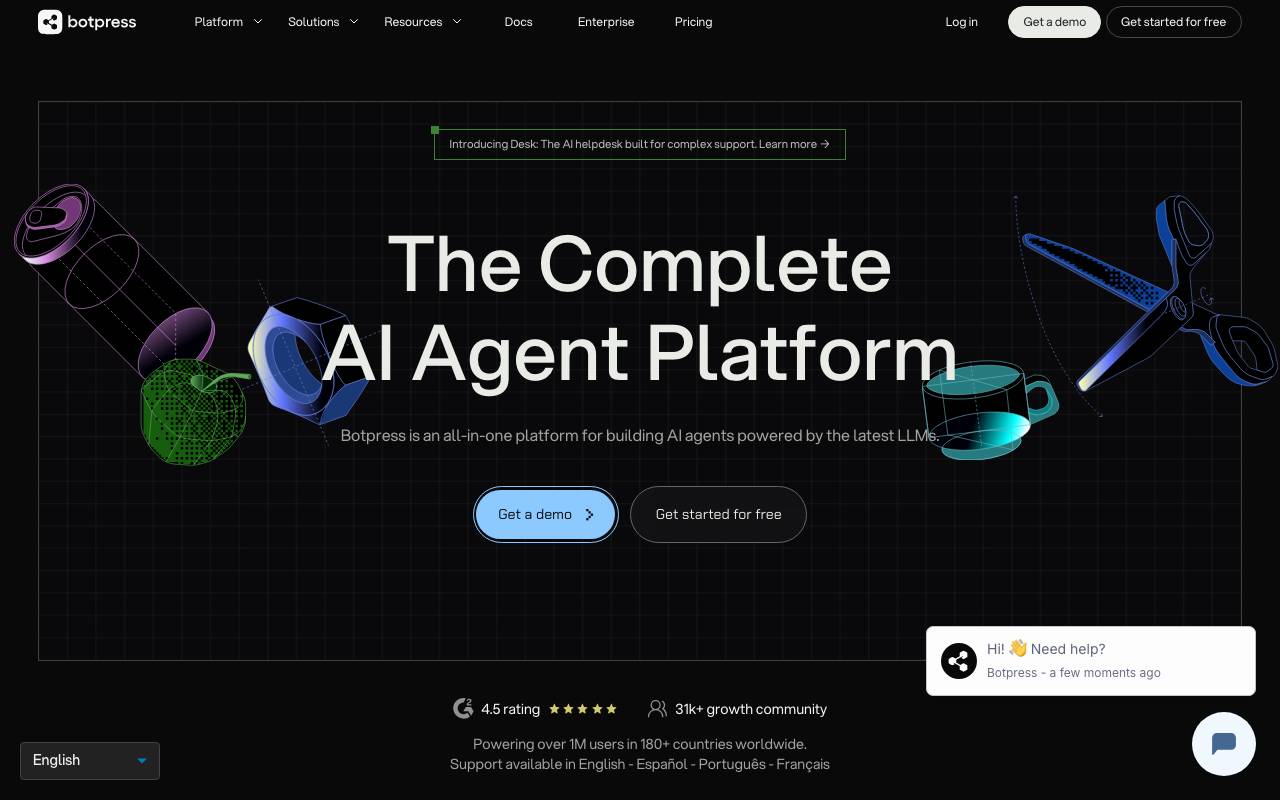
Botpress is a development platform for creating conversational AI agents powered by large language models. It provides a visual flow builder, an SDK, and integrations with popular messaging channels, letting teams design agents that can hold natural conversations, call APIs, and execute multi-step tasks. The platform combines low-code tools with deeper customization options, so both non-technical users and developers can collaborate on the same project. Features like knowledge bases, analytics, and human handoff make it suitable for production use cases such as customer support, lead generation, and internal automation. Botpress offers a free tier for experimentation and paid plans that scale with usage, plus an open-source community edition for self-hosted deployments.
Criteria breakdown
- Drag-and-drop conversation flow editor
- LLM-powered agents with tool use
- Knowledge base ingestion from docs and URLs
- Multi-channel deployment (web, WhatsApp, Slack, etc.)
- Analytics and conversation monitoring
- Human handoff and team collaboration