Best Coding Library (2026)

3 min read
If you sign up through a link on this page, we may earn a commission — it never affects our rankings.
A curated guide to the best Coding Library tools, covering reusable code collections, SDKs, and packages that help developers ship faster with proven components.
As a developer, I'm sure you've struggled with the tedious task of integrating AI models into your projects. From data preprocessing to post-processing, the process can be overwhelming, especially when working with large language models. That's where a reliable coding library comes in – but how do you choose the right one for your needs?
Understanding the Importance of a Coding Library
When selecting a coding library, it's crucial to focus on the features that will directly impact your project's reliability and maintainability. For instance, if you're working with unstructured data, you'll want a library that can handle this input with minimal errors. Outlines excels at this with its structured, reliable outputs from large language models – it's a game-changer for large-scale projects.
On the other hand, security should also be a major concern, particularly if your project involves user interaction or handles sensitive data. This is where PixeeAI comes in – it not only identifies vulnerabilities but also fixes them, hardening your code and squashing bugs to ensure software security.
Key Factors to Consider When Choosing a Coding Library
When evaluating a coding library, here are a few key factors to consider:
- Data Management: Look for libraries that make data processing and validation straightforward. Pydantic is an excellent example of a library that streamlines data validation using type hints, making it easier to identify errors before runtime.
- Scalability: Large language models can be computationally expensive, so choose a library with efficient handling of these complex tasks.
- Integration: If your project involves integrating AI chat interfaces, consider libraries that make this process seamless. assistant-ui offers a flexible open-source solution for TypeScript and React applications.
Common Pitfalls When Choosing a Coding Library
One common pitfall to avoid is relying on free libraries for mission-critical features – while they can be a great starting point, always consider the long-term implications of using a non-commercial tool. Additionally, don't get caught up in overly feature-rich libraries that might not suit your project's specific needs.
Pricing Patterns
When it comes to pricing, coding libraries generally fall into three categories:
- Free: These are often ideal for proof-of-concepts or small projects where licensing fees are not a concern. Keep in mind, however, that free libraries can be vulnerable to changes, updates, or even outright discontinuation.
- Subscription-based: This model offers access to a wider range of features or support services for a recurring fee.
- One-time licensing fees: Some libraries charge a flat fee upfront, offering flexibility and peace of mind for commercial projects.
Practical Advice
Here are a few parting pieces of advice:
- Evaluate libraries with open eyes: Make an informed decision based on your project's specific requirements and long-term goals.
- Consider the wider ecosystem: How well does the library integrate with your existing tech stack, and are there other tools that work seamlessly together?
- Always test and validate: Before committing to a library, try it out on a small scale to ensure it meets your project's needs.
By following these guidelines and considering your project's unique requirements, you'll be well on your way to finding the perfect coding library for your needs.
Coding Library by the numbers
Pricing mix
Best Coding Library (2026)
- 1
 assistant-uiAn open-source TypeScript/React library enabling developers to integrate AI chat interfaces into their applications.4.8 (5)
 - 2
 PydanticPython data validation and settings management powered by type hints.4.8 (4)
 - 3
 OutlinesPython library for structured, reliable outputs from large language models.4.6 (5)
 - 4
 PixeeAIAn automated product security engineer that fixes vulnerabilities, hardens code, and squashes bugs to enhance software security.4.5 (4)

assistant-ui
An open-source TypeScript/React library enabling developers to integrate AI chat interfaces into their applications.
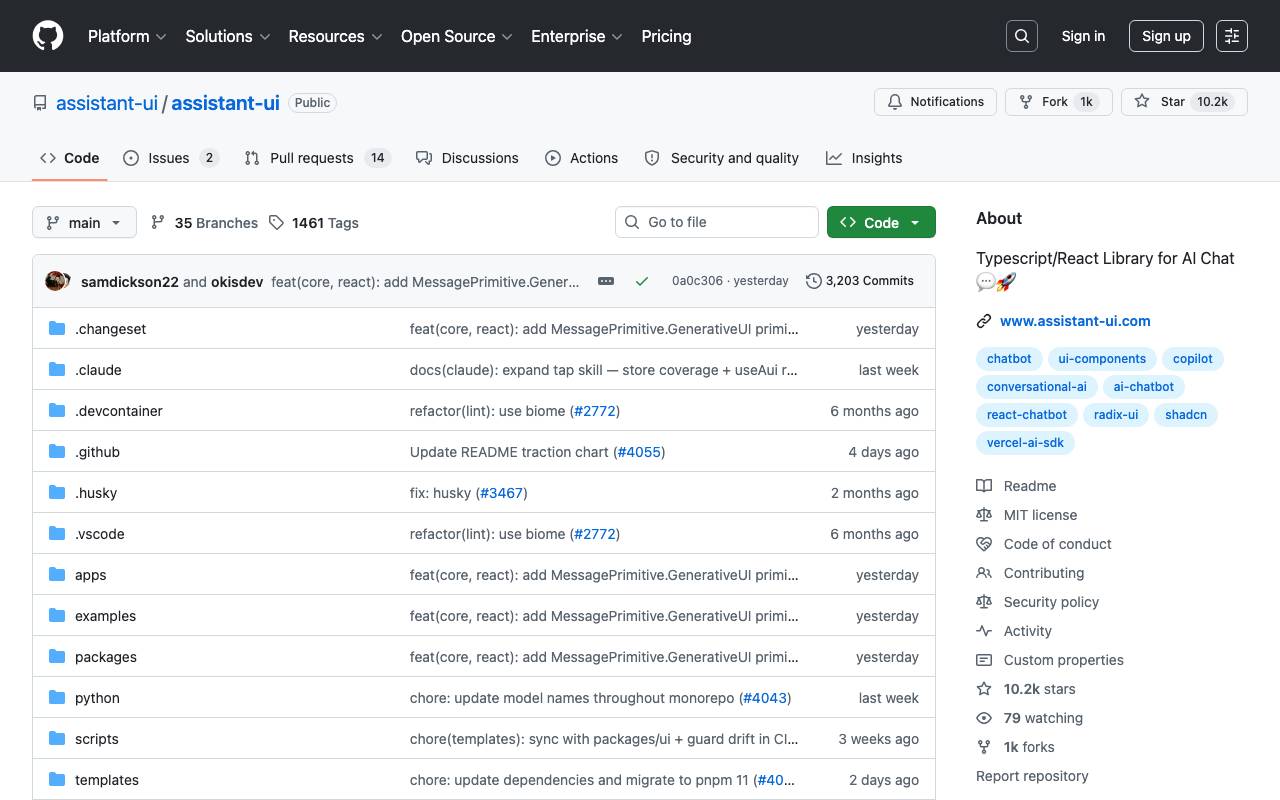
Assistant-ui is an open-source TypeScript/React library that enables developers to integrate AI chat interfaces into their applications. It provides a set of production-ready components and state management tools to build conversational AI agents. The library is designed to work with various LLM providers, including Vercel AI SDK and LangChain, and is optimized for high performance and minimal bundle size. Assistant-ui allows developers to create ChatGPT-like UI experiences with theming and sensible defaults, and supports features like streaming, interruptions, and multi-turn conversations. The library is backed by several notable organizations and has been praised by developers for its ease of use and flexibility. It has been used in a variety of applications, including financial assistants and chatbot experiences. Assistant-ui also provides a documentation index and supports integration with other tools and services, such as LangGraph and LangSmith. One of the key benefits of assistant-ui is its ability to save developers time and effort in building chat interfaces. By providing a set of pre-built React components, the library eliminates the need for developers to build chat interfaces from scratch. This allows developers to focus on the logic of their AI agents, rather than the UI. Assistant-ui also supports integration with other services, such as Neon Database, which provides a cloud-based solution for storing and managing chat threads. This allows developers to build conversational AI agents that can store and manage user interactions over time. In terms of strengths and limitations, assistant-ui is a powerful tool for building conversational AI agents, but it may require some technical expertise to use effectively. The library is highly customizable, but this can also make it more difficult to learn and use for developers who are new to React and TypeScript. Overall, assistant-ui is a useful tool for developers who want to build conversational AI agents with a ChatGPT-like UI experience. Its flexibility, customizability, and support for various LLM providers make it a popular choice among developers. Assistant-ui has been used by several companies and organizations, including LangChain and Y Combinator, and has been praised for its ease of use and flexibility. It is a popular choice among developers who want to build conversational AI agents with a high-quality UI experience. The library is well-documented and has a strong community of developers who contribute to it and provide support. This makes it a good choice for developers who are new to building conversational AI agents, as well as those who are experienced and looking for a flexible and customizable solution.
- Pre-built React components for building chatbot experiences
- State management tools for conversational AI agents
- Support for streaming, interruptions, and multi-turn conversations
- High-performance rendering and minimal bundle size
- Integration with LangGraph and LangSmith
- Support for Vercel AI SDK and LangChain

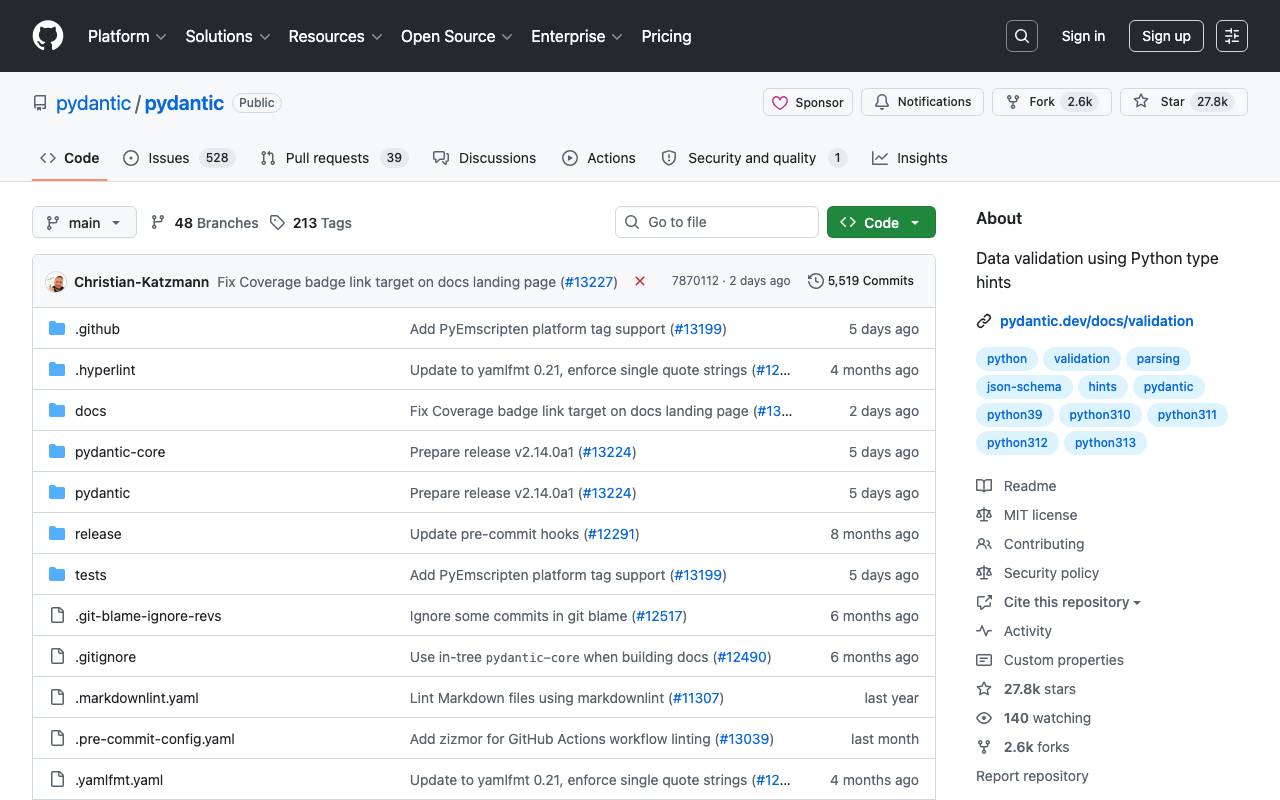
Pydantic is an open-source Python library that uses standard type hints to validate, parse, and serialize data at runtime. It converts incoming data into well-typed Python objects, raising clear, structured errors when inputs don't match the expected schema. Widely adopted across the Python ecosystem, Pydantic underpins frameworks like FastAPI and is commonly used for API payloads, configuration management, and structured outputs from LLMs. Version 2 introduced a Rust-based core that delivers significantly faster validation while preserving the familiar, Pythonic API. Beyond basic validation, Pydantic supports JSON schema generation, custom validators, strict and lax type coercion, and environment-based settings via the pydantic-settings package, making it a practical foundation for production Python applications.
- Type-hint based data validation and parsing
- Automatic JSON schema generation
- Custom validators and serializers
- Settings management via pydantic-settings
- Strict and coercive validation modes
- Integration with LLM structured output workflows

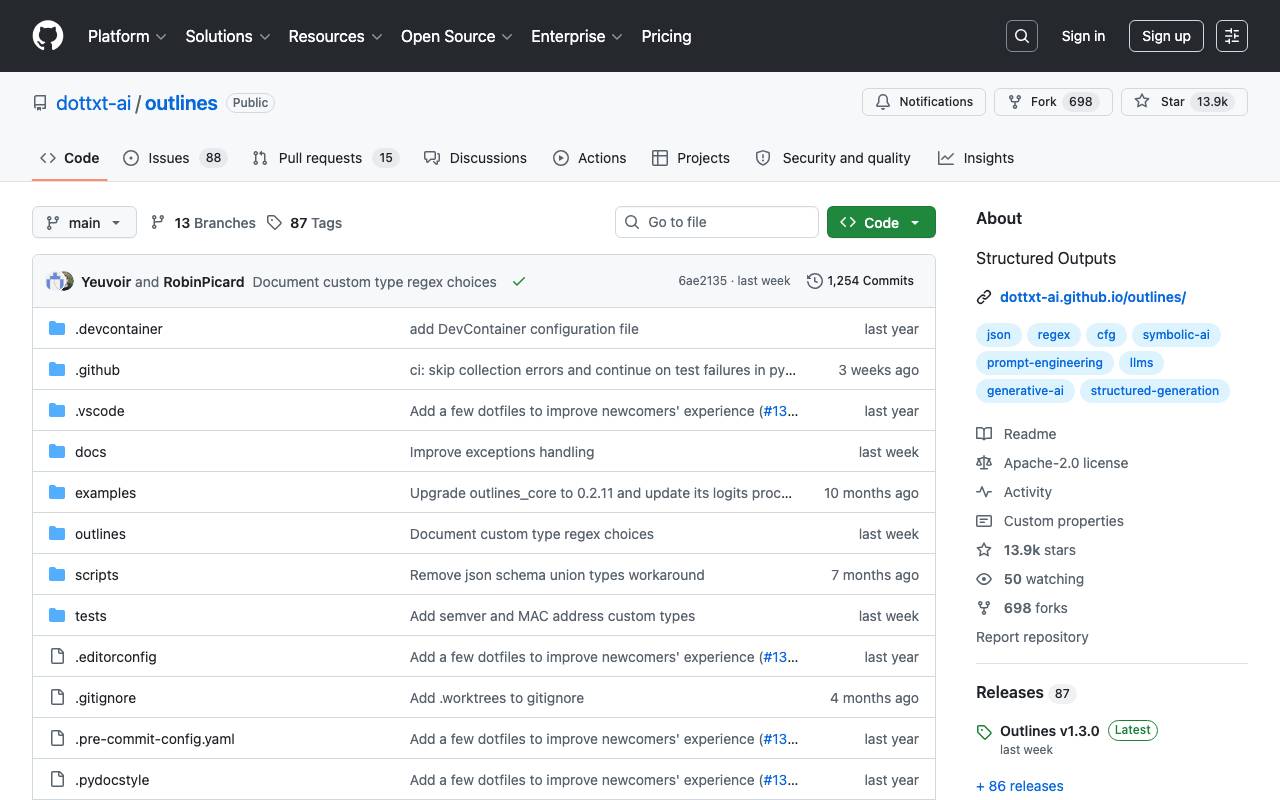
Outlines is an open-source Python library designed to help developers generate structured, predictable text from large language models. Instead of relying on free-form prompts and hoping the model returns valid output, Outlines lets you constrain generation to specific formats such as JSON schemas, regular expressions, type signatures, or context-free grammars. The library integrates with popular model backends and is particularly useful for building production pipelines where parsing, validation, and reliability matter. Common use cases include extracting structured data, routing decisions, function calling, and agent workflows that depend on machine-readable responses. Because Outlines guides the model during decoding rather than after the fact, it can reduce retries, post-processing, and brittle prompt engineering, making LLM-driven applications easier to maintain.
- Schema-constrained JSON generation
- Regex and grammar-guided decoding
- Type-based structured outputs
- Support for multiple LLM backends
- Tooling for prompt templating
- Open-source Python API

PixeeAI
An automated product security engineer that fixes vulnerabilities, hardens code, and squashes bugs to enhance software security.
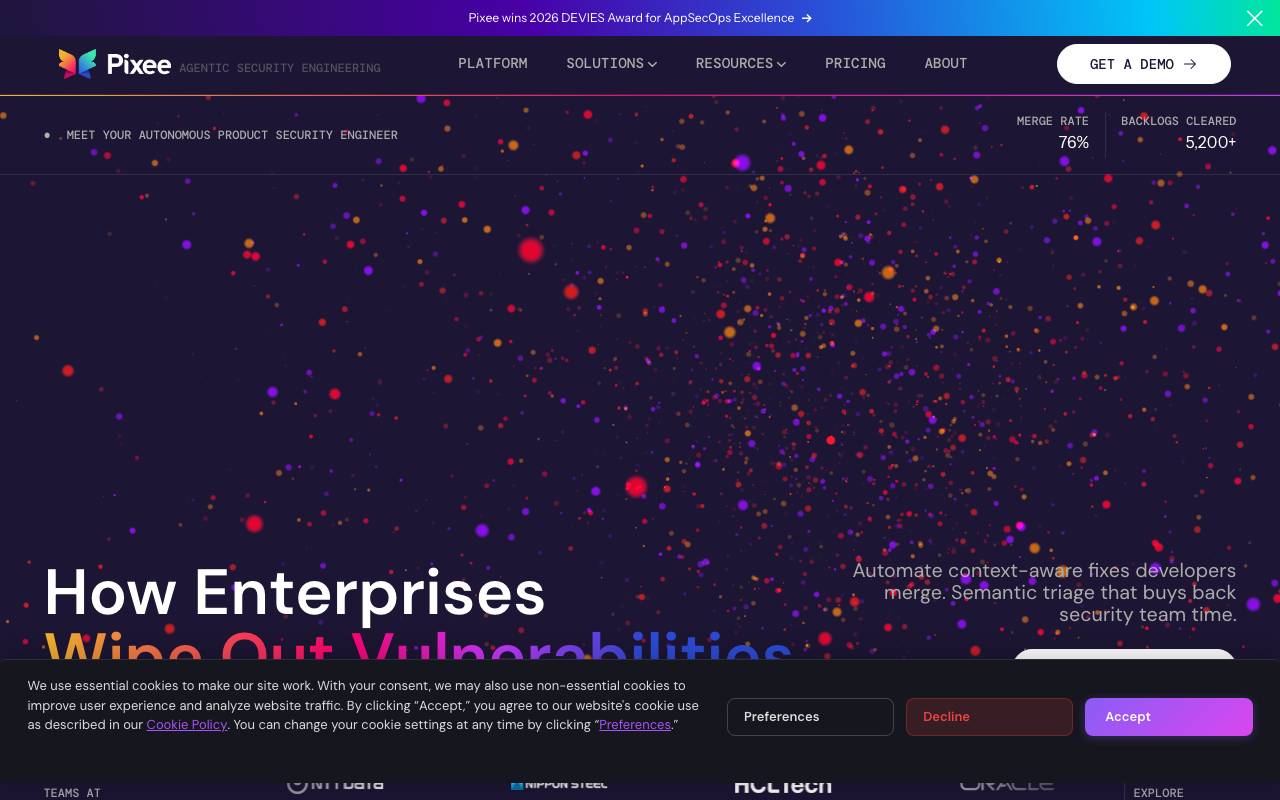
PixeeAI is an automated product security engineer that helps enterprises strengthen software security by identifying and fixing vulnerabilities, eliminating false positives, and preventing future threats. It works by analyzing codebases, security policies, and architecture to determine the real attack surface, then generating fixes that are ready to merge and respect existing security rules and CI. By using PixeeAI, companies can clear backlogs, reduce noise, and enhance their overall security posture. PixeeAI's capabilities include deep codebase analysis, exploitability analysis, false positive elimination, threat modeling, and generation of fixes that are tailored to the specific needs of the development team. It can identify real risks, prioritize remediation, and provide evidence-based triage to ensure that only critical issues are addressed. PixeeAI also allows developers to work with the AI-generated fixes, respecting their conventions and security rules, and enabling them to prioritize and focus on the most critical security weaknesses. By automating the process of identifying and fixing vulnerabilities, PixeeAI can significantly reduce the complexity and time required to resolve security backlogs, enabling development teams to focus on shipping new features and delivering value to customers.
- Deep codebase analysis
- Exploitability analysis
- False positive elimination
- Threat modeling
- Convention-aware fixes
- Ready-to-merge PRs
Browse all 4 Coding Library tools
The complete, searchable directory — ranked by real user reviews.


