Past battle · 2024-02-11 UTC
Gaming Showdown — February 11, 2024
From the Gaming category. 32 marks placed across 7 fighters. GCS Cheats took the crown.
Final standings






The line-up
The fighters
Profiles of every tool that competed in this battle, ranked by their final score.


GCS Cheats is a service that sells private cheat software for popular competitive online games, advertising features such as aimbots, ESP overlays, and anti-detection measures. It targets players seeking an unfair advantage in titles where third-party software is prohibited by the publisher. The product is distributed on a subscription basis, with separate loaders for different supported games. Promotional material emphasizes stealth against common anti-cheat systems, though effectiveness varies and changes frequently as anti-cheat vendors update their detection methods. Use of cheating software almost always violates game terms of service and can result in account bans, hardware bans, or legal action in some jurisdictions. This entry is informational and does not endorse use.
Criteria breakdown
- Aimbot with customizable settings
- ESP and wallhack overlays
- Claimed anti-detection bypasses
- Per-game loader and licensing
- Configurable visual and combat options
- User configs and presets

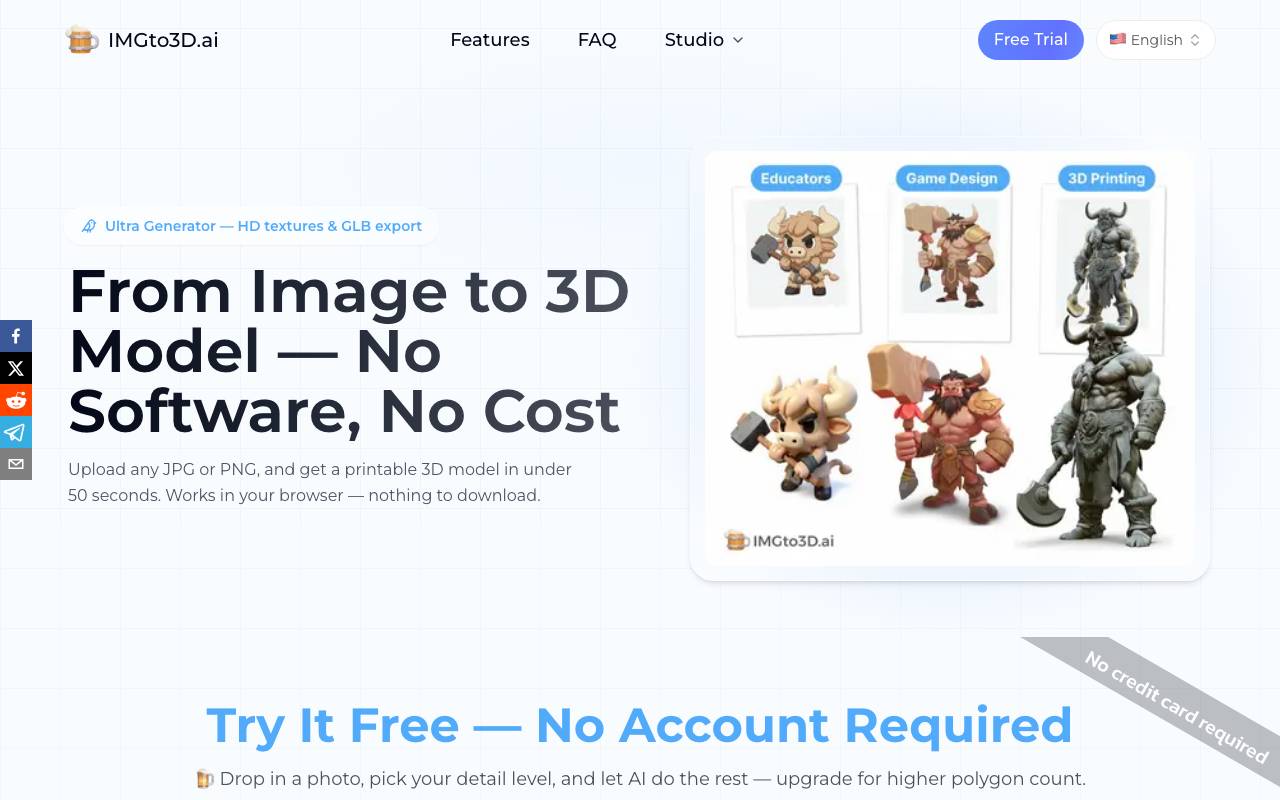
Image to 3D AI is a tool that utilizes AI-powered generation to convert 2D images into 3D models in a short span of time. The exact problem it solves and the specific use cases it supports are unclear. The tool's target audience and how it works are also unknown. There is no information provided on its standout capabilities, integrations, strengths, limitations, or comparison to other alternatives.
Criteria breakdown
- AI-driven 2D to 3D conversion
- Single-image input workflow
- Downloadable 3D model files
- Web-based interface
- Quick turnaround in seconds
- Accessible free generation option

nunu.ai
Pioneering AI technology startup revolutionizing game quality assurance with advanced AI agents.
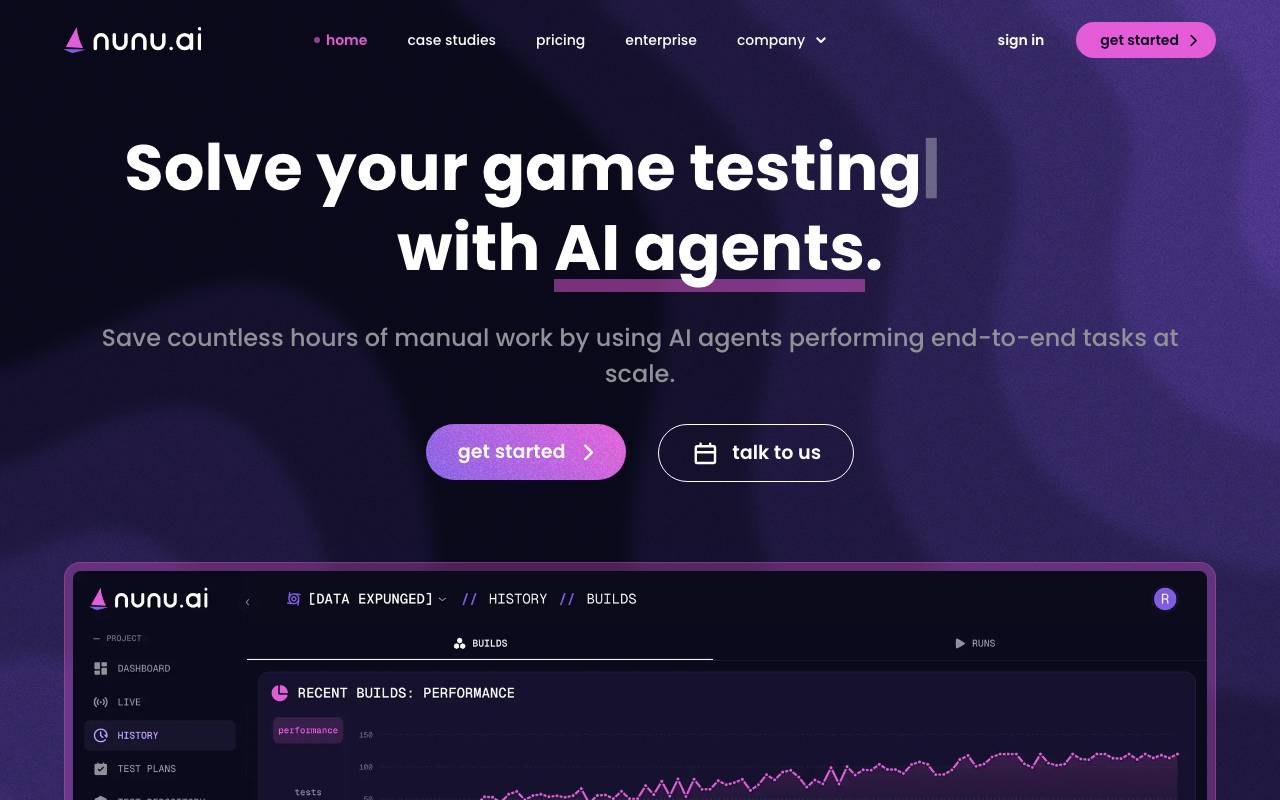
Nunu.ai uses AI agents to improve game quality assurance. The technology likely involves machine learning models to automate testing, identify bugs, and provide actionable insights to developers. This approach may accelerate game development, enhance player experience, and reduce testing costs. Its primary application is in the video game industry, serving game developers, publishers, and QA teams. The technology likely supports multiple game engines and platforms. Nunu.ai's AI agents can be fine-tuned for specific game requirements, ensuring optimal performance and adaptability. Its capabilities likely include automated bug detection, regression testing, and quality assessment. However, limitations may arise from its dependency on high-quality training data, potential biases in AI decision-making, and the need for human oversight in critical situations. As a relatively new and pioneering technology, Nunu.ai may face competition from established quality assurance tools and techniques. In comparison to traditional QA methods, Nunu.ai's AI agents can provide faster and more accurate results, while also reducing human error and increasing testing efficiency. However, its effectiveness in complex game environments and its ability to integrate with diverse game development pipelines remain to be seen. Nunu.ai's AI agents can help developers identify and prioritize critical issues, streamline their testing processes, and optimize resource allocation. By leveraging AI-driven quality assurance, developers can focus on creating engaging gameplay experiences while ensuring a high level of technical quality. Despite the potential benefits, Nunu.ai may not be a suitable replacement for traditional QA methods in all scenarios, particularly where human intuition and expertise are essential. Its long-term value relies on its ability to continuously learn from new data, improve its decision-making capabilities, and maintain alignment with industry standards. Ultimately, Nunu.ai's success will depend on its ability to effectively address the complexities of game development, provide actionable insights, and drive business results for its clients.
Criteria breakdown
- Automated bug detection
- Regression testing
- Quality assessment
- Automated testing
- Actionable insights
- Fine-tuning for game requirements


Partaake is an AI-powered platform designed to make organizing and managing golf events more manageable. It's intended for event organizers, primarily those involved in golf events. Using artificial intelligence, the platform streamlines the process, simplifying tasks and potentially improving event efficiency. Key capabilities, such as workflow automation and integration, likely contribute to its ability to simplify the process of arranging and running golf events. By doing so, it helps users optimize their time and increase their effectiveness in event management.
Criteria breakdown
- AI-assisted player pairings and flights
- Online registration and payment collection
- Live scoring and leaderboards
- Sponsor and hole assignment management
- Participant communication tools
- Event analytics and reporting

Voyager
LLM-powered autonomous agent that learns and explores in Minecraft without human input.
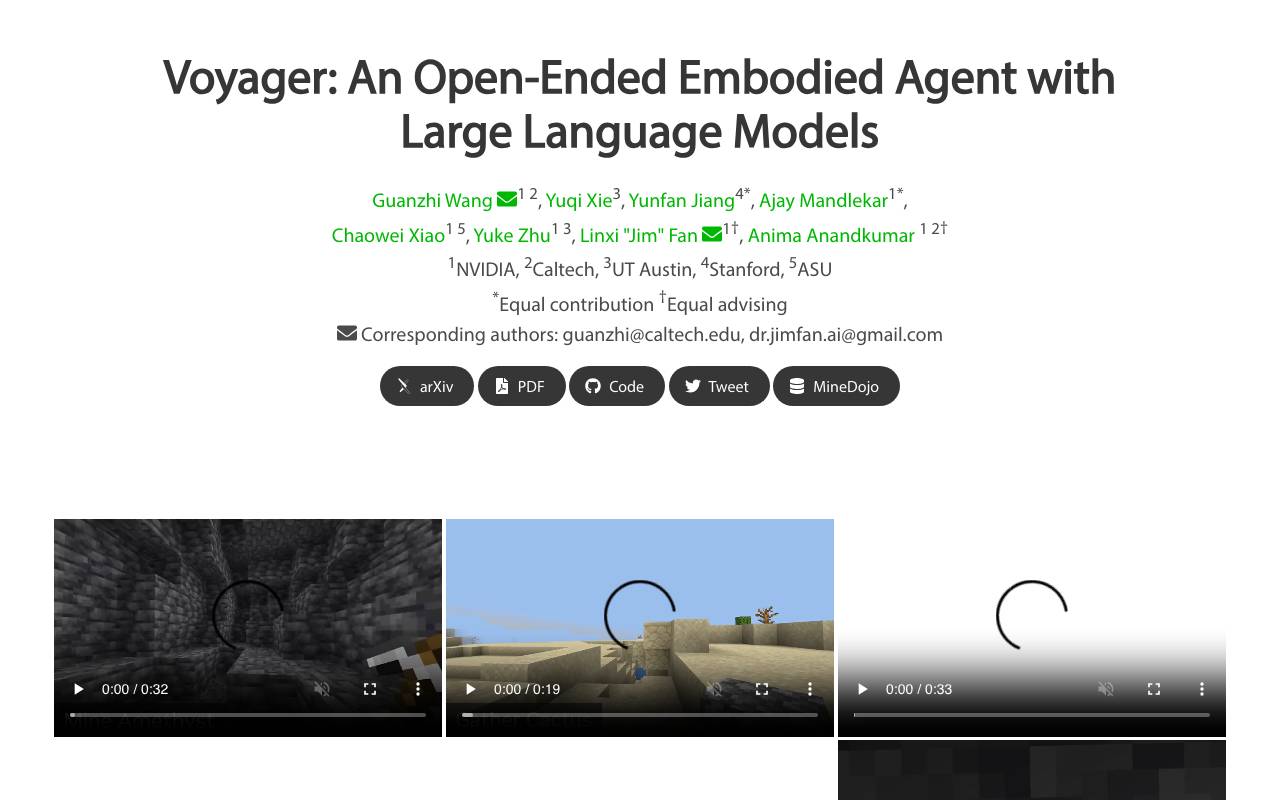
Voyager is a research project that uses large language models to drive an autonomous agent inside Minecraft. The agent sets its own goals, writes executable code to act in the world, and incrementally builds a library of reusable skills as it plays. It combines an automatic curriculum for open-ended exploration, an iterative prompting loop that refines code through environment feedback, and a growing skill library that lets the agent tackle progressively harder tasks. Over time, Voyager unlocks new tech tree milestones, gathers diverse items, and traverses more terrain than prior Minecraft agents. Voyager is primarily of interest to AI researchers, game AI developers, and hobbyists exploring embodied agents, lifelong learning, and LLM-driven decision making in open-world environments.
Criteria breakdown
- Automatic curriculum for goal generation
- Iterative prompting with environment feedback
- Growing skill library of executable code
- LLM-driven planning and reasoning
- Open-ended exploration in Minecraft
- Research-oriented, open-source implementation

Happy Oyster AI
Open-ended world model for generating continuous, physics-consistent virtual environments.

Happy Oyster AI is a world model designed to simulate open-ended environments with persistent state and physically plausible behavior. Instead of producing isolated clips or static scenes, it generates continuous worlds that can be explored, interacted with, and extended over time. The system aims to maintain consistency across long horizons, keeping objects, dynamics, and spatial relationships coherent as a user navigates or manipulates the environment. This makes it suitable for research in embodied AI, simulation, game prototyping, and generative environment design. By combining generative modeling with physics-aware reasoning, Happy Oyster AI positions itself as a foundation for building interactive simulations where agents and users can act freely within a believable, evolving world.
Criteria breakdown
- Open-ended world generation
- Physics-consistent environment simulation
- Long-horizon state persistence
- Interactive exploration support
- Foundation for embodied agent training
- Generative scene and dynamics modeling

Pal Breed Calc
Pick two parent Pals to see their child, or pick a target Pal to see every parent combination. Instant results, free, no sign-up.
The Pal Breed Calc is a tool designed for players of the game Palworld, specifically for calculating the breeding results of Pals. It allows users to pick two parent Pals to see their child or select a target Pal to see every parent combination, providing instant results without requiring sign-up. The calculator is based on verified Palworld 1.0 combination data, ensuring accurate results. The tool offers two main lookups: parents to child and child to parents. For the parents to child lookup, users can select Parent A and Parent B, and the calculator will display the child species, its elements, and whether a mutated version can appear. The parent order does not matter, as swapping Parent A and Parent B will always return the same child. For the child to parents lookup, users can select a target Pal, and the calculator will list every parent pair that produces it in Palworld 1.0. This feature helps players find the cheapest route to breed their desired Pal by scanning the list for Pals already in their Palbox. The calculator reproduces the exact 1.0 formula used in Palworld, which averages the CombiRank values of the two parent Pals and rounds the result to determine the child species. It also takes into account 164 special breeding combos that override the formula entirely. Additionally, the calculator recognizes that 28 Pals, including Legendaries and tower bosses, can only breed true with another Pal of the same species. The Pal Breed Calc also supports breeding with Terraria collab Pals, allowing players to use them as parents with regular Pals. Overall, the tool provides a convenient and accurate way for Palworld players to plan and execute their Pal breeding strategies.
Criteria breakdown
- Forward breeding: pick two parent Pals and instantly see their child
- Reverse lookup: pick a target Pal and list every parent combination that produces it
- Breeding Path Planner that finds the fewest-step route from Pals you own to a target
- Full breeding tree drawn out with reused parents collapsed into back-references
- Verified Palworld 1.0 data: all 299 breedable Pals and the revised combination table
- 164 special combinations that override the standard breeding formula