Past battle · 2025-11-27 UTC
AI Agents Showdown — November 27, 2025
From the AI Agents category. 25 marks placed across 7 fighters. Humans.ai took the crown.
Final standings





The line-up
The fighters
Profiles of every tool that competed in this battle, ranked by their final score.

Humans.ai
Heart-driven AI platform combining generative creation with blockchain-based governance and ownership.
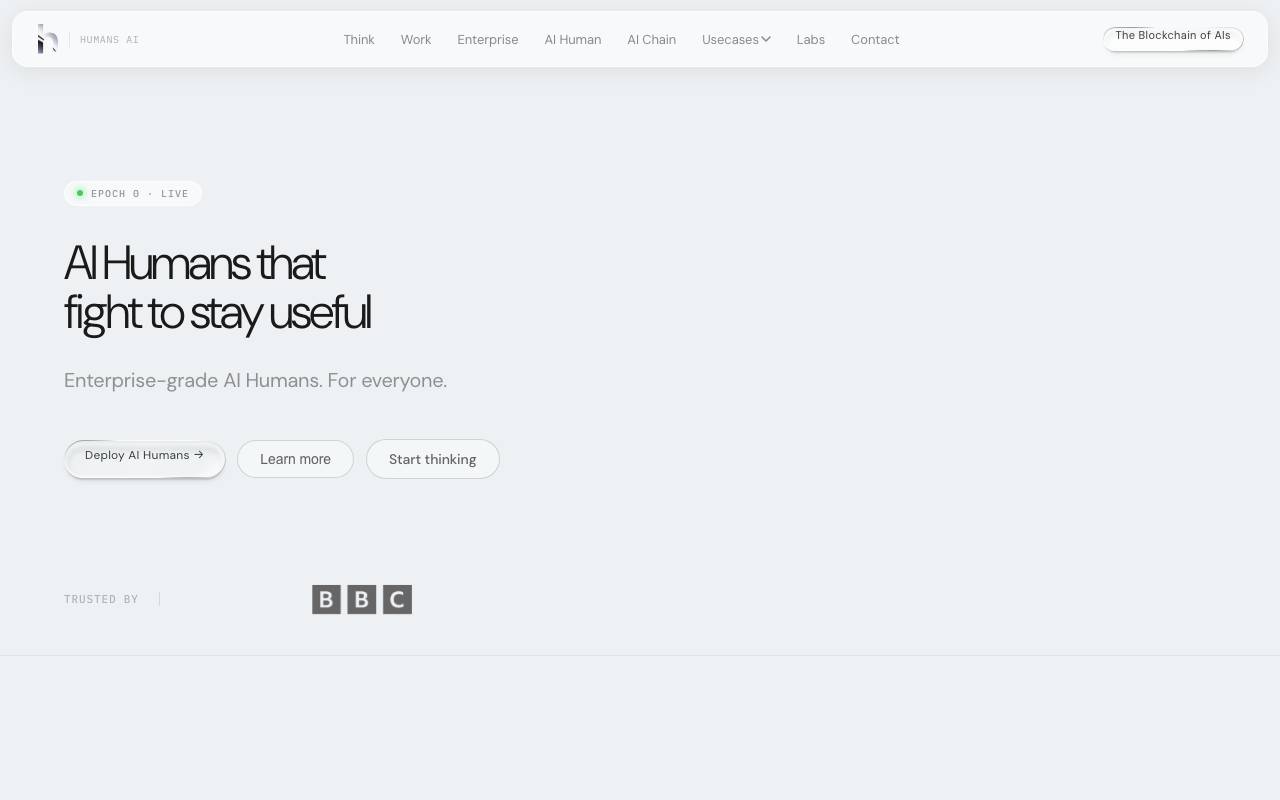
Humans.ai is a platform that blends artificial intelligence with blockchain infrastructure, enabling users to create, train, and deploy AI models while maintaining clear ownership and provenance. It focuses on responsible AI development by giving contributors verifiable rights over their data, voices, likenesses, and generated outputs. The platform supports a range of generative tools, including voice cloning, image synthesis, and avatar creation, all underpinned by a tokenized governance model. Stakeholders can participate in decisions about how models are validated, used, and rewarded through a proof-of-human protocol. Aimed at creators, enterprises, and developers, Humans.ai positions itself as a bridge between ethical AI principles and Web3-native ownership, offering an ecosystem where AI assets can be minted, licensed, and traded transparently.
Criteria breakdown
- Voice cloning and synthesis tools
- AI avatar and image generation
- Proof-of-human validation protocol
- Blockchain-based asset minting and licensing
- Decentralized governance via tokens
- Marketplace for AI models and outputs


LegacyBot is an AI assistant designed to help individuals organize and document their personal legacy. It guides users through the often overwhelming process of capturing important life details, wishes, and instructions in one structured place. Through conversational prompts, the tool helps gather information about finances, possessions, digital accounts, and personal messages for loved ones. The goal is to make legacy planning feel approachable rather than intimidating, even for those without prior estate planning experience. LegacyBot is positioned as a starting point for organizing your affairs, though users are typically encouraged to consult legal and financial professionals for binding documents.
Criteria breakdown
- Guided legacy planning conversations
- Digital asset and account inventory
- Personal message and memory recording
- Beneficiary and wishes documentation
- Structured export of planning details
- Step-by-step prompts for difficult topics

Neo
An AI-powered autonomous machine learning engineer capable of developing, deploying, and maintaining machine learning models without human intervention.
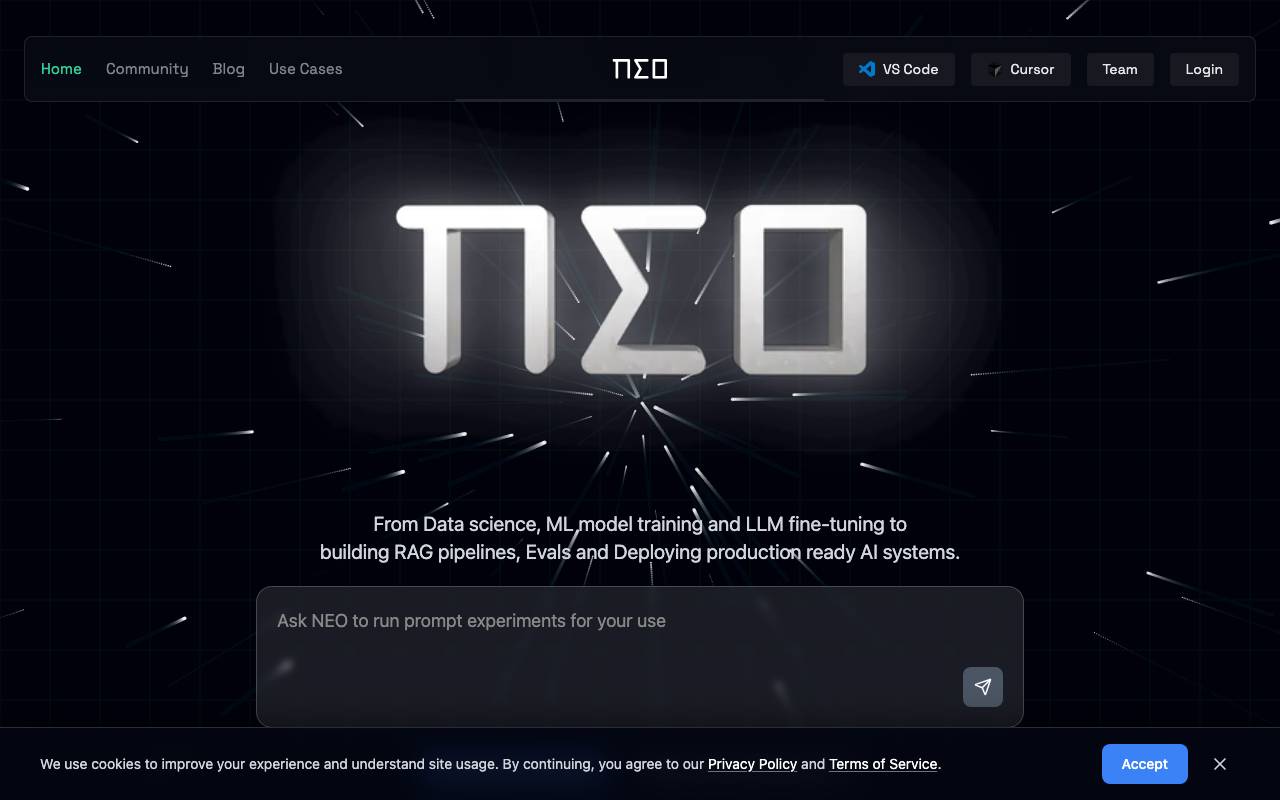
Neo is an AI-powered engineering agent that helps automate the process of developing, deploying, and maintaining machine learning models. It works with popular tooling like Claude Code, Cursor, and VS Code IDE, and can perform tasks such as code generation, experiment management, debugging, and model evaluation. Neo uses multi-step reasoning and a GPU sandbox to perform iterative ML experimentation, running hundreds of experiments and automatically selecting the best model. One of the key features of Neo is its ability to learn and adapt to the user's workflow, and it can handle tasks such as fine-tuning models, building benchmarks, and performing prompt optimization. Neo also comes with a user-friendly interface that allows users to guide its exploration of models and approaches, providing context and expertise to accelerate tasks. The company claims that Neo has proven performance on real benchmarks, and it has won competitions such as MLEBench. Some of the use cases that Neo can handle include model evals, prompt tests, RAG pipelines, dataset prep, experiments, and reports. Neo's capabilities can be broken down into a 4-step workflow: describing the task, adding context, running experiments, and steering or testing the results. One of the advantages of using Neo is that it can automate the engineering loop and keep iterating until the task is done, freeing up ML engineers to focus on higher-level tasks. Neo can also make use of SOTA models and software to perform its tasks.
Criteria breakdown
- Code generation
- Experiment management
- Debugging
- Model evaluation
- Fine-tuning models
- Prompt optimization

Bardeen AI
Browser-based automation that connects apps and handles repetitive workflows without code.
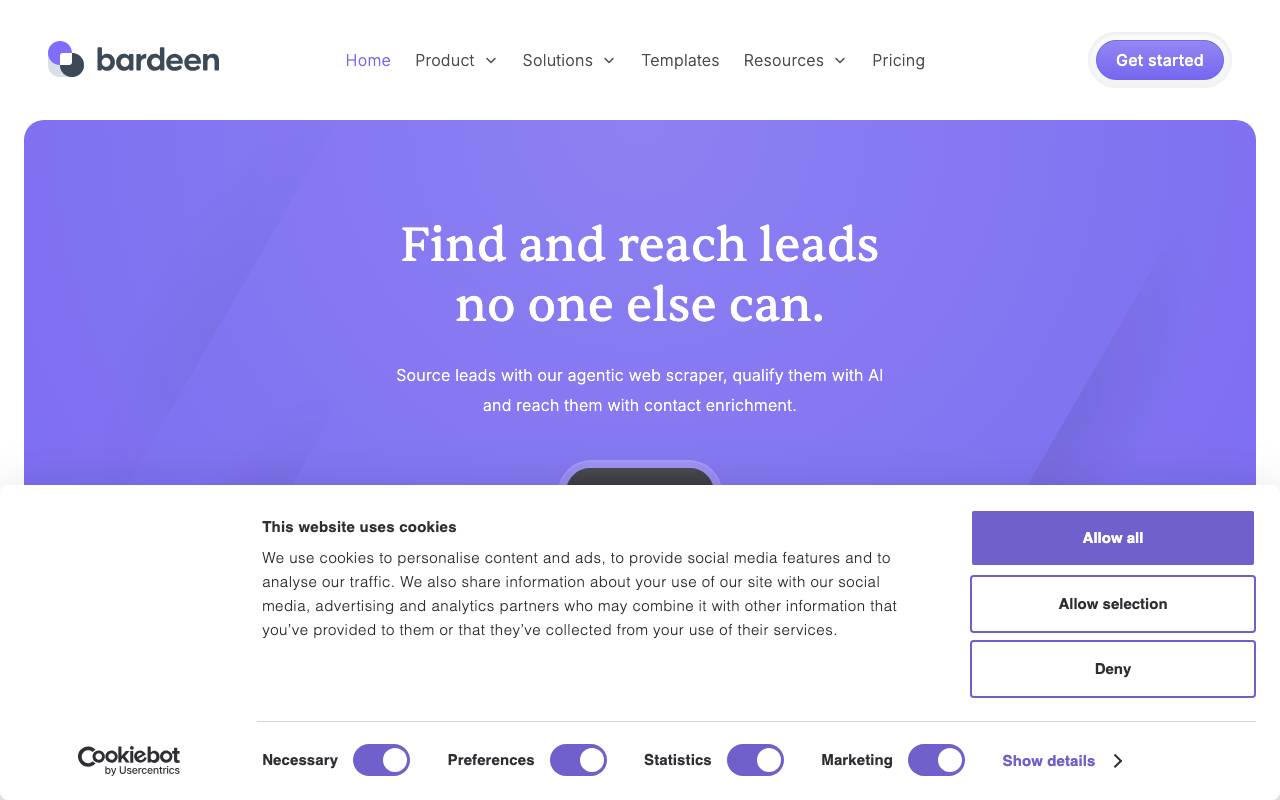
Bardeen AI is a no-code automation platform that runs in your browser, helping users automate repetitive tasks across web apps and websites. It connects with popular tools like Google Sheets, Notion, Slack, HubSpot, LinkedIn, and many more, allowing data to flow between them through prebuilt playbooks or custom workflows. Using AI, Bardeen can interpret plain-language instructions to build automations, scrape data from websites, enrich leads, send messages, and trigger actions based on events. It's aimed at professionals in sales, recruiting, operations, and research who want to reduce manual work without writing code. Bardeen offers a free tier alongside paid plans for teams needing more runs, premium integrations, and advanced features, making it accessible for individuals as well as growing businesses.
Criteria breakdown
- Prebuilt playbooks and automation templates
- AI-powered workflow builder from natural language
- Web scraping and data extraction tools
- Integrations with CRM, productivity, and messaging apps
- Scheduled and event-triggered automations
- Team collaboration and sharing options

Retell AI
An AI-powered platform that enables businesses to build, test, deploy, and monitor conversational voice agents for automating customer interactions.
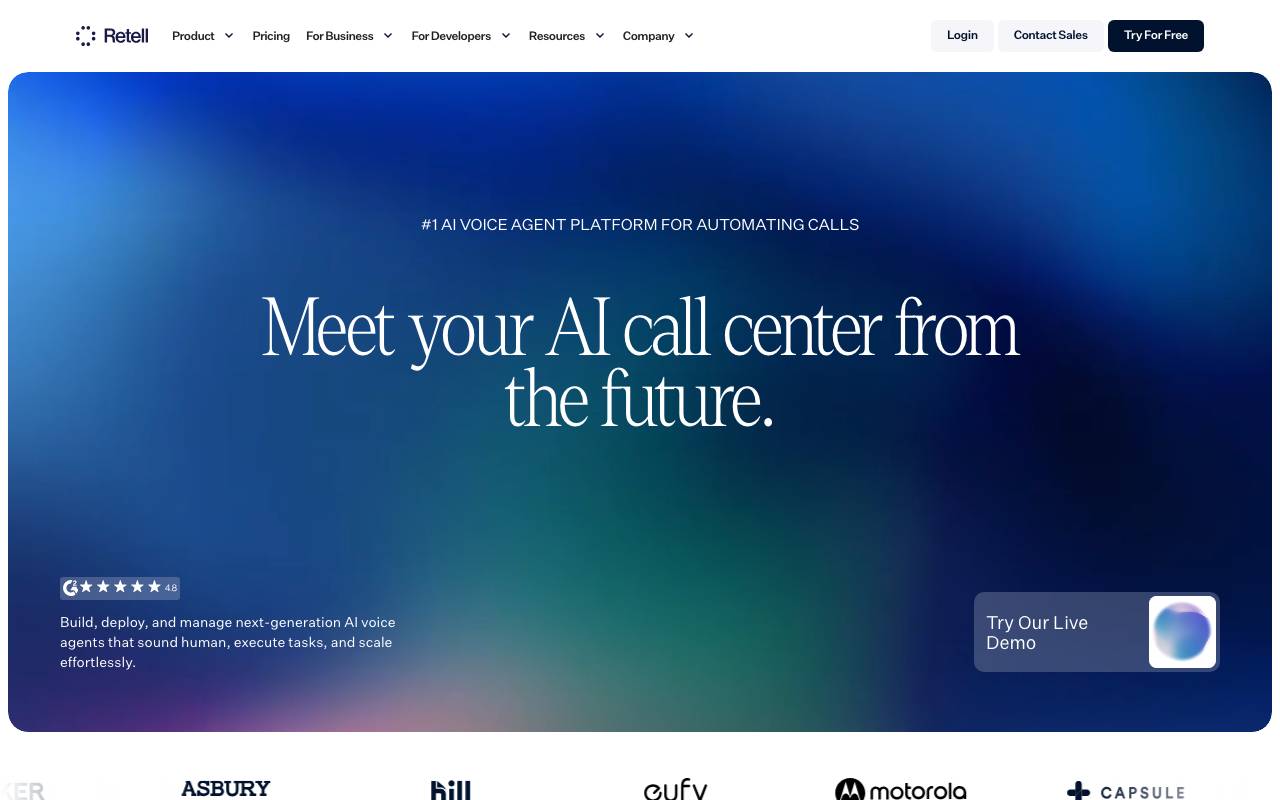
Retell AI is an AI-powered platform designed to help businesses build, test, deploy, and monitor conversational voice agents for automating customer interactions. It is built using Large Language Models (LLMs) and offers human-like, voice-first conversational AI. Unlike other solutions like IVR and IVA voice agents, Retell's platform is powered by NLP and intent mapping, allowing it to handle edge cases, unexpected inputs, and complex interactions. With Retell, businesses can streamline operations, enhance customer service, and scale effortlessly. The platform is designed to be highly configurable, allowing users to handle routine requests and complex edge cases without trade-offs. It features a real-time function calling system and a streaming recall of agents (RAG) for knowledge and auto-sync capability. Retell has proven to be effective in various industries, including healthcare and customer support, with notable case studies showing significant improvements in scheduling NPS, customer service, and revenue collection. Retell's AI voice agents can be used for various purposes, such as receptionist services, appointment setting, lead qualification, customer service, and debt collection. They can be integrated with existing systems and can handle multiple channels, making it an ideal solution for businesses looking to automate customer interactions.
Criteria breakdown
- Proprietary Voice AI Orchestration
- Proprietary turn-taking model
- Real-time function calling with preset functions
- Streaming RAG for knowledge and auto-sync capability
- Drag-and-drop agentic framework for designing call flows
- Built-in guardrails and full control over agent behavior

Temporal
Durable execution platform for orchestrating reliable, scalable AI and backend workflows.
Temporal is an open-source durable execution platform that helps developers build workflows resilient to failures, timeouts, and infrastructure issues. By persisting the state of every step, Temporal lets long-running processes resume exactly where they left off, eliminating much of the boilerplate around retries, queues, and state management. It is increasingly used to orchestrate AI-driven systems, including multi-step LLM pipelines, agent workflows, RAG processes, and human-in-the-loop tasks. Developers define workflows as code in languages like Go, Java, TypeScript, Python, and .NET, while Temporal handles execution guarantees, observability, and scaling. Available as a self-hosted open-source project or as Temporal Cloud, the platform targets teams building mission-critical distributed applications that require strong consistency and fault tolerance.
Criteria breakdown
- Durable workflow execution engine
- Automatic retries, timeouts, and error handling
- SDKs for Go, Java, Python, TypeScript, .NET, PHP
- Web UI for workflow observability and replay
- Signals, queries, and human-in-the-loop support
- Temporal Cloud managed service option
FastAgency
Framework for rapidly building and deploying production-ready AI agent workflows.
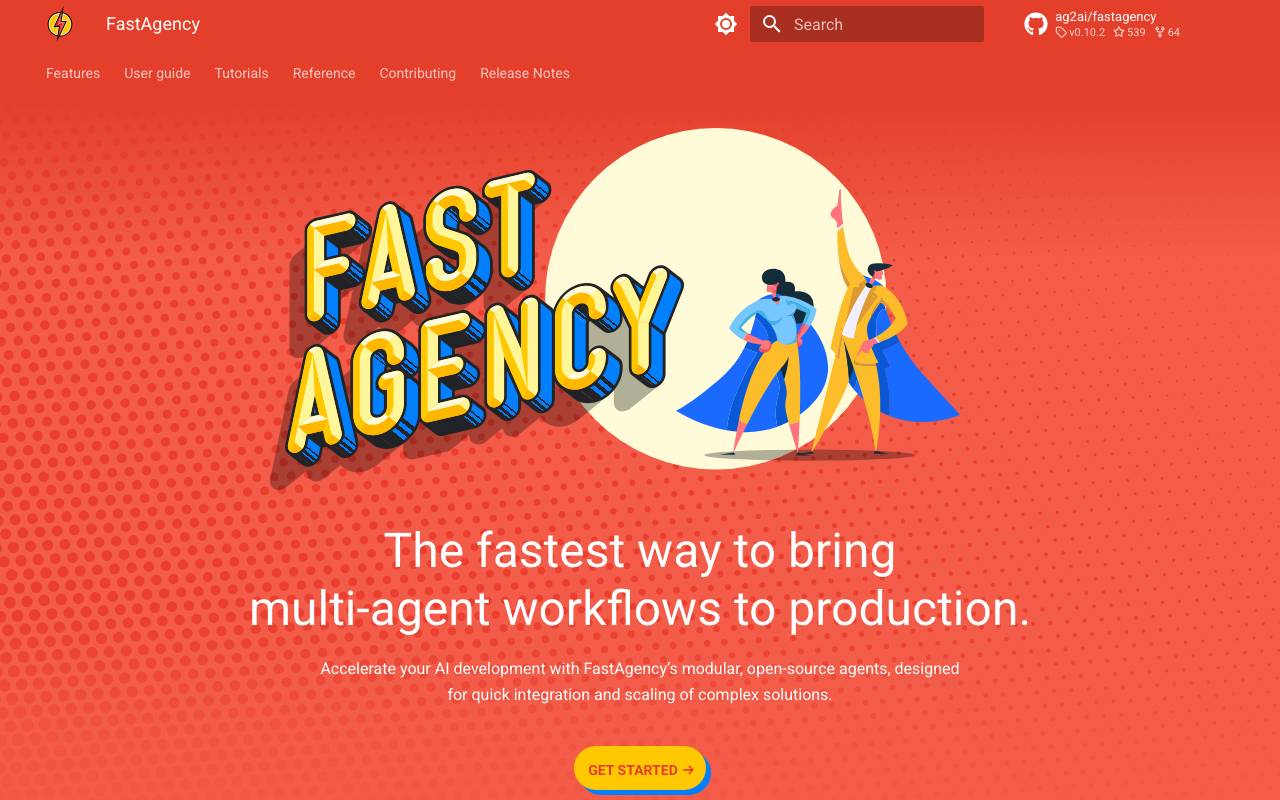
FastAgency is an open-source framework designed to help developers move AI agent prototypes into real-world applications with minimal friction. It provides the scaffolding needed to turn multi-agent workflows into deployable services, complete with user interfaces and API endpoints. The tool integrates with popular agent frameworks and supports multiple runtime environments, letting teams choose between console interactions, web UIs, or REST APIs. This flexibility makes it suitable for both internal experimentation and customer-facing deployments. FastAgency targets developers who want to focus on agent logic rather than boilerplate, offering a structured path from local testing to scalable production setups.
Criteria breakdown
- Multi-agent workflow scaffolding
- Console, web, and API runtimes
- Integration with agent frameworks like AutoGen
- REST API generation for agents
- Deployment-ready project structure
- Open-source codebase