Past battle · 2025-09-16 UTC
Autonomous Agent Showdown — September 16, 2025
From the Autonomous Agent category. 35 marks placed across 8 fighters. Olas took the crown.
Final standings





The line-up
The fighters
Profiles of every tool that competed in this battle, ranked by their final score.

Olas
A platform enabling co-ownership of AI through autonomous agent economies, allowing individuals to run AI agents and earn rewards.
Olas enables co-ownership of AI through autonomous agent economies, allowing individuals to run AI agents and earn rewards. The platform, seen in Pearl: The 'Agent App-Store', enables users to control their funds while their agents work on various tasks, from predicting the future to managing their portfolios. Users can deploy, co-own, and monetize AI agents through a decentralized marketplace. The platform's token, OLAS, powers a flywheel that drives larger agent economies. Each user stakes OLAS to access agent benefits, and fees collected are used to burn OLAS. Olas has reported 4,534,972 OLAS currently staked, 13,231,252 A2A transactions, and $104,894.33 turnover. It has also been trusted by leading crypto teams and users, with notable case studies, such as Gnosis Chain, demonstrating Olas' impact. Overall, Olas offers a unique opportunity for users to engage with AI agents, earn rewards, and participate in a thriving agent economy.
Criteria breakdown
- Deploy and co-own AI agents
- Monetize AI agent services through a decentralized marketplace
- Stake OLAS token for access to agent benefits
- Burn OLAS token through fees collected
- Powers AI agent economies
- Autonomous agent economies for AI

Synthflow AI
No-code platform for building AI voice agents that handle business phone calls.
Synthflow AI is a no-code platform for building AI voice agents that handle business phone calls. It offers an end-to-end Voice AI solution with in-house telephony and a proven deployment framework, enabling enterprises to connect with customers more effectively. The platform allows users to design, test, and deploy AI voice agents for various industries, including real estate, e-commerce, and healthcare. These agents can handle tasks such as lead qualification, appointment scheduling, and customer support. Synthflow AI's voice agents are designed to have natural conversations, adapting to the caller's pace and asking relevant questions to gather information. The platform provides a visual flow designer and a knowledge base to help users create and manage their AI voice agents. While the platform appears to offer a range of features and capabilities, its limitations and potential applications are not explicitly stated on the website.
Criteria breakdown
- Drag-and-drop voice agent builder
- Inbound and outbound calling support
- CRM and calendar integrations
- Multilingual voice options
- Call transcripts and analytics
- Custom knowledge base for agent responses
Wayfound is a management layer for organizations deploying AI agents, giving teams visibility into how those agents behave across tasks, conversations, and workflows. It aggregates agent activity, evaluates outcomes, and surfaces issues so operators can intervene before small problems become customer-facing ones. The platform focuses on two main concerns: performance and compliance. Teams can review agent interactions, score them against defined criteria, and track trends over time, while compliance features help ensure agents adhere to internal policies and external regulations. This makes Wayfound most useful for companies running multiple agents in production environments where accountability matters.
Criteria breakdown
- Agent activity monitoring and analytics
- Performance evaluation and scoring
- Compliance and policy enforcement
- Interaction review and auditing
- Issue detection and alerts
- Multi-agent oversight dashboard

Hapax is an AI platform designed specifically for banks, credit unions, and other financial institutions. It focuses on the unique demands of the industry, including regulatory compliance, internal policy interpretation, and complex decision support workflows. The platform helps teams quickly find answers buried in regulations, procedures, and institutional knowledge, reducing the time spent on manual research. By tailoring its models and guardrails to financial services, Hapax aims to deliver more reliable, context-aware results than general-purpose AI tools. Financial professionals can use Hapax to streamline reviews, support lending and risk decisions, and standardize how staff handle compliance-heavy tasks across the organization.
Criteria breakdown
- Regulatory compliance research and Q&A
- Workflow automation for financial teams
- Decision support for lending and risk
- Policy and procedure knowledge retrieval
- Industry-specific AI guardrails
- Centralized institutional knowledge access

Landbase
AI-powered GTM platform that finds, qualifies, scores, and enriches B2B accounts automatically.
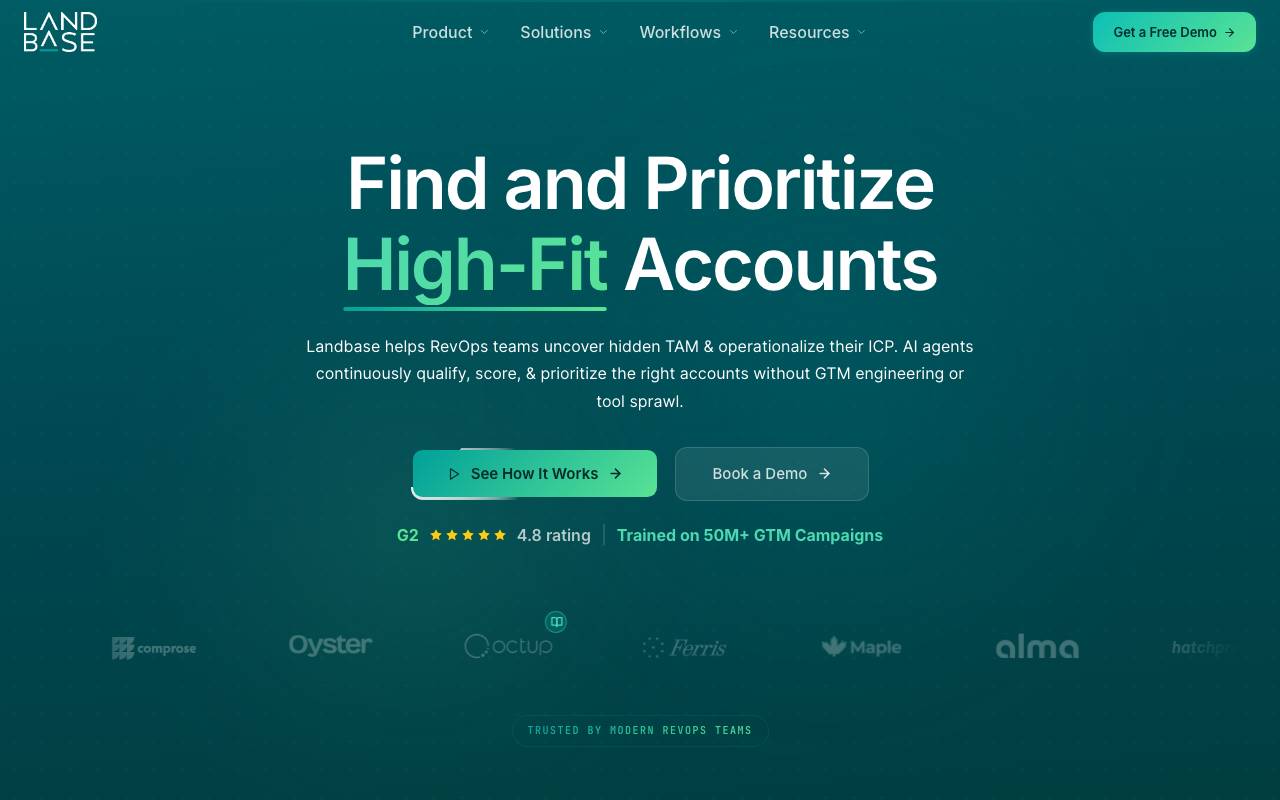
Landbase is a go-to-market platform built around AI agents that handle the heavy lifting of B2B prospecting. It continuously sources accounts, verifies firmographic and contact data, and applies scoring models to surface the leads most likely to convert, replacing much of the manual research typically done by sales development teams. The platform pairs autonomous agents with enrichment and qualification workflows so revenue teams can move from a raw market to a prioritized, outreach-ready pipeline. By centralizing data discovery, scoring, and account intelligence, Landbase aims to shorten the path between identifying a target market and starting meaningful sales conversations.
Criteria breakdown
- Autonomous AI prospecting agents
- Account discovery and targeting
- Contact and firmographic enrichment
- Lead qualification and scoring
- B2B data sourcing at scale
- Pipeline-ready account lists
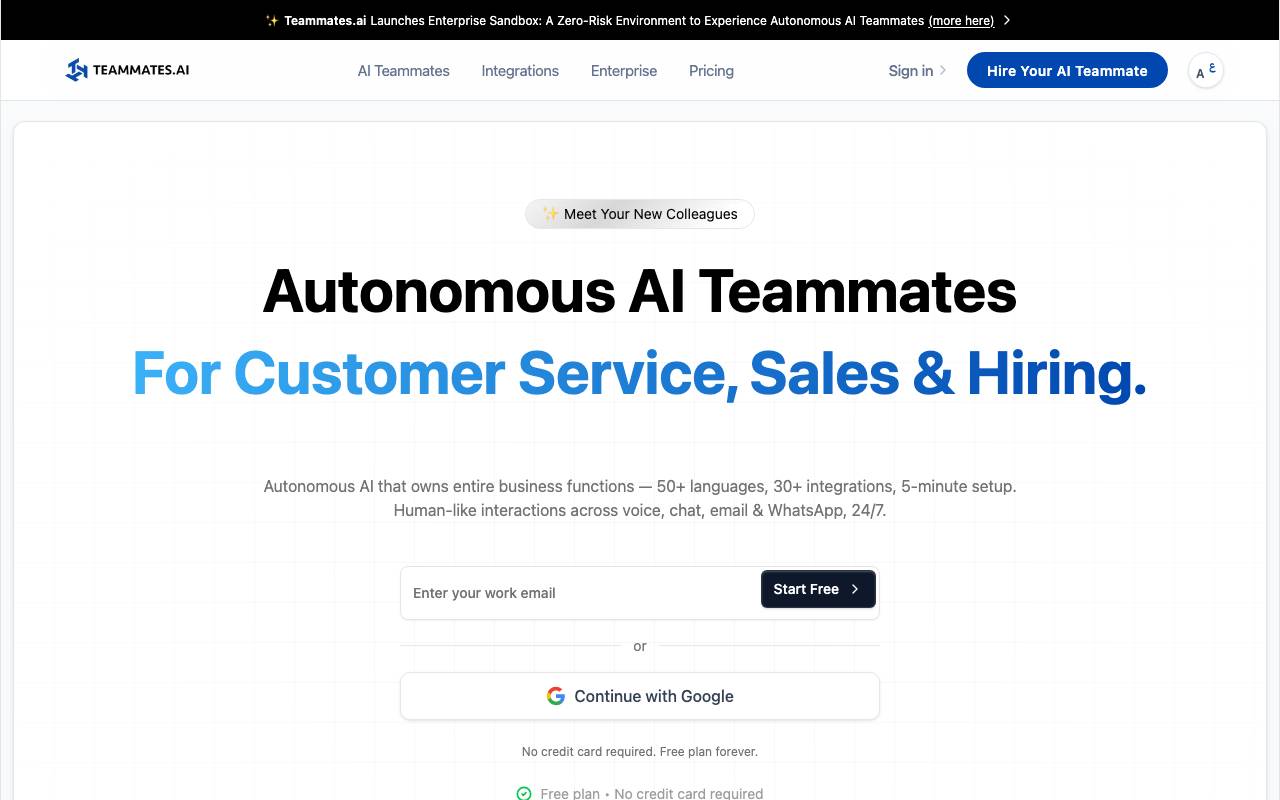
Teammates.ai offers autonomous AI agents designed to take on recurring business workflows without constant human oversight. Each agent can be configured for a specific role, allowing teams to offload tasks like outreach, customer support, research, or operations to a digital workforce that runs 24/7. The platform positions these agents as virtual hires rather than simple chatbots, with the ability to plan, execute multi-step actions, and interact with tools and data sources. This makes it suitable for small teams looking to scale output without expanding headcount, as well as larger organizations automating repetitive functions.
Criteria breakdown
- Autonomous task execution
- Role-based AI agents
- 24/7 operation
- Multi-step workflow handling
- Integration with business tools
- Configurable agent behavior

APIDNA
AI platform that automates multi‑step API integrations with vertically‑trained agents

APIDNA is an AI platform that builds vertically‑trained autonomous agents to automate complex enterprise workflows across APIs, databases, and legacy systems. It targets organizations that need reliable, production‑grade integration of disparate software, especially in regulated industries such as finance, payments, and security. The platform claims to close the gap between demo‑level AI agents and operational use by training agents on the specific domain, rules, and data structures of each customer. Agents are created on an execution layer that can invoke APIs, read and write to ERPs, and process structured or unstructured documents. The platform provides an execution canvas where multiple specialized agents can be orchestrated in parallel, enabling multi‑step, branching workflows without custom middleware. Monitoring, governance, and audit capabilities are built in from day one. The service reports 99.98 % match accuracy, 99.99 % uptime SLA, and maintains full trace logs for each action, supporting compliance frameworks such as ISO 20022, PSD2, GDPR, and SOC 2 Type II. Reported performance metrics include an average of 3,847 live actions per minute and a typical deployment time of under 48 hours once the target ERP schema is confirmed. The platform also offers agents for specific tasks such as reconciliation, compliance report generation, knowledge indexing, anomaly detection, and DORA reporting. Limitations include the need for domain‑specific training and schema confirmation before agents can operate, and the platform appears focused on larger enterprises with strict governance requirements, which may limit suitability for small teams or low‑complexity integrations.
Criteria breakdown
- Multi‑step workflow automation
- Cross‑system API and ERP execution
- Document and data processing at scale
- Agent orchestration for parallel tasks
- Full observability and audit trails
- Vertically trained domain intelligence

Tektonic AI
GenAI agents that automate complex back-office workflows for operations teams.
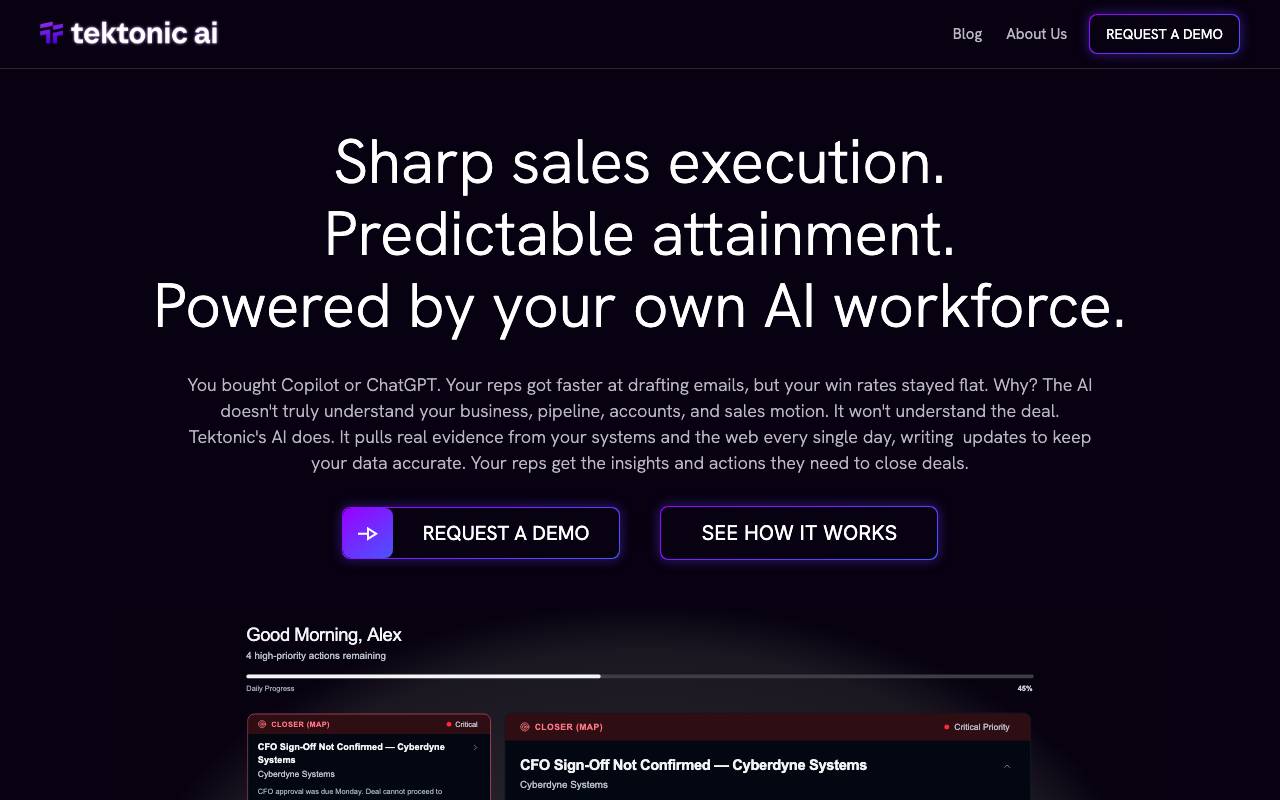
Tektonic AI builds generative AI agents designed to take on multi-step business processes that typically require human judgment, such as data entry across systems, customer onboarding, billing reconciliation, and CRM updates. The platform aims to reduce the manual workload on revenue and operations teams while improving accuracy and turnaround time. Rather than offering a single chatbot, Tektonic focuses on enterprise-grade agents that can connect to existing tools, follow business rules, and operate with auditability. This makes it suited to companies looking to scale operations without proportionally scaling headcount. Target users include RevOps, finance operations, and customer operations leaders in mid-market and enterprise organizations dealing with high-volume, repetitive but nuanced workflows.
Criteria breakdown
- GenAI agents for business process automation
- Integrations with CRM, billing, and ERP tools
- Support for multi-step decision workflows
- Audit trails and human-in-the-loop controls
- Use cases across RevOps, finance, and customer ops
- Enterprise-grade security posture