Past battle · 2026-04-12 UTC
AI Infrastructure & MLOps Showdown — April 12, 2026
From the AI Infrastructure & MLOps category. 41 marks placed across 10 fighters. Foundry took the crown.
Final standings

The line-up
The fighters
Profiles of every tool that competed in this battle, ranked by their final score.

Foundry is a development platform focused on AI agents that operate across the web. It gives builders the infrastructure to design agents, run them against real or simulated browsing tasks, and iterate on their behavior with structured evaluations. Beyond construction, Foundry emphasizes the training and testing loop. Developers can benchmark agent performance, capture failure cases, and refine models or prompts to improve reliability on tasks like navigation, form filling, data extraction, and multi-step workflows. The tool is aimed at teams shipping production-grade browser agents who need repeatable evaluation, debugging visibility, and continuous improvement rather than one-off scripts.
Criteria breakdown
- Agent development environment
- Automated testing on browsing tasks
- Training and fine-tuning workflows
- Performance benchmarking and evals
- Debugging and trace inspection
- Iterative improvement tooling

Nexus Agent
Enterprise AI infrastructure layer connecting business systems and models to team-built agents
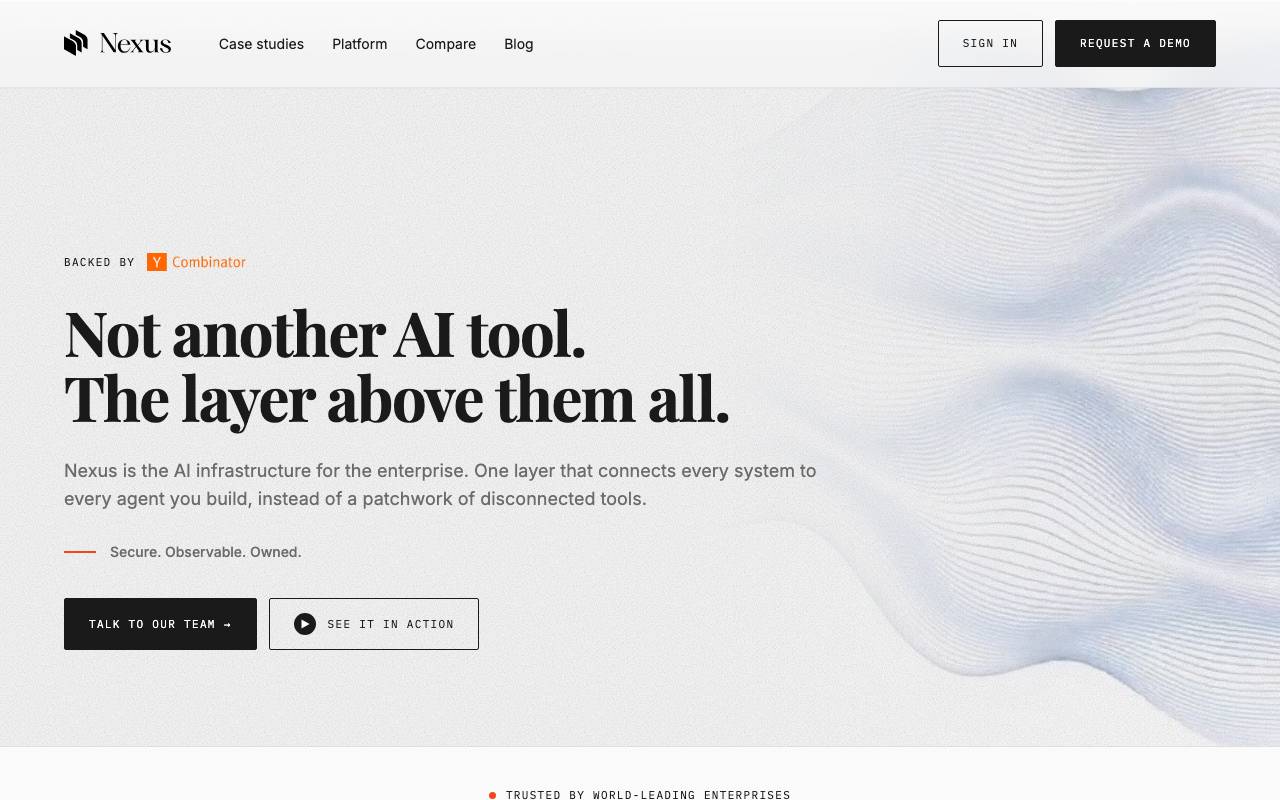
Nexus Agent (Nexus) positions itself as an AI infrastructure layer for enterprises rather than a standalone AI assistant. Its core premise is that companies struggle with a patchwork of disconnected AI tools, and that a single connective layer can link every internal and external system and model to the agents that business teams build on top of them. The product is organized around a three-layer model. The bottom layer is the company's existing stack — the models and business systems already in use, with the claim that nothing needs to be migrated or replaced. The middle layer is Nexus itself, where IT sets up systems, models, and permissions once and turns them into reusable building blocks. The top layer is the agents themselves, built, deployed, and owned by the teams that use them on top of the infrastructure IT controls. The stated aim is to balance governance and autonomy: IT retains control over connections, security, and permissions, while business users assemble agents without rebuilding integrations or seeking repeated approvals. Nexus emphasizes that it is secure, observable, and owned by the enterprise. The company markets toward large organizations and cites enterprise outcomes, including a case study with Orange Group, a multi-billion euro telecom, where a Digital Sales team built autonomous agents for customer onboarding. It also references a recently announced seed round and a product called Cue. The entry should be read with caution: much of the available material is promotional, citing figures such as yearly LTV and conversion improvements that are vendor-reported and not independently verified. Concrete details on pricing, supported integrations, and underlying technical architecture are not specified in the source material.
Criteria breakdown
- Infrastructure layer connecting business systems to AI agents
- Reusable building blocks for systems, models, and permissions
- IT-managed connections and access control
- Business-team agent building and deployment
- Support for multiple AI models and external/internal systems


Oraczen offers AI agents designed to automate complex business workflows across teams. Their solutions include Auron for capturing, understanding, and transforming sales and customer conversations into organizational memory, and Scorpio for optimizing spend, contract, category, and supplier information to unlock procurement savings. The Zen Platform supports the deployment of these agents, while Observezen provides visibility into agent execution, conversations, and performance metrics. Oraczen aims to help enterprises navigate the challenges of AI adoption and operationalize their AI visions.
Criteria breakdown
- AI agents for task automation
- Workflow orchestration across systems
- Enterprise-oriented deployment
- Custom agent configuration
- Integration with business tools
- Scalable across teams and departments
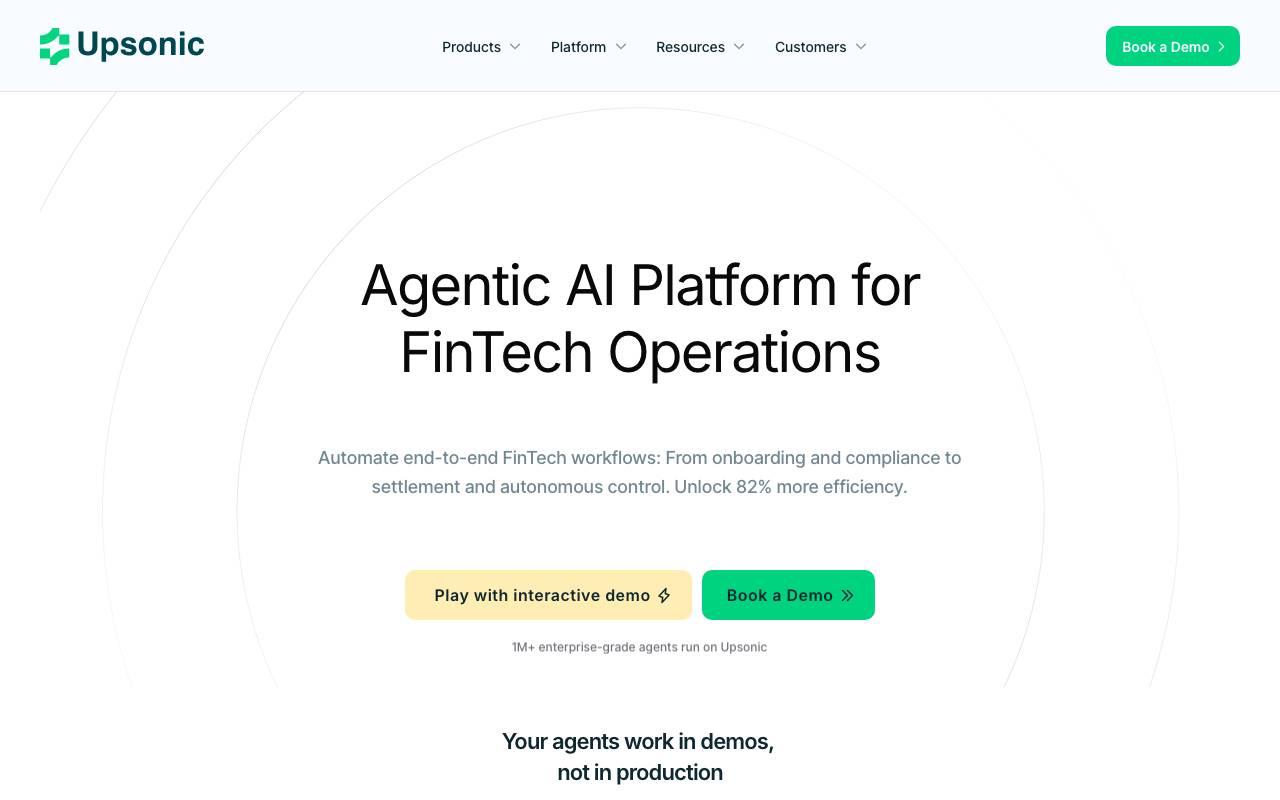
Upsonic is an AI agent platform aimed at financial technology teams looking to automate repetitive operational tasks. It enables companies to deploy agents that can handle workflows such as compliance checks, transaction monitoring, customer onboarding, and reporting with less manual intervention. The platform focuses on reliability and integration, allowing agents to connect with internal systems and data sources so teams can scale operations without proportionally scaling headcount. It targets organizations that need both the flexibility of LLM-driven automation and the predictability required in regulated environments.
Criteria breakdown
- AI agents for FinTech workflows
- Automation of back-office tasks
- System and data source integrations
- Workflow orchestration
- Monitoring and oversight tools
- Customizable agent behaviors
AgentOS
Platform for building and orchestrating specialized AI agents that collaborate on complex tasks.
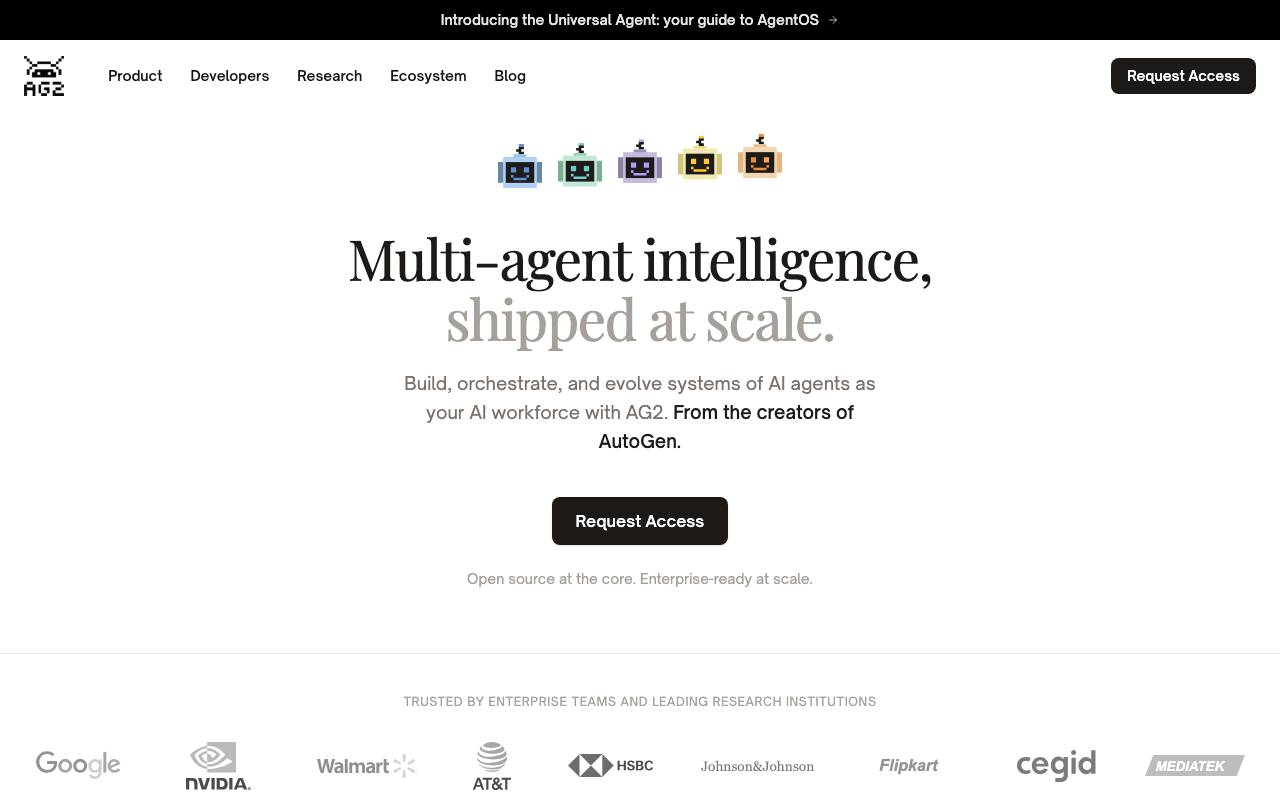
AgentOS is a development platform designed for creating networks of specialized AI agents that work together to complete multi-step workflows. Instead of relying on a single general-purpose model, teams can spin up focused agents that each handle a defined role and coordinate through a shared runtime. The platform emphasizes speed of iteration, giving developers tools to define agent behavior, connect external data sources, and manage how agents pass information between one another. It is aimed at engineers and product teams looking to ship agent-based features without building orchestration infrastructure from scratch.
Criteria breakdown
- Specialized agent creation
- Multi-agent orchestration runtime
- Inter-agent communication
- Integration with external tools and data
- Workflow design and management
- Developer-focused tooling
StackAI
No-code platform for building and deploying AI agents that automate enterprise workflows.
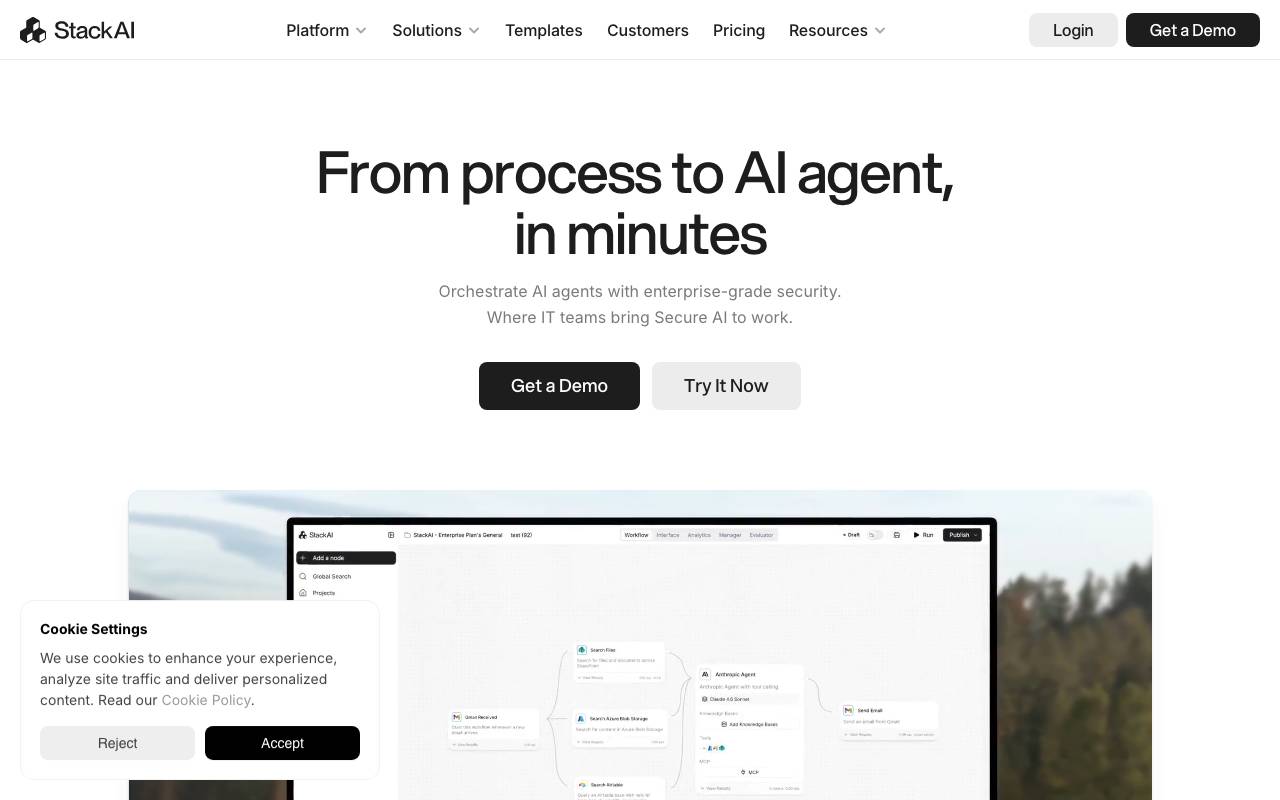
StackAI is a no-code platform that lets teams design, test, and deploy AI agents to automate business tasks across departments like operations, finance, HR, and customer support. Users assemble agents visually by connecting large language models, data sources, and tools through a drag-and-drop interface. The platform supports integrations with common enterprise systems and document stores, enabling agents to read from internal knowledge bases, call APIs, and produce structured outputs. Built-in evaluation, logging, and access controls aim to make agents reliable enough for production use in regulated environments. StackAI targets organizations that want to move beyond prototypes without hiring a dedicated AI engineering team, offering hosted deployment, role-based permissions, and compliance options suitable for business adoption.
Criteria breakdown
- Drag-and-drop agent builder
- Connectors to databases, APIs, and document sources
- Support for multiple LLM providers
- Knowledge base and RAG capabilities
- Deployment as chatbots, forms, or API endpoints
- Team collaboration and permission management
Voyage AI develops embedding and reranking models designed to improve the accuracy of search, retrieval-augmented generation (RAG), and other information retrieval tasks. Its models convert text, code, and domain-specific content into dense vector representations that capture semantic meaning, helping applications surface more relevant results than traditional keyword search. The platform offers general-purpose embeddings alongside specialized variants tuned for domains like code, finance, and law. Developers can access the models through an API and integrate them into vector databases, chatbots, and enterprise search systems. Rerankers further refine candidate results, improving precision on top of an initial retrieval step. Voyage AI is aimed at engineering teams building LLM-powered products who need retrieval quality that goes beyond off-the-shelf options.
Criteria breakdown
- Text and code embedding models
- Domain-tuned variants (finance, law, code)
- Reranker models for result refinement
- API access for easy integration
- Support for multilingual content
- Compatible with popular vector databases
OpenRouter
Unified API gateway for accessing hundreds of AI models through a single endpoint.
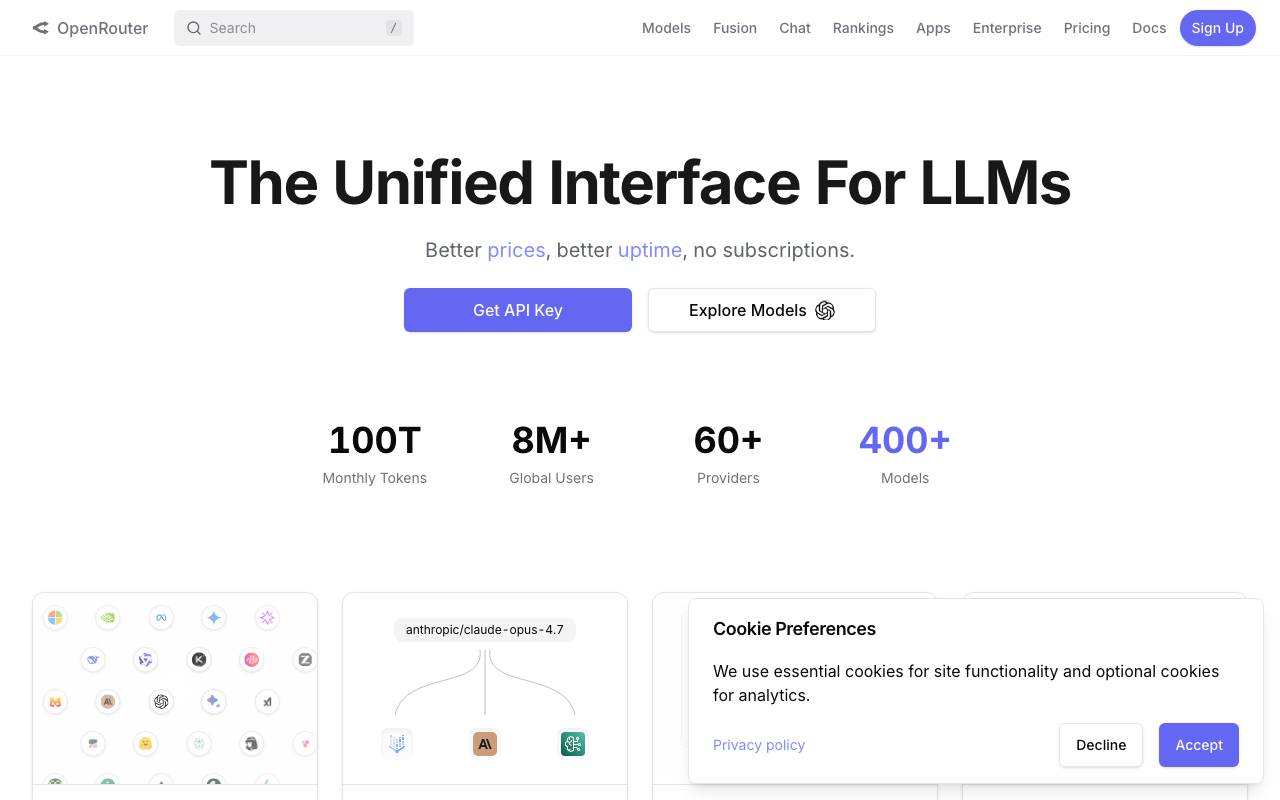
OpenRouter is an API aggregation service that lets developers access a wide range of large language models from providers like OpenAI, Anthropic, Google, Meta, and Mistral through one standardized interface. Instead of managing separate accounts, keys, and SDKs for each provider, teams can route requests to any supported model with a single integration. The platform automatically handles failover between providers, compares pricing across hosts of the same open-source model, and offers usage analytics. This makes it easier to experiment with new models, optimize costs, and maintain uptime when individual providers experience outages. OpenRouter is commonly used by developers building AI applications, agents, and prototypes who want flexibility to switch models without rewriting code.
Criteria breakdown
- Unified OpenAI-compatible API
- Access to hundreds of models
- Automatic provider failover and load balancing
- Transparent per-token pricing comparisons
- Usage dashboard and analytics
- Support for streaming and tool calls
GaiaHub AI is a no-code platform designed to help users create and launch AI-powered applications without writing any code. It targets entrepreneurs, product teams, and non-technical builders who want to turn ideas into working AI tools in a short timeframe. The platform combines drag-and-drop building blocks with pre-configured AI models, allowing users to design workflows, connect data sources, and publish apps directly from the interface. This streamlines the process of moving from concept to a deployable product. GaiaHub AI is particularly useful for rapid prototyping, internal automation, and small teams that need to ship AI features without hiring specialized developers.
Criteria breakdown
- Visual no-code app builder
- Pre-integrated AI models
- One-click deployment
- Workflow and automation tools
- Data source connectors
- Templates for common use cases

agentpilot
Open platform for building, running, and managing AI agents and multi-step workflows.
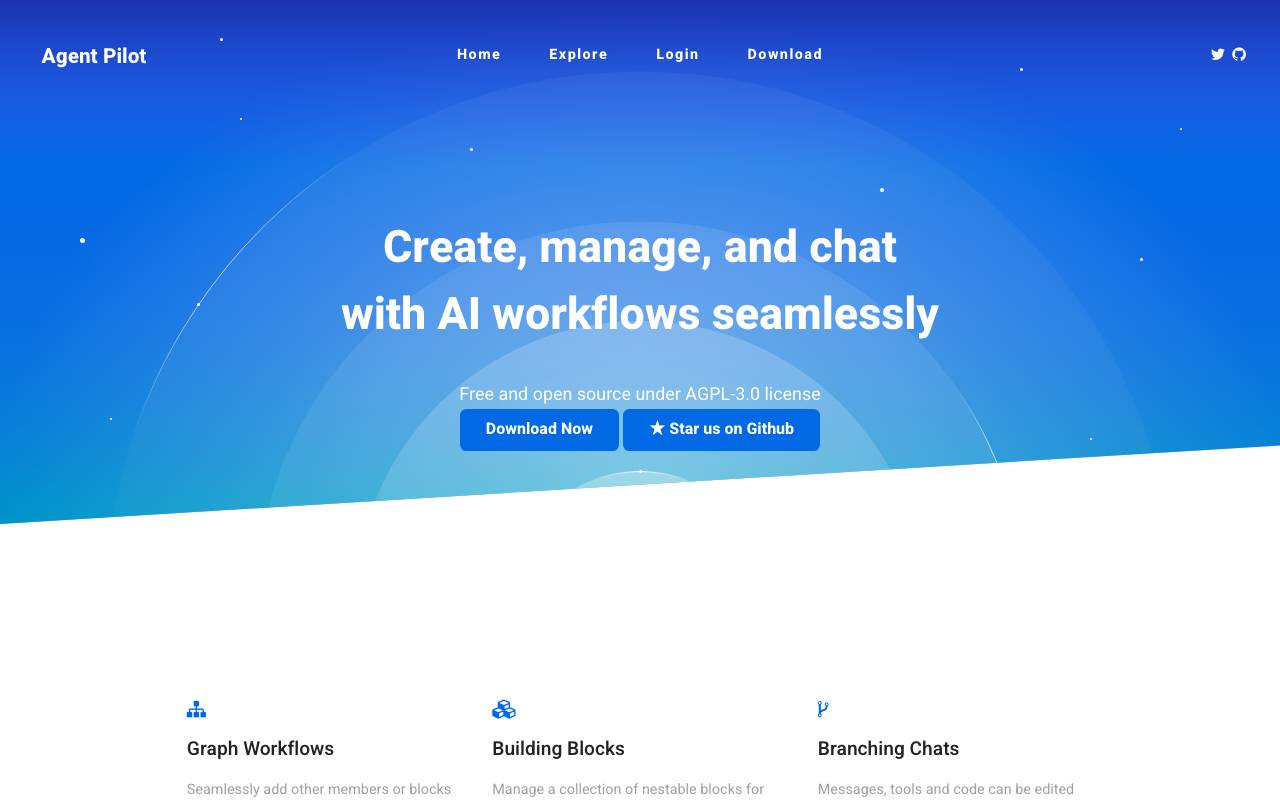
Agent Pilot is an open platform for building, running, and managing AI agents and multi-step workflows. It allows users to create, manage, and interact with AI workflows seamlessly. The platform is free and open-source under the AGPL-3.0 license. It offers a free membership with limited support, as well as a paid tier for $5/mo with additional support. The source code is available on Github, and users can download binaries from the platform's website.
Criteria breakdown
- Agent builder with model and prompt configuration
- Multi-agent workflow orchestration
- Support for various LLM providers
- Reusable agent templates
- Workspace for testing and iteration
- Integration with external tools