OpenRouterUnified API gateway for accessing hundreds of AI models through a single endpoint.

Overview
Key features
- Unified OpenAI-compatible API
- Access to hundreds of models
- Automatic provider failover and load balancing
- Transparent per-token pricing comparisons
- Usage dashboard and analytics
- Support for streaming and tool calls
Pricing
- Model
- Free
- Category
- AI Infrastructure & MLOps
- Rating
- 4.6 / 5 (5)
Use cases
Multi-Model Experimentation
Developers can quickly test and compare outputs from OpenAI, Anthropic, Google, Meta, and Mistral models through one API without setting up separate accounts or SDKs.
Cost Optimization for Open Models
Teams can compare per-token pricing across multiple hosts serving the same open-source model and route requests to the most affordable provider.
High-Availability AI Apps
Production applications can rely on automatic failover and load balancing to maintain uptime when individual model providers experience outages or rate limits.
Unified Usage Analytics
Engineering teams can monitor token consumption, costs, and model performance across all providers from a single dashboard instead of stitching together separate reports.
Pros & Cons
Pros
- Single API for many model providers
- Automatic failover improves reliability
- Competitive pricing across providers
- Easy model switching without code changes
- Pay-as-you-go with no separate accounts
Cons
- Adds a middle layer between app and provider
- Latency may vary by routed provider
- Some advanced provider-specific features unsupported
- Requires trusting a third party with API traffic
Battle record
Across 2 battles in the Pantheon.
Last 2 battles
Reviews
Average from 5 ratings.
Sign in to leave a review.
Does the job
Pretty happy overall. Access to hundreds of models just works and automatic failover improves reliability. Requires trusting a third party with API traffic can be annoying, but no dealbreakers — I'd recommend it to a friend without hesitating.
Compared a few options
Evaluated this against two competitors. Where it wins: usage dashboard and analytics and single API for many model providers. Where it lags: some advanced provider-specific features unsupported. On balance the feature set — especially usage dashboard and analytics — justifies the 5 stars for our use case.

Solid for our team
We rolled this out across the team last quarter and automatic failover improves reliability. Transparent per-token pricing comparisons fits neatly into how we already work, and unified OpenAI-compatible API removed a step we used to do by hand. Adds a middle layer between app and provider, which is the main caveat, but it has held up under daily use.

Skeptical, then convinced
I went in skeptical — most tools in this space overpromise. It actually delivers on automatic provider failover and load balancing, and easy model switching without code changes caught me off guard. Requires trusting a third party with API traffic is why this isn't a perfect score, still, I'd recommend giving it a real trial.

Compared a few options
Evaluated this against two competitors. Where it wins: support for streaming and tool calls and automatic failover improves reliability. Where it lags: requires trusting a third party with API traffic. On balance the feature set — especially automatic provider failover and load balancing — justifies the 5 stars for our use case.
Q&A
How does model fallback work if a provider is unavailable?
OpenRouter automatically falls back to the next provider on errors. Configure provider routing in documentation.
Asked by Gabriel Duarte · Sep 6, 2025
What is the expected latency/response time for different models?
Model pages show latency and throughput by provider. Use :nitro to route to faster providers.
Asked by Larisa Ionescu · Aug 20, 2025
What are model variants?
Variants are suffixes that modify behavior. Static variants are available on specific models, listed in the models API: :free – free model with low rate limits, :extended – longer context length, :thinking – reasoning by default. Dynamic variants can be used on all models: :online – attach web results to the prompt, :nitro – optimize for faster throughput, :floor – prioritize lowest price.
Asked by Nikolai Petrenko · Aug 10, 2025
How frequently are new models added?
We add models regularly, often in partnership with labs. If something’s missing, reach out on Discord.
Asked by Priya Nair · Jul 25, 2025
What LLM models does OpenRouter support?
Access a wide variety of models, including frontier models. See the models browser or the models API.
Asked by Petra Vogel · Jul 12, 2025
Ask a question
AI Infrastructure & MLOps alternatives

 OraczenAI Infrastructure & MLOps
Smart AI agents that automate complex business workflows across teams.

Embedding and reranking models for high-accuracy retrieval and search.

On-device AI runtime for running models locally across phones, PCs, and edge hardware.
Platform to build, evaluate, and operate trustworthy AI agents with reliability and safety guardrails.
Analytics platform for improving voice and chat AI agent performance and revenue impact.

No-code platform for building and deploying AI applications quickly.
No-code playground for testing and comparing AI models side by side.
Unified gateway to monitor, debug, and optimize LLM applications across providers.
Trending now

 Reducto AIAI Agent Development Platforms
Document intelligence API that parses, splits, OCRs, and extracts structured data from complex PDFs, slides, and spreadsheets.
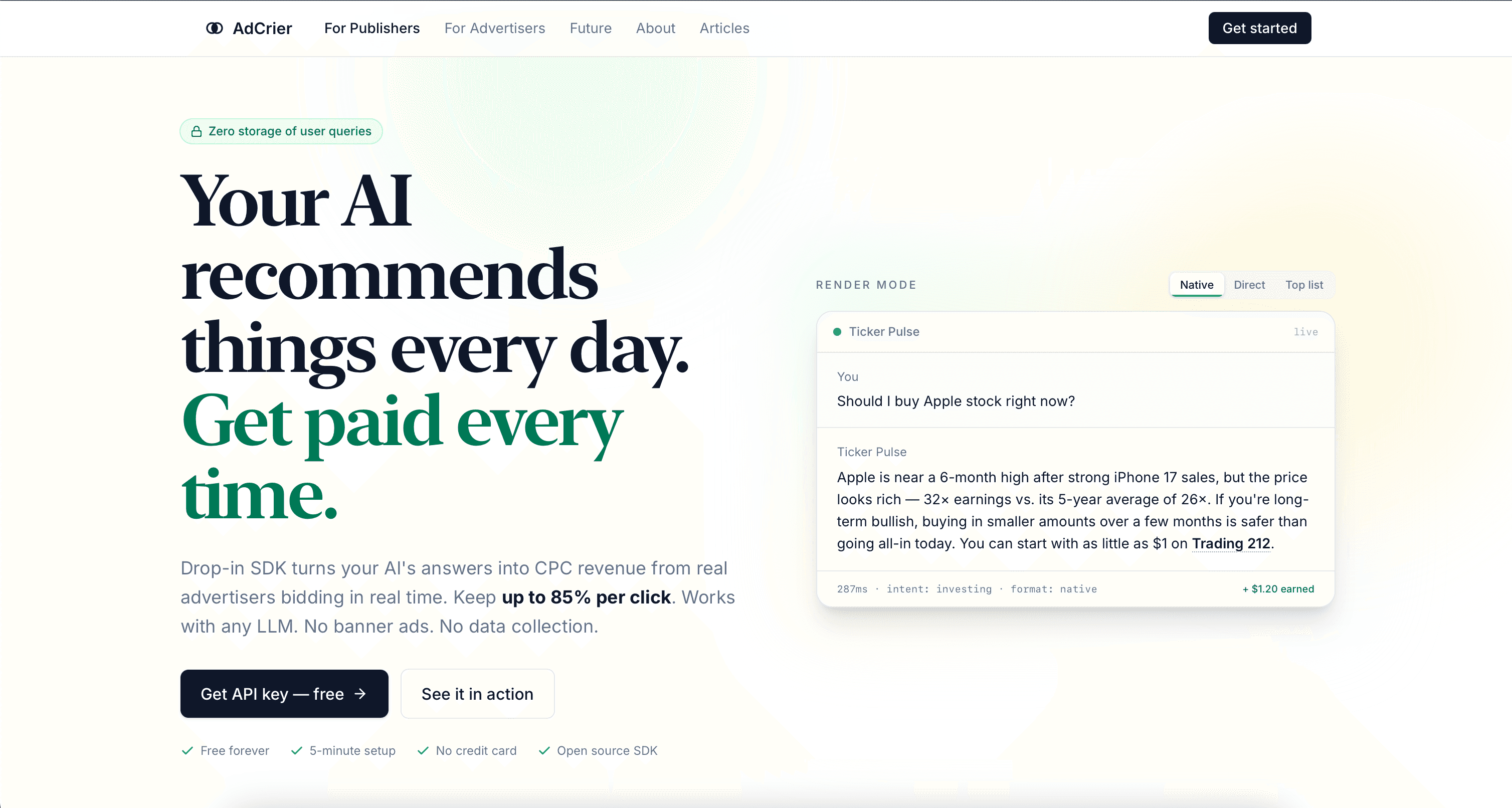
 AdCrierMarketing & Advertising
Sponsored answers, paid per click.

 Biology AIEducation AI
Accurate Homework Help with Full Explanations

 Pixtral 12B 24.09LLM
Open multimodal 12B model handling interleaved images and text with a 128K context window.