Best AI Infrastructure & MLOps (2026)

3 min read
If you sign up through a link on this page, we may earn a commission — it never affects our rankings.
A curated guide to the best AI infrastructure and MLOps platforms for training, deploying, monitoring, and scaling machine learning models in production.
The Never-Ending Battle: Migrating to AI Infrastructure 2.0 =====================================================
Have you ever found yourself stuck in a vicious cycle of trial-and-error with AI model deployments? You're not alone. As the promise of AI-driven innovation grows, the complexity of integrating and maintaining these systems has become a monumental task. It's like trying to scale a skyscraper with a pile of LEGO blocks. The pieces might look great individually, but they don't always fit together as seamlessly as you'd like.
This is where the right AI infrastructure and MLOps tools come in – your trusty sidekicks in the AI migration saga. Their main goal is to abstract away the intricacies of AI deployment, allowing your team to focus on the creative aspects of building AI-powered applications.
Choosing the Right AI Infrastructure Tool
When selecting an AI infrastructure and MLOps tool, there are a few key factors to consider. Scalability is often at the top of the list, as it determines how easily your project can grow with your requirements. Another crucial aspect is integration, as you'll likely be connecting your AI solution with other systems and services within your organization. Don't be swayed by overly complex features – look for a balance between ease of use and customization possibilities. Community support can also play a significant role in your decision, particularly if you encounter any issues down the line.
#### Pricing Patterns
The AI infrastructure and MLOps tooling landscape spans multiple price tiers. StackAI and Foundry both offer no-code solutions with free plans, making them great options for exploring these concepts without an initial investment. At the other end of the spectrum, SwarmZero and Keywords AI operate on a paid model, which may be attractive for businesses seeking comprehensive, high-end support.
#### Real-World Examples
In practice, platforms like Convolytic help optimize AI agent performance, ensuring that your voice and chat interfaces generate maximum revenue impact for your business. By using Convolytic, you can improve the overall quality of these interactions and drive tangible growth. Operators.dev's AI agents can also streamline processes and handle a variety of tasks without the need for extensive coding.
Operators.dev and StackAI stand out for their no-coding approaches. By abstracting away the need for custom code, they simplify AI integration and minimize the risk of complex system failures. Meanwhile, tools such as BaseAI provide open-source frameworks for building serverless AI agents. While offering flexibility and cost savings, these solutions often demand more technical expertise.
Final Advice
When tackling the AI migration challenge, it's essential to strike a balance between your business needs and the technical capabilities of your team. Don't fall into the trap of trying to implement a high-end AI solution with limited resources. SwarmZero and Keywords AI cater specifically to those with the budget and the need for full-feature support, but may not be suitable for smaller projects or those on a tight budget.
Keywords AI, for example, provides detailed observability and debugging tools for LLM-powered applications, making it a great choice for teams pushing the boundaries of language models. By contrast, Vijil prioritizes trustworthy AI design with guardrails against reliability and safety issues. This could be the ideal solution for businesses that place the utmost importance on these factors.
As your business continues down the AI migration path, Convolytic, StackAI, BaseAI, Vijil, and other AI infrastructure tools are here to guide you through the process. Take your time to evaluate these options, and remember to focus on your specific needs – only then can you build the seamless AI ecosystem your organization deserves.
AI Infrastructure & MLOps by the numbers
Pricing mix
Best AI Infrastructure & MLOps (2026)
- 1
 OraczenSmart AI agents that automate complex business workflows across teams.5.0 (5)
 - 2VVoyage AIEmbedding and reranking models for high-accuracy retrieval and search.4.8 (6)
- 3NNexa AIOn-device AI runtime for running models locally across phones, PCs, and edge hardware.4.8 (6)
- 4VVijilPlatform to build, evaluate, and operate trustworthy AI agents with reliability and safety guardrails.4.8 (5)
- 5CConvolyticAnalytics platform for improving voice and chat AI agent performance and revenue impact.4.8 (5)
- 6GGaiaHub AINo-code platform for building and deploying AI applications quickly.4.8 (5)
- 7MModelBenchNo-code playground for testing and comparing AI models side by side.4.8 (5)
- 8HHeliconeUnified gateway to monitor, debug, and optimize LLM applications across providers.4.8 (5)
- 9
agentpilotOpen platform for building, running, and managing AI agents and multi-step workflows.
4.8 (4) - 10
 Nexus AgentEnterprise AI infrastructure layer connecting business systems and models to team-built agents4.8 (4)


Oraczen offers AI agents designed to automate complex business workflows across teams. Their solutions include Auron for capturing, understanding, and transforming sales and customer conversations into organizational memory, and Scorpio for optimizing spend, contract, category, and supplier information to unlock procurement savings. The Zen Platform supports the deployment of these agents, while Observezen provides visibility into agent execution, conversations, and performance metrics. Oraczen aims to help enterprises navigate the challenges of AI adoption and operationalize their AI visions.
- AI agents for task automation
- Workflow orchestration across systems
- Enterprise-oriented deployment
- Custom agent configuration
- Integration with business tools
- Scalable across teams and departments
Voyage AI develops embedding and reranking models designed to improve the accuracy of search, retrieval-augmented generation (RAG), and other information retrieval tasks. Its models convert text, code, and domain-specific content into dense vector representations that capture semantic meaning, helping applications surface more relevant results than traditional keyword search. The platform offers general-purpose embeddings alongside specialized variants tuned for domains like code, finance, and law. Developers can access the models through an API and integrate them into vector databases, chatbots, and enterprise search systems. Rerankers further refine candidate results, improving precision on top of an initial retrieval step. Voyage AI is aimed at engineering teams building LLM-powered products who need retrieval quality that goes beyond off-the-shelf options.
- Text and code embedding models
- Domain-tuned variants (finance, law, code)
- Reranker models for result refinement
- API access for easy integration
- Support for multilingual content
- Compatible with popular vector databases
Nexa AI
On-device AI runtime for running models locally across phones, PCs, and edge hardware.
Nexa AI is a local inference platform that lets developers and end users run AI models directly on their own devices instead of relying on cloud APIs. It supports a range of model types—including language, vision, audio, and multimodal—optimized to work offline across mobile, desktop, and embedded environments. The platform focuses on performance and privacy, using hardware acceleration to keep latency low while ensuring data never leaves the device. Developers can integrate it into apps through SDKs, while non-technical users can experiment with prepackaged models through the Nexa interface. It is aimed at teams building privacy-sensitive applications, edge AI products, or offline-capable assistants where cloud dependence is impractical or costly.
- On-device inference engine
- Support for LLMs, vision, and audio models
- Hardware acceleration across CPU, GPU, and NPU
- SDKs for app integration
- Offline-first architecture
- Cross-platform deployment
Vijil
Platform to build, evaluate, and operate trustworthy AI agents with reliability and safety guardrails.
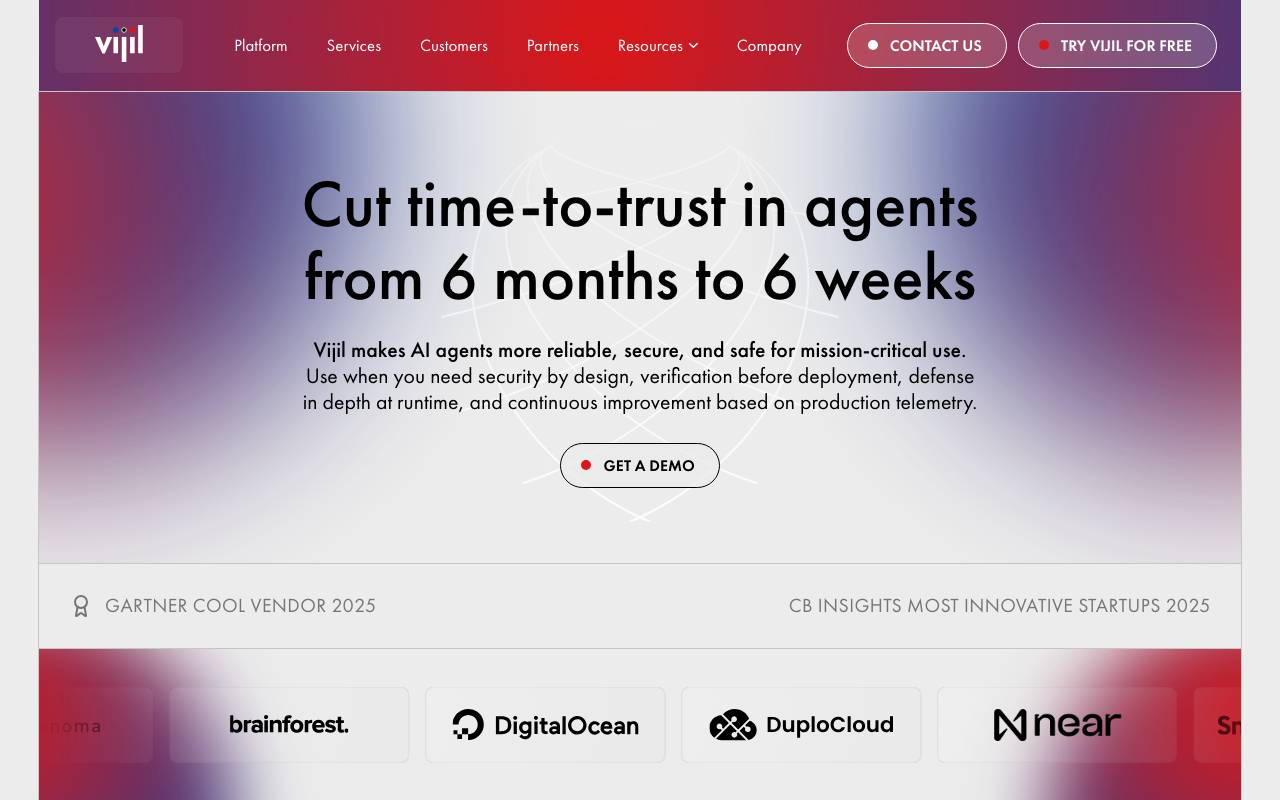
Vijil is a developer platform focused on the trust layer of AI agents. It provides tooling to design agents, stress-test them against safety and reliability benchmarks, and monitor their behavior once deployed, helping teams catch issues like hallucinations, prompt injections, and unsafe outputs before they reach end users. The platform combines automated evaluations, red-teaming, and runtime controls so engineering and risk teams can ship agentic systems with measurable confidence. It is aimed at organizations building production AI agents that need consistent performance, policy compliance, and audit-ready evidence of testing.
- Agent evaluation and benchmarking suite
- Automated red-teaming for safety and security
- Runtime guardrails and monitoring
- Reliability and hallucination testing
- Reporting for risk and compliance reviews
- APIs for integration into agent pipelines
Convolytic
Analytics platform for improving voice and chat AI agent performance and revenue impact.
Convolytic is an analytics layer designed for teams operating voice and chat AI agents. It captures conversation data, surfaces performance gaps, and provides insights aimed at turning automated interactions into measurable business outcomes. By tracking how agents handle real customer conversations, the tool helps teams identify failure points, refine prompts and flows, and understand which interactions drive conversions. It's positioned for product, CX, and revenue teams looking to optimize AI-driven communication channels.
- Conversation analytics and tracking
- Performance monitoring for AI agents
- Revenue and conversion insights
- Voice and chat channel support
- Tools for identifying optimization opportunities
GaiaHub AI is a no-code platform designed to help users create and launch AI-powered applications without writing any code. It targets entrepreneurs, product teams, and non-technical builders who want to turn ideas into working AI tools in a short timeframe. The platform combines drag-and-drop building blocks with pre-configured AI models, allowing users to design workflows, connect data sources, and publish apps directly from the interface. This streamlines the process of moving from concept to a deployable product. GaiaHub AI is particularly useful for rapid prototyping, internal automation, and small teams that need to ship AI features without hiring specialized developers.
- Visual no-code app builder
- Pre-integrated AI models
- One-click deployment
- Workflow and automation tools
- Data source connectors
- Templates for common use cases
ModelBench is a no-code workspace where teams can evaluate and compare outputs from multiple AI models in parallel. Instead of juggling separate APIs or building custom scripts, users can send the same prompt to several models at once and review responses side by side. The platform is geared toward product teams, prompt engineers, and researchers who need to choose the right model for a use case before committing to integration. By streamlining experimentation, ModelBench aims to shorten the path from idea to production launch.
- No-code prompt testing interface
- Multi-model side-by-side comparison
- Shared workspace for team collaboration
- Prompt iteration and versioning
- Access to a range of leading AI models
- Evaluation tools for picking the best output
Helicone
Unified gateway to monitor, debug, and optimize LLM applications across providers.
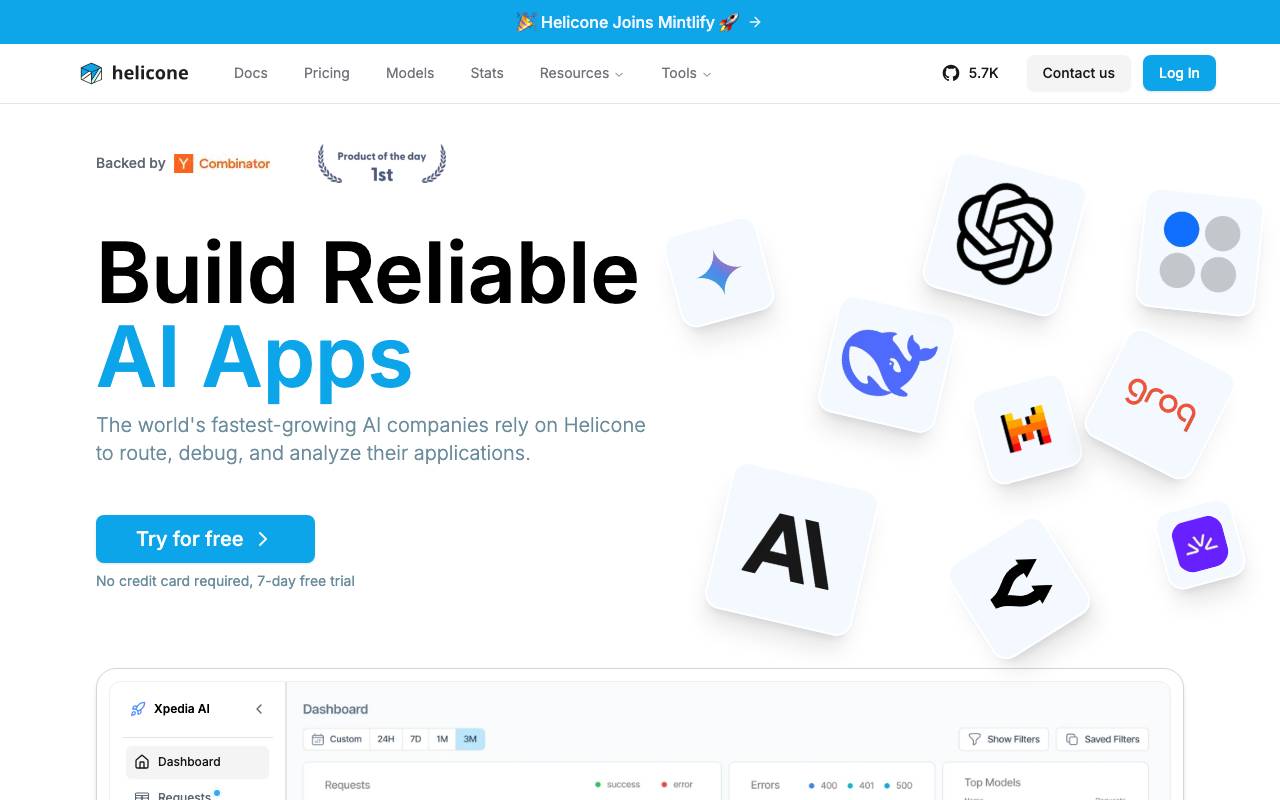
Helicone is an observability and gateway platform built for teams developing with large language models. It sits between your application and AI providers, capturing requests, responses, latency, costs, and errors so developers can debug prompts and track performance from a single dashboard. Beyond logging, Helicone offers tools for prompt management, A/B testing, caching, rate limiting, and user-level analytics. Its provider-agnostic gateway lets teams route traffic across models from OpenAI, Anthropic, and others, making it easier to experiment, control spend, and ship reliable AI features.
- Request and response logging
- Prompt versioning and experiments
- Caching and rate limiting
- Cost tracking per user or session
- Multi-provider gateway routing
- Custom alerts and dashboards

agentpilot
Open platform for building, running, and managing AI agents and multi-step workflows.
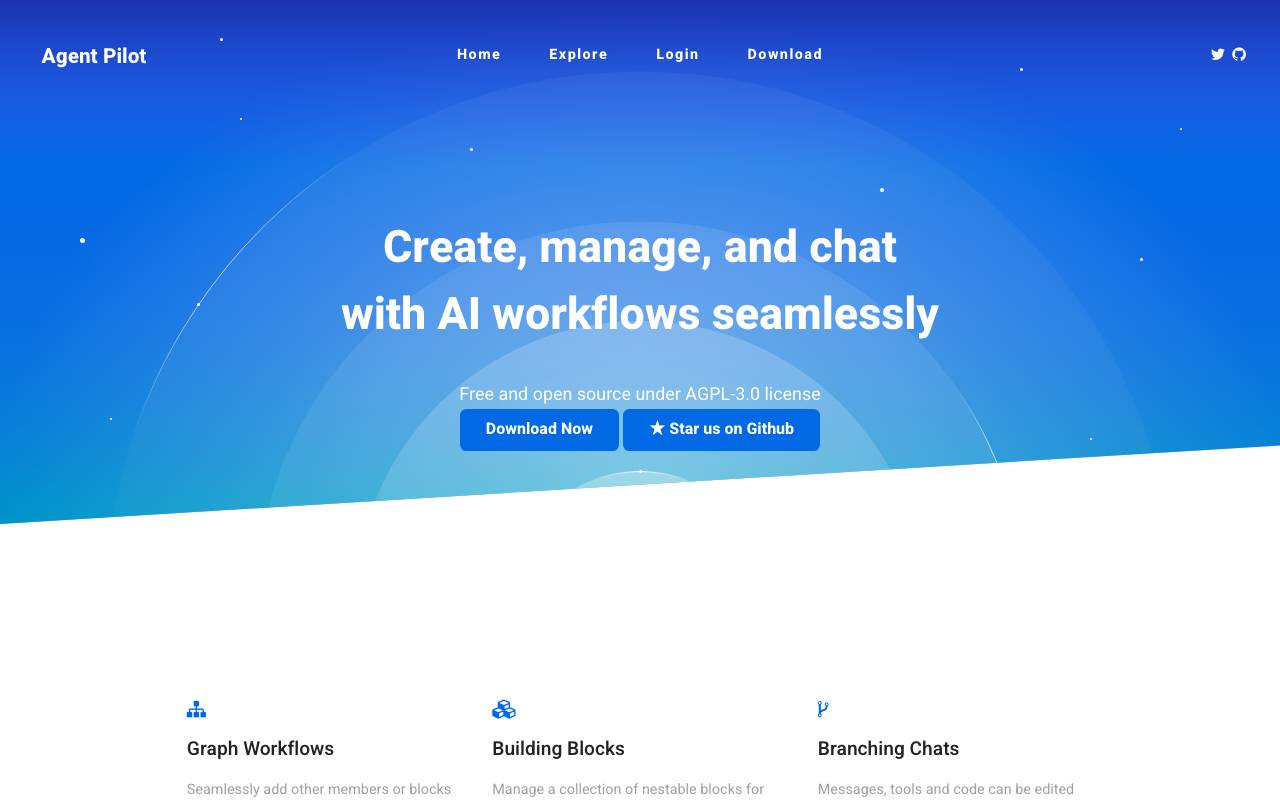
Agent Pilot is an open platform for building, running, and managing AI agents and multi-step workflows. It allows users to create, manage, and interact with AI workflows seamlessly. The platform is free and open-source under the AGPL-3.0 license. It offers a free membership with limited support, as well as a paid tier for $5/mo with additional support. The source code is available on Github, and users can download binaries from the platform's website.
- Agent builder with model and prompt configuration
- Multi-agent workflow orchestration
- Support for various LLM providers
- Reusable agent templates
- Workspace for testing and iteration
- Integration with external tools

Nexus Agent
Enterprise AI infrastructure layer connecting business systems and models to team-built agents
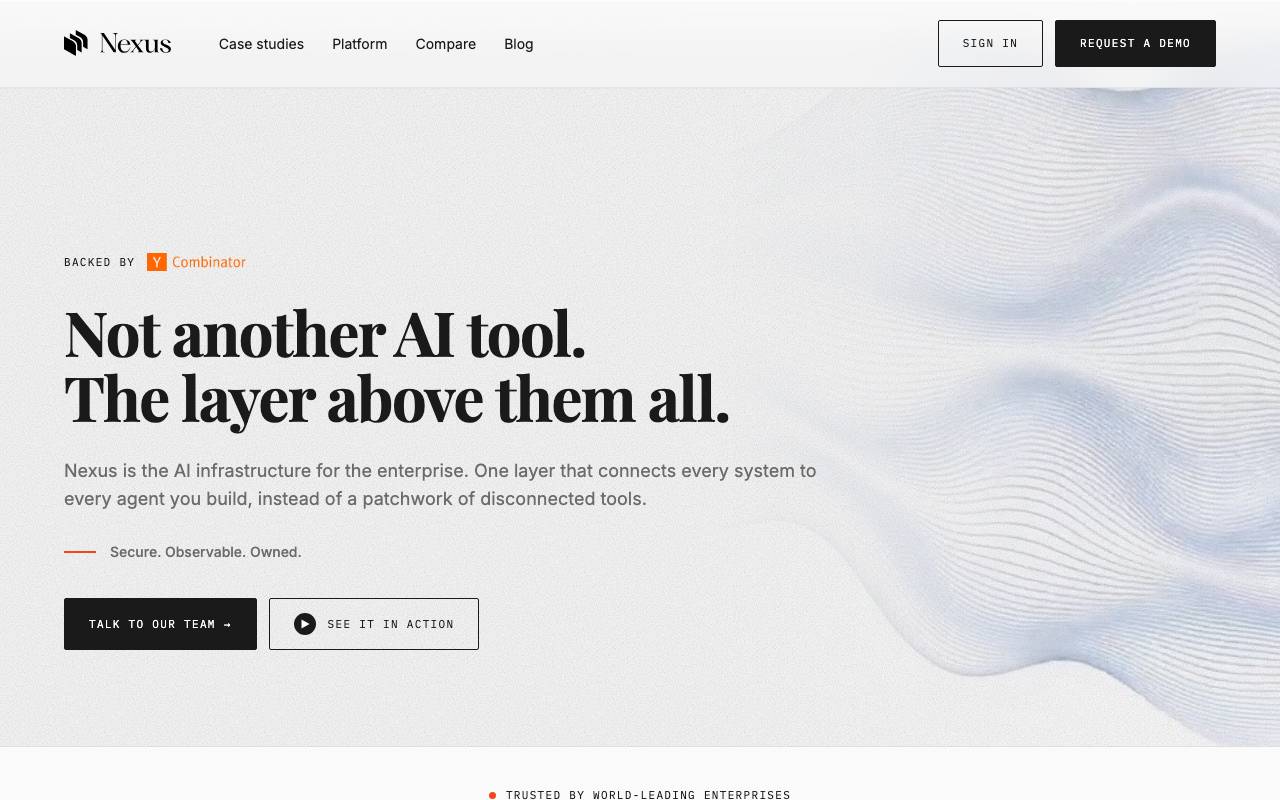
Nexus Agent (Nexus) positions itself as an AI infrastructure layer for enterprises rather than a standalone AI assistant. Its core premise is that companies struggle with a patchwork of disconnected AI tools, and that a single connective layer can link every internal and external system and model to the agents that business teams build on top of them. The product is organized around a three-layer model. The bottom layer is the company's existing stack — the models and business systems already in use, with the claim that nothing needs to be migrated or replaced. The middle layer is Nexus itself, where IT sets up systems, models, and permissions once and turns them into reusable building blocks. The top layer is the agents themselves, built, deployed, and owned by the teams that use them on top of the infrastructure IT controls. The stated aim is to balance governance and autonomy: IT retains control over connections, security, and permissions, while business users assemble agents without rebuilding integrations or seeking repeated approvals. Nexus emphasizes that it is secure, observable, and owned by the enterprise. The company markets toward large organizations and cites enterprise outcomes, including a case study with Orange Group, a multi-billion euro telecom, where a Digital Sales team built autonomous agents for customer onboarding. It also references a recently announced seed round and a product called Cue. The entry should be read with caution: much of the available material is promotional, citing figures such as yearly LTV and conversion improvements that are vendor-reported and not independently verified. Concrete details on pricing, supported integrations, and underlying technical architecture are not specified in the source material.
- Infrastructure layer connecting business systems to AI agents
- Reusable building blocks for systems, models, and permissions
- IT-managed connections and access control
- Business-team agent building and deployment
- Support for multiple AI models and external/internal systems
Browse all 24 AI Infrastructure & MLOps tools
The complete, searchable directory — ranked by real user reviews.


