Best Data science (2026)

3 min read
If you sign up through a link on this page, we may earn a commission — it never affects our rankings.
A curated guide to the best AI tools for data science, covering platforms that support data exploration, modeling, automation, and deployment across analyst and ML engineering workflows.
When I started my current research role, I was excited to dive into the world of data science, but quickly realized that getting from raw data to insights was a daunting task. The data was messy, the pipelines were complicated, and it felt like every hour I spent wrangling data was taking away from the actual analysis and modeling I wanted to do. I wasn't alone in this struggle – every data scientist I've met has complained about the same thing. That's where the data science tools come in, aiming to make this process easier and more efficient.
Choosing Your Data Science Tool
Given the complexity of data science, it's no wonder that choosing the right tool can be overwhelming. Here's the thing: most data science tools are designed to perform a specific task, whether it's data quality checks, pipeline management, or AI-assisted analysis. When selecting a tool, it's essential to identify the specific pain points you're trying to solve and look for tools that specifically address those issues.
For example, if you're struggling with data quality, you might want to consider a tool like DataQuality&Anomaly Detection Agent, which offers one-click data quality checks and anomaly detection. Similarly, if you're looking to streamline your pipeline management, TensorStax is an excellent choice, with its autonomous AI agents that build, fix, and manage your data pipelines.
It's also crucial to consider your budget and the type of pricing model the tool offers. Some tools, like causaLens and Biliki AI, offer freemium models, while others, like Hex, are free to use but offer premium features at a cost. When reviewing pricing, be sure to also consider the costs of any additional features or services you might need.
Another common pitfall is over-investing in flashy features rather than focusing on the core functionality you need. It's easy to get caught up in the hype surrounding AI and data science, but the truth is, most data science work involves a lot of mundane tasks like data cleaning and pipeline maintenance. If a tool can save you time and effort in these areas, it's likely a good investment, even if it's not the most glamorous.
Real-World Examples and Beyond
One tool that's really caught my attention is causaLens, which offers a unique approach to building decision-making Digital Workers that automate business processes. The free version is incredibly feature-rich, making it an excellent option for data scientists working with limited budgets. I've also had great experiences with Plottie, which AI-assists the creation of publication-ready scientific figures for papers, grants, and talks. The result is a massive time-saver, allowing me to focus on the analysis rather than formatting and visualizing the data.
In contrast, tools like BlindOracle and Biliki AI are pushing the boundaries of what's possible in data science. BlindOracle's autonomous AI agent for DeFi stress-testing and scenario simulation is a game-changer for anyone working in the cryptocurrency space, while Biliki AI's AI-powered platform for personalized, eco-friendly travel itineraries is a great example of how data science can be used to promote sustainability.
Practical Advice
So, what can I do to make data science easier and more efficient? In my experience, it's all about finding the right tools for the job and using them to automate as much of the process as possible. Here are a few practical tips to get you started:
- Identify your pain points and look for tools that specifically address those issues.
- Consider the type of pricing model the tool offers and budget accordingly.
- Focus on core functionality rather than shiny new features.
- Take advantage of free versions and trials to get a feel for the tool before committing.
- Don't be afraid to explore new tools and approaches – data science is constantly evolving, and there may be something out there that can save you a lot of time and effort.
By following these tips and doing your research, you can make the process of data science a whole lot easier and more enjoyable.
Data science by the numbers
Pricing mix
Best Data science (2026)
- 1ccausaLensCausal AI platform for building decision-making Digital Workers that automate business processes.4.8 (5)
- 2
 DataQuality&Anomaly Detection AgentOne-click data quality checks, anomaly detection, and readiness validation for analytics pipelines.4.8 (5)
 - 3TTensorStaxAutonomous AI agents that build, fix, and manage your data pipelines.4.6 (5)
- 4
 causaLens AIAn AI platform enabling organizations to build and deploy AI Data Scientists for scalable data science solutions.4.6 (5)
 - 5
 Biliki AIAn AI-powered platform offering personalized, eco-friendly travel itineraries to promote sustainable tourism.4.6 (5)
 - 6
 BlindOracleAutonomous AI agent for DeFi stress-testing and scenario simulation against protocol parameters.4.6 (5)
 - 7
 QualligenceAI agents and LLM-driven workflows for enterprise data intelligence and research automation.4.5 (6)
 - 8
 PlottieAI-assisted creation of publication-ready scientific figures for papers, grants, and talks.4.5 (4)
 - 9HHexCollaborative data workspace with built-in AI for analytics and reporting.4.2 (6)
causaLens
Causal AI platform for building decision-making Digital Workers that automate business processes.

causaLens develops causal AI technology that goes beyond pattern recognition to model cause-and-effect relationships in data. The platform powers Digital Workers—AI agents designed to handle decision-intensive business tasks across functions like finance, supply chain, marketing, and operations. Unlike traditional machine learning tools that focus on prediction alone, causaLens emphasizes explainability and intervention, helping teams understand why outcomes occur and how actions will influence results. Digital Workers can be configured to interact with existing data systems and workflows, providing recommendations or executing decisions with human oversight. The platform is aimed at enterprises seeking to operationalize AI for complex decision-making rather than simple automation, with a focus on transparency, robustness, and alignment with domain expertise.
- Causal AI modeling engine
- Pre-built and custom Digital Workers
- Decision intelligence and what-if analysis
- Explainability and bias diagnostics
- Enterprise data integrations
- Human-in-the-loop oversight
DataQuality&Anomaly Detection Agent
One-click data quality checks, anomaly detection, and readiness validation for analytics pipelines.
DataQuality & Anomaly Detection Agent is an automated tool that inspects datasets for integrity issues, statistical outliers, and structural problems before they reach downstream analytics or machine learning workflows. With a single action, it profiles your data, flags inconsistencies, and reports on whether the dataset is ready for use. The agent combines rule-based validation with anomaly detection techniques to surface missing values, schema drift, duplicates, and unusual patterns. It is designed for data teams who need a fast, repeatable way to certify data quality without writing extensive custom scripts. Results are presented in a consolidated view, making it easier to triage issues, document findings, and decide whether to proceed, clean, or escalate before further processing.
- Automated data profiling and quality scoring
- Anomaly and outlier detection
- Schema and consistency validation
- Missing value and duplicate checks
- Readiness report for analytics or ML
- Single-click workflow execution

TensorStax is an AI-driven data engineering platform that automates the creation, monitoring, and repair of data pipelines. It uses autonomous agents to translate business and technical requirements into production-ready workflows across common data stack tools, reducing the manual effort typically required from data teams. The platform integrates with warehouses, orchestrators, and transformation frameworks, allowing engineers to oversee pipeline health, catch failures early, and trigger automated fixes. By handling repetitive engineering tasks, TensorStax aims to free data teams to focus on modeling, analytics, and higher-level architecture decisions.
- Autonomous agents for pipeline generation
- Automated error detection and remediation
- Integrations with warehouses and orchestrators
- Pipeline monitoring and health checks
- Support for SQL and transformation frameworks
- Human-in-the-loop review of agent actions

causaLens AI
An AI platform enabling organizations to build and deploy AI Data Scientists for scalable data science solutions.
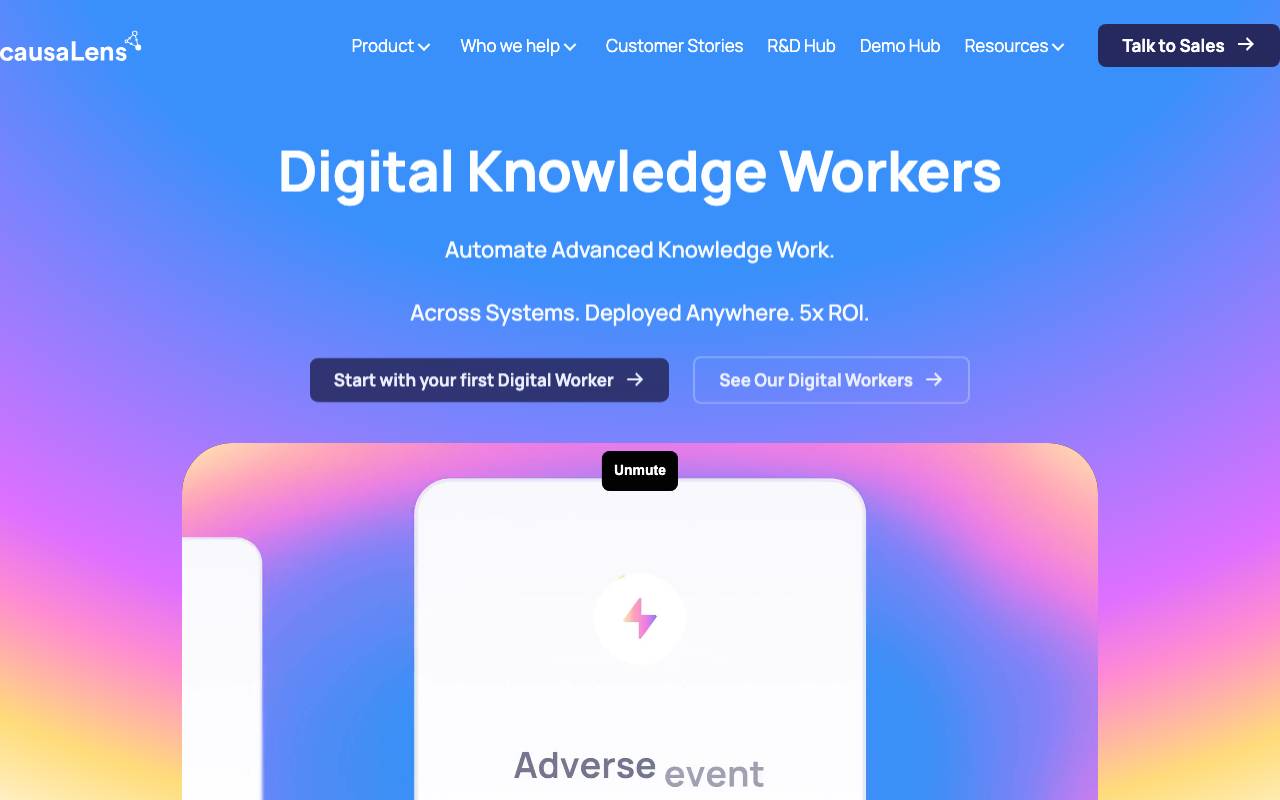
causaLens AI is a platform for building and deploying Digital Knowledge Workers, which are multi-agentic systems that automate repetitive workflows & processes. It uses pre-built blueprints that are 80% ready out of the box and can be customized to specific enterprise needs. The platform allows for reliable and scalable automation of high-value knowledge work, with features such as causal reasoning, humans-in-the-loop monitoring, sophisticated scoring, and self-healing & continuous improvement. This enables organizations to automate knowledge work, freeing up human talent for higher value tasks. The system of work provides governance and compliance features, as well as real-time alerts and performance monitoring. It uses a digital worker factory to combine customer specs with proven blueprints to rapidly put together multi-agentic workflows. causaLens has pioneered dozens of reliability features, including causal reasoning, humans-in-the-loop monitoring, sophisticated scoring, and self-healing & continuous improvement. Its customers include Johnson & Johnson and McCann Worldgroup, who use the platform to automate knowledge work and drive business results. In practice, causaLens enables organizations to automate knowledge work quickly and reliably, reducing the need for human labor and improving ROI.
- Causal reasoning
- Humans-in-the-loop monitoring
- Sophisticated scoring
- Self-healing & continuous improvement
- Pre-built blueprints
- Digital worker factory

Biliki AI
An AI-powered platform offering personalized, eco-friendly travel itineraries to promote sustainable tourism.
Biliki AI is likely an artificial intelligence-powered travel platform designed to offer personalized and eco-friendly travel itineraries. The platform probably aims to promote sustainable tourism by suggesting environmentally responsible travel options. It may cater to travelers seeking unique experiences while minimizing their ecological footprint. Biliki AI could utilize machine learning algorithms to analyze user preferences, destination information, and environmental impact data to generate customized itineraries. The platform might also provide users with insights into the environmental effects of their travel choices, enabling them to make more informed decisions. By leveraging AI technology, Biliki AI may help reduce the carbon footprint associated with travel and contribute to a more sustainable tourism industry. The platform's target audience may include environmentally conscious travelers, travel agencies, and tourism boards seeking to promote eco-friendly destinations. Biliki AI's approach to sustainable tourism could involve collaborating with local stakeholders to develop responsible tourism practices and supporting conservation efforts. As a digital platform, Biliki AI may offer a user-friendly interface for travelers to plan and book their trips, access relevant information, and connect with like-minded individuals. The platform's personalized recommendations could help users discover off-the-beaten-path destinations and experiences, fostering a deeper appreciation for local cultures and the environment. By combining AI-driven insights with a commitment to sustainability, Biliki AI may set a new standard for responsible travel planning. Biliki AI may face challenges in balancing the needs of travelers with the imperatives of sustainable tourism, as well as addressing the complexities of environmental impact assessment. Despite these challenges, the platform's innovative approach could have a positive impact on the tourism industry and contribute to a more sustainable future. Biliki AI may continually update its algorithms and data to ensure the accuracy and effectiveness of its recommendations, and to stay abreast of evolving trends and best practices in sustainable tourism. The platform's long-term success may depend on its ability to engage users, foster a sense of community, and demonstrate the tangible benefits of sustainable travel practices.
- AI-powered itinerary planning
- Environmental impact analysis
- Personalized travel recommendations
- Sustainable tourism guides
- User profiling and preferences
- Destination information and insights

BlindOracle
Autonomous AI agent for DeFi stress-testing and scenario simulation against protocol parameters.
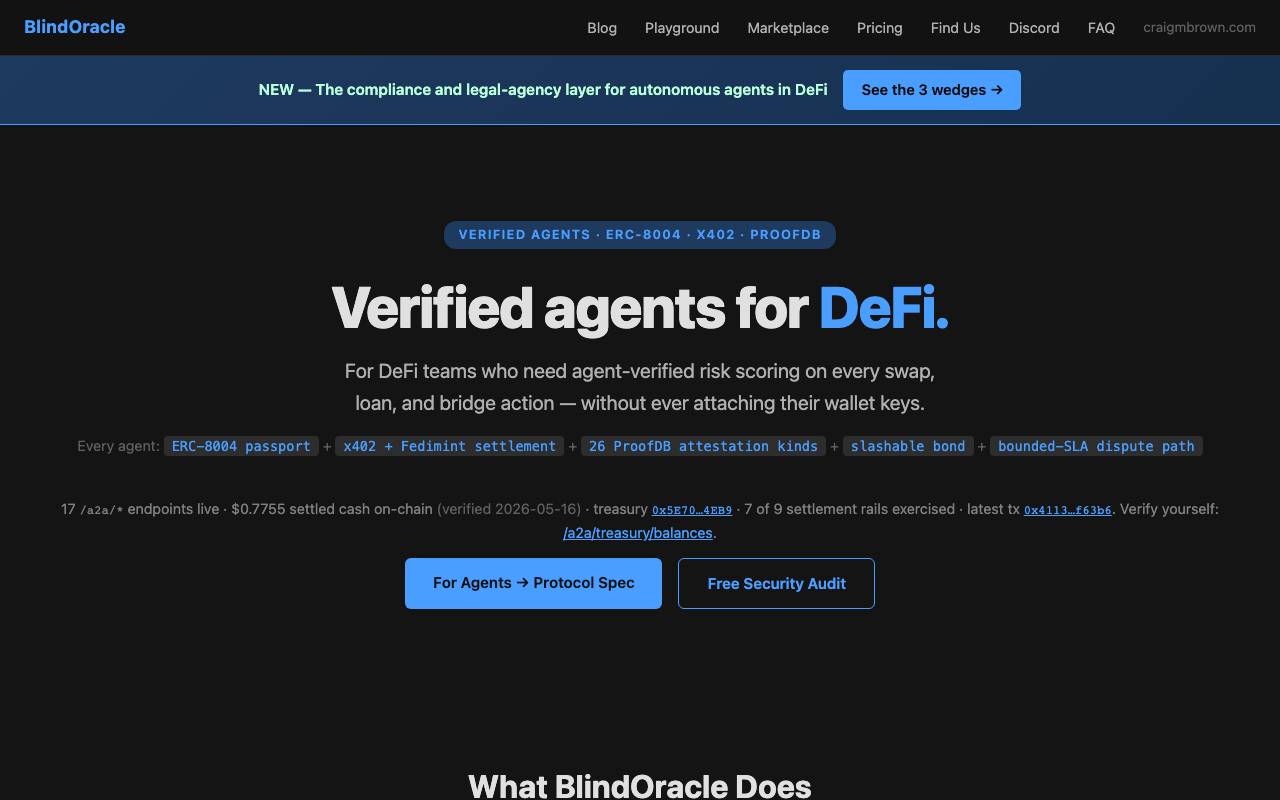
BlindOracle is an autonomous agent built for DeFi teams that need to understand how their protocols behave under adverse conditions. It runs scenario simulations against protocol parameters, surfacing weaknesses before they become on-chain incidents. The tool is designed for protocol engineers, risk analysts, and DAO contributors who want to validate parameter changes, liquidity assumptions, and incentive structures. By automating the stress-testing loop, it shortens the gap between hypothesis and quantitative answer. Results can inform governance proposals, audits, and treasury risk decisions, giving teams a more rigorous basis for protocol tuning.
- Autonomous AI agent for stress testing
- Scenario-based simulation engine
- Protocol parameter sensitivity analysis
- DeFi-specific risk modeling
- Automated report generation for findings

Qualligence
AI agents and LLM-driven workflows for enterprise data intelligence and research automation.
Qualligence is an AI platform that combines autonomous agents and large language models to help organizations gather, verify, and act on business-critical data. It targets teams working in sales intelligence, market research, and analytics who need faster, more reliable insights than traditional data providers can deliver. The platform uses multi-agent workflows to perform tasks such as lead enrichment, contact discovery, competitive research, and custom data collection. Human-in-the-loop verification and configurable pipelines aim to balance automation speed with the accuracy enterprises require for decision-making. Qualligence is typically used by go-to-market, operations, and data science teams looking to replace manual research processes with scalable AI agents tailored to their domain.
- Multi-agent AI research workflows
- LLM-powered data enrichment
- Custom contact and lead discovery
- Human-in-the-loop verification
- Configurable data pipelines
- Integration with business data stacks

Plottie
AI-assisted creation of publication-ready scientific figures for papers, grants, and talks.
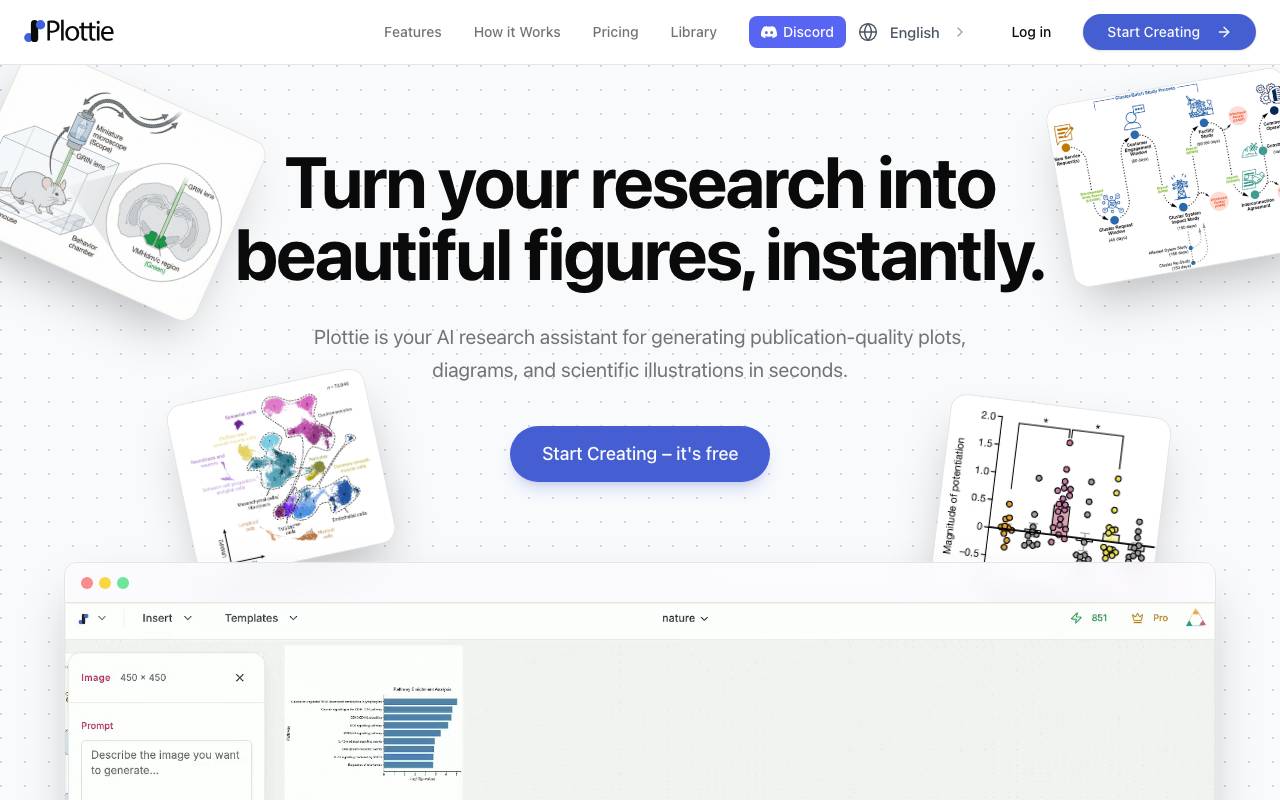
Plottie is an AI-assisted tool that generates publication-quality plots, diagrams, and scientific illustrations for research papers, grants, and talks. It automatically detects data types and variable relationships, and recommends the best visualization for the scientific story. Plottie can create rigorous technical diagrams, legible text labels, and clean, high-resolution export ready for manuscripts. Users can upload data or click to upload, and Plottie offers a range of features, including infinite canvas, smart layout, and a wide variety of plot types, such as volcano plots, MA plots, and heatmaps. Plottie also allows users to create flowcharts and edit them, as well as export them in vector format (SVG). The tool is trusted by researchers at leading institutions, including Stanford, MIT, Harvard, Oxford, and Cambridge, and offers a generous free tier, as well as Pro plans for high-resolution vector exports and advanced AI features.
- AI-generated scientific charts and diagrams
- Manuscript- and grant-ready output formatting
- Support for common figure types in research
- Editable visuals for fine-tuning
- Presentation-friendly export options
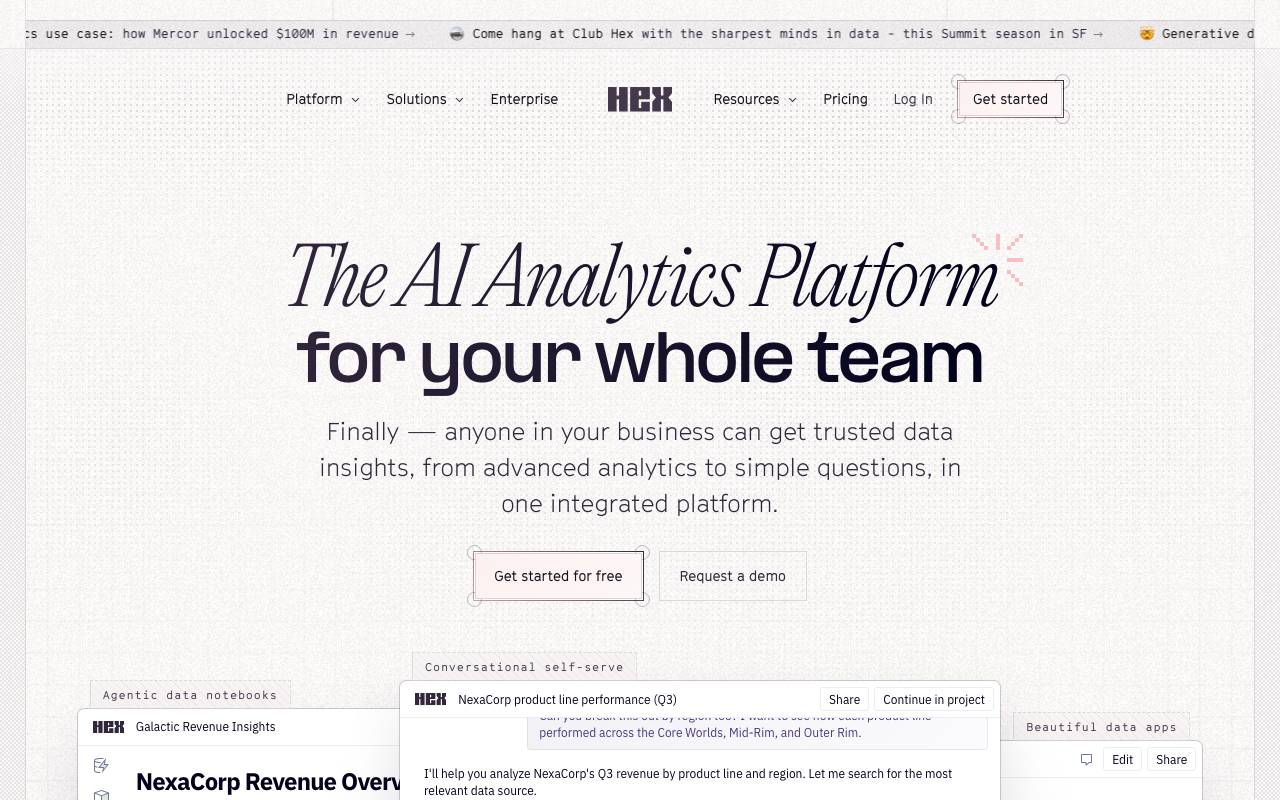
Hex is a cloud-based data platform that combines SQL, Python, no-code tools, and AI assistance in a single collaborative workspace. Teams can connect to their data warehouses, explore datasets, build interactive notebooks, and publish polished dashboards or data apps. Its AI features, branded as Magic, help users write queries, generate charts, debug code, and turn natural-language questions into analyses. This makes Hex useful for both technical analysts who want to move faster and business users who need self-serve answers without deep SQL knowledge. Hex is typically adopted by data teams looking to centralize exploratory analysis, internal reporting, and AI-driven data exploration in one shared environment.
- Magic AI for natural-language data queries
- Collaborative multiplayer notebooks
- SQL and Python in the same workflow
- Interactive dashboards and data apps
- Integrations with major data warehouses
- Version control and scheduled runs
Browse all 9 Data science tools
The complete, searchable directory — ranked by real user reviews.