Past battle · 2024-07-19 UTC
AI Agent Development Frameworks Showdown — July 19, 2024
From the AI Agent Development Frameworks category. 22 marks placed across 7 fighters. kagent took the crown.
Final standings





The line-up
The fighters
Profiles of every tool that competed in this battle, ranked by their final score.

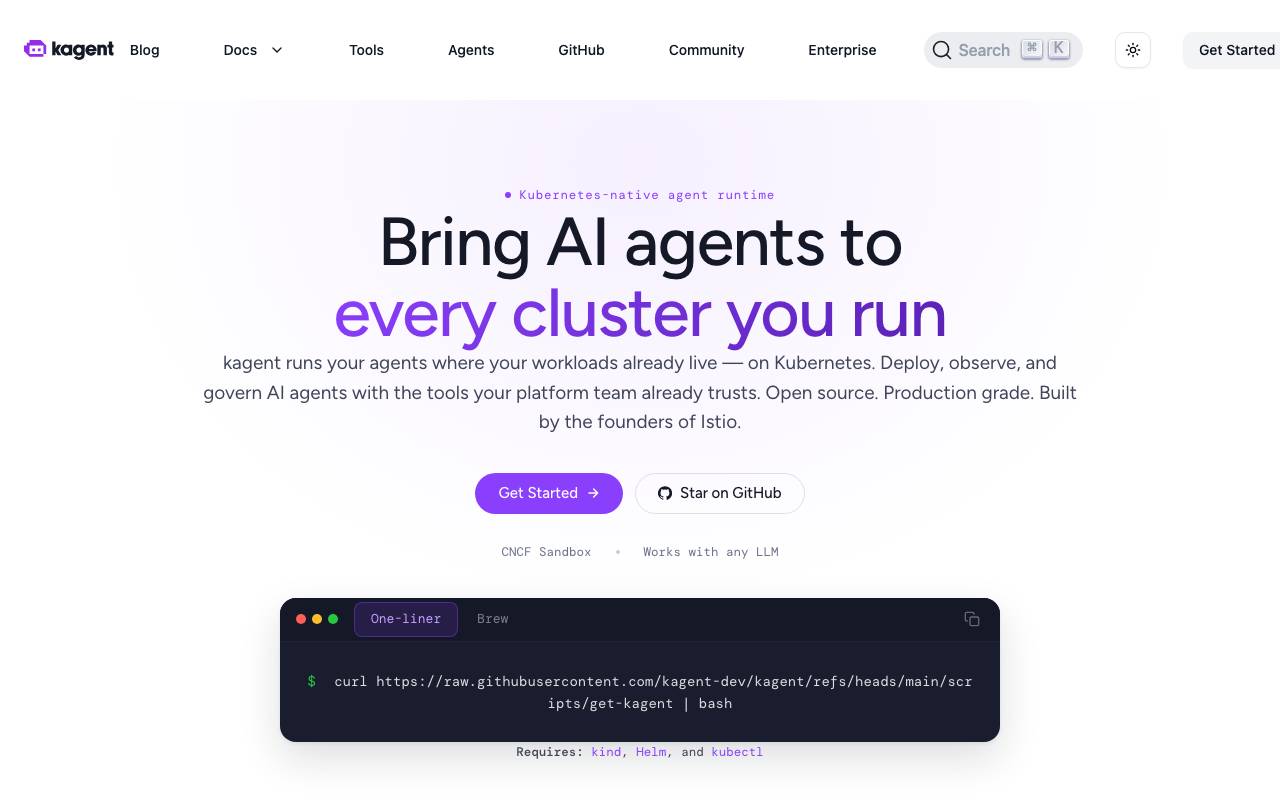
Kagent enables AI agents to automate Kubernetes operations. It allows agents to be deployed, observed, and governed using familiar Kubernetes tools. kagent makes agents a first-class workload on Kubernetes, allowing them to be versioned as Kubernetes Custom Resource Definitions (CRDs) and reviewed in pull requests. This approach enables the use of existing Kubernetes tools to manage agents. The framework is open-source and built by the founders of Istio. It supports a variety of language and framework combinations, including Go and Python, and allows for the use of any large language model (LLM) provider. kagent provides robust security and observability features, including OpenTelemetry tracing, Prometheus metrics, and structured logs. It also supports multi-runtime support, agent-to-agent communication, and the ability to load knowledge from Git repositories. Overall, kagent provides a powerful and flexible framework for automating Kubernetes operations with AI agents.
Criteria breakdown
- Agent Substrate for fast startup and efficient resource usage
- Zero-trust ready with mTLS and fine-grained RBAC
- Persistent vector-backed memory for long-term memory
- Human-in-the-loop tool approval gates and agent-initiated questions
- Agent-to-agent (A2A) delegation for composing multi-agent workflows

BabyCatAGI is a simplified, modified version of BabyAGI designed to handle complex tasks through autonomous AI agents. It breaks down high-level objectives into manageable subtasks, executes them sequentially, and adapts its plan based on intermediate results, making it suitable for research, content generation, and multi-step problem solving. The framework prioritizes minimal code and readability, making it accessible for developers who want to experiment with agentic AI without the overhead of larger orchestration libraries. It integrates with language models and web search tools to gather context, reason through problems, and produce structured outputs. As an open experimental project, BabyCatAGI is best suited for prototyping agent workflows, learning how task-driven autonomous systems operate, and customizing pipelines for specific automation needs.
Criteria breakdown
- Task list creation and prioritization
- Autonomous subtask execution
- Web search integration for context
- Sequential reasoning workflow
- Lightweight Python implementation
- Customizable objectives and prompts

MCP‑Use
Open‑source platform to connect LLMs with MCP servers and build custom AI agents with tool access.
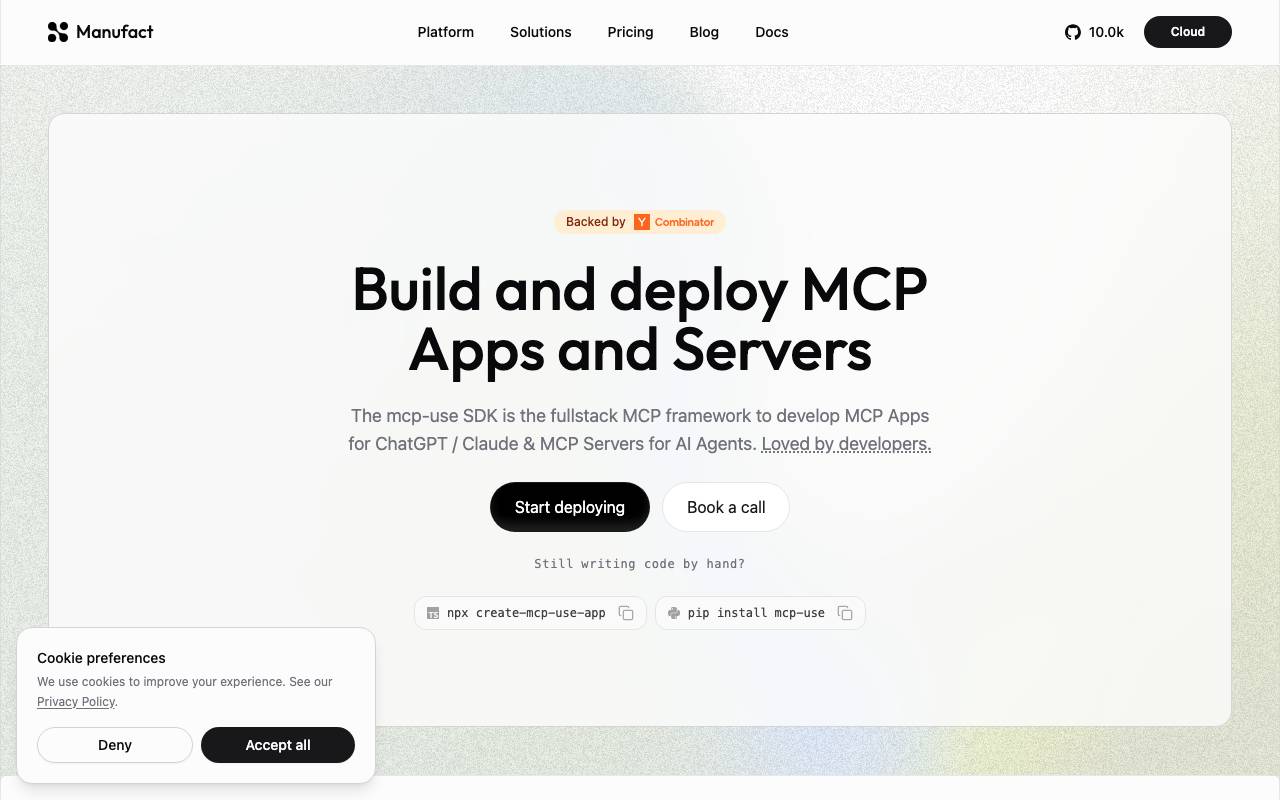
mcp-use is an open-source platform that facilitates the connection of Large Language Models (LLMs) with MCP servers and enables the development of custom AI agents that can interact with these LLMs. The platform provides a full-stack MCP framework (mcp-use SDK) to build ChatGPT Apps, Claude Connectors, and MCP Servers. With mcp-use, developers can leverage a single codebase to deploy their applications on various surfaces where users and agents already work, including ChatGPT, Claude, and Gemini. The platform offers a range of tools and features, such as the ability to scaffold MCP applications in one command, automatic deployment to Manufact Cloud, and built-in analytics and observability. Developers can use the mcp-use SDK to build and deploy MCP servers and applications without requiring additional tools. The platform also provides a Visual Inspector and Sandbox testing capabilities, allowing developers to test their applications without the need for a live LLM. mcp-use aims to simplify the development and deployment of MCP-based applications, making it an attractive option for developers looking to build and deploy custom AI agents and applications.
Criteria breakdown
- MCP server management
- LLM connection and integration
- Custom AI agent development
- Automated deployment and scalability
- Visual Inspector and Sandbox testing
- Built-in analytics and observability

Claude MCP Agents
AI agents built on Anthropic's MCP for seamless tool and data integration.
Claude MCP Agents are AI agents that leverage Anthropic's Model Context Protocol (MCP) to connect with a wide range of external data sources, APIs, and developer tools. By standardizing how context flows between Claude and outside systems, these agents can read files, query databases, invoke services, and act on real-time information without bespoke integrations for each source. The approach is aimed at developers and teams building automation, research assistants, and workflow agents that need reliable access to enterprise or personal data. MCP's open specification means the same agent can plug into new tools as connectors emerge, reducing lock-in and integration overhead.
Criteria breakdown
- Model Context Protocol integration
- Connects to files, APIs, and databases
- Extensible via custom MCP servers
- Supports agentic, multi-step workflows
- Compatible with Claude model family
- Open standard for interoperability

Gemma 3
An open-source AI model optimized for single-GPU performance, supporting multimodal inputs and over 140 languages.
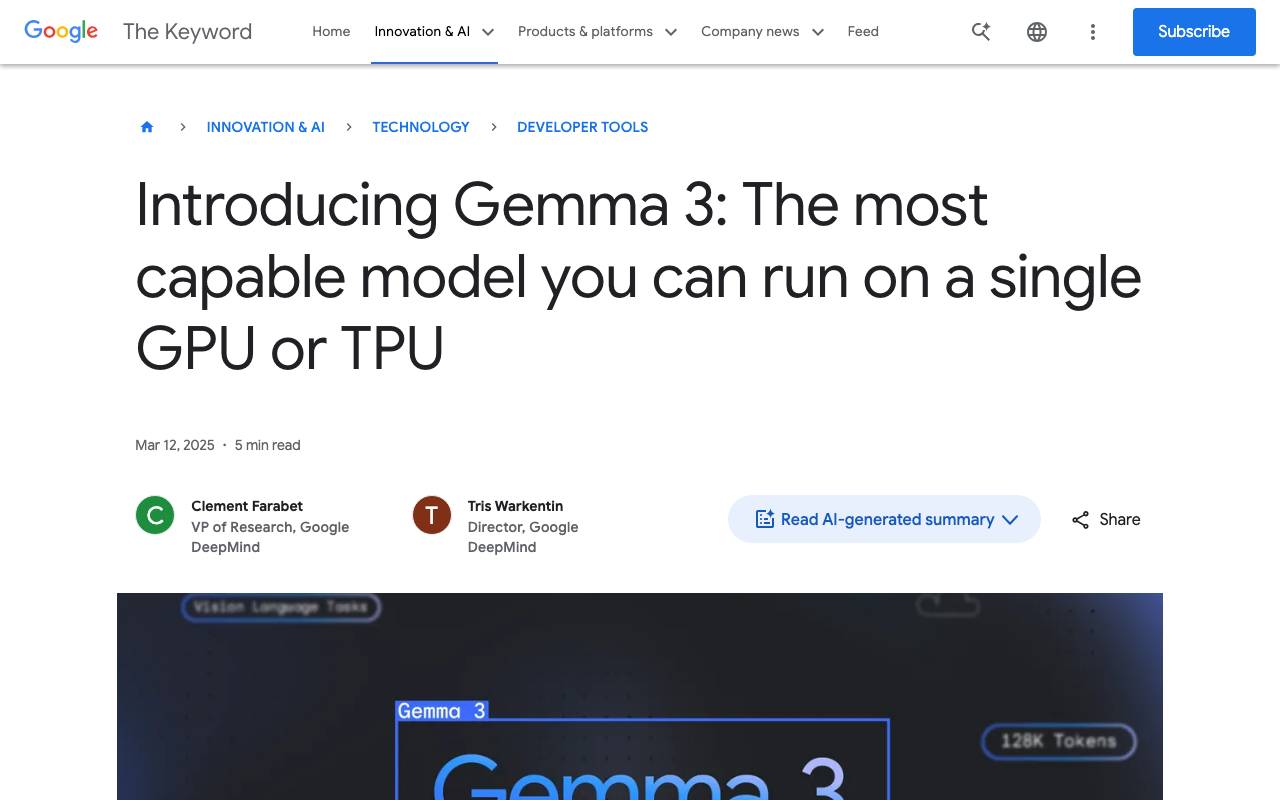
Gemma 3 is a collection of lightweight, state-of-the-art open models designed to run on devices, particularly optimized for single-GPU performance. It supports multimodal inputs and over 140 languages. The model comes in various sizes (1B, 4B, 12B, and 27B), allowing developers to choose the best fit for their hardware and performance needs. Gemma 3 offers advanced text and visual reasoning capabilities, a 128k-token context window, and function calling for complex tasks. It also includes quantized versions for faster performance and reduced computational requirements. The model is part of Google's commitment to making useful AI technology accessible and builds upon the same research and technology that powers their Gemini 2.0 models. Gemma 3 is designed to enable developers to create AI applications that can run directly on devices such as phones, laptops, and workstations. Gemma 3 delivers state-of-the-art performance for its size, outperforming other models like Llama3-405B, DeepSeek-V3, and o3-mini in preliminary human preference evaluations. It allows for global applications with out-of-the-box support for over 35 languages and pretrained support for over 140 languages. The model enables the creation of AI-driven workflows using function calling and structured output. The development of Gemma 3 included rigorous safety protocols, such as extensive data governance, alignment with safety policies via fine-tuning, and robust benchmark evaluations. The Gemma family of open models has seen significant adoption, with over 100 million downloads and a vibrant community that has created more than 60,000 Gemma variants. Gemma 3's capabilities make it suitable for developers looking to create engaging user experiences that can fit on a single GPU or TPU host.
Criteria breakdown
- multimodal AI support
- responsibility-focused development
- extensive fine-tuning
- support for 140 languages
- improved performance

Agency Swarm
An open-source AI agent orchestration framework designed to automate and streamline AI development processes through collaborative agent swarms.
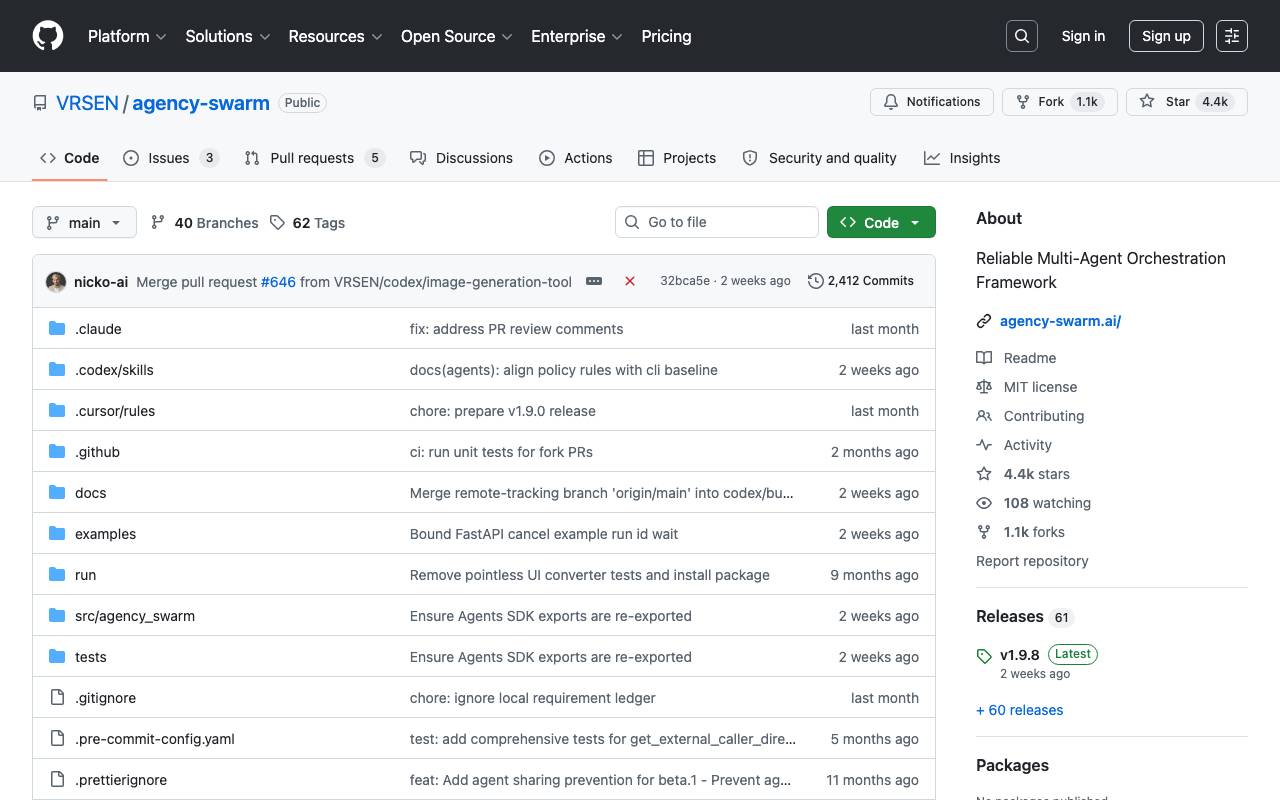
Agency Swarm is an open-source framework that builds upon the OpenAI Agents SDK and Responses API. It offers a structured and production-ready environment for creating multi-agent applications. Key features include customizable agent roles, the ability to handle different model backends (e.g., OpenAI's GPT-family models, Anthropic, Google's Gemini, Azure's OpenRouter, and self-made LiteLLM tools, enabled by the @function_tool decorator (recommended) or by Extending BaseTool Object. A key benefit of Agency Swarm's architecture is its stability in both Python and Linux environments. Installation is simple with the standard pip pip install agency-swarm command. Description: The description should explain Agency Swarm as an open-source tool that builds on top of the OpenAI Agents SDK and Responses API. Description (details) Agency Swarm is an open-source AI toolkit that helps developers create multi-agent applications for real-world AI development. Key Features: - Auto-generated CLI tools: Discover your application's REST API for easy access to core services to increase productivity. - Customizable agent roles: You can easily determine specific functions and permission levels for each agent role, for increased customizability in your application. - Full Stack Implementation: Agency Swarm is a full stack for Python only. If you are on Linux, think of it as full-stack implementation without any constraints due to the Python standard library. Pros: 1. Stability in Python/Linux environments 2. Easy Integration with your application 3. Composable and easy-to-use CLI tools 4. Custom Agent Roles Cons: 1. Language Model Compatibility Limitations (Personal chatbots: GPT-3, etc.) N/A 2. Development Environment Requirements N/A 3. Limited Model Backend Support N/A 4. Basic User Interface N/A 5. Learning Capabilities N/A 6. Feature Integration N/A 7. Documenting Process N/A 8. Machine Learning AI capabilities: N/A 9. Advanced Dialogue Flow Management N/A 10. Multilayer Applications N/A 11. Simultaneous Execution N/A 12. Access to the Application State N/A 13. Automatic Deployment N/A 14. Advanced Task Execution N/A 15. Custom Agent Types N/A 16. Large Language Model Support N/A 17. Works in Python ↻ N/A 18. Full Control N/A 19. Performance Measurement N/A 20. Offering Local Workspaces N/A 21. Integrating w/ OpenALink: A web development framework for Python apps 22. Collaborate with AI agents on a project 23. Interpretability 24. Monitoring N/A 25. Full Source Code Integration N/A 26. Scalability N/A 27. Low Performance N/A Cons:
Criteria breakdown
- Customizable Agent Roles
- Full Control Over Prompts/Instructions
- Type-Safe Tools for Development
- Orchestrated Agent Communication
- Flexible State Persistence
- Multi-Agent Orchestration

Mosaic AI Agent Framework
A suite of tools by Databricks for building, deploying, and evaluating high-quality AI agents and RAG applications.
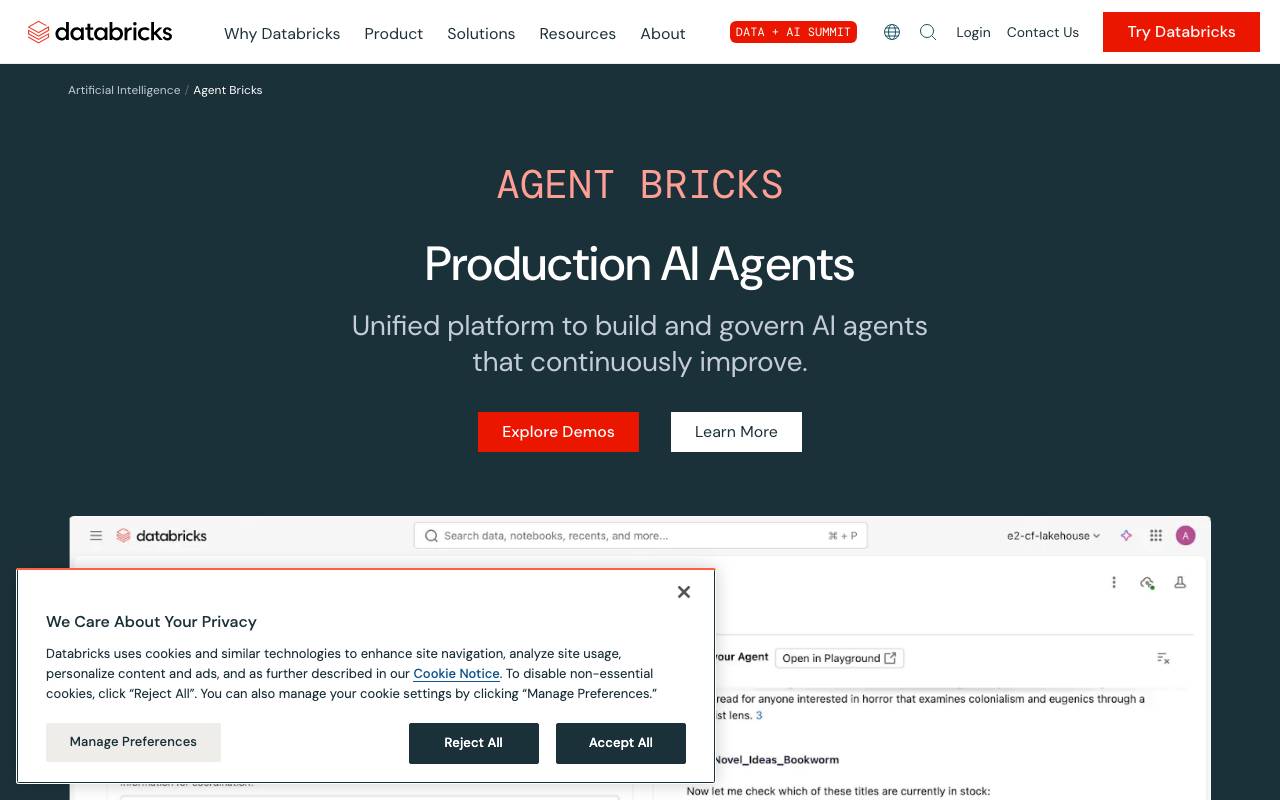
The Databricks Agent Framework (AAF) is a set of tools provided by Databricks for building, deploying, and governing AI agents. These agents can connect to any tool, database, or SaaS application through a single, governed protocol (Model Context Protocol, MCP). The framework includes integrated AI development, experimentation, and deployment into serverless computing using Databricks Apps without managing infrastructure. Agent Bricks and Unity Catalog are essential for governance and security; they apply predefined policies on models, tools, and connections while enforcing rate limits, fallbacks, and other safeguards required for prompt injection prevention, sensitive data detection, and content filtering.
Criteria breakdown
- Agent Bricks
- Unity Catalog
- Databricks Apps
- Model Context Protocol (MCP)
- Centralized governance
- Per-user control