Past battle · 2024-01-11 UTC
Observability Showdown — January 11, 2024
From the Observability category. 40 marks placed across 10 fighters. Quotient AI took the crown.
Final standings





The line-up
The fighters
Profiles of every tool that competed in this battle, ranked by their final score.

Quotient AI
Real-time monitoring and evaluation platform for catching AI failures in search, RAG, and agents.
Quotient AI is an observability and evaluation platform built for teams shipping AI-powered features. It continuously monitors production AI systems—including search, retrieval-augmented generation (RAG), and autonomous agents—to surface hallucinations, retrieval errors, and other quality issues before end users encounter them. The platform combines automated evaluations with real-time alerts, helping engineering and ML teams diagnose root causes, track regressions across model or prompt changes, and maintain reliability at scale. By instrumenting AI pipelines, Quotient gives developers visibility into how their applications actually behave in the wild rather than relying solely on offline benchmarks.
Criteria breakdown
- Real-time AI monitoring and alerting
- Hallucination and retrieval error detection
- Evaluation tooling for RAG pipelines
- Agent behavior tracking and diagnostics
- Regression analysis across model and prompt changes
- Production observability for AI applications

Weave
A no-code AI workflow builder that enables businesses to automate operations by integrating multiple large language models (LLMs) and connecting prompts seam...
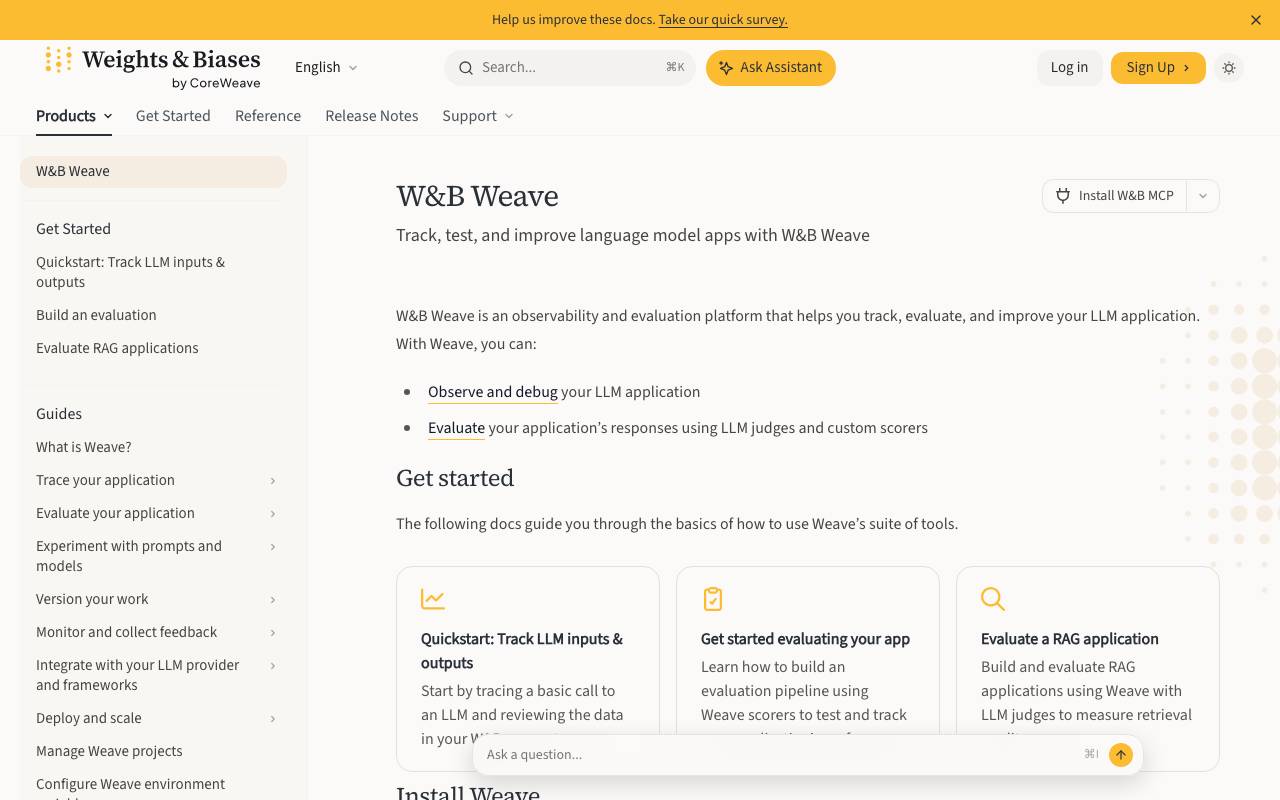
W&B Weave is an observability and evaluation platform that helps track and improve large language model (LLM) applications. Weave provides tools to trace, collect metrics, and evaluate application responses using LLM judges and custom scorers. Key features include tracing sessions, LLM calls, and tool calls, as well as manual instrumentation of custom agents. The platform supports integrations with popular SDKs and harnesses, as well as custom agent observability. Weave provides Python and TypeScript libraries for installing and using the platform. It is hosted on Weights & Biases (W&B), requiring a W&B account and API key for authentication. Users can trace calls to LLMs, review inputs and outputs, and view agent metrics in the Weave UI. While Weave facilitates automation and evaluation of LLM applications, it is not a no-code AI workflow builder as suggested by its name.
Criteria breakdown
- Agent tracing and metric collection
- Custom agent observability
- LLM tracing and evaluation
- OpenTelemetry span support
- Weights & Biases (W&B) integrations
- Python and TypeScript libraries
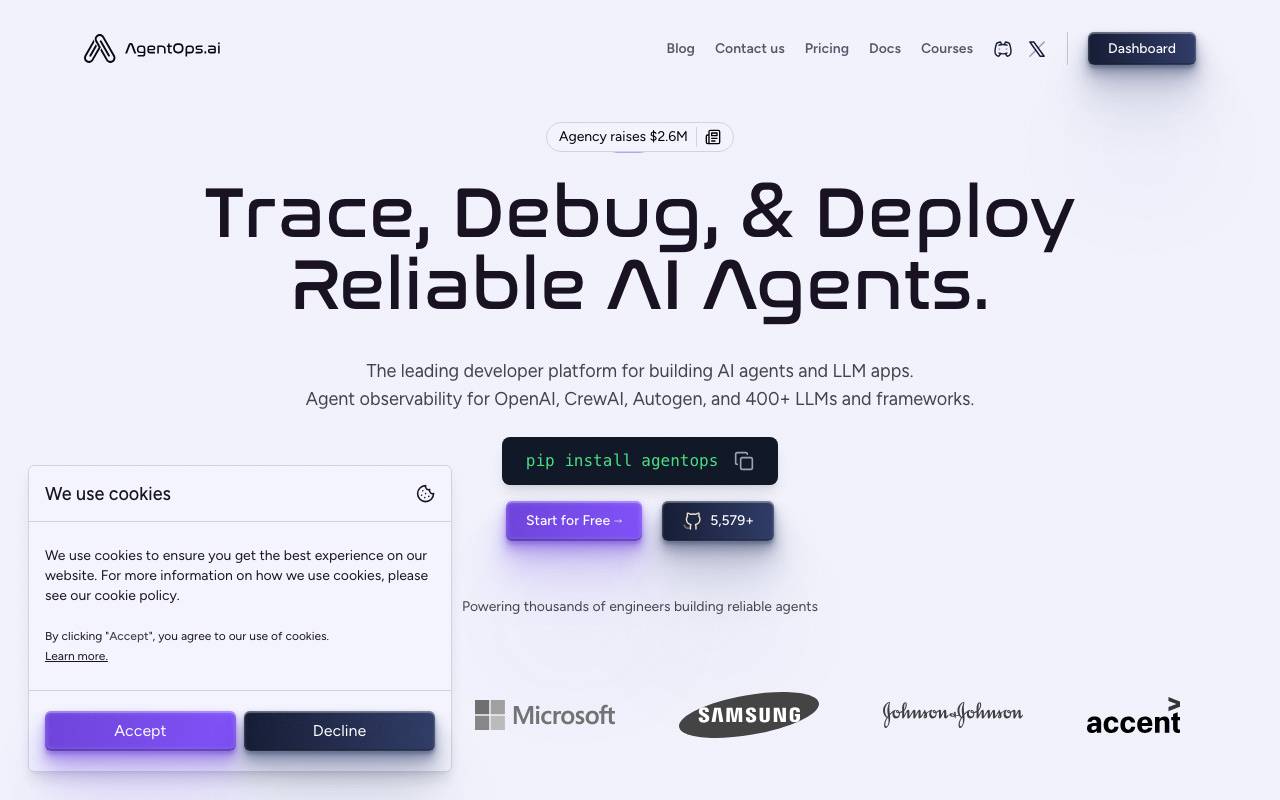
AgentOps is a developer platform focused on the lifecycle of AI agents, providing tracing, monitoring, and debugging tools that surface what agents actually do at runtime. It captures LLM calls, tool usage, costs, and errors so teams can understand agent behavior across complex multi-step workflows. Beyond visibility, AgentOps offers session replay, performance analytics, and integrations with popular agent frameworks like LangChain, CrewAI, and AutoGen. This helps engineers move from prototype to production with measurable reliability instead of relying on guesswork or log scraping. It is aimed at developers and teams shipping agentic applications who need to track regressions, control spend, and prove that their agents behave correctly before and after deployment.
Criteria breakdown
- Agent session recording and replay
- LLM call and tool-use tracing
- Cost and token analytics
- Error and failure detection
- Framework SDKs for Python and JavaScript
- Dashboards for agent performance metrics

Confident AI
LLM evaluation platform built on DeepEval for testing, monitoring and improving AI applications.
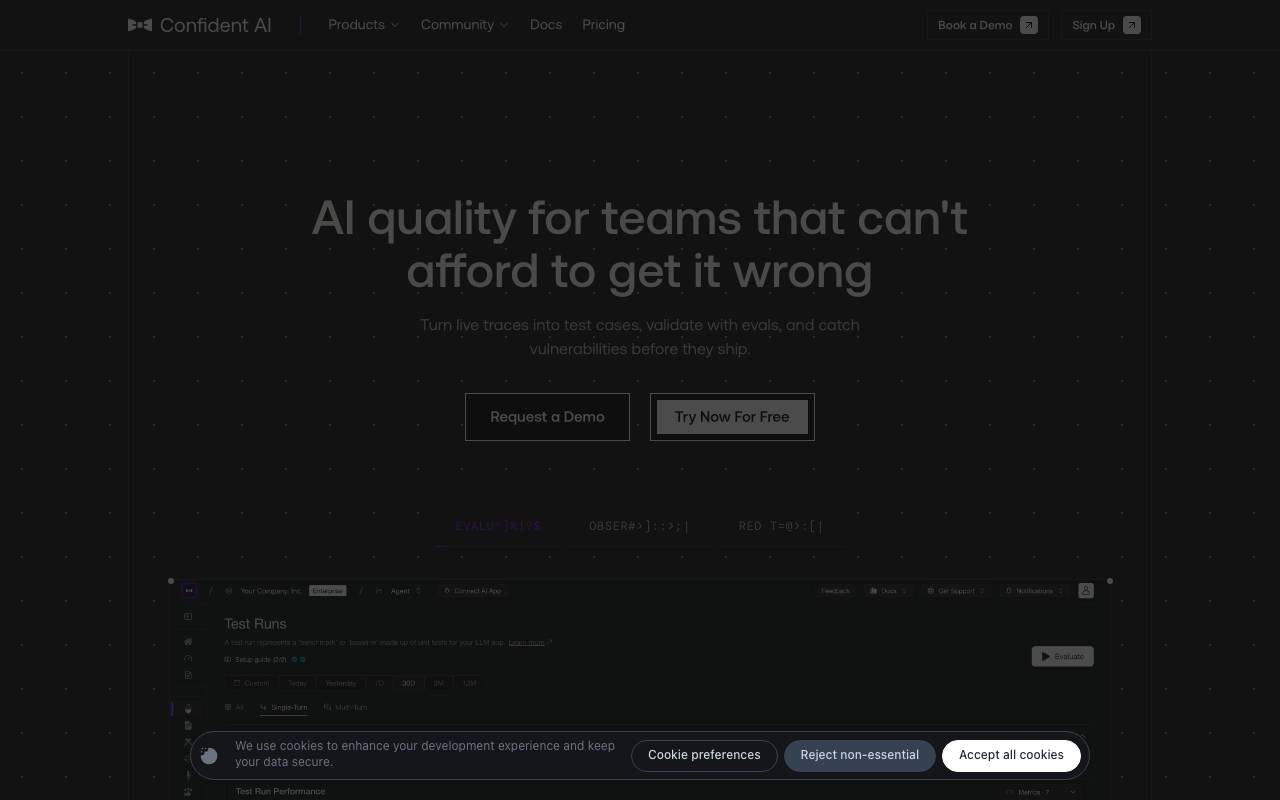
Confident AI is an evaluation and observability platform for teams building large language model applications. Powered by the open-source DeepEval framework, it provides a unified workspace to run benchmarks, regression tests and quality checks across prompts, models and retrieval pipelines. The platform helps engineers catch hallucinations, prompt regressions and retrieval failures before shipping, while offering production monitoring to track real user interactions. Teams can centralize datasets, share test results and iterate on prompts with measurable feedback rather than guesswork. It is aimed at developers, ML engineers and QA teams who want a structured, metrics-driven approach to LLM quality assurance rather than ad-hoc manual review.
Criteria breakdown
- DeepEval-powered evaluation metrics
- Regression testing for prompts and models
- RAG and retrieval evaluation
- Production tracing and monitoring
- Dataset and test case management
- Team collaboration on evaluation results

Fiddler AI
AI observability and security platform for monitoring, explaining, and governing ML and LLM applications.

Fiddler AI is an enterprise platform that helps teams monitor, analyze, and secure machine learning models and generative AI applications in production. It provides visibility into model performance, data drift, bias, and quality issues, while also offering safeguards against risks specific to LLMs such as hallucinations, prompt injection, and unsafe outputs. Designed for ML engineers, data scientists, and risk and compliance teams, Fiddler combines explainability, real-time monitoring, and guardrails in a single workflow. It integrates with common ML pipelines and cloud environments, helping organizations operationalize responsible AI practices at scale.
Criteria breakdown
- Model performance and drift monitoring
- LLM hallucination and safety detection
- Prompt injection and jailbreak protection
- Explainable AI and root cause analysis
- Bias and fairness assessments
- Dashboards and alerts for production AI

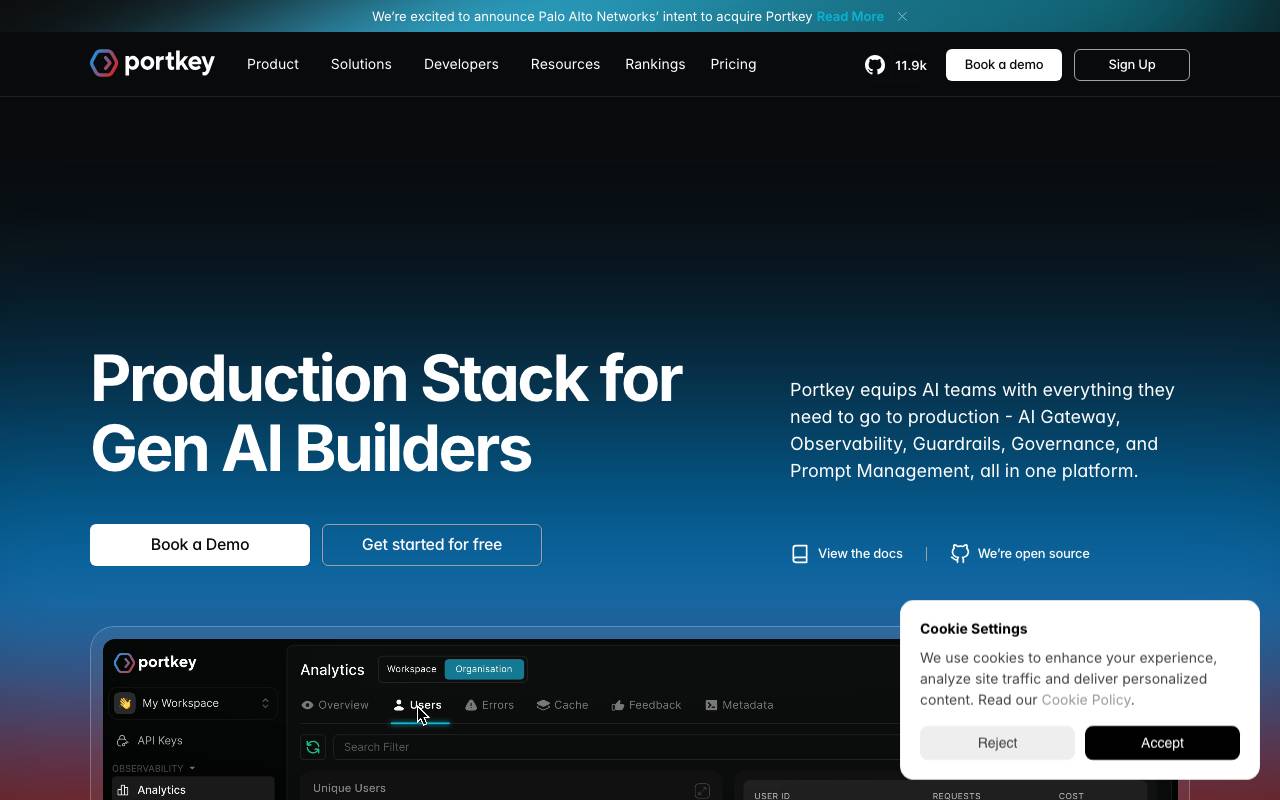
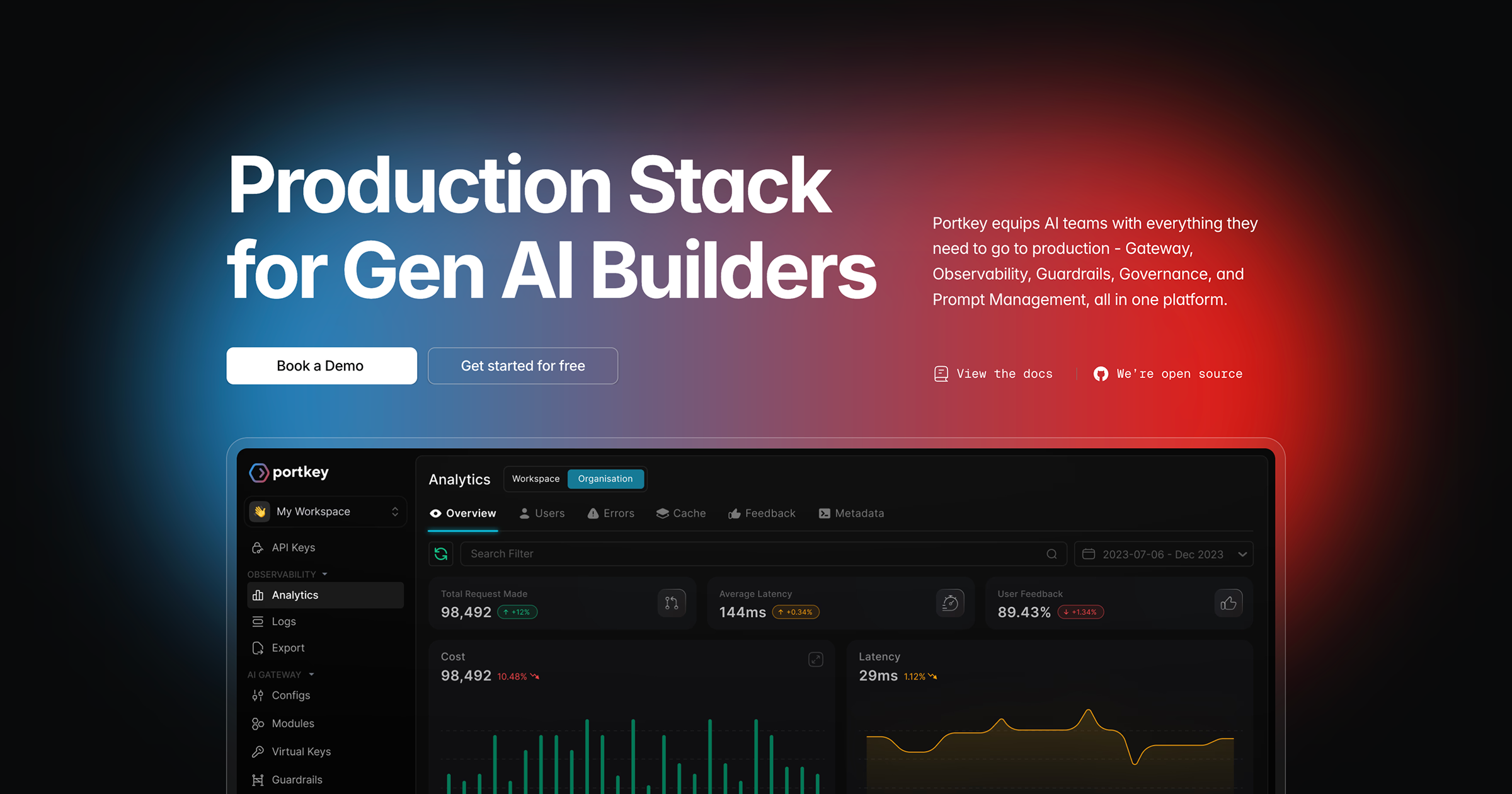
Portkey is a unified control plane for building, managing, and monitoring AI applications. It provides a comprehensive platform for AI teams to go to production, offering features such as AI Gateway, Observability, Guardrails, Governance, and Prompt Management. The platform allows users to access over 1,600 LLMs via a unified API, streamlining the process of integrating models and enabling teams to focus on building rather than managing. Portkey also offers real-time observability, allowing users to monitor LLM behavior, catch anomalies early, and manage usage proactively. Additionally, the platform provides caching capabilities, which have been shown to save users thousands of dollars by reducing redundant tests. Portkey is designed for AI teams and supports a wide range of LLMs, with over 3,000 GenAI teams and a large number of tokens processed daily.
Criteria breakdown
- AI gateway with multi-provider routing
- Prompt management and versioning
- Request logs, traces, and analytics
- Semantic caching and retries
- Guardrails for input and output validation
- Usage and cost monitoring dashboards
Relari (YC W24)
Testing, evaluation, and synthetic data generation platform for AI agents.
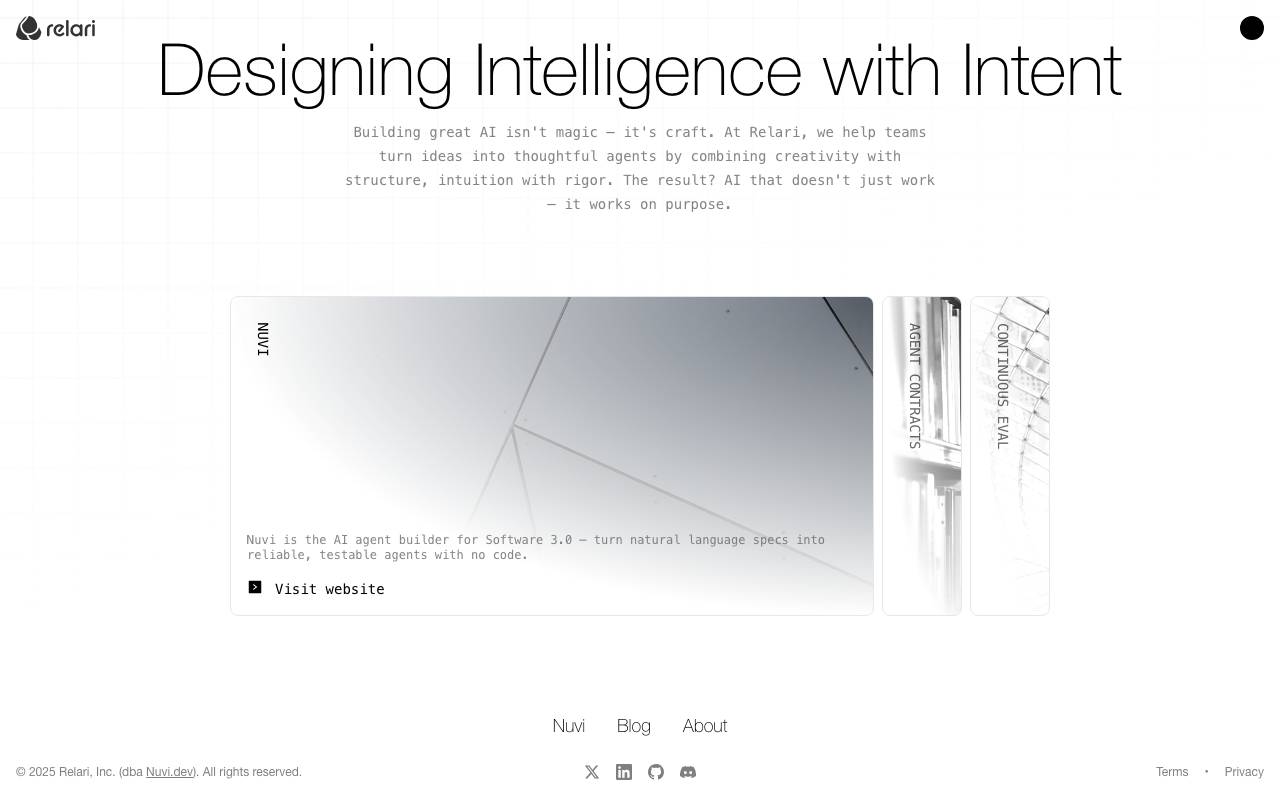
Relari is a developer platform focused on improving the reliability of AI agents through systematic testing and evaluation. It helps teams generate synthetic datasets, run automated evaluations, and benchmark agent performance across realistic scenarios before shipping to production. Backed by Y Combinator (W24), Relari targets engineering teams building complex LLM applications and multi-step agents where traditional QA falls short. Its tooling aims to bring software-engineering rigor—unit tests, regression checks, and measurable metrics—to non-deterministic AI systems. The platform supports custom evaluators, scenario simulation, and continuous monitoring, making it useful for both pre-launch validation and ongoing quality assurance of production agents.
Criteria breakdown
- Synthetic dataset generation
- Automated agent evaluation pipelines
- Scenario and conversation simulation
- Customizable evaluation metrics
- Regression testing for LLM apps
- Performance benchmarking and reporting

Arize AI
An AI observability and LLM evaluation platform that assists AI developers and data scientists in monitoring, troubleshooting, and enhancing the performance...
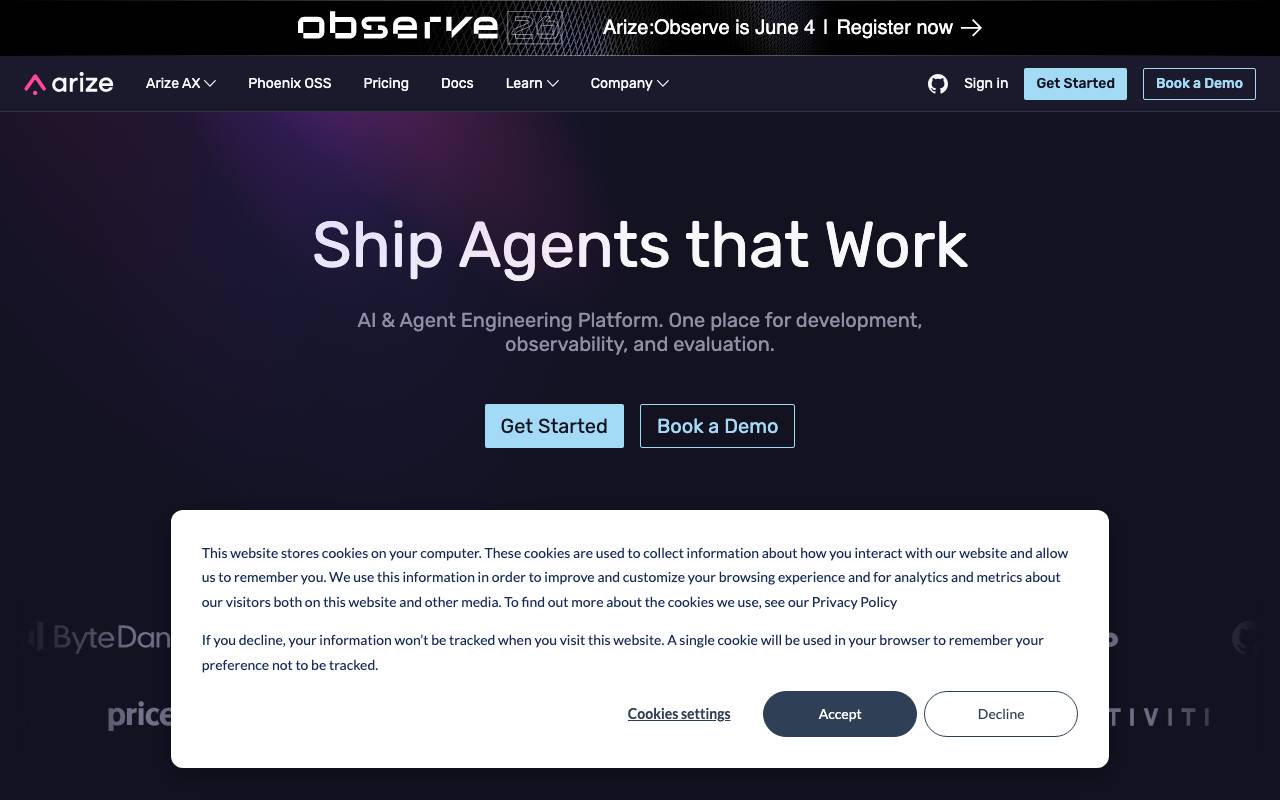
Arize AI is an AI observability and LLM evaluation platform. It assists AI developers and data scientists in monitoring, troubleshooting, and enhancing the performance of their AI models. The platform provides tools for identifying issues and proposing fixes, helping users improve their models' accuracy and reliability. Arize AI is designed for AI developers and data scientists who need to optimize their models' performance. The platform's capabilities include monitoring and troubleshooting, allowing users to quickly identify and address issues. Arize AI also provides features for evaluating and enhancing model performance, enabling users to refine their models over time. By using Arize AI, users can ensure their AI models are operating at peak performance, leading to better decision-making and outcomes. The platform's focus on observability and evaluation sets it apart from other AI development tools, making it a valuable resource for those working with large language models and other complex AI systems.
Criteria breakdown
- AI model monitoring
- Troubleshooting and issue identification
- Proposed fix generation
- Model performance evaluation
- LLM evaluation and optimization

Edwin AI
AI agent for IT operations that speeds up incident detection, triage, and resolution.
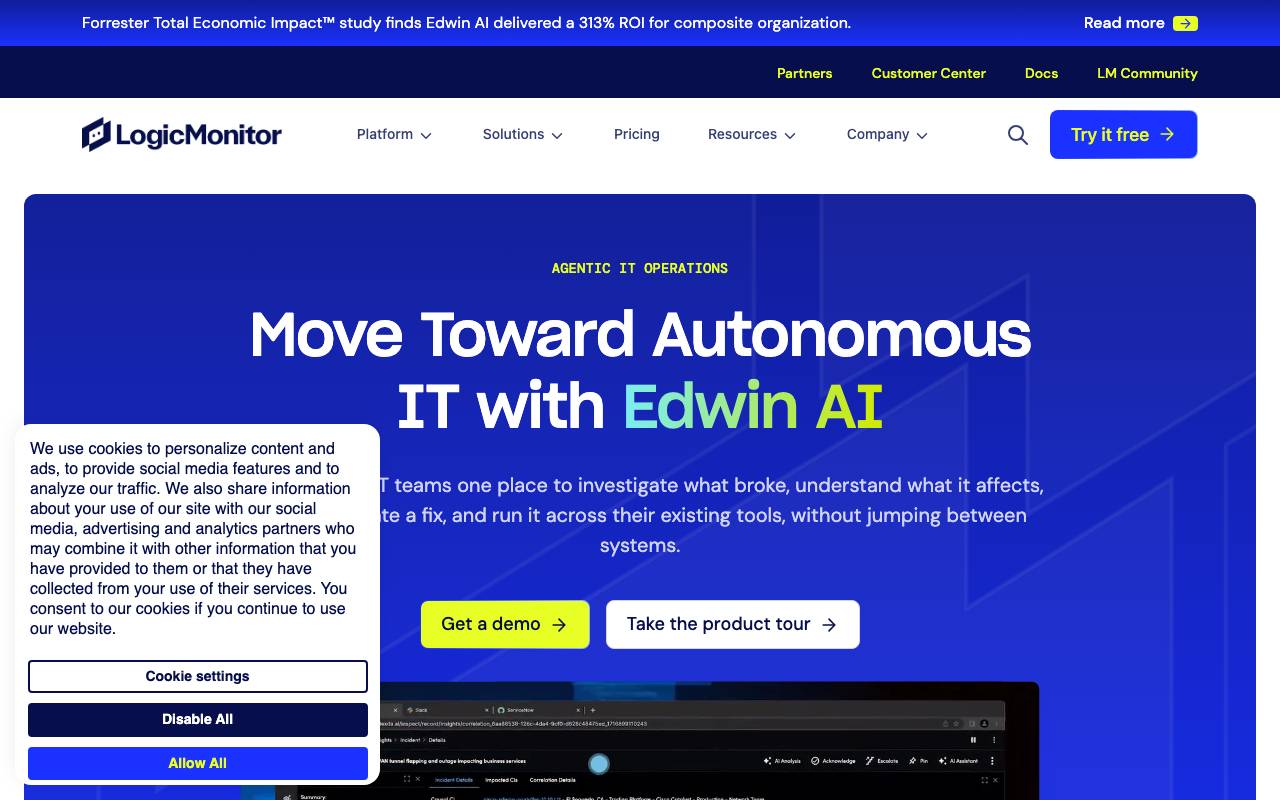
Edwin AI is an AI agent for IT operations designed to speed up incident detection, triage, and resolution. It provides a centralized platform for IT teams to investigate incidents, understand their impact, find or generate fixes, and apply them across existing tools without needing to switch between systems. Edwin AI correlates alerts, identifies root causes, and initiates remediation automatically, starting from the first alert through to verified resolution. It uses historical patterns and observability data to predict and prevent outages. The tool integrates with over 3,000 tools across observability, APM, security, and CMDB, enabling real-time, actionable insights and eliminating silos. A Forrester study found that Edwin AI delivered a 313% ROI for a composite organization, with a payback period of 6 months or less.
Criteria breakdown
- Alert correlation and noise reduction
- AI-driven root cause suggestions
- Natural-language incident summaries
- Integrations with ITSM and observability platforms
- Automated triage workflows
- Knowledge enrichment from past incidents


FoundryAI is a development platform focused on creating AI agents that handle real business workflows. It combines agent design, testing, and continuous improvement tools so teams can move from prototype to production without stitching together separate systems. The platform emphasizes evaluation, giving builders ways to measure agent performance against defined tasks and refine behavior over time. This makes it suited for organizations automating customer support, internal operations, or repetitive knowledge work where reliability matters. FoundryAI targets technical teams who need more control than no-code builders offer but want faster iteration than building agents entirely from scratch.
Criteria breakdown
- Agent building environment
- Evaluation and testing tools
- Performance monitoring
- Workflow automation support
- Iterative improvement loops
- Integration with business systems