Past battle · 2025-09-14 UTC
Code Generation Showdown — September 14, 2025
From the Code Generation category. 16 marks placed across 6 fighters. Codename Goose took the crown.
Final standings





The line-up
The fighters
Profiles of every tool that competed in this battle, ranked by their final score.

Codename Goose
An open-source, on-machine AI agent automating complex engineering tasks to enhance developer productivity.
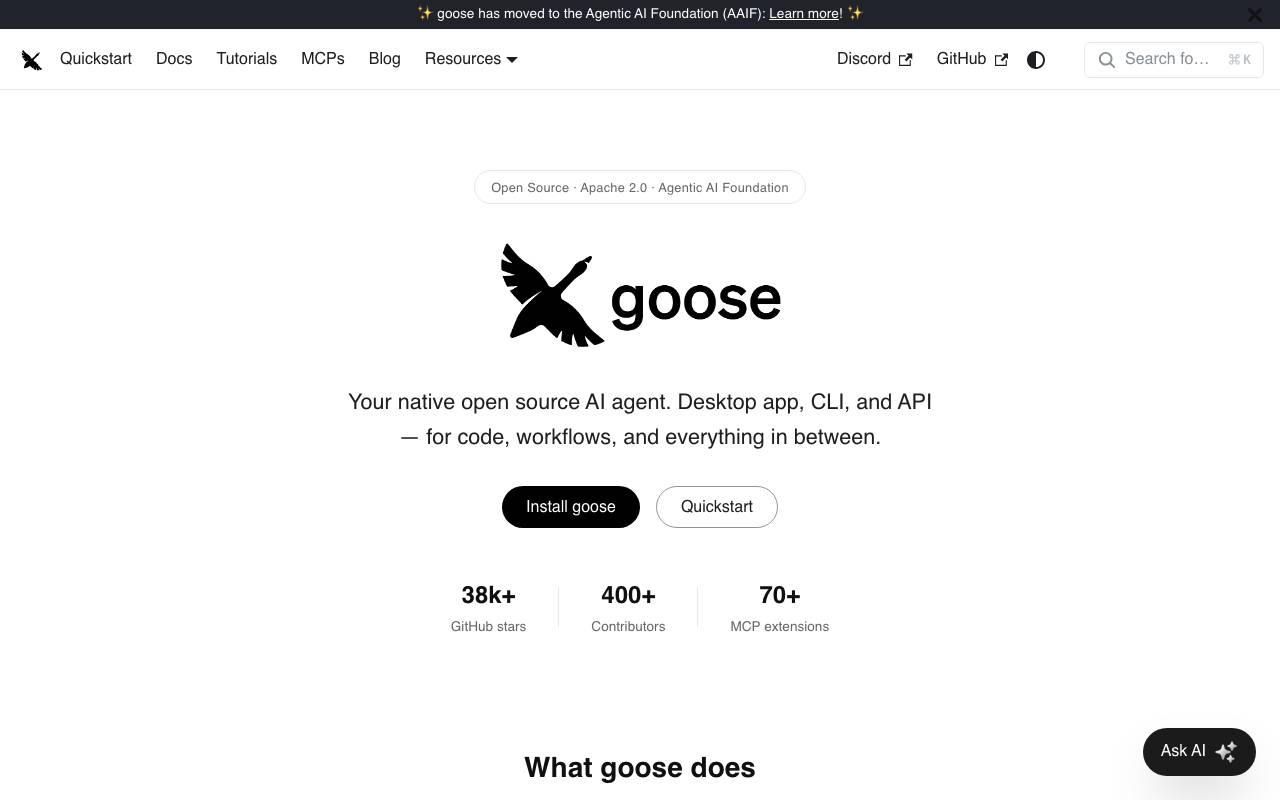
Codename Goose, also known as goose, is an open-source, on-machine AI agent designed to automate complex engineering tasks and enhance developer productivity. It is a general-purpose AI agent that can be used for various tasks beyond code, including research, writing, automation, and data analysis. The goose AI agent is available as a native desktop app for macOS, Linux, and Windows, a full CLI for terminal workflows, and an API that can be embedded anywhere. It is built in Rust, which provides performance and portability. goose works with over 15 providers, including Anthropic, OpenAI, Google, and Azure, and supports API keys or existing subscriptions via ACP. One of the standout capabilities of goose is its ability to connect to over 70 extensions via the Model Context Protocol open standard. This allows developers to extend the functionality of the AI agent and integrate it with other tools and services. goose is also part of the Agentic AI Foundation (AAIF) at the Linux Foundation, which provides a framework for the development and governance of AI agents. The goose AI agent can be used to automate various tasks, including code suggestions, installation, execution, editing, and testing with any large language model (LLM). It is designed to be extensible, allowing developers to build their own custom distributions with preconfigured providers, extensions, and branding. Overall, goose is an open-source AI agent that has the potential to significantly enhance developer productivity and automate complex engineering tasks. Its flexibility, extensibility, and ability to work with multiple providers and extensions make it a powerful tool for developers and researchers alike.
Criteria breakdown
- Supports 15+ providers
- Embeddable via API
- Connects to 70+ extensions via MCP open standard
- Works with existing subscriptions via ACP
- Customizable via custom distributions and provider configurations

OpenAI Codex
AI coding assistant that translates natural language into working code across dozens of programming languages.

OpenAI Codex is a language model fine-tuned for software development, capable of interpreting plain English prompts and producing functional code. Built on the GPT architecture, it understands context across multiple files and supports a wide range of programming languages, with particular strength in Python, JavaScript, TypeScript, Go, Ruby, and Shell. Developers can use Codex to generate boilerplate, write functions from descriptions, refactor existing code, explain unfamiliar snippets, and automate repetitive tasks. It powers tools like GitHub Copilot and can be integrated into custom workflows via the OpenAI API, making it useful for both individual coders and engineering teams looking to speed up development. While Codex accelerates many coding tasks, its output still requires human review for correctness, security, and adherence to project standards. It works best as a collaborator rather than a replacement for engineering judgment.
Criteria breakdown
- Natural language to code generation
- Multi-language programming support
- Code completion and suggestions
- Refactoring and code explanation
- API access for custom integrations
- Context-aware multi-file understanding

SWE-1 ai coding model
Windsurf's in-house AI model family purpose-built for end-to-end software engineering workflows.
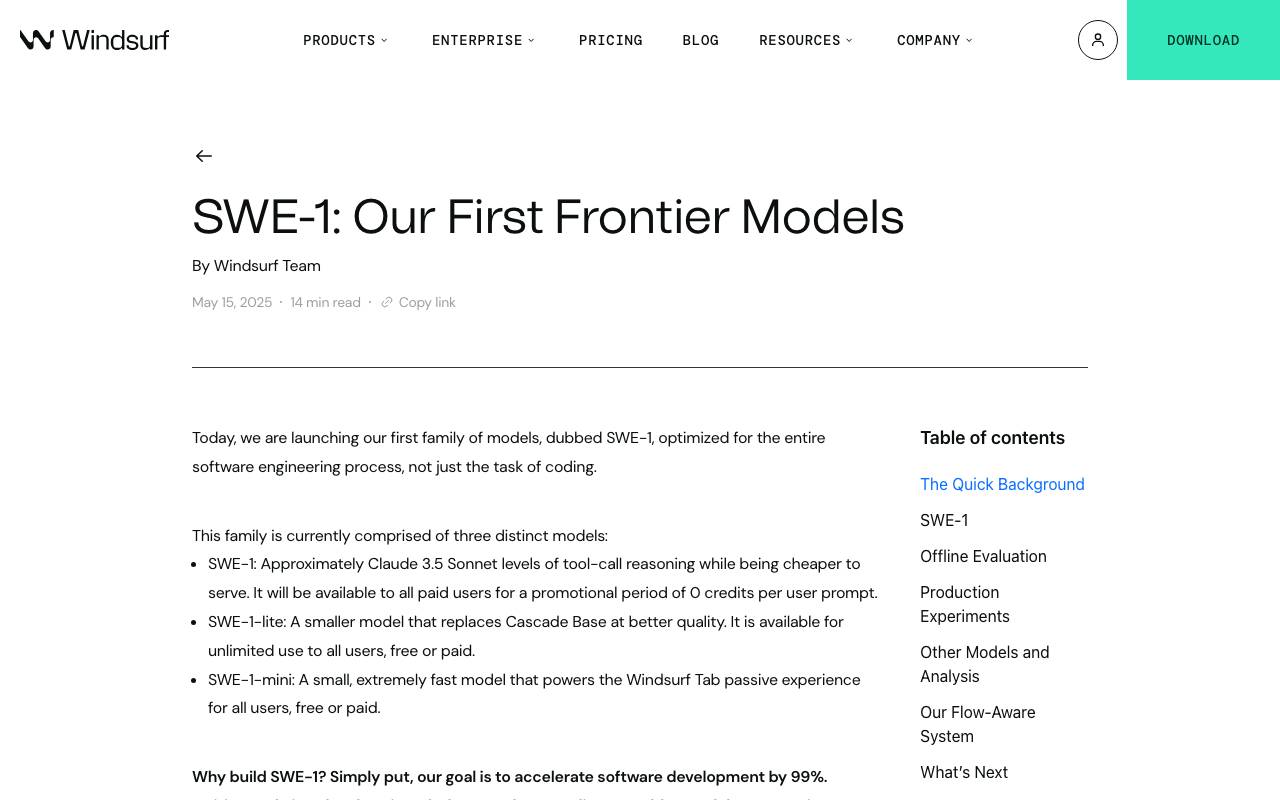
SWE-1 is a family of AI coding models developed by Windsurf to power assistive and agentic software engineering tasks inside its IDE and related products. Rather than focusing solely on code completion, the models are tuned for the broader engineering loop, including reasoning across files, navigating large repositories, and collaborating with human developers over longer sessions. The lineup typically spans different sizes and capability tiers, letting Windsurf route lightweight tasks like autocomplete to faster variants while reserving more capable models for complex edits, refactors, and agent workflows. Because the models are trained with real developer activity in mind, they aim to handle incomplete states, multi-step changes, and tool use more naturally than general-purpose LLMs. SWE-1 is most useful to teams already working inside Windsurf who want a tightly integrated coding model rather than a general chatbot bolted onto an editor.
Criteria breakdown
- Family of models tuned for coding
- Repository-aware reasoning
- Support for agentic, multi-step edits
- Optimized autocomplete and chat modes
- Integration with Windsurf's Cascade workflows
- Routing across lightweight and heavier variants


Keringit is a platform that enables users to create and deploy their own applications, including agents, tokens, and various blockchain-based projects. The platform offers a range of templates and ideas to get started, such as building a bridge for cross-chain asset transfer, creating a prediction market, or launching a decentralized exchange (DEX). The platform claims to provide 10x faster results, allowing users to quickly turn their ideas into reality. It also offers features like seamless token bridging, deep liquidity, and competitive lending rates. Keringit seems to be targeting dreamers and entrepreneurs who want to ship their projects quickly and efficiently. The platform's focus on speed and ease of use suggests that it is designed for users who may not have extensive technical expertise. One of the notable aspects of Keringit is its emphasis on community involvement, with the option to launch tokens backed by believers. This suggests that the platform is geared towards creating a supportive ecosystem for projects to grow and thrive. The platform is currently working on its version 2, and users can join the waitlist to be the first to try it out. Overall, Keringit appears to be a platform that aims to empower users to create and deploy their own blockchain-based projects with ease and speed.
Criteria breakdown
- Text-to-app generation
- Editable, ownable output
- Quick launch workflow
- Suitable for MVPs and prototypes
- Iterative prompt refinement

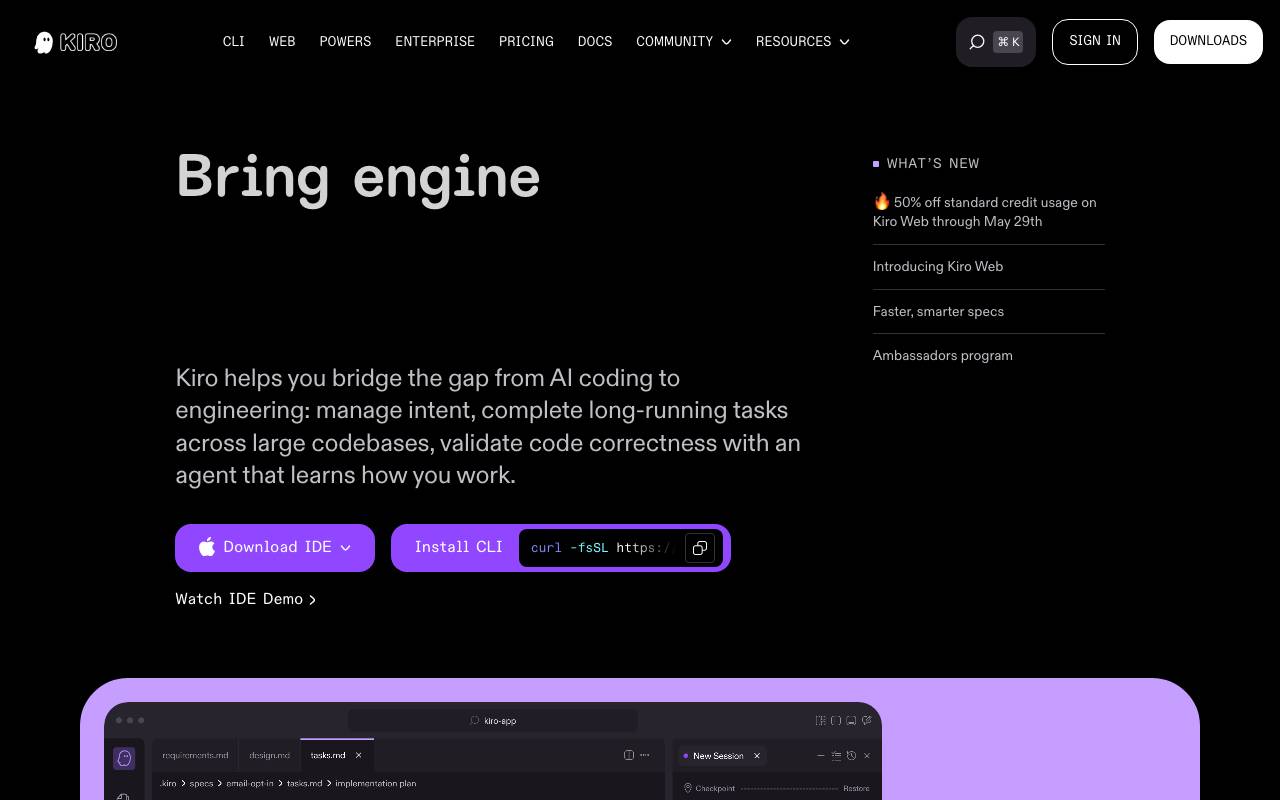
Kiro AI is an AI-powered IDE that enables developers and teams to efficiently turn projects into production-ready code. It achieves this through spec-driven development, which involves turning prompts into structured requirements, architectural designs, and sequenced tasks implemented by parallel agents. Kiro also validates code correctness with property-based tests, reducing issues that pass unit tests but break in production. The platform is designed to bring structure to AI coding, ensuring code is more secure, maintainable, and matches the intended outcome. Kiro supports a range of features, including planning with specs, implementing with parallel agents, catching bugs with property-based tests, and connecting to GitHub or GitLab for review. It allows developers to choose the best model for every task and is powered by popular models such as Anthropic Claude. The platform is built on open standards and is enterprise-ready, offering a credit-based model with no daily or weekly rate limits, IAM and SSO authentication, and administration controls. Kiro has been praised by engineers worldwide for its ability to justify the use of their time for developing business-critical assets in-house, accelerating feature development, and reducing time to customer value. It is a strong ally for startups, naturally turning overlooked docs and specs into robust assets, making growth smoother and future scaling more effective. Overall, Kiro AI is a powerful tool for developers and teams looking to efficiently turn projects into production-ready code, with its focus on spec-driven development, code correctness, and enterprise-readiness making it an attractive option for those seeking to improve their coding workflows.
Criteria breakdown
- AI-assisted code generation
- Contextual code suggestions
- Refactoring and debugging help
- Project scaffolding from prompts
- Integrated development workflow
- Support for multiple languages

Anima | UX Design Agent
UX design agent that learns your brand and design system to generate on-spec interfaces.
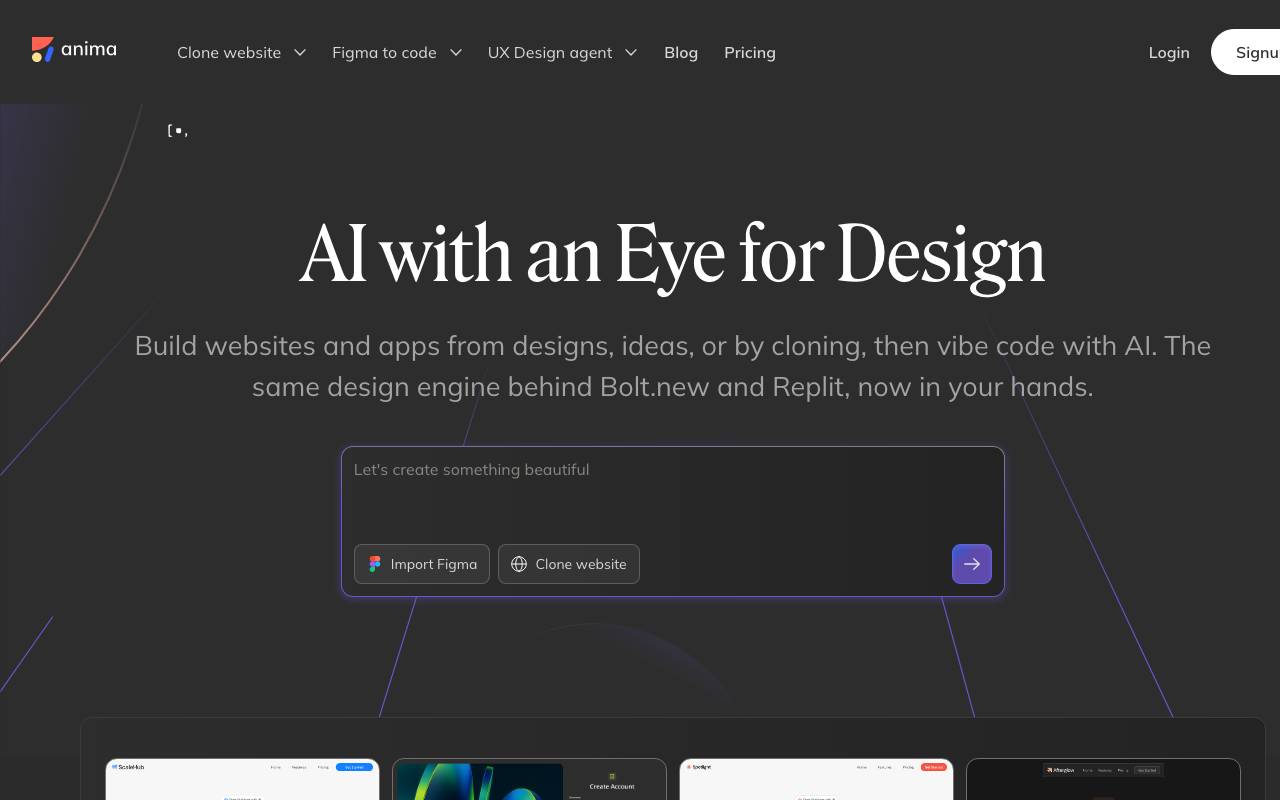
Anima is an AI-powered UX design agent built to act as an extension of a product team. It ingests a company's brand guidelines, component libraries, and existing design system, then uses that context to produce screens, flows, and UI variations that stay consistent with established patterns. Rather than generating generic mockups, Anima aims to output work that is ready to hand off, integrating with common design and development workflows. Teams can use it to accelerate early exploration, fill in repetitive screens, or translate ideas into polished, system-aligned designs without starting from scratch.
Criteria breakdown
- Brand and design system ingestion
- AI-generated UX screens and flows
- Component-aware UI suggestions
- Consistency across multiple artifacts
- Designer-in-the-loop editing
- Workflow integration for handoff