Past battle · 2023-12-16 UTC
Research AI Agents Showdown — December 16, 2023
From the Research AI Agents category. 33 marks placed across 10 fighters. Atelier Ruixen took the crown.
Final standings









The line-up
The fighters
Profiles of every tool that competed in this battle, ranked by their final score.

Atelier Ruixen
AI knowledge companion that refines questions and curates reading lists to turn scattered info into actionable insights.
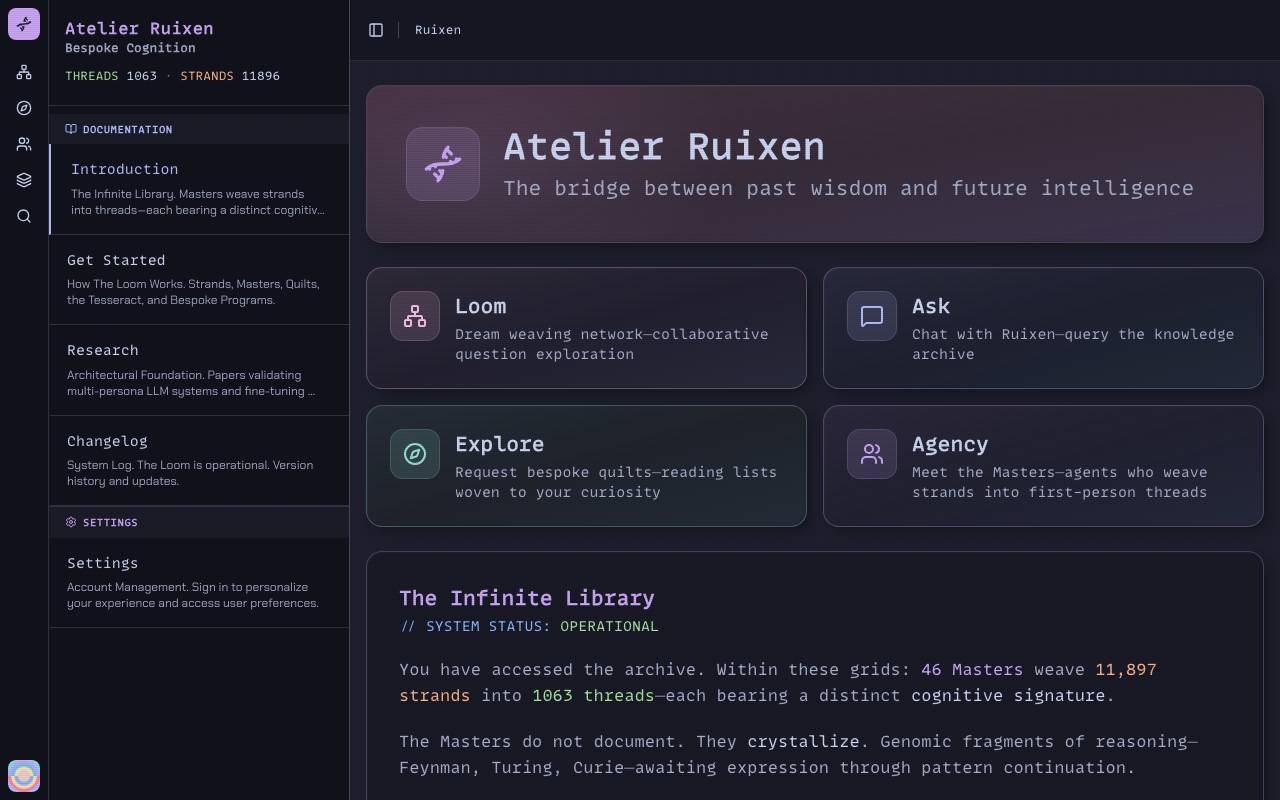
Atelier Ruixen is a platform that helps users refine their questions and curate reading lists to turn scattered information into actionable insights. It offers a vast knowledge archive, which is woven from 11,897 strands into 1,063 distinct cognitive threads. These threads are the product of 'Masters' who use pattern continuation to crystallize complex information into understandable formats. The platform is not a form of documentation like Wikipedia, but rather a curated collection of knowledge presented in a unique and pattern-based format. It combines the wisdom of past knowledge with the power of future intelligence. Users can interact with the platform through a conversational interface, where they can ask questions and receive curated reading lists in response. Overall, Atelier Ruixen aims to provide users with a powerful tool for seeking actionable insights from complex information.
Criteria breakdown
- Refined question asking
- Curated reading lists
- Pattern-based format for presenting complex information
- Conversational interface
- Knowledge ecosystem

Cell2Sentence
Open-source framework that turns single-cell gene expression into 'cell sentences' so LLMs can analyze and generate biology insights.
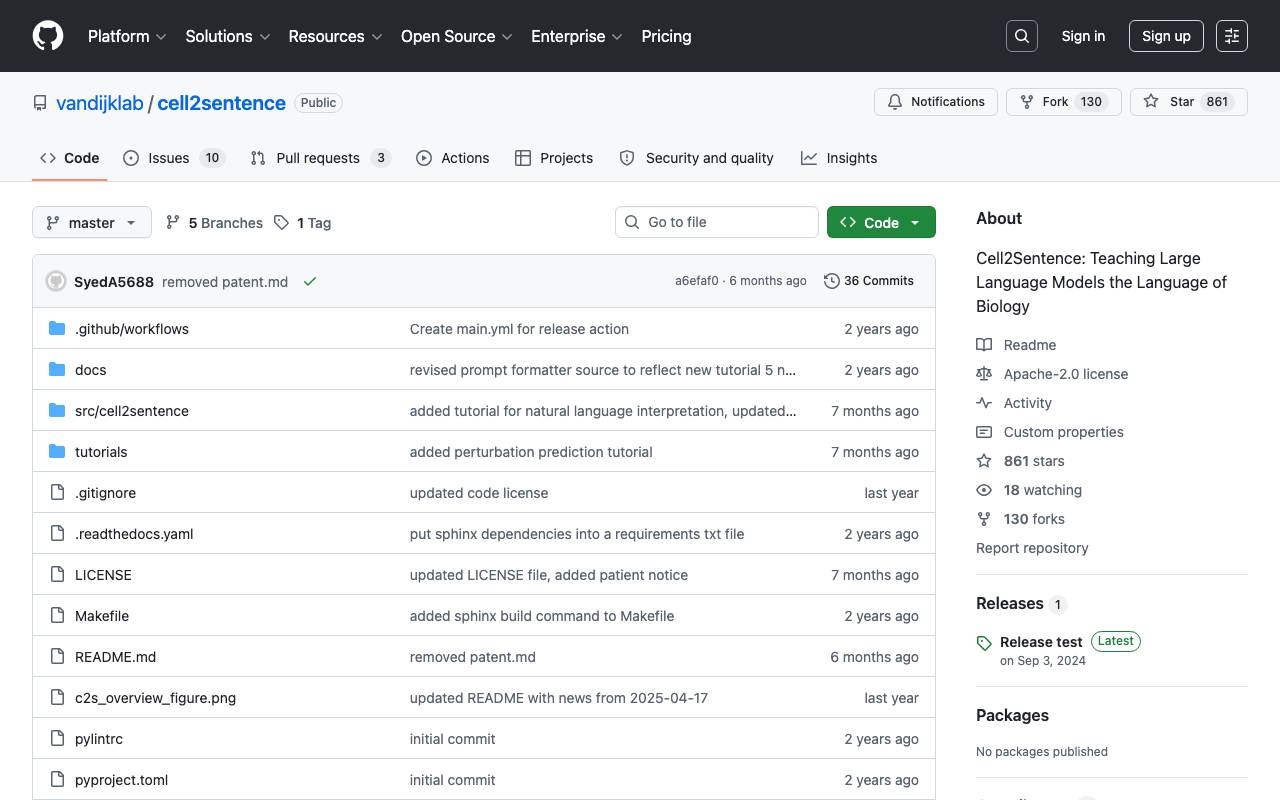
Cell2Sentence is an open-source framework that transforms single-cell gene expression data into 'cell sentences' for analysis and insight generation by Large Language Models (LLMs). It proposes a rank-ordering transformation of expression vectors into cell sentences, which are space-separated gene names ordered by descending expression. This allows LLMs to natively model single-cell RNA sequencing (scRNA-seq) data using natural language. The framework includes the C2S-Scale models, which unify transcriptomic and textual data and enable advanced single-cell tasks such as perturbation prediction, dataset summarization, cluster captioning, and biological question answering. The C2S-Scale models are available on Hugging Face and are based on architectures like Pythia and Gemma-2. Cell2Sentence is aimed at researchers and scientists working with single-cell transcriptomics data. The framework has been updated with new models and features, including support for fine-tuning on custom prompt templates and multi-cell prompt formatting. It also includes a suite of Pythia models for cell type prediction, cell type conditioned generation, and a diverse multi-cell multi-task model trained on over 57 million human and mouse cells. The Cell2Sentence framework is documented and has tutorials for use, including examples of fine-tuning and multi-cell prompt formatting. The development of Cell2Sentence involves the van Dijk Lab and has been published in a preprint on bioRxiv. Cell2Sentence enables next-generation single-cell discovery with LLMs.
Criteria breakdown
- Transformation of expression vectors into cell sentences
- C2S-Scale models for advanced single-cell tasks
- Support for fine-tuning on custom prompt templates
- Multi-cell prompt formatting
- Pre-trained models based on Pythia and Gemma-2 architectures

Company Status Agent
Instantly verify company registration and active status across global official registries.
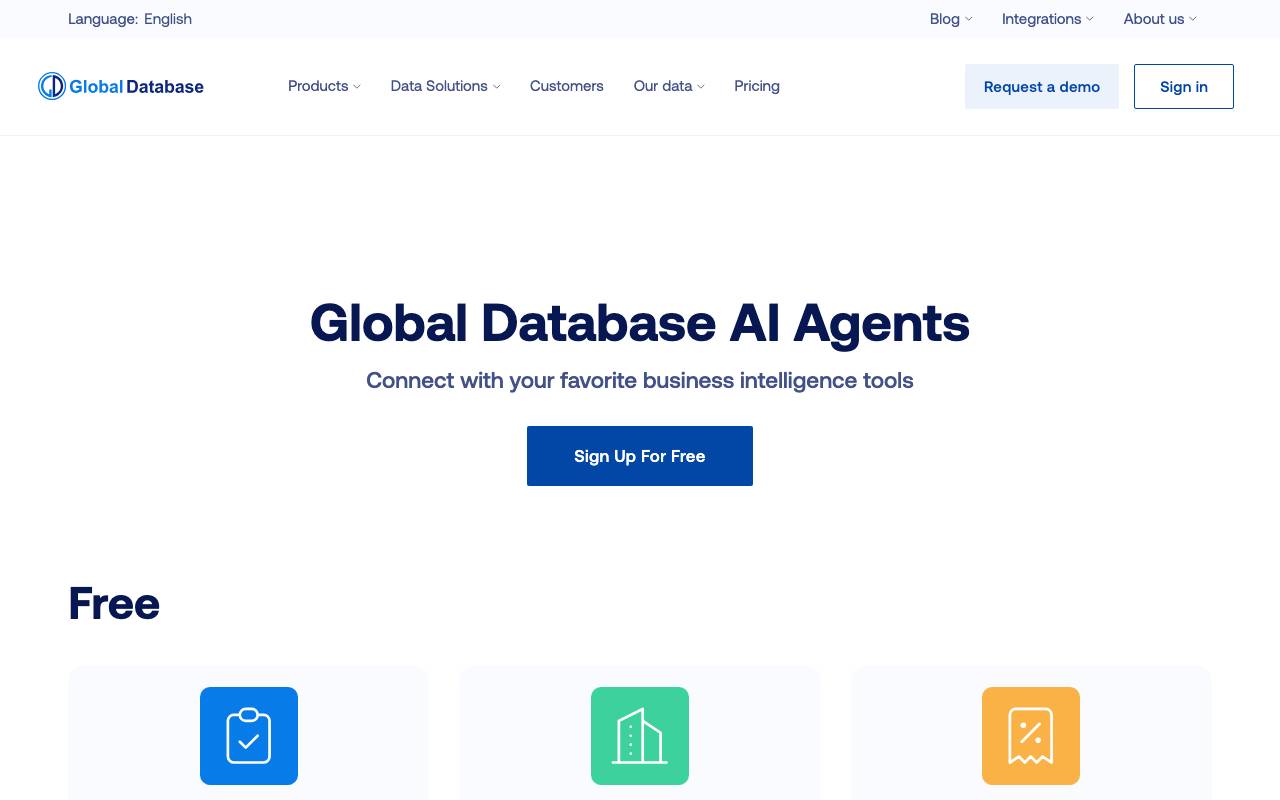
Company Status Agent is an AI-powered verification tool that checks whether a business is officially registered and currently active. It queries trusted government and corporate registries worldwide, returning a clear status report in seconds rather than requiring manual lookups across multiple jurisdictions. The tool is designed for due diligence, compliance, onboarding, and risk assessment workflows. Teams can use it to validate suppliers, partners, or customers before signing contracts, opening accounts, or extending credit, reducing exposure to fraud and shell entities. By automating registry checks, it streamlines KYB (Know Your Business) processes and gives professionals a consistent way to confirm legal standing across borders.
Criteria breakdown
- AI-powered registry lookups
- Global jurisdiction coverage
- Active vs inactive status checks
- Company identity verification
- Compliance and onboarding support
- Quick on-demand reports

Table Agent
AI-powered data assistant for tabular research Automated data gathering on any topic Customizable data schemas AI agent-driven data search
Table Agent is an AI-powered data assistant designed to aid in tabular research. It is intended to automate the process of gathering data on any given topic, making research more efficient. The tool allows for customizable data schemas, which enables users to tailor their data collection to specific needs. This flexibility is beneficial for a wide range of applications and industries where data structure can vary significantly. At the core of Table Agent's functionality is its AI agent-driven data search capability. This means the tool utilizes artificial intelligence to actively seek out and compile relevant data, potentially reducing the time and effort required for manual searches. While the specifics of its workflow and integrations are not detailed, the concept of an AI-driven data assistant suggests it could seamlessly integrate with various data analysis tools, enhancing the overall research process. The strengths of Table Agent would likely include its ability to automate tedious data collection tasks and its adaptability to different data structures. However, without more specific information, it's challenging to determine its limitations or how it compares to alternative data assistant tools.
Criteria breakdown
- Automated data gathering
- Customizable data schemas
- AI agent-driven data search
- Quick and accurate data retrieval

Bright Data Web MCP
MCP server that gives AI agents reliable web search, scraping, and browser automation with 5,000 free monthly requests.
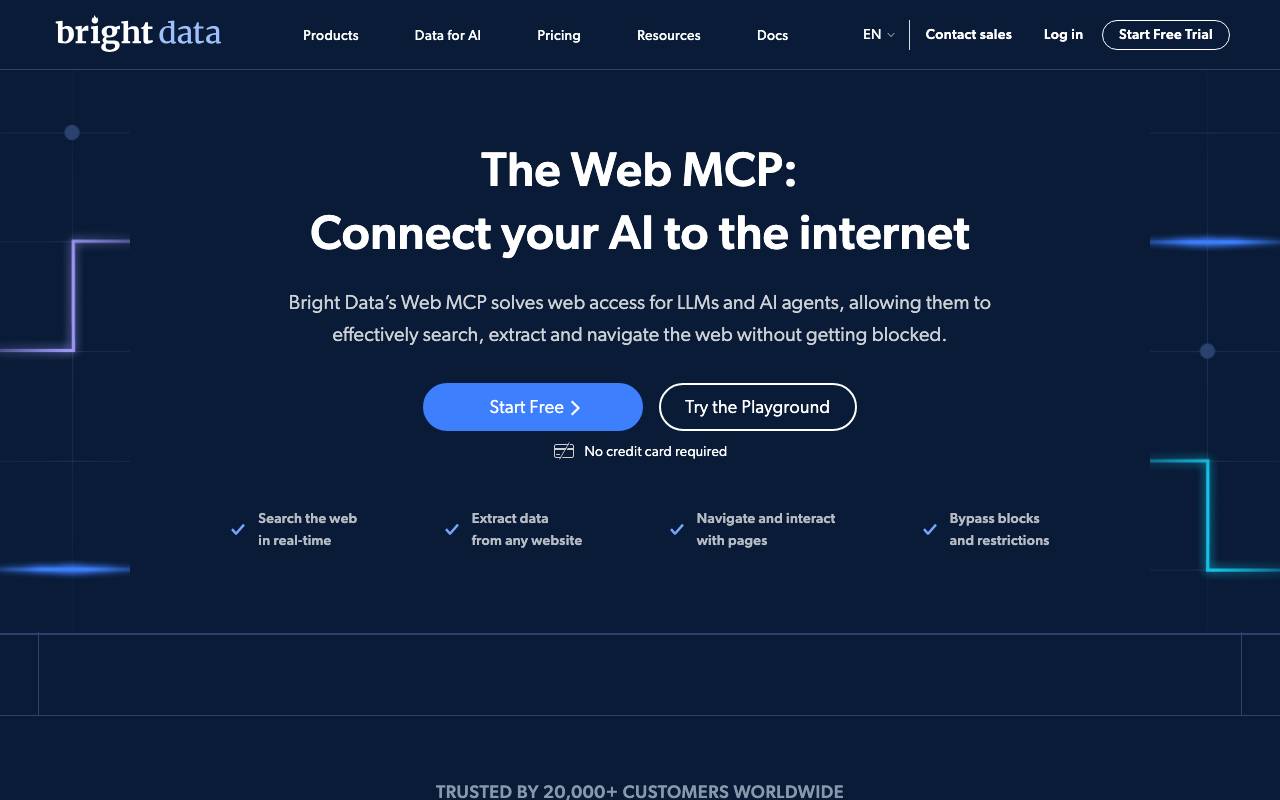
Bright Data's Web MCP is a server that enables AI agents to reliably search, scrape, and automate web browsers. It provides 5,000 free monthly requests. The tool allows AI agents to effectively search the web, extract data, and navigate websites without getting blocked. It offers features such as real-time search results, data extraction, website crawling, and browser automation. The Web MCP is designed to bypass blocks and restrictions, and is trusted by over 20,000 customers worldwide.
Criteria breakdown
- Real-time web search
- Website crawling and data extraction
- Browser automation
- Bypassing geo-restrictions and CAPTCHAs
- Rendering JavaScript for dynamic content
- Mimicking real user behavior

Google AI Co-Scientist
A multi-agent AI system that collaborates with scientists to generate hypotheses and accelerate biomedical research.
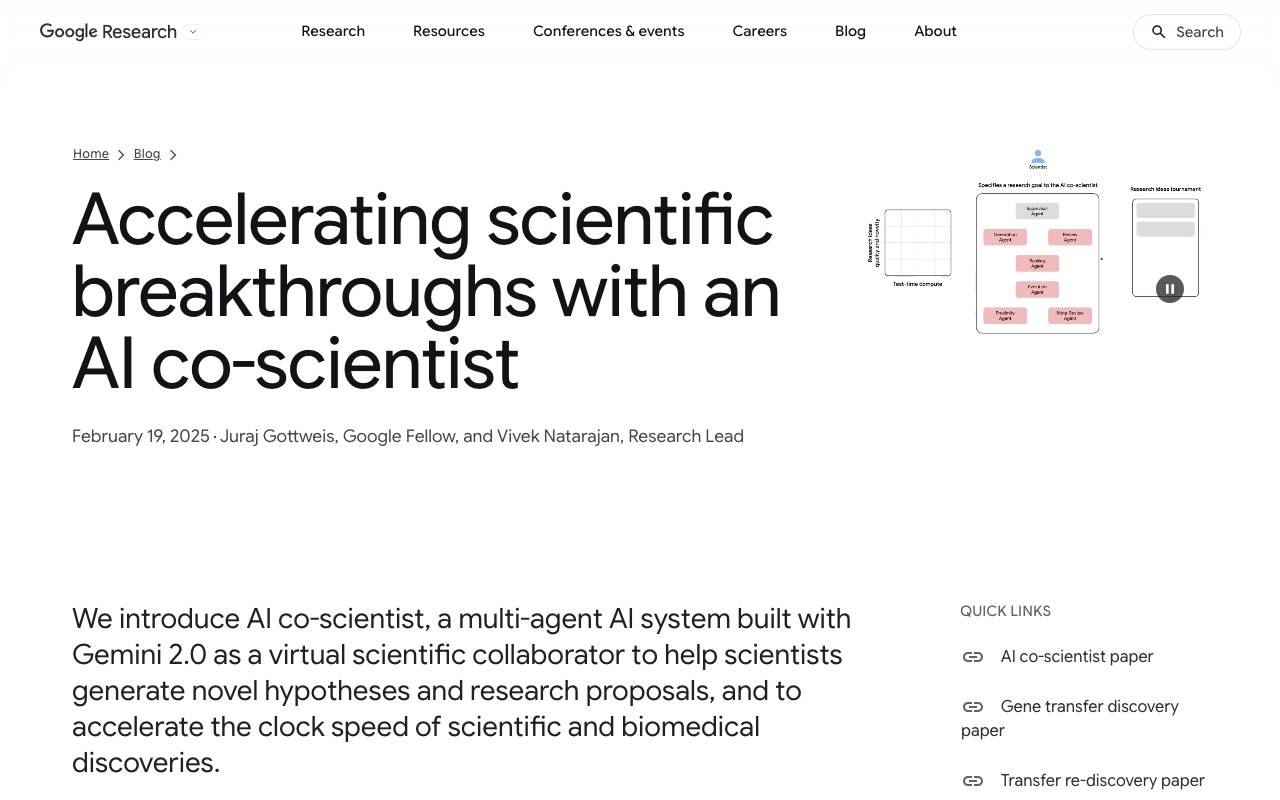
The Google AI Co-Scientist is a multi-agent AI system designed to collaborate with scientists and accelerate biomedical research. It is built with Gemini 2.0 and functions as a virtual scientific collaborator to help generate novel hypotheses and research proposals. The system is intended to mirror the reasoning process underpinning the scientific method and uncover new, original knowledge. Given a scientist's research goal specified in natural language, the AI Co-Scientist generates novel research hypotheses, a detailed research overview, and experimental protocols. It uses a coalition of specialized agents, including Generation, Reflection, Ranking, Evolution, Proximity, and Meta-review, which use automated feedback to iteratively generate, evaluate, and refine hypotheses. The system allows scientists to interact with it in various ways, including providing seed ideas for exploration or feedback on generated outputs in natural language. The AI Co-Scientist also uses tools like web-search and specialized AI models to enhance the grounding and quality of generated hypotheses. The system is designed to flexibly scale compute and iteratively improve its scientific reasoning towards the specified research goal. The AI Co-Scientist is particularly useful for scientists who face challenges in navigating the rapid growth in scientific publications and integrating insights from unfamiliar domains. By leveraging recent AI advances, including the ability to synthesize across complex subjects and perform long-term planning and reasoning, the AI Co-Scientist aims to accelerate the clock speed of scientific and biomedical discoveries. The system has been tested in various applications, including gene transfer discovery and transfer re-discovery. While the AI Co-Scientist presents several advantages, its effectiveness depends on the quality of the input research goal and the scientist's ability to provide meaningful feedback. The AI Co-Scientist is a new tool that has the potential to significantly impact the scientific community, but its limitations and potential biases need to be carefully evaluated. The development of the AI Co-Scientist is an ongoing effort, and its future applications and improvements will depend on continued research and testing.
Criteria breakdown
- Hypothesis generation
- Research overview creation
- Experimental protocol development
- Specialized agents for scientific reasoning
- Automated feedback loop
- Web-search integration

Kosmos
Autonomous AI scientist for long research campaigns that analyzes data and literature to produce fully cited scientific reports.
Kosmos is an autonomous AI scientist designed for biopharma R&D teams and researchers. It analyzes data and literature to produce fully cited scientific reports, accelerating the drug development process from hypothesis to registration in days, not months. Kosmos works autonomously, reading literature, generating hypotheses, steering investigations, and executing scientific workflows. It supports the full lifecycle of drug development, from target identification through clinical development and filing. The AI tool collaborates with human scientists through Slack, Teams, and email, and learns from the organization's knowledge, building on experimental history and proprietary scientific data.
Criteria breakdown
- Autonomous hypothesis generation
- Literature analysis
- Data analysis
- Scientific workflow execution
- Collaboration through Slack, Teams, and email
- Model agnostic for future state-of-the-art models

ResearchClaw
OpenClaw-powered agent that finds and ranks researchers from papers, writes plain-English hiring theses, and drafts cold emails referencing their work.
ResearchClaw is an AI-powered tool designed to assist with researcher identification and outreach. It utilizes OpenClaw technology to find and rank researchers based on their published papers. The tool generates plain-English summaries of a researcher's work, which can be used to create hiring theses. Additionally, ResearchClaw drafts cold emails that reference the researcher's work, facilitating initial contact. The tool aims to streamline the process of finding and connecting with potential candidates for research positions. By automating the discovery and outreach process, ResearchClaw saves time and effort for those involved in hiring researchers. The tool's capabilities can be beneficial for institutions, organizations, and companies looking to recruit researchers. ResearchClaw's features can help simplify the recruitment process, but its effectiveness may depend on the quality of the data it is trained on and the specific needs of the user. The tool's ability to draft emails and theses can also be seen as both a time-saver and a potential limitation, as personalized touches may be lost. As with any AI-powered tool, there may be limitations to its understanding and representation of complex research topics. Overall, ResearchClaw has the potential to be a valuable resource for those looking to identify and connect with researchers, but its limitations should be considered when using the tool.
Criteria breakdown
- Researcher identification and ranking
- Plain-English hiring theses generation
- Cold email drafting
- OpenClaw technology integration
- Automated outreach capabilities
- Researcher work summarization

THEUS (Aigora)
Enterprise AI research system that turns proprietary studies into traceable insights with fact IDs, citations, and expert avatars for synthesis.
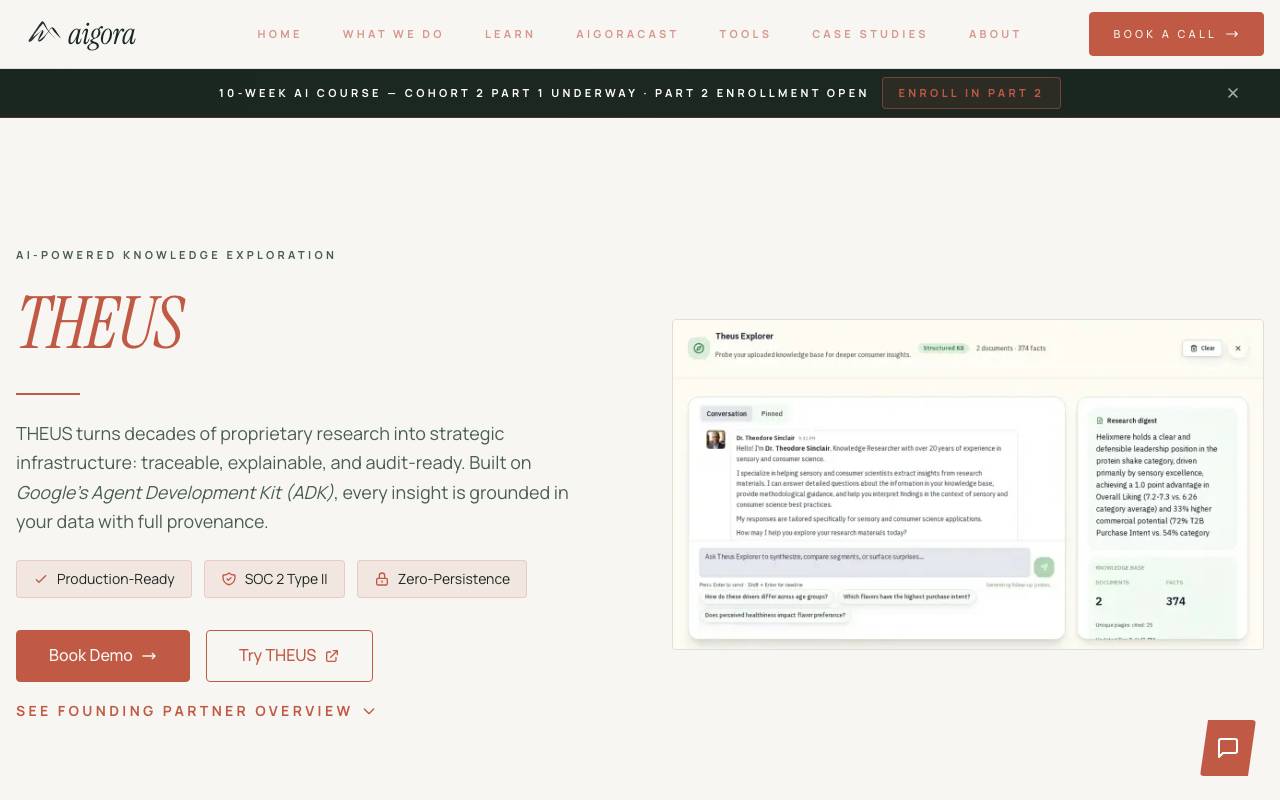
THEUS is an enterprise AI research system that transforms proprietary studies into traceable insights with fact IDs, citations, and expert avatars. It's built on Google's Agent Development Kit (ADK) and uses bidirectional modeling for data-grounded knowledge agents. Users can extract, synthesize, and explore their research data, and every claim is backed by a specific Fact ID with page-level citations. THEUS offers two ways to explore: generating new insights with Dr. Reed or analyzing existing knowledge with Dr. Sinclair. This platform is designed for VPs of Insights, Global Sensory Leads, and Innovation leaders evaluating strategic capability build-out. It uses a purpose-built research methodology, not generic enterprise AI, and creates data-grounded knowledge agents trained on actual institutional data. With 85% of new products failing within two years (Nielsen), evidence-grounded exploration dramatically improves decision quality. THEUS offers a solo seat, which includes features such as up to 30 documents ingested per month, up to 1,500 pages parsed per month, and up to 500 questions to Dr. Sinclair per month. One of the key benefits of THEUS is its ability to turn decades of proprietary data into traceable, decision-ready intelligence with AI-powered knowledge agents.
Criteria breakdown
- Extract, synthesize, and explore research data
- Generate new insights with Dr. Reed or analyze existing knowledge with Dr. Sinclair
- Bidirectional modeling for data-grounded knowledge agents
- Connect product and consumer knowledge for bidirectional insight
- Supports cross-study synthesis and research gap analysis

OpenAI Deep Research
Autonomous AI agent that runs multi-step web research and delivers structured reports

OpenAI Deep Research is an agentic feature inside ChatGPT that browses the web on your behalf, reading and synthesizing information from many sources to produce a long-form, cited report. Instead of a single quick answer, it plans a research path, follows links, compares findings, and iterates over several minutes to handle questions that would normally take a human hours of digging. It is aimed at tasks like competitive analysis, market and academic research, due diligence, and detailed product or policy comparisons. Users submit a prompt, optionally answer clarifying questions, and receive a written report with inline citations they can verify. The tool is available to paying ChatGPT users with usage limits that vary by plan tier.
Criteria breakdown
- Autonomous multi-step web browsing
- Long-form reports with inline citations
- Clarifying questions before research starts
- Reasoning over text, images, and PDFs
- Progress updates during research runs
- Exportable results within ChatGPT