
Google AI Co-ScientistA multi-agent AI system that collaborates with scientists to generate hypotheses and accelerate biomedical research.

Overview
Key features
- Hypothesis generation
- Research overview creation
- Experimental protocol development
- Specialized agents for scientific reasoning
- Automated feedback loop
- Web-search integration
Pricing
- Model
- Free
- Category
- Research AI Agents
- Rating
- 4.5 / 5 (4)
Use cases
Generate Novel Research Hypotheses
Help scientists brainstorm and refine testable hypotheses by leveraging multi-agent AI collaboration to explore the biomedical literature and propose new directions.
Accelerate Biomedical Discovery
Support research teams in speeding up early-stage discovery workflows by surfacing relevant prior work and synthesizing insights across complex scientific domains.
Collaborative Literature Review
Assist researchers in reviewing and synthesizing large volumes of biomedical publications, identifying connections that may inform new experiments.
Augment Scientific Teams
Act as an AI collaborator alongside scientists, contributing ideas and structured reasoning to complement domain expertise during research planning.
Pros & Cons
Pros
- Accelerates scientific discoveries
- Generates novel research hypotheses
- Enhances scientific reasoning
- Improves research quality
- Facilitates collaboration between scientists and AI systems
Cons
- Dependence on input quality
- Potential biases in generated hypotheses
- Limited interpretability
- Requires meaningful feedback from scientists
Battle record
Across 4 battles in the Pantheon.
Last 4 battles
Reviews
Average from 4 ratings.
Sign in to leave a review.
Compared a few options
Evaluated this against two competitors. Where it wins: the dashboard and support is responsive. Where it lags: the mobile experience lags. On balance the feature set — especially the automation — justifies the 5 stars for our use case.

Solid for our team
We rolled this out across the team last quarter and it is genuinely easy to set up. The core workflow fits neatly into how we already work, and the integrations removed a step we used to do by hand. The mobile experience lags, which is the main caveat, but it has held up under daily use.
Years in this space
I've evaluated a lot of these over the years. What stands out here is the integrations — handled better than most — and support is responsive. Worth the time if this is your use case.

Compared a few options
Evaluated this against two competitors. Where it wins: the integrations and it is genuinely easy to set up. Where it lags: a few rough edges remain. On balance the feature set — especially the API — justifies the 4 stars for our use case.
Q&A
Can it replace human scientists in the research process?
No. It is positioned as a collaborator that works alongside scientists to support hypothesis generation, not as a replacement for human expertise, experimentation, or peer review.
Asked by Victor Nguyen · Jan 23, 2026
Who is the target user for this tool?
It is aimed at biomedical researchers and scientists looking for an AI collaborator to help brainstorm and refine hypotheses, rather than at general consumers or non-scientific users.
Asked by Tariq Aziz · Dec 28, 2025
What is Google AI Co-Scientist designed to do?
Google AI Co-Scientist is a multi-agent AI system that collaborates with scientists to generate research hypotheses and accelerate biomedical research workflows.
Asked by Naomi Suzuki · Dec 21, 2025
Ask a question
Research AI Agents alternatives

 Lila SciencesResearch AI Agents
Platform combining autonomous labs & AI to accelerate discovery in life, chemical, and materials sciences.

 Isomorphic LabsResearch AI Agents
An AI-driven drug discovery company leveraging AlphaFold to accelerate therapeutic development.

 ResearchClawResearch AI Agents
OpenClaw-powered agent that finds and ranks researchers from papers, writes plain-English hiring theses, and drafts cold emails referencing their work.

 Atelier RuixenResearch AI Agents
AI knowledge companion that refines questions and curates reading lists to turn scattered info into actionable insights.
 KosmosResearch AI Agents
Autonomous AI scientist for long research campaigns that analyzes data and literature to produce fully cited scientific reports.

 OpenAI Deep ResearchResearch AI Agents
Autonomous AI agent that runs multi-step web research and delivers structured reports

 AutoresearchResearch AI Agents
An open-source project that lets AI agents autonomously run LLM training experiments and keep the best model changes.
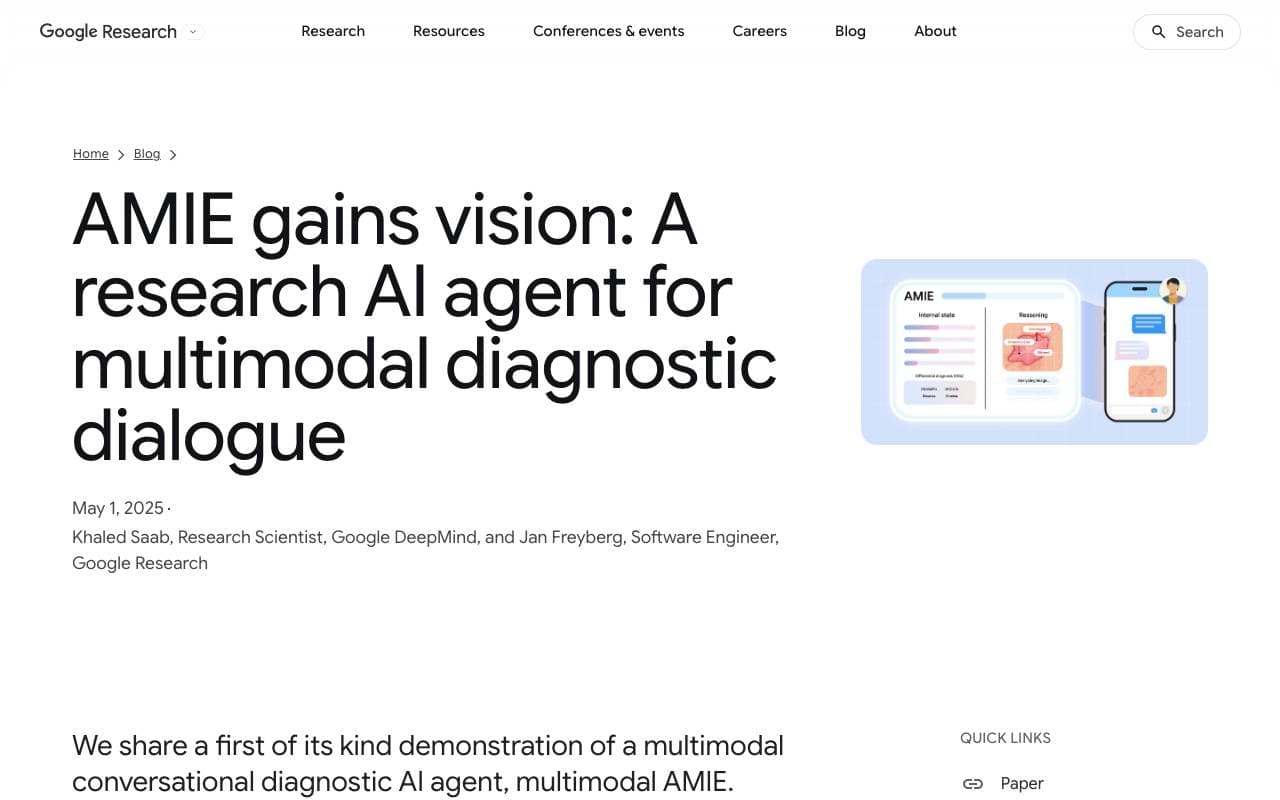
 AMIEResearch AI Agents
A multimodal AI diagnostic agent that conducts clinical conversations and interprets medical images for accurate diagnoses.
Trending now

 Biology AIEducation AI
Accurate Homework Help with Full Explanations

 Reducto AIAI Agent Development Platforms
Document intelligence API that parses, splits, OCRs, and extracts structured data from complex PDFs, slides, and spreadsheets.

 Pixtral 12B 24.09LLM
Open multimodal 12B model handling interleaved images and text with a 128K context window.
 AdCrierMarketing & Advertising
Sponsored answers, paid per click.