Past battle · 2024-02-09 UTC
AI Infrastructure & MLOps Showdown — February 9, 2024
From the AI Infrastructure & MLOps category. 19 marks placed across 6 fighters. Helicone took the crown.
Final standings
The line-up
The fighters
Profiles of every tool that competed in this battle, ranked by their final score.
Helicone
Unified gateway to monitor, debug, and optimize LLM applications across providers.
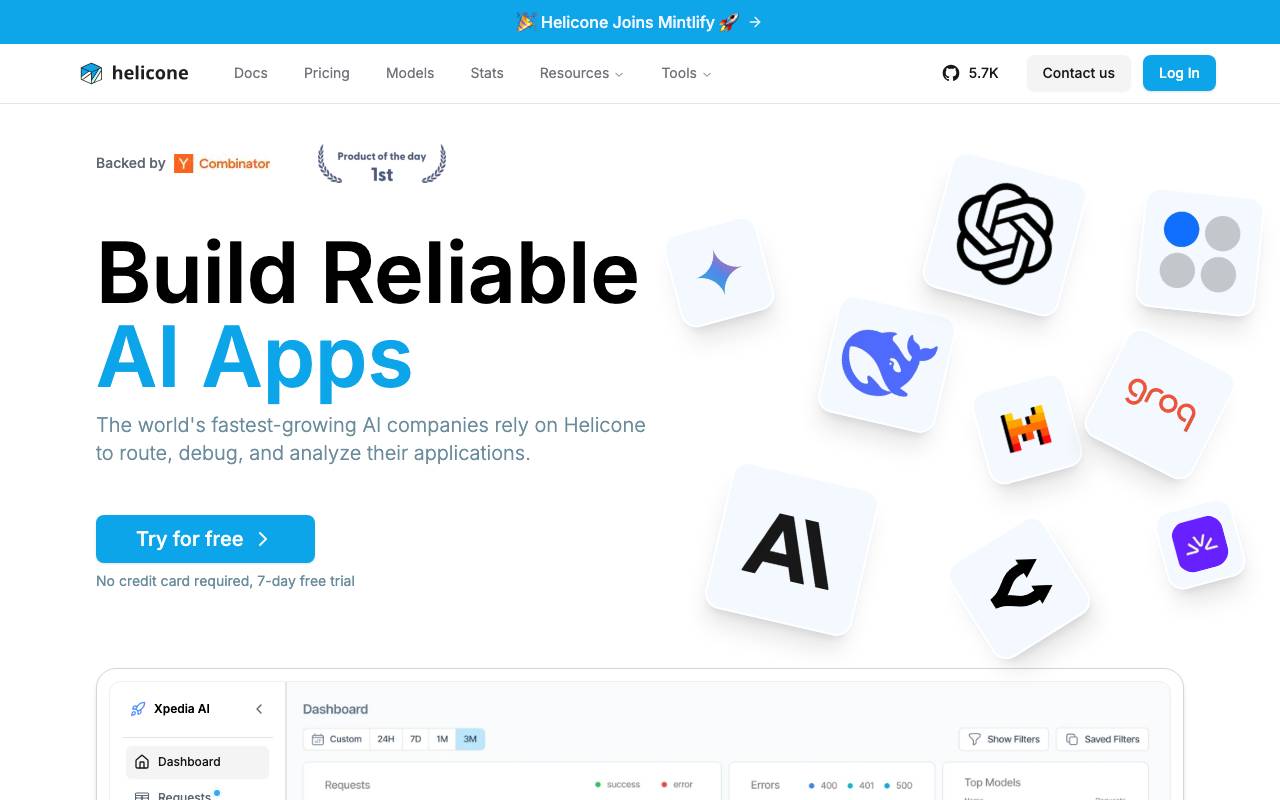
Helicone is an observability and gateway platform built for teams developing with large language models. It sits between your application and AI providers, capturing requests, responses, latency, costs, and errors so developers can debug prompts and track performance from a single dashboard. Beyond logging, Helicone offers tools for prompt management, A/B testing, caching, rate limiting, and user-level analytics. Its provider-agnostic gateway lets teams route traffic across models from OpenAI, Anthropic, and others, making it easier to experiment, control spend, and ship reliable AI features.
Criteria breakdown
- Request and response logging
- Prompt versioning and experiments
- Caching and rate limiting
- Cost tracking per user or session
- Multi-provider gateway routing
- Custom alerts and dashboards
Keywords AI
Observability and debugging platform for shipping reliable LLM-powered applications faster.
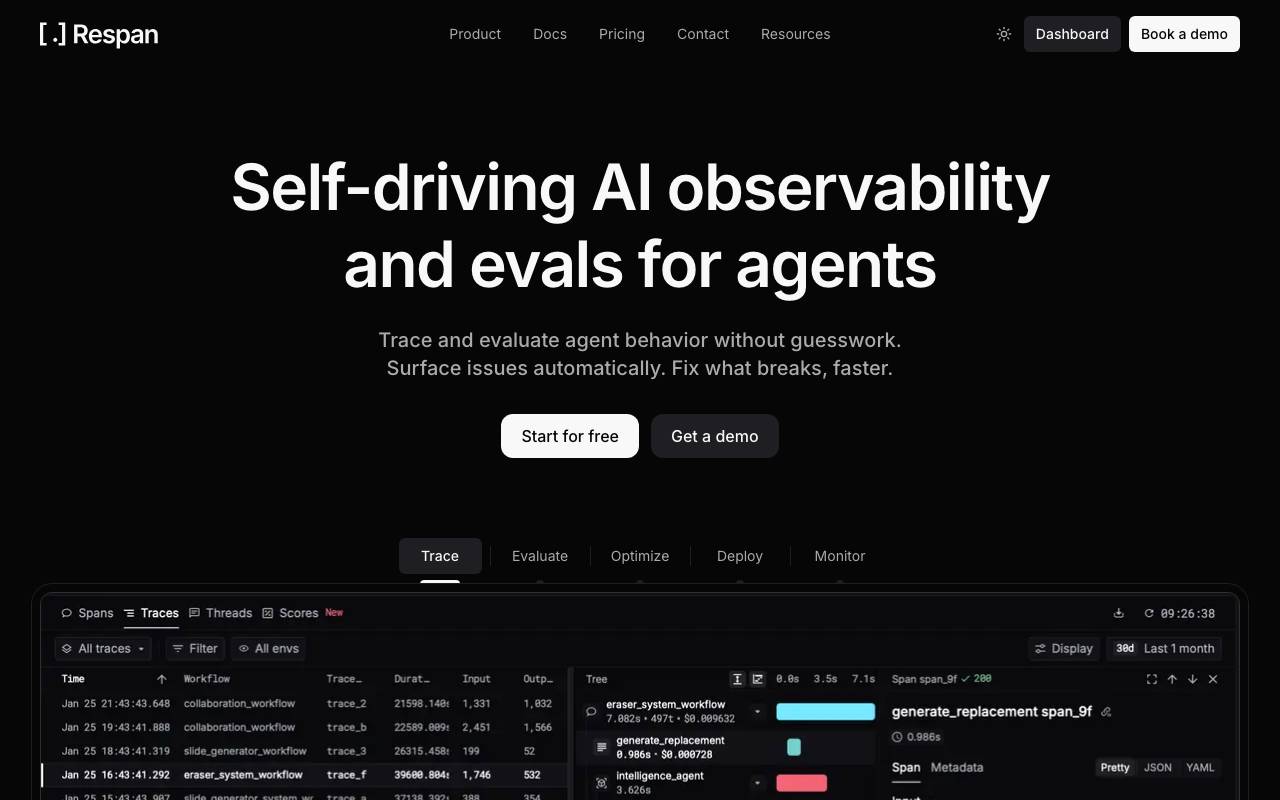
Keywords AI is a developer platform for monitoring, debugging, and improving AI applications built on large language models. It centralizes logs, traces, and metrics so teams can see how their prompts, models, and agents behave in production. The tool helps engineers catch regressions, latency spikes, and quality issues before users do. By providing structured visibility into requests, responses, and costs, it shortens the feedback loop between experimentation and deployment. It is aimed at teams that want to treat LLM features with the same rigor as the rest of their stack, combining evaluation, alerting, and analytics in one workspace.
Criteria breakdown
- Request and response logging
- Tracing for multi-step LLM workflows
- Prompt and model performance analytics
- Cost and token usage tracking
- Evaluation and alerting tools
- SDKs for popular LLM providers

TheAgentic AI
Applied AI research company that builds and launches vertical AI companies with founders and domain experts
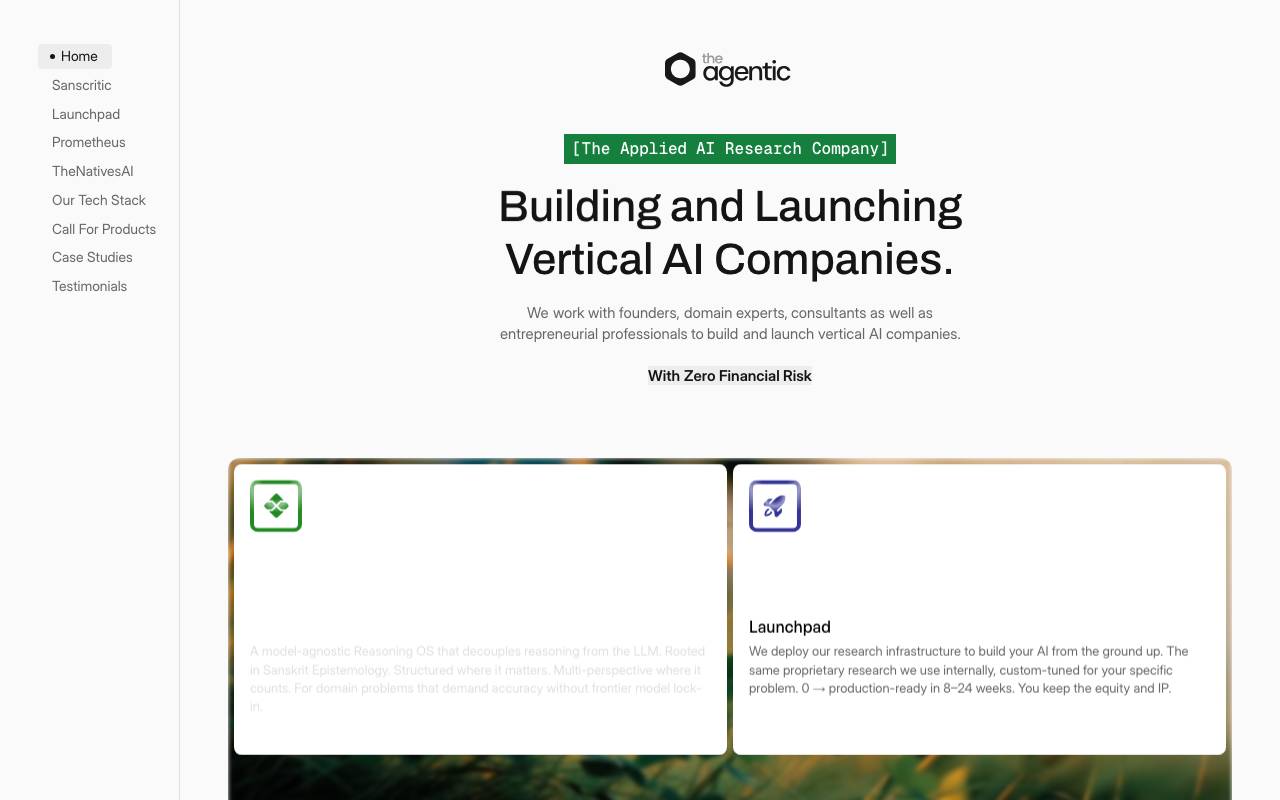
TheAgentic AI is an applied AI research company that builds and launches vertical AI companies in partnership with founders, domain experts, consultants, and entrepreneurial professionals. Rather than positioning itself purely as a self-serve software product, it operates as a venture-style studio that combines proprietary research infrastructure with hands-on engineering, product, and go-to-market execution. The company's offerings are organized into several programs. Launchpad Gold deploys TheAgentic's research infrastructure to build a client's AI product from the ground up, aiming to go from zero to production-ready in roughly 8–24 weeks while the partner retains equity and IP. Prometheus splits responsibilities so the partner brings domain knowledge and at least one design partner, and TheAgentic handles engineering, product management, lead generation, sales, billing, and contracts. TheNativesAI provides a structured pathway for professionals to build and own AI-native businesses, and Phoenix supports B2B AI and SaaS startups navigating the gap between angel/seed funding and later stages. Platinum Operators is aimed at commercial leaders who want to act as market-facing operators for vertical AI solutions. Underpinning these programs is a technology stack developed by TheAgentic's R&D group, including Sanscritic, described as a model-agnostic "Reasoning OS" that decouples reasoning from the underlying LLM and draws on Sanskrit epistemology to provide structured, multi-perspective reasoning for domain problems that require accuracy without frontier-model lock-in. The stack also includes TheAgentic Memory, a self-organizing semantic and episodic memory system with temporal context for agents that need to retain information over time, plus frameworks for orchestration and knowledge. The model is best suited to founders and domain specialists who have deep expertise but lack the engineering capacity to build production AI systems, and who are comfortable with a partnership or equity-based arrangement. Because much of the value comes through bespoke build engagements and programs rather than a published self-service product, the experience depends heavily on the partnership structure and selection process. Public details on pricing, terms, and the technical specifics of the underlying frameworks are limited on the site.
Criteria breakdown
- Sanscritic model-agnostic reasoning OS
- TheAgentic Memory with semantic and episodic memory
- Agent orchestration and knowledge frameworks
- Done-with-you vertical AI build programs
- Go-to-market support including sales, billing, and contracts
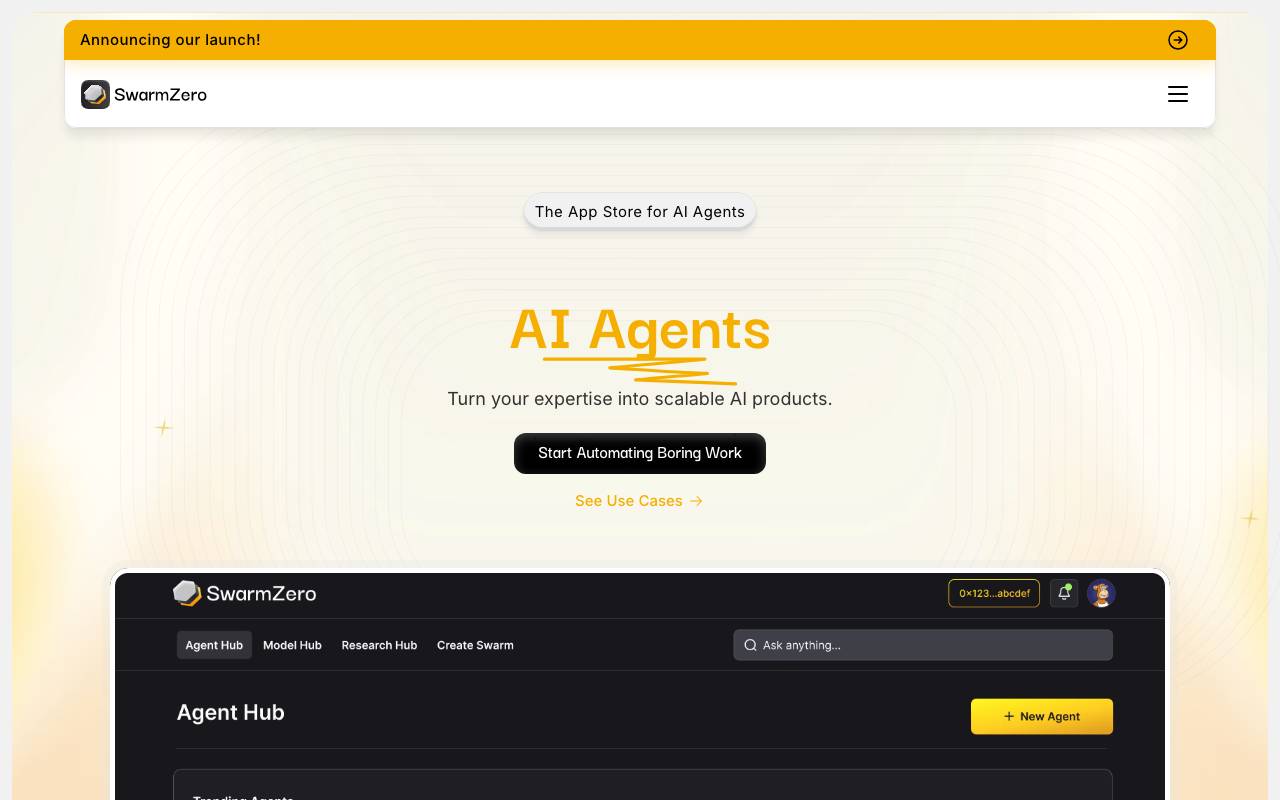
SwarmZero is a platform that connects creators of AI agents with users looking to automate tasks across business, research, and personal workflows. Developers can publish specialized agents to a shared marketplace, while end users browse, deploy, and combine them to handle jobs ranging from data analysis to content generation. The platform emphasizes agent interoperability, allowing multiple agents to coordinate on complex multi-step tasks. Built-in monetization tools let creators earn revenue from their agents, turning niche expertise into reusable, on-demand services. SwarmZero targets both technical builders who want distribution for their agent work and non-technical users who prefer ready-made automations over building from scratch.
Criteria breakdown
- Agent marketplace and discovery
- Revenue sharing for creators
- Multi-agent task orchestration
- Deployable prebuilt automations
- Developer SDK for publishing agents
- Task and workflow management
Voyage AI develops embedding and reranking models designed to improve the accuracy of search, retrieval-augmented generation (RAG), and other information retrieval tasks. Its models convert text, code, and domain-specific content into dense vector representations that capture semantic meaning, helping applications surface more relevant results than traditional keyword search. The platform offers general-purpose embeddings alongside specialized variants tuned for domains like code, finance, and law. Developers can access the models through an API and integrate them into vector databases, chatbots, and enterprise search systems. Rerankers further refine candidate results, improving precision on top of an initial retrieval step. Voyage AI is aimed at engineering teams building LLM-powered products who need retrieval quality that goes beyond off-the-shelf options.
Criteria breakdown
- Text and code embedding models
- Domain-tuned variants (finance, law, code)
- Reranker models for result refinement
- API access for easy integration
- Support for multilingual content
- Compatible with popular vector databases
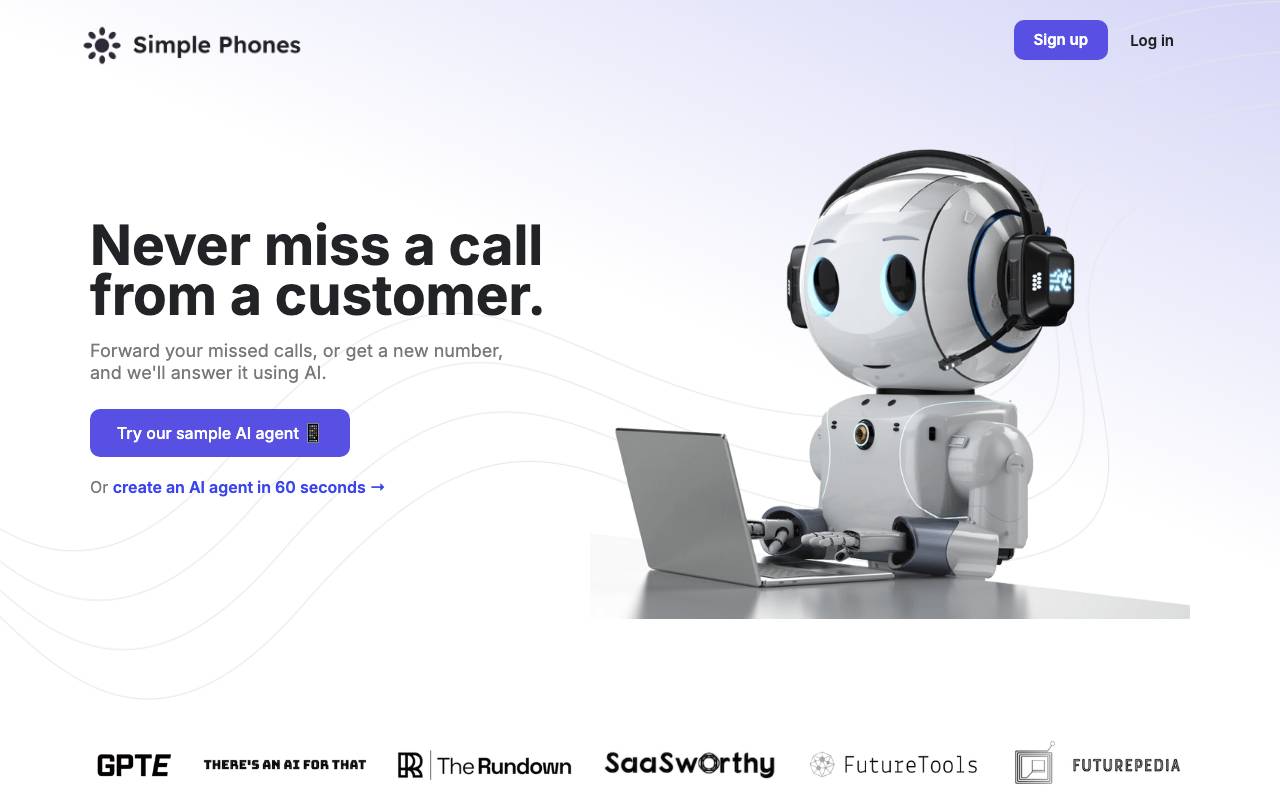
Simple Phones provides AI-powered voice agents that handle inbound and outbound business calls. The service forwards missed or all calls to a custom AI agent that can answer questions, capture lead details, book appointments, and route urgent calls to a human when needed. Businesses set up an agent by describing their company, services, and FAQs, then receive a new phone number or forward an existing one. Each call is logged with a transcript, summary, and recording, making it easy to review interactions and refine the agent over time. It's aimed at small businesses, agencies, and service providers that struggle to keep up with phone volume.
Criteria breakdown
- AI voice agent for inbound calls
- Custom phone number or call forwarding
- Call transcripts, recordings, and summaries
- Appointment booking and lead capture
- Human handoff and call routing
- Continuous agent tuning based on past calls