Past battle · 2024-06-24 UTC
Coding assistant Showdown — June 24, 2024
From the Coding assistant category. 22 marks placed across 7 fighters. Friday took the crown.
Final standings







The line-up
The fighters
Profiles of every tool that competed in this battle, ranked by their final score.

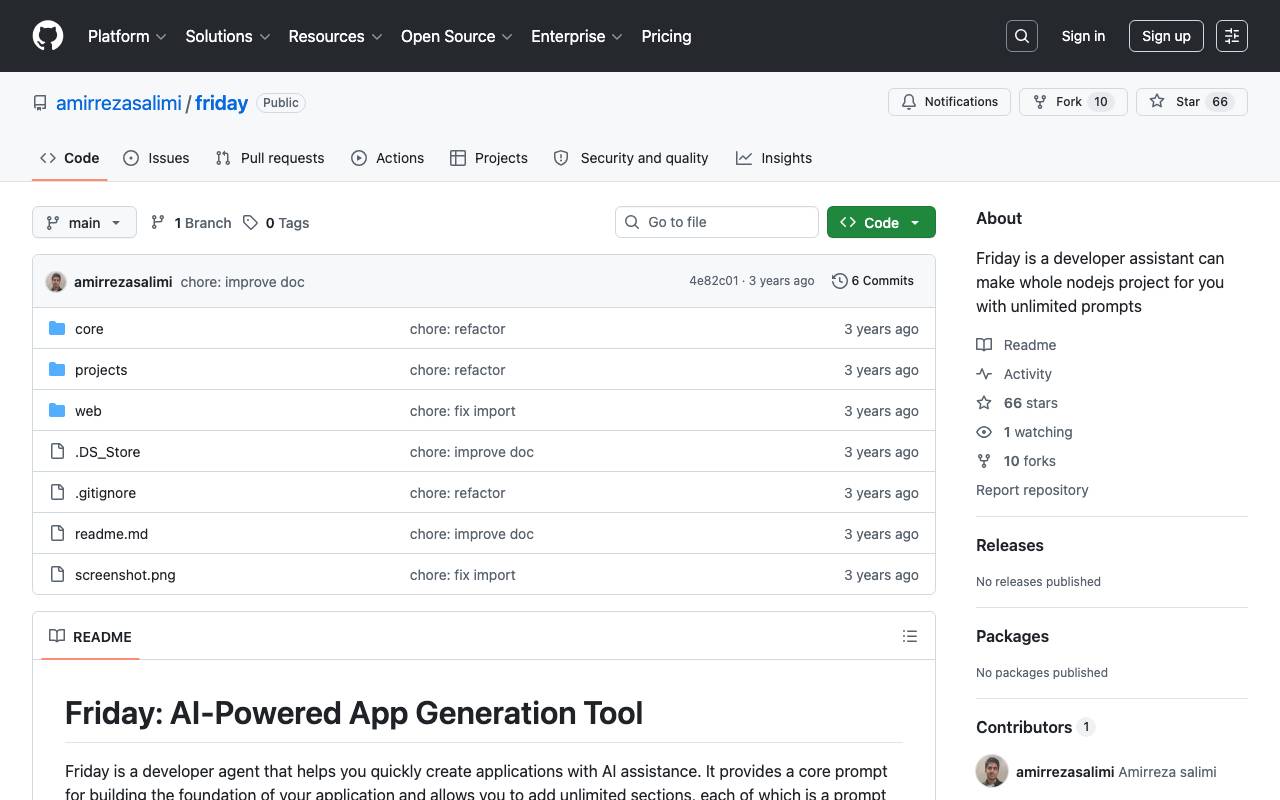
Friday is an AI-powered developer assistant designed to rapidly scaffold Node.js projects. It utilizes GPT-4 for AI assistance, optimized with GPT-4-32k for better performance. The tool provides a core foundation for applications and allows users to add unlimited sections, each representing a specific part of the app through prompts. Friday employs esbuild behind the scenes for every app created. To use it, a GPT-like chat completion API, such as GPT-4 or GPT-4-32k, is required. The project structure includes a core module, web frontend, and backend module. Setup involves configuring the AI API key and endpoint, building the core module, and running the backend and frontend servers. The tool is licensed under the MIT License. Known limitations include occasional issues with package inclusion in the packages.json file and a simple user interface. Future goals include enhancing scalability for multi-file apps, improving the user interface, implementing documentation features, and introducing a code debugger. Friday is suitable for developers looking to quickly create Node.js applications with AI assistance. While it streamlines the scaffolding process, users should be aware of its current limitations and potential areas for improvement.
Criteria breakdown
- AI-assisted project scaffolding
- Natural language code generation
- Automatic dependency configuration
- Boilerplate for routes and modules
- Rapid prototyping support

DevArchitect
AI-assisted coding companion for planning, building, and refining software projects.
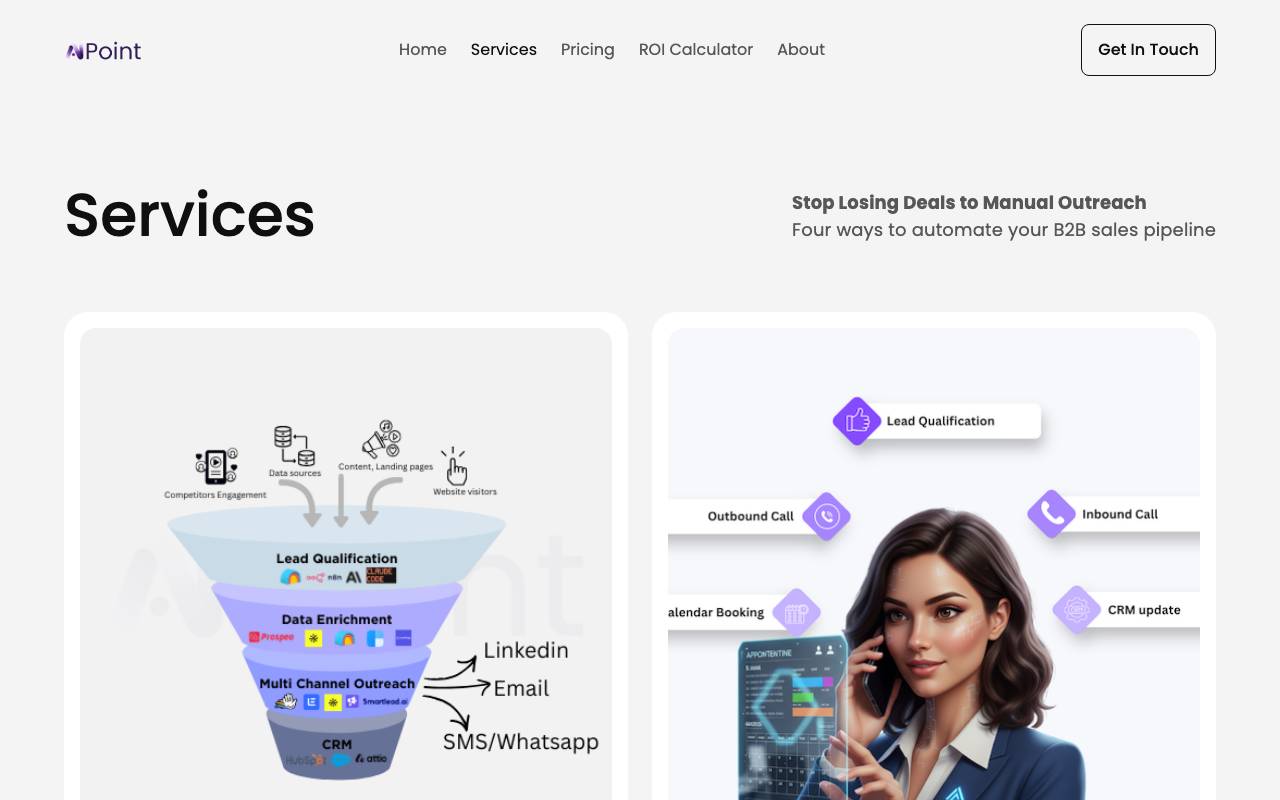
DevArchitect is an AI-powered development assistant designed to help engineers move from idea to implementation more quickly. It supports tasks like generating code, structuring project architectures, reviewing snippets, and suggesting improvements across common programming languages and frameworks. The tool aims to act as a collaborative partner during the software development lifecycle, offering contextual guidance whether you're scaffolding a new application, debugging an existing codebase, or exploring design patterns. By combining code generation with architectural reasoning, it targets both individual developers and small teams looking to streamline their workflow.
Criteria breakdown
- AI-driven code generation and completion
- Project architecture suggestions
- Code review and improvement hints
- Multi-language and framework support
- Debugging and refactoring assistance
- Context-aware development workflow

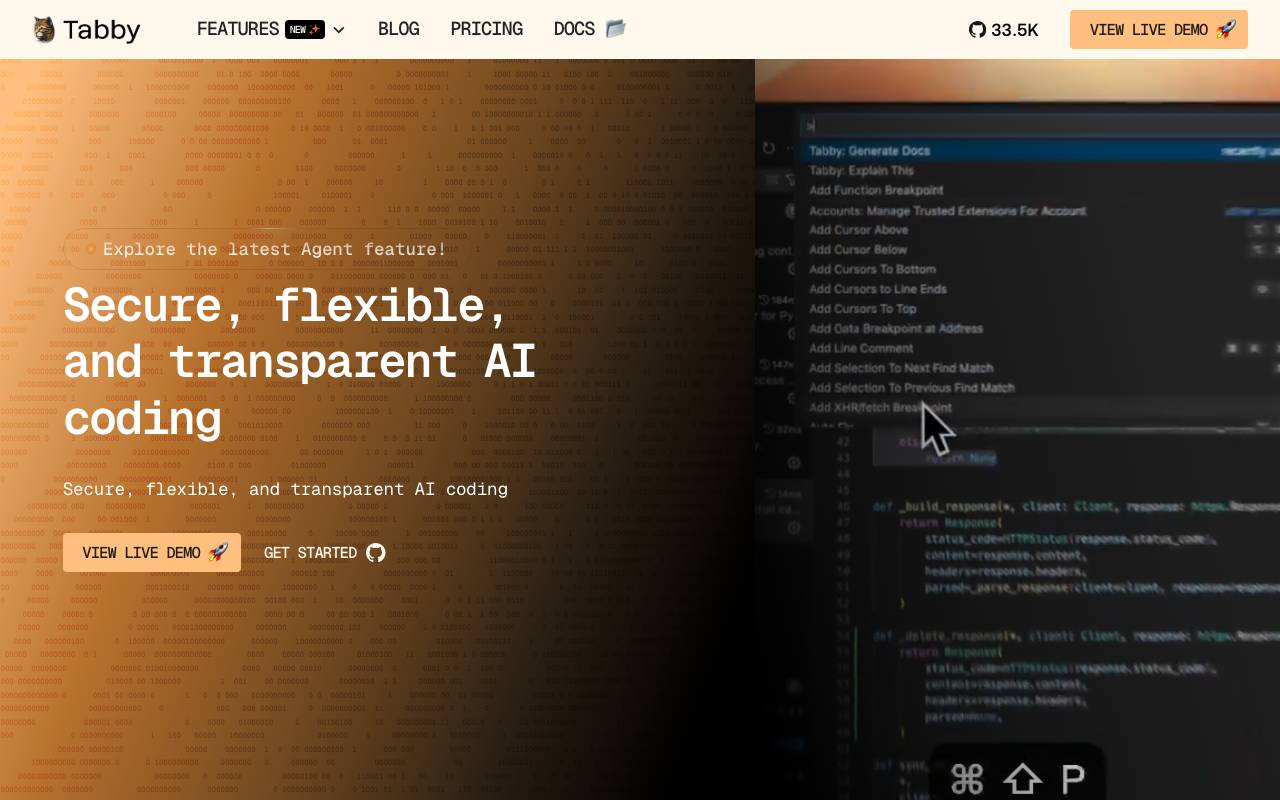
Tabby is an open-source AI coding assistant that you can run on your own infrastructure, giving teams a self-hosted alternative to cloud-based code completion tools. It plugs into popular editors and provides real-time suggestions, multi-line completions, and contextual autocompletion across many programming languages. Because it runs locally or on private servers, Tabby keeps source code inside the organization's environment, making it appealing for companies with strict data, compliance, or IP requirements. It supports consumer GPUs and various open-source models, letting teams tune cost and performance to their hardware. With editor extensions for VS Code, JetBrains IDEs, and Vim/Neovim, plus a transparent, community-driven codebase, Tabby is aimed at developers who want a Copilot-style experience without sending code to a third-party API.
Criteria breakdown
- Real-time code completion and suggestions
- Self-hosted deployment with Docker support
- Extensions for VS Code, JetBrains, and Vim
- Support for multiple open-source LLMs
- GPU-accelerated local inference
- Team usage analytics and admin controls

Sweep AI
An AI-powered junior developer that transforms bug reports and feature requests into code changes, streamlining the software development process.
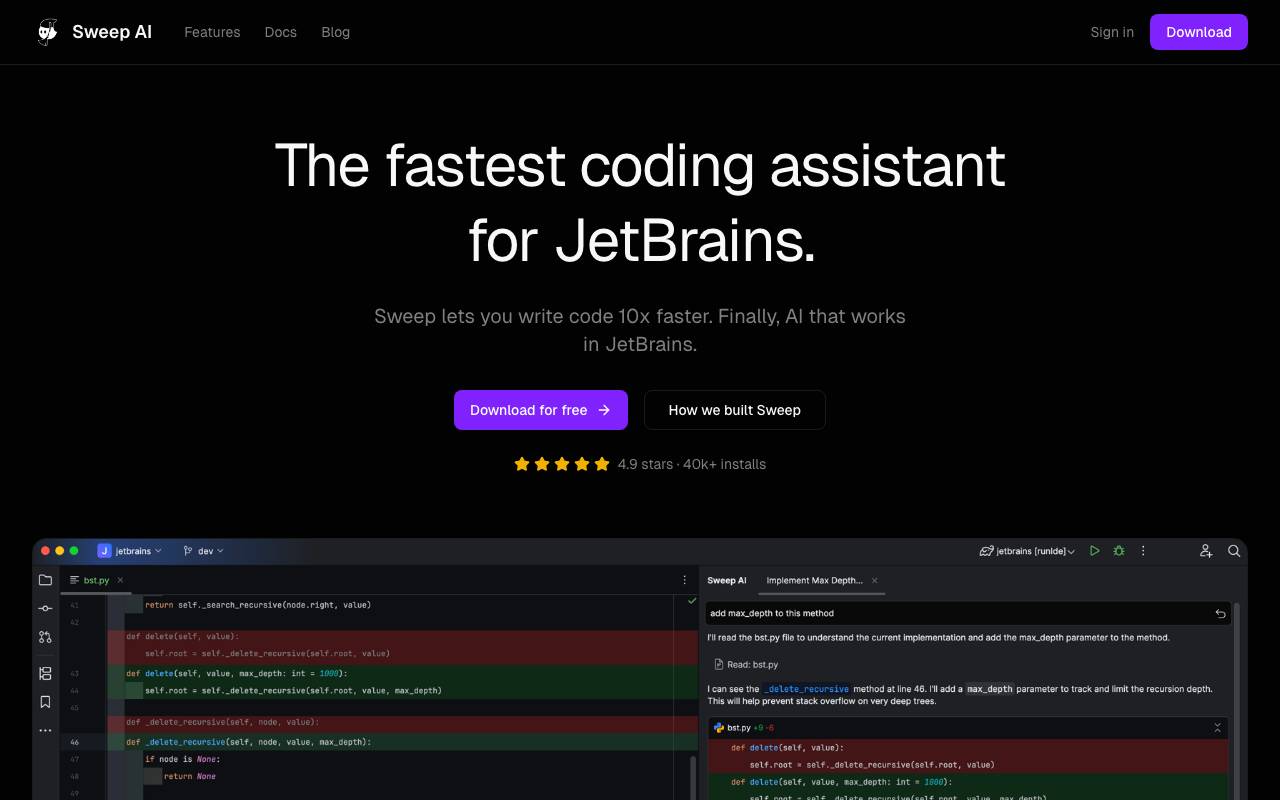
Sweep AI is an artificial intelligence-powered coding assistant designed to work seamlessly within JetBrains integrated development environments (IDEs). It aims to streamline the software development process by suggesting precise code changes, effectively acting as a junior developer. Sweep integrates with various JetBrains IDEs, including IntelliJ IDEA, PyCharm, and WebStorm, making it a versatile tool for developers across different projects. The AI technology behind Sweep, including its custom Tab model and autocomplete features, enables developers to write code faster and more efficiently. Sweep's ability to index the entire project for context-aware suggestions underscores its potential to understand complex codebases and provide relevant assistance. By facilitating rapid and accurate coding, Sweep seeks to boost developer productivity and transform the development workflow. Sweep also emphasizes security and privacy, boasting SOC 2 compliance and zero data retention, which is crucial for enterprises handling sensitive information. The tool's instantaneous code suggestions and comprehensive indexing contribute to its appeal as a productivity-enhancing solution for professional developers. With a strong focus on performance, security, and ease of use, Sweep positions itself as a valuable asset for developers seeking to enhance their coding experience within the JetBrains ecosystem. Sweep's integration with JetBrains IDEs and its commitment to privacy and security standards make it an attractive option for developers looking for a reliable and efficient coding assistant. The tool's impact on developer productivity is highlighted by testimonials from users who have experienced significant improvements in their workflow efficiency. By leveraging AI to automate certain aspects of coding, Sweep enables developers to focus on more complex and creative tasks, potentially leading to better software quality and faster development cycles. Overall, Sweep AI represents a noteworthy innovation in coding assistance, offering a powerful combination of AI-driven code completion, project indexing, and seamless integration with popular development environments.
Criteria breakdown
- AI-powered code completion
- Custom Tab model for precise code suggestions
- Project indexing for context-aware assistance
- Seamless integration with JetBrains IDEs
- SOC 2 compliance and zero data retention for enhanced security and privacy

devlo
AI teammate that helps engineering teams ship code faster by automating routine dev tasks.
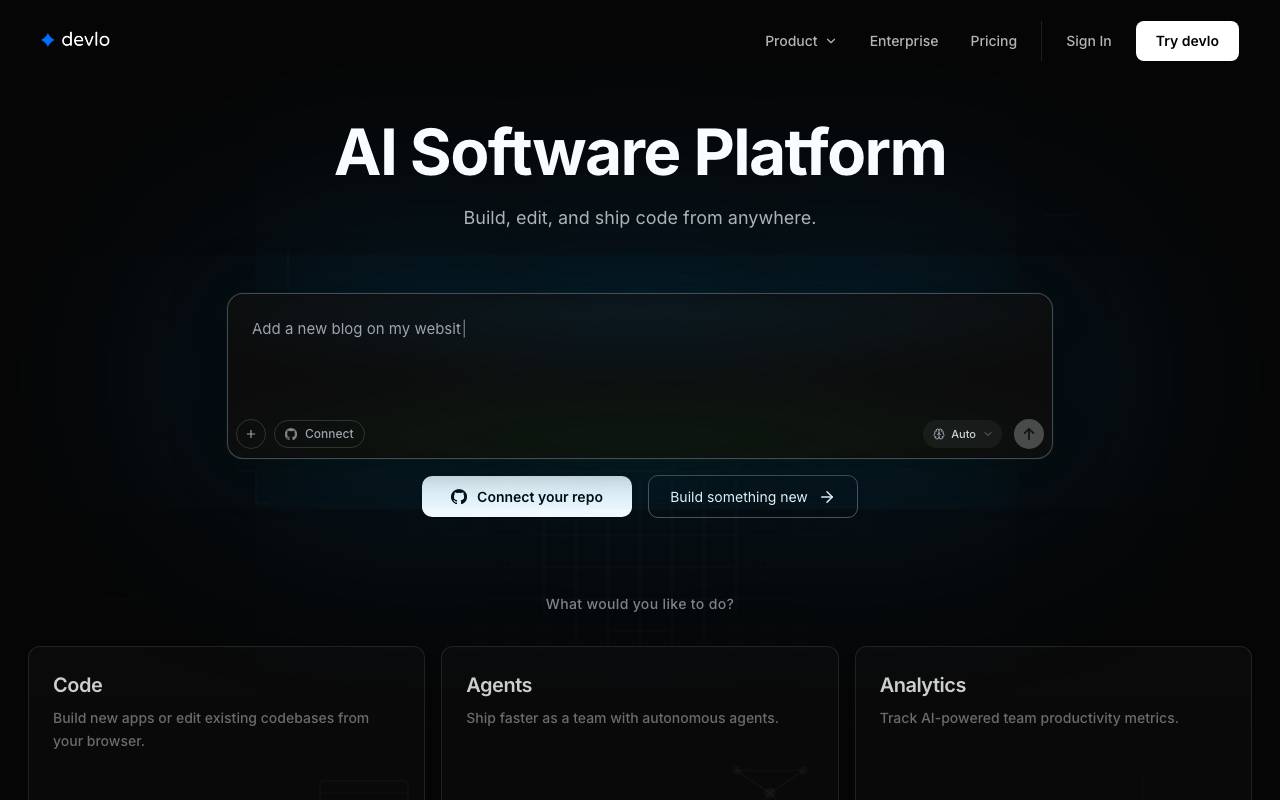
Devlo is an AI-powered tool designed to assist engineering teams in shipping code more efficiently. It aims to automate routine development tasks, potentially streamlining the coding process. By leveraging AI, devlo could help reduce the time spent on mundane tasks, allowing developers to focus on more complex and creative aspects of their work. However, specific features, functionalities, and integrations of devlo are not detailed in available information. As such, its direct capabilities and limitations are not clearly defined. Generally, AI teammates like devlo are sought after for their potential to enhance productivity and code quality within development teams.
Criteria breakdown
- AI-driven code review assistance
- Automated bug fixing
- Test case generation
- Pull request collaboration
- Repository-aware context
- Developer workflow integration

Maige
An open-source AI-powered tool that automates natural language workflows within your codebase, integrating seamlessly with GitHub.
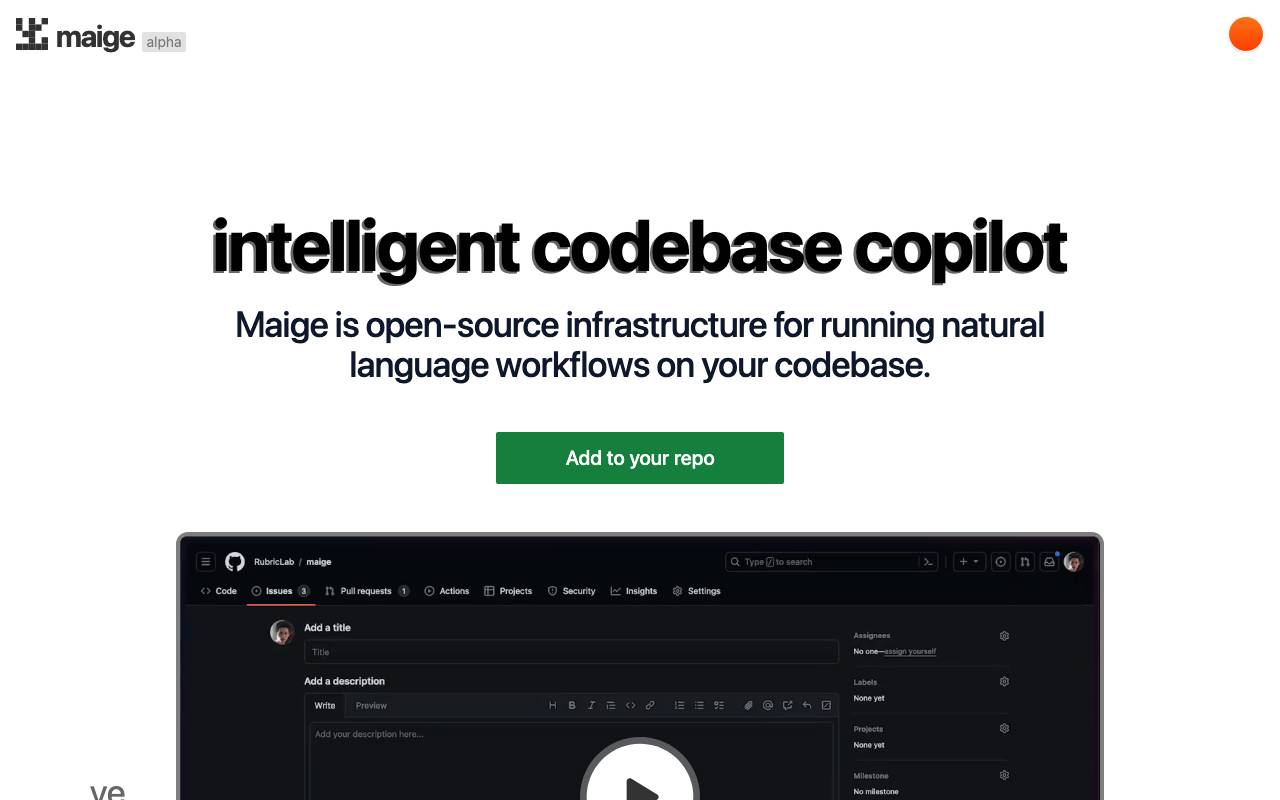
Maige is open-source infrastructure for running natural language workflows on your codebase. When connected to your GitHub repository, it creates a webhook, embeddings of your entire codebase, and a sandbox environment. You can then describe the actions you want Maige to take when issues and pull requests are opened, such as labeling, assigning, commenting, reviewing code, and running simple code snippets. Maige works flexibly with the GitHub API and allows you to monitor and provide feedback in its dashboard. It is an AI with access to GitHub and can automate various tasks, including labeling issues automatically, customizing instructions, and code review. Maige is a flexible and customizable tool that enables you to automate natural language workflows within your codebase. It is primarily used by open-source developers to streamline their workflow and improve collaboration. The tool has been used by over 4,300 repositories and allows users to monitor runs and provide feedback in its dashboard.
Criteria breakdown
- Webhook integration
- Codebase embeddings
- Sandbox environment
- Automated issue labeling
- Custom instructions
- Code review

ReactAgent
An open-source autonomous agent utilizing GPT-4 to generate and compose React components from user stories.

ReactAgent is an open-source autonomous agent designed to generate and compose React components. It utilizes GPT-4, a powerful language model, to create these components from user stories. This approach aims to simplify and accelerate the development process of React applications by automating the creation of components based on natural language descriptions. The tool is intended for developers and teams looking to improve their workflow efficiency and reduce the time spent on manual coding. By leveraging AI, ReactAgent has the potential to streamline React development, making it more accessible and faster. However, the quality and accuracy of the generated components would depend on the capabilities of the GPT-4 model and the clarity of the user stories provided. ReactAgent's ability to understand and translate user requirements into functional components could significantly impact how React applications are developed and maintained. As an open-source tool, ReactAgent may also benefit from community contributions and feedback, potentially leading to continuous improvement and expansion of its capabilities. The use of ReactAgent could fit into a broader strategy of adopting AI-driven development tools, reflecting a trend towards more automated and efficient software development processes.
Criteria breakdown
- GPT-4 integration
- React component generation
- User story interpretation
- Automated coding
- Open-source framework