Past battle · 2024-03-20 UTC
Autonomous Agent Showdown — March 20, 2024
From the Autonomous Agent category. 13 marks placed across 5 fighters. MyUser took the crown.
Final standings




The line-up
The fighters
Profiles of every tool that competed in this battle, ranked by their final score.

MyUser
Autonomous B2B sales agent that finds leads, researches prospects, and books meetings.
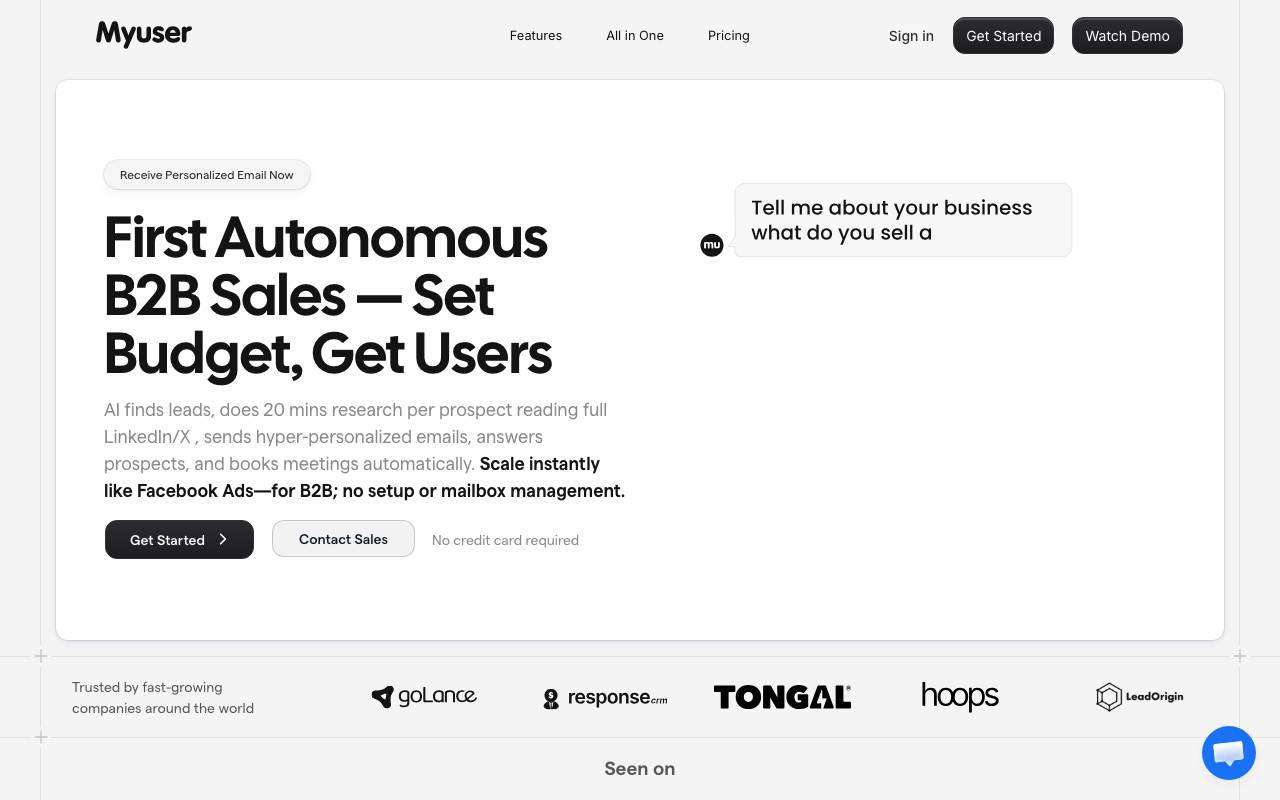
Myuser is an autonomous B2B sales agent that finds leads, researches prospects, and books meetings. It uses AI to find leads, conduct 20-minute research on each prospect, send hyper-personalized emails, answer prospects' questions, and schedule meetings automatically. The platform allows users to set a budget and targeting criteria, and Myuser's AI handles everything else, from prospect research to meeting scheduling. It also offers features such as unlimited and free personalization, a 20-minute deep research, obsessive goal orientation, and set-and-forget operation. Myuser integrates with sales stacks and offers simple, pay-per-prospect pricing, allowing users to only pay for the hyper-personalized emails they send.
Criteria breakdown
- Automated lead discovery
- Prospect research and enrichment
- Personalized outbound messaging
- Reply handling and follow-ups
- Calendar-integrated meeting booking
- ICP-based targeting

Tektonic AI
GenAI agents that automate complex back-office workflows for operations teams.
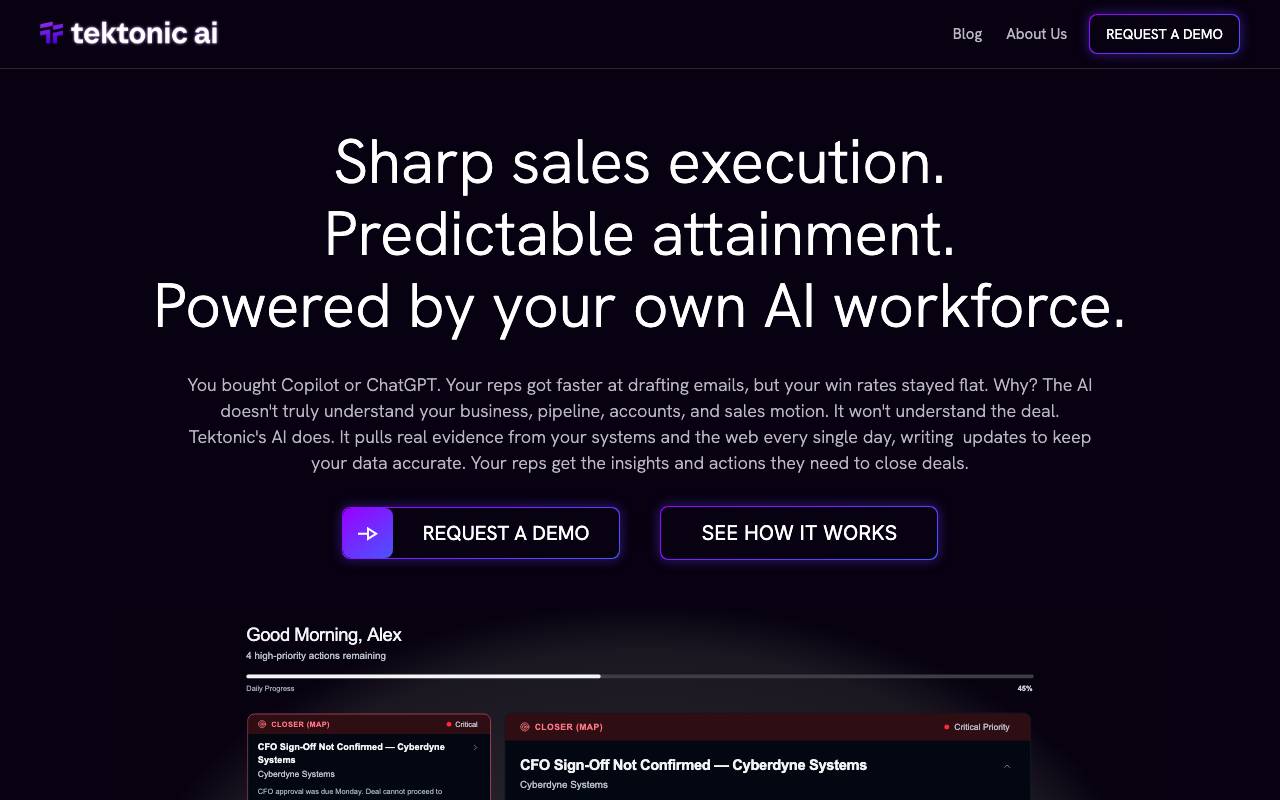
Tektonic AI builds generative AI agents designed to take on multi-step business processes that typically require human judgment, such as data entry across systems, customer onboarding, billing reconciliation, and CRM updates. The platform aims to reduce the manual workload on revenue and operations teams while improving accuracy and turnaround time. Rather than offering a single chatbot, Tektonic focuses on enterprise-grade agents that can connect to existing tools, follow business rules, and operate with auditability. This makes it suited to companies looking to scale operations without proportionally scaling headcount. Target users include RevOps, finance operations, and customer operations leaders in mid-market and enterprise organizations dealing with high-volume, repetitive but nuanced workflows.
Criteria breakdown
- GenAI agents for business process automation
- Integrations with CRM, billing, and ERP tools
- Support for multi-step decision workflows
- Audit trails and human-in-the-loop controls
- Use cases across RevOps, finance, and customer ops
- Enterprise-grade security posture

APIDNA
AI platform that automates multi‑step API integrations with vertically‑trained agents

APIDNA is an AI platform that builds vertically‑trained autonomous agents to automate complex enterprise workflows across APIs, databases, and legacy systems. It targets organizations that need reliable, production‑grade integration of disparate software, especially in regulated industries such as finance, payments, and security. The platform claims to close the gap between demo‑level AI agents and operational use by training agents on the specific domain, rules, and data structures of each customer. Agents are created on an execution layer that can invoke APIs, read and write to ERPs, and process structured or unstructured documents. The platform provides an execution canvas where multiple specialized agents can be orchestrated in parallel, enabling multi‑step, branching workflows without custom middleware. Monitoring, governance, and audit capabilities are built in from day one. The service reports 99.98 % match accuracy, 99.99 % uptime SLA, and maintains full trace logs for each action, supporting compliance frameworks such as ISO 20022, PSD2, GDPR, and SOC 2 Type II. Reported performance metrics include an average of 3,847 live actions per minute and a typical deployment time of under 48 hours once the target ERP schema is confirmed. The platform also offers agents for specific tasks such as reconciliation, compliance report generation, knowledge indexing, anomaly detection, and DORA reporting. Limitations include the need for domain‑specific training and schema confirmation before agents can operate, and the platform appears focused on larger enterprises with strict governance requirements, which may limit suitability for small teams or low‑complexity integrations.
Criteria breakdown
- Multi‑step workflow automation
- Cross‑system API and ERP execution
- Document and data processing at scale
- Agent orchestration for parallel tasks
- Full observability and audit trails
- Vertically trained domain intelligence

AI Point
AI sales engine automating multi-channel B2B outreach across LinkedIn, email, WhatsApp, and SMS.
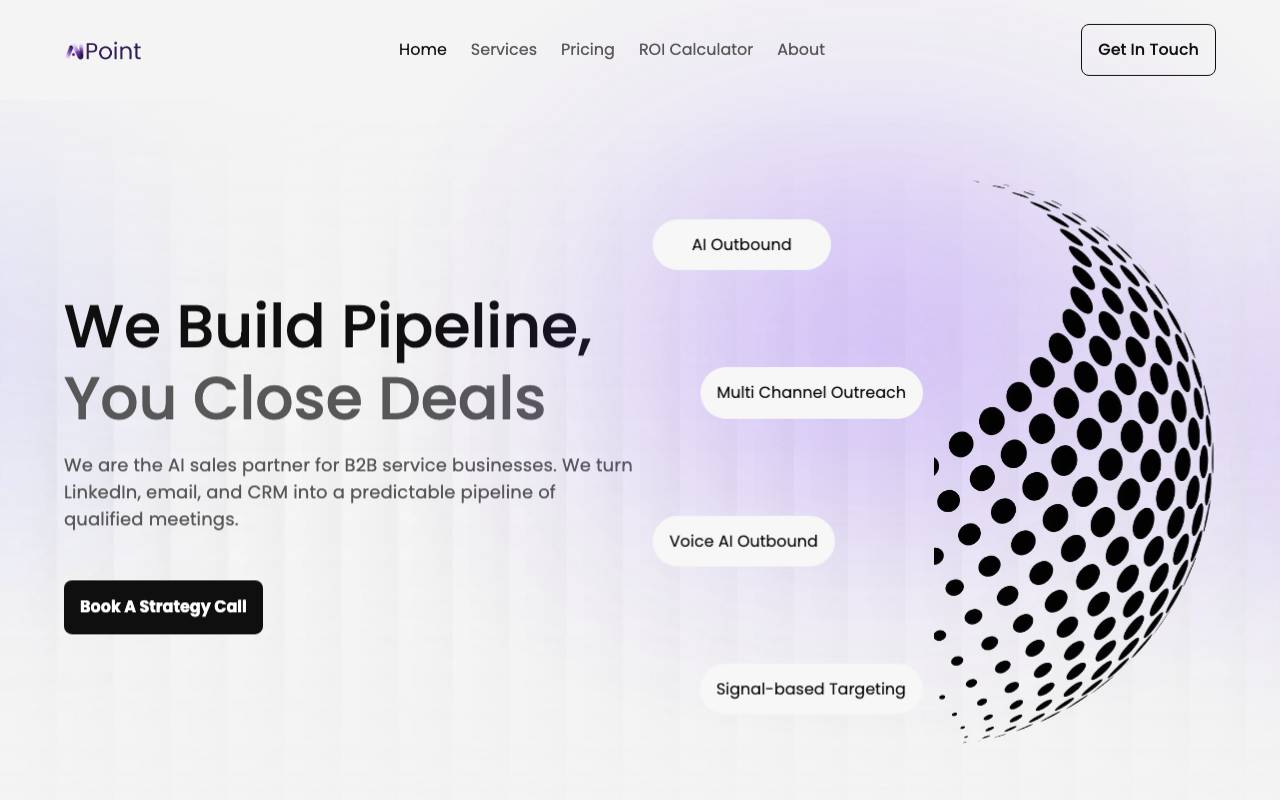
AI Point is a sales automation platform that helps B2B teams run prospecting campaigns across multiple channels from a single workflow. It coordinates outreach on LinkedIn, email, WhatsApp, and SMS, using AI to personalize messages and adapt sequences based on prospect behavior. The tool is built for sales development reps, founders, and agencies who want to scale outbound without manually juggling separate tools for each channel. It centralizes contact data, message templates, and reply tracking, while AI handles message drafting, follow-ups, and timing decisions. By unifying channels and automating repetitive steps, AI Point aims to shorten the path from cold contact to booked meeting, giving smaller sales teams the reach of a larger operation.
Criteria breakdown
- LinkedIn, email, WhatsApp, and SMS automation
- AI-generated personalized messaging
- Multi-step cadence builder
- Centralized inbox and reply tracking
- Lead and campaign analytics
- Template and sequence library

Ariglad
AI agent that auto-updates knowledge bases by mining support tickets for new and outdated articles.
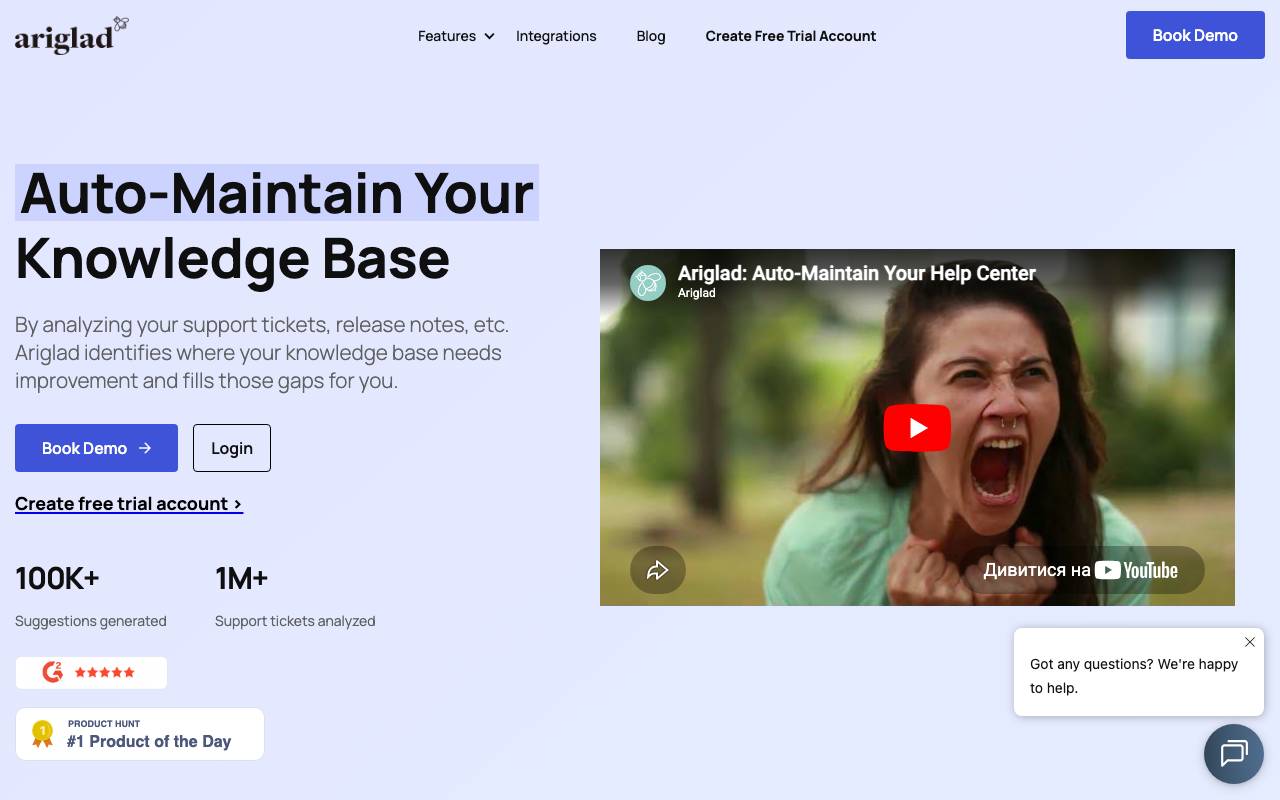
Ariglad is an AI agent designed to keep customer support knowledge bases accurate and up to date without manual upkeep. It continuously analyzes incoming support tickets, identifies recurring questions, and detects gaps where no documentation exists, then drafts new articles or flags existing ones that need revisions. By connecting to help desks and knowledge base platforms, Ariglad reduces the workload on support and content teams while improving self-service deflection rates. It surfaces trends in customer issues, helping organizations spot product friction points and prioritize documentation efforts based on real user demand.
Criteria breakdown
- Automatic ticket analysis and clustering
- AI-drafted knowledge base articles
- Detection of outdated or missing content
- Integrations with major help desk platforms
- Insights on recurring support topics
- Continuous knowledge base monitoring