Past battle · 2024-01-31 UTC
AI security Showdown — January 31, 2024
From the AI security category. 19 marks placed across 5 fighters. Salesforce’s Data Cloud took the crown.
Final standings




The line-up
The fighters
Profiles of every tool that competed in this battle, ranked by their final score.

Salesforce’s Data Cloud
Unify enterprise data in Salesforce to power analytics, personalization, and AI agents.

Salesforce Data Cloud is a real-time data platform that ingests, harmonizes, and activates customer and operational data from across an organization's systems. It connects sources like CRM records, web and mobile interactions, data warehouses, and third-party feeds into a unified profile that can be queried, segmented, and acted on without copying data between silos. The platform is tightly integrated with the Salesforce ecosystem, feeding insights into Sales, Service, Marketing, Commerce, Tableau, and Einstein AI. Teams use it to build audiences, trigger automations, train predictive models, and ground generative AI agents in trusted business context, making it most valuable for mid-to-large companies already invested in Salesforce.
Criteria breakdown
- Data ingestion from CRM, web, mobile, and external sources
- Identity resolution and unified profiles
- Zero-copy integration with Snowflake, BigQuery, Databricks
- Audience segmentation and activation
- AI grounding for Einstein and Agentforce
- Built-in analytics with Tableau connectivity

Creasura
AI toolbox for optimizing online business performance, security, and marketing workflows.

Creasura is an AI-powered toolbox built for online businesses that want to streamline day-to-day operations without juggling multiple specialized platforms. It bundles utilities for site performance, security checks, and marketing tasks into a single workspace aimed at small teams and solo operators. The platform leans on automation and AI-generated suggestions to help users diagnose issues, draft content, and refine campaigns. By combining technical and marketing tools, Creasura targets users who need practical results across multiple business areas rather than depth in a single niche.
Criteria breakdown
- AI-assisted marketing content tools
- Website performance optimization
- Security monitoring and checks
- Workflow automation utilities
- Centralized dashboard for online businesses

Payman AI
Secure financial rails letting AI agents pay humans under programmable policies.
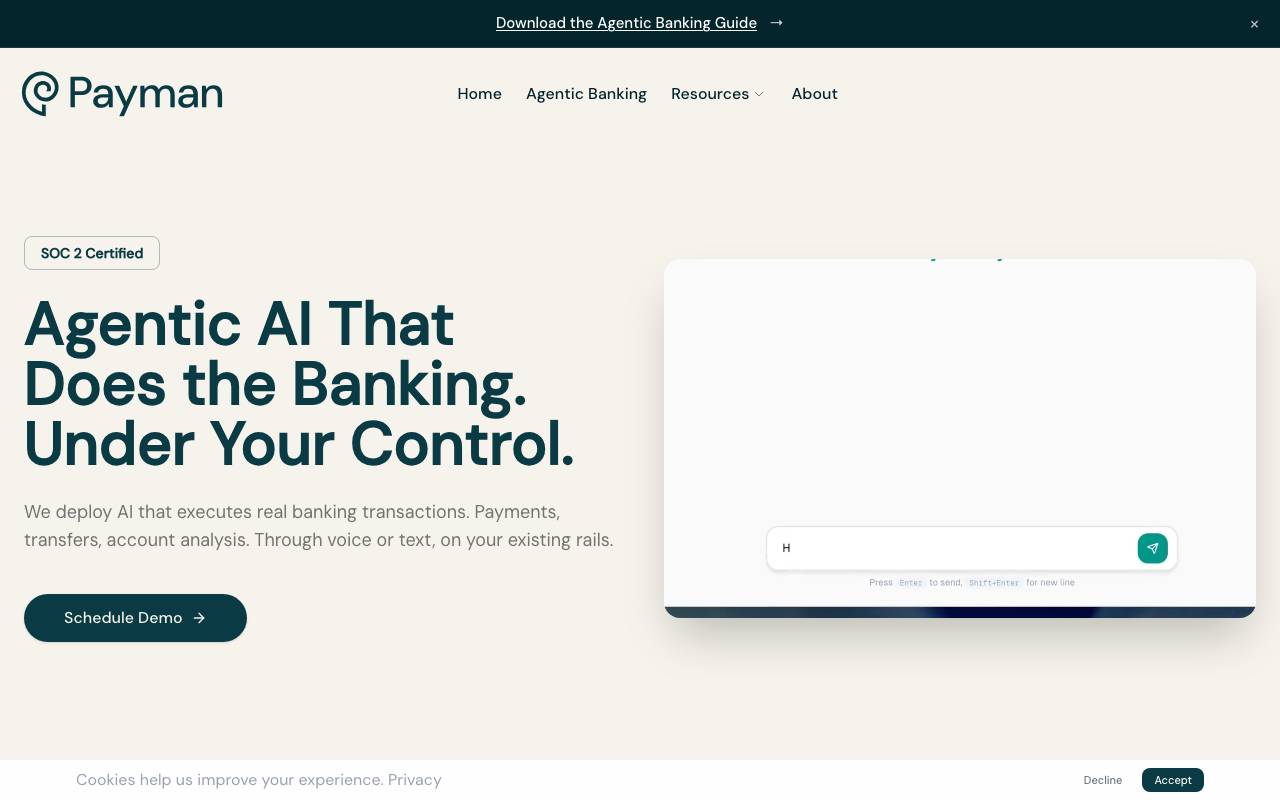
Payman AI is a financial infrastructure platform built specifically for AI agents that need to move money. It allows autonomous agents to send payments to humans and other agents, while keeping every transaction bounded by programmable policies, approval workflows, and spending limits set by the developer or operator. The platform sits between AI applications and traditional payment networks, handling identity, compliance, and authorization so builders can focus on agent logic rather than banking integrations. Use cases include paying gig workers, settling marketplace transactions, disbursing rewards, and reimbursing customers through agent-driven workflows. By combining policy guardrails with auditable transaction logs, Payman AI aims to make agent-initiated payments safe enough for production use in regulated environments.
Criteria breakdown
- Agent-to-human payment APIs
- Configurable approval and policy engine
- Spending caps and risk controls
- Identity and compliance handling
- Transaction logging and audit reports
- SDKs for common agent frameworks

Pixee
AI-driven code security platform that automatically fixes vulnerabilities, exposed secrets, and risky dependencies.
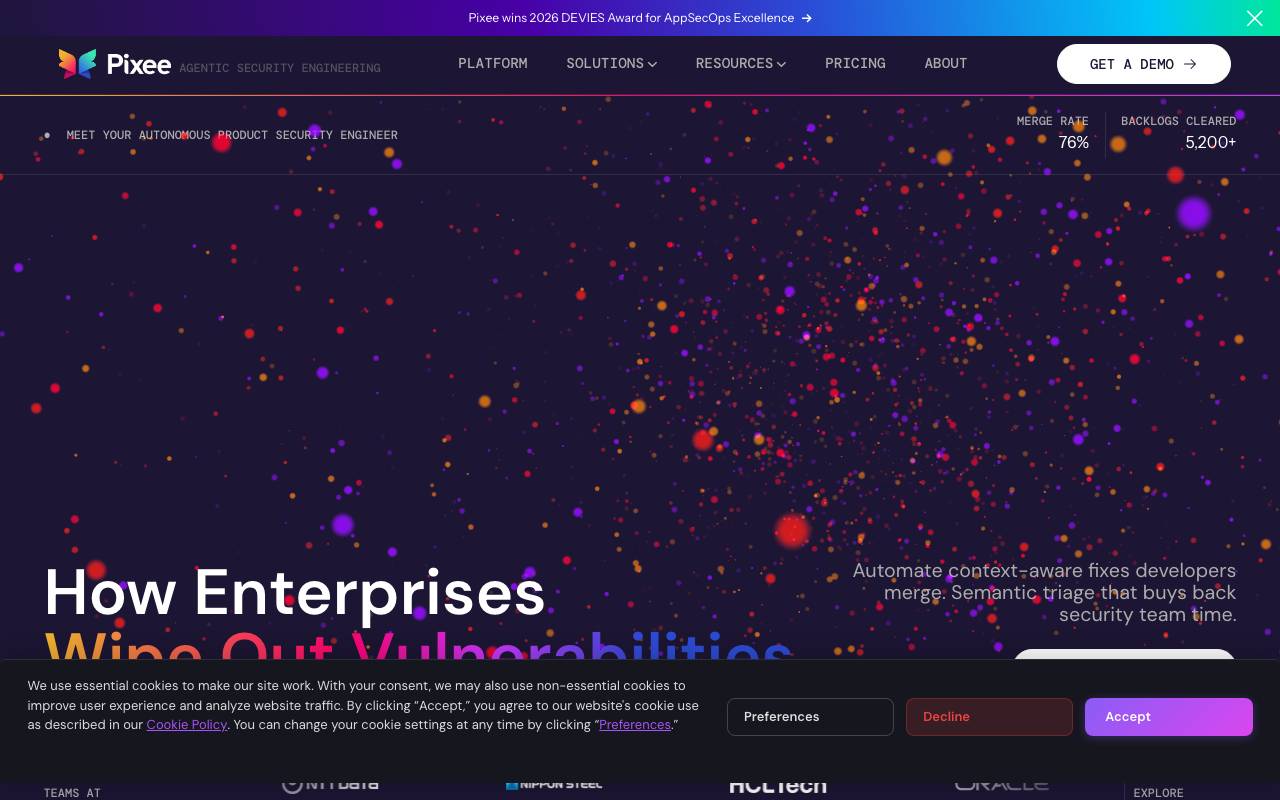
Pixee is an automated code security tool that uses AI agents to find and remediate weaknesses directly inside developer workflows. Instead of just flagging issues, it opens pull requests with concrete fixes for common vulnerability classes, hardened dependencies, and leaked secrets, letting teams ship safer code without manual triage. The platform integrates with source control providers and CI pipelines, working alongside existing SAST and SCA tools to act on their findings. By focusing on remediation rather than detection alone, Pixee aims to reduce security backlog and shorten the time between a vulnerability being identified and resolved.
Criteria breakdown
- Automated vulnerability remediation via pull requests
- Secrets detection and removal
- Dependency hardening and updates
- Integration with GitHub, GitLab, and CI tools
- Works with existing scanners like Sonar and Semgrep
- AI-assisted code transformations with explanations

UFO
Open-source multi-agent framework for automating Windows app interactions through natural language.
UFO is a UI-focused agent framework designed to operate Windows applications by interpreting user requests in natural language and acting directly on graphical interfaces. It coordinates multiple specialized agents that observe the screen, plan steps, and execute actions across native and third-party Windows apps. The system combines large language models with screen understanding and control APIs, enabling tasks that span multiple applications, such as moving data between Word, Excel, and Outlook. It is primarily aimed at researchers and developers exploring desktop automation and OS-level AI agents.
Criteria breakdown
- Multi-agent planning and execution
- Visual grounding of UI elements
- Cross-app workflow handling
- Natural language task input
- Integration with LLM providers
- Logging and step-by-step traces