Past battle · 2024-05-02 UTC
Large Language Models (LLMs) Showdown — May 2, 2024
From the Large Language Models (LLMs) category. 24 marks placed across 7 fighters. Uni-1 by Luma AI took the crown.
Final standings





The line-up
The fighters
Profiles of every tool that competed in this battle, ranked by their final score.

Uni-1 by Luma AI
Multimodal AI model for high-fidelity image generation with strong spatial reasoning and accurate text rendering.
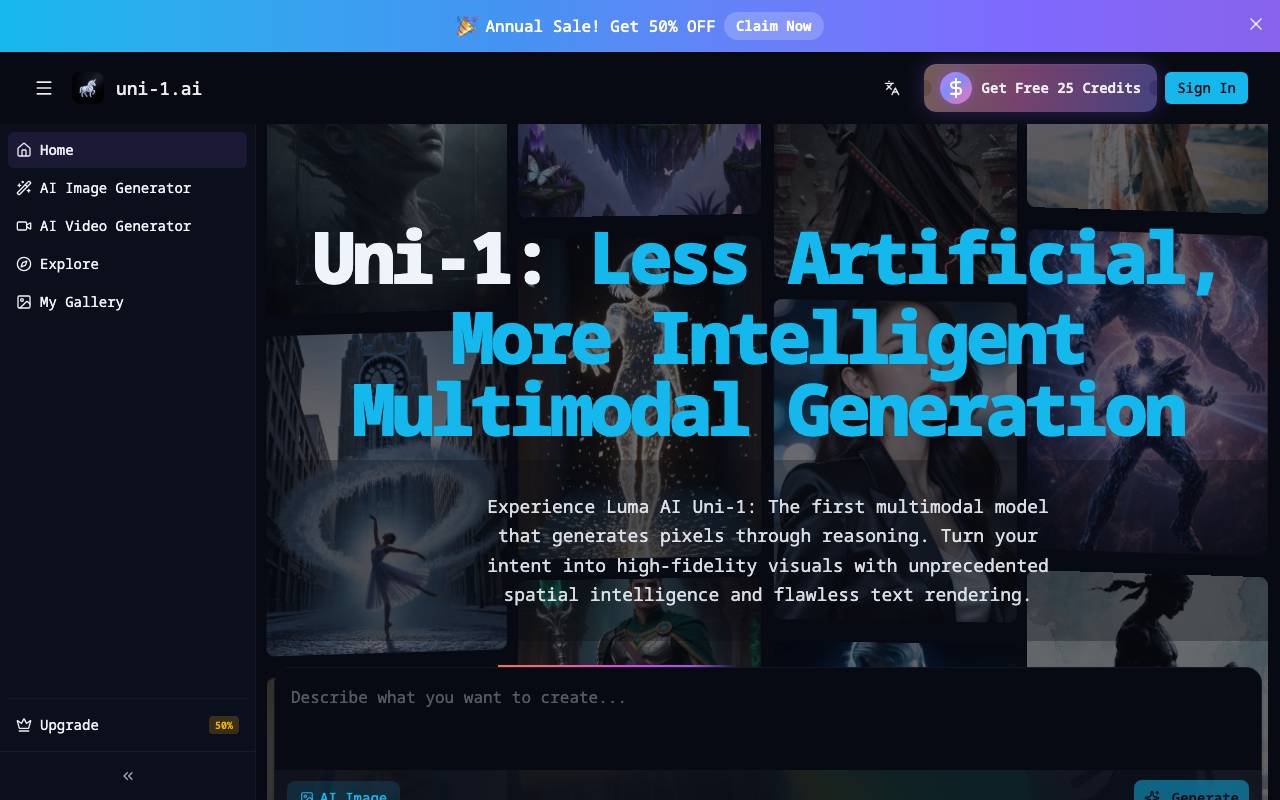
Uni-1 is Luma AI's multimodal generative model focused on producing detailed, photorealistic images from text and reference inputs. It places particular emphasis on spatial understanding, allowing it to handle complex compositions, object relationships, and scene layouts more reliably than typical diffusion models. The model also targets a common weakness in image generators: rendering legible, accurate text inside images. This makes it suitable for use cases like poster design, product mockups, signage, and editorial visuals where typography matters as much as visual fidelity. As part of Luma AI's broader creative suite, Uni-1 is positioned for designers, marketers, and developers who need consistent, prompt-faithful image output for both creative exploration and production work.
Criteria breakdown
- Text-to-image and multimodal generation
- Improved typography and text accuracy
- Spatial and compositional understanding
- High-resolution photorealistic rendering
- Reference-guided image creation
- Integration with Luma AI's creative tools
Ollama is an open-source tool that lets you download, run, and manage large language models directly on your personal computer. It supports a wide range of popular open models, including Llama, Mistral, Gemma, Phi, and DeepSeek, and handles model packaging, weights, and configuration through a simple command-line interface. Designed for developers, researchers, and privacy-conscious users, Ollama runs entirely offline once models are downloaded, keeping prompts and data on your own hardware. It also exposes a local REST API and integrates with popular frameworks and front-end UIs, making it a practical foundation for building local AI applications, chatbots, and coding assistants.
Criteria breakdown
- One-command model download and run
- Local REST API for app integration
- Model library with quantized versions
- Custom Modelfile for tailored model configs
- GPU acceleration on supported hardware
- Works offline after initial setup

Haystack AI
Open-source Python framework for building search, RAG, and LLM-powered applications.
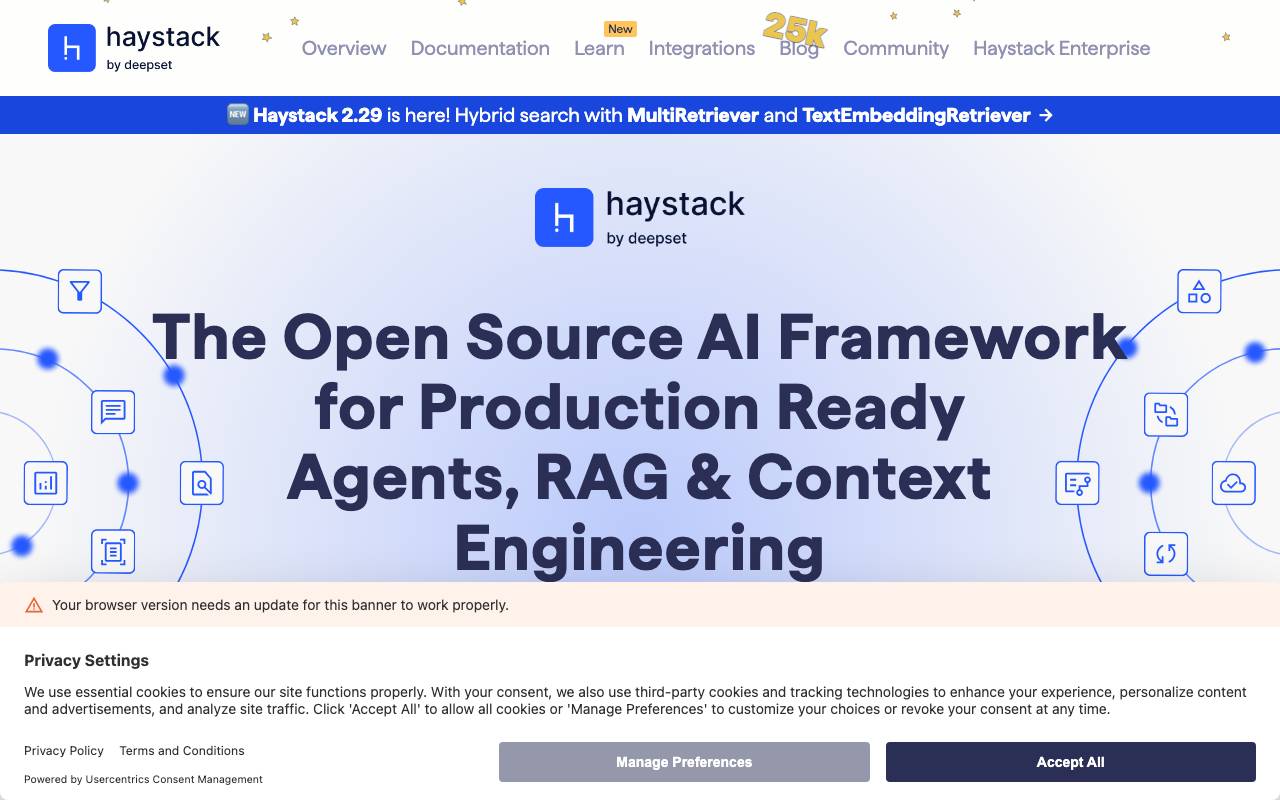
Haystack AI is an open-source framework developed by deepset for building production-ready applications powered by large language models. It provides a modular pipeline architecture that lets developers connect components like document stores, retrievers, embedders, and generators to create custom NLP workflows. The framework is commonly used for retrieval-augmented generation (RAG), semantic search, question answering, summarization, and agent-based systems. It integrates with popular model providers, vector databases, and tools, making it flexible for both prototypes and large-scale deployments. With a strong focus on developer experience, Haystack offers clear documentation, prebuilt pipelines, and evaluation tools to help teams iterate on LLM applications and move them from experimentation to production.
Criteria breakdown
- Composable pipelines for LLM workflows
- Retrieval-augmented generation support
- Integrations with major vector databases
- Document store and retriever components
- Built-in evaluation and monitoring tools
- Agent and tool-calling capabilities

Hermes 3
Open-source frontier LLM tuned for reasoning, roleplay, and agentic workflows.

Hermes 3 is an open-weight large language model designed as a steerable, neutral assistant that adapts closely to user instructions. Built on the Llama architecture and released by Nous Research, it targets strong performance in reasoning, long-context tasks, and structured outputs without heavy alignment guardrails. The model emphasizes practical capabilities developers need for real applications, including reliable function calling, structured JSON generation, multi-turn roleplay, and agentic tool use. It is available in multiple parameter sizes, making it suitable for both local deployment and production-scale inference. Because Hermes 3 is open source, teams can fine-tune, self-host, and integrate it into custom pipelines without vendor lock-in, while community tooling and quantized builds make experimentation accessible on consumer hardware.
Criteria breakdown
- Agentic function-calling and tool use
- Structured JSON and schema-guided outputs
- Extended context window
- Roleplay and persona consistency
- Multiple model sizes including 8B, 70B, and 405B
- Compatible with standard inference frameworks

H2O.ai
End-to-end AI cloud platform for building, deploying, and scaling machine learning models.
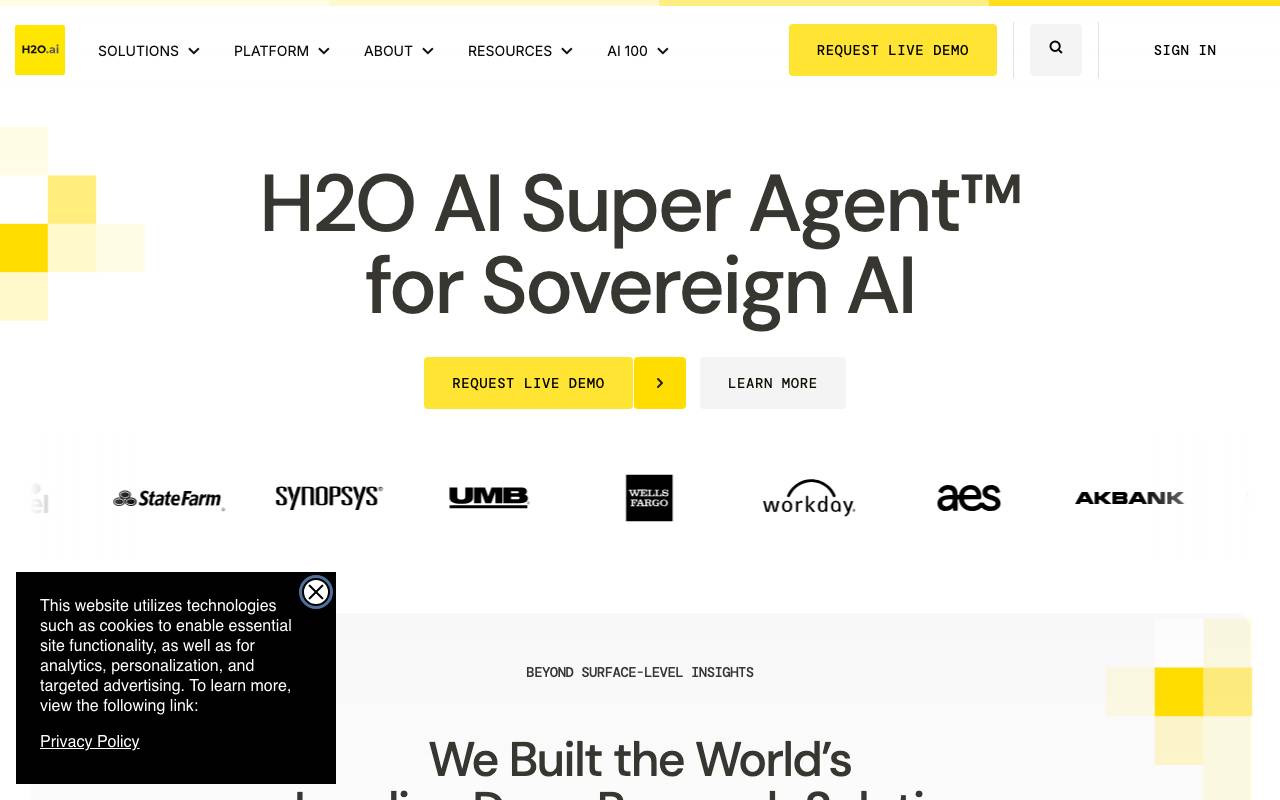
H2O.ai is an enterprise AI platform designed to help organizations develop and operationalize machine learning at scale. It offers a suite of tools spanning automated machine learning, generative AI, document processing, and MLOps, allowing both data scientists and business users to work with predictive and generative models. The platform supports the full model lifecycle, from data preparation and training to deployment and monitoring. With open-source roots and enterprise-grade products like H2O Driverless AI and h2oGPT, it caters to teams looking to combine traditional ML workflows with modern LLM-based applications across industries such as finance, healthcare, and insurance.
Criteria breakdown
- AutoML with H2O Driverless AI
- h2oGPT for private LLM deployments
- Document AI for unstructured data
- MLOps for model deployment and monitoring
- Support for Python, R, and notebooks
- On-prem, cloud, and hybrid deployment options

replicate.so
Visual bug reporting tool that captures screen recordings with technical context for faster fixes.
Replicate.so is a bug reporting and triage platform designed to bridge the gap between testers, designers, and developers. Instead of vague written tickets, users can capture screen recordings, screenshots, and annotations alongside automatically gathered technical metadata such as browser, OS, console logs, and network activity. The tool packages this information into shareable reports that integrate with common developer workflows. By giving engineers everything they need to reproduce an issue in a single link, Replicate.so aims to reduce back-and-forth communication and shorten the time from bug discovery to resolution. It is particularly useful for QA teams, product managers, and remote development teams who need a structured, reproducible way to document and route issues.
Criteria breakdown
- Screen recording and screenshot capture
- Automatic console and network log collection
- Browser and device metadata reporting
- Annotated visual feedback
- Shareable bug report links
- Integration with developer workflows
Rita AI
Autonomous job search assistant that finds roles and submits applications for you.
Rita AI is an autonomous job search assistant designed to streamline the job hunting process. It is aimed at individuals looking for employment who wish to automate the discovery of job opportunities and the submission of applications. Rita AI operates by utilizing algorithms to search for job openings that match the user's criteria, such as skills, experience, and preferences. The tool is capable of scouring various job boards and company career pages to find relevant roles. Once it identifies suitable positions, Rita AI can automatically submit applications on behalf of the user, potentially saving time and increasing the chances of getting noticed by employers. While specifics about its standout capabilities, limitations, and how it compares to human-driven job searching or other AI-assisted tools are not detailed, Rita AI's core function is to act as a personal job search assistant, handling tasks that typically require a significant amount of time and effort from job seekers.
Criteria breakdown
- Automated job discovery across multiple sources
- Auto-apply to matched positions
- Resume and profile-based matching
- Application tracking dashboard
- Personalized job recommendations
- Background search that runs continuously