Past battle · 2025-05-12 UTC
Code Assistants Showdown — May 12, 2025
From the Code Assistants category. 26 marks placed across 9 fighters. ReleasePad took the crown.
Final standings






The line-up
The fighters
Profiles of every tool that competed in this battle, ranked by their final score.

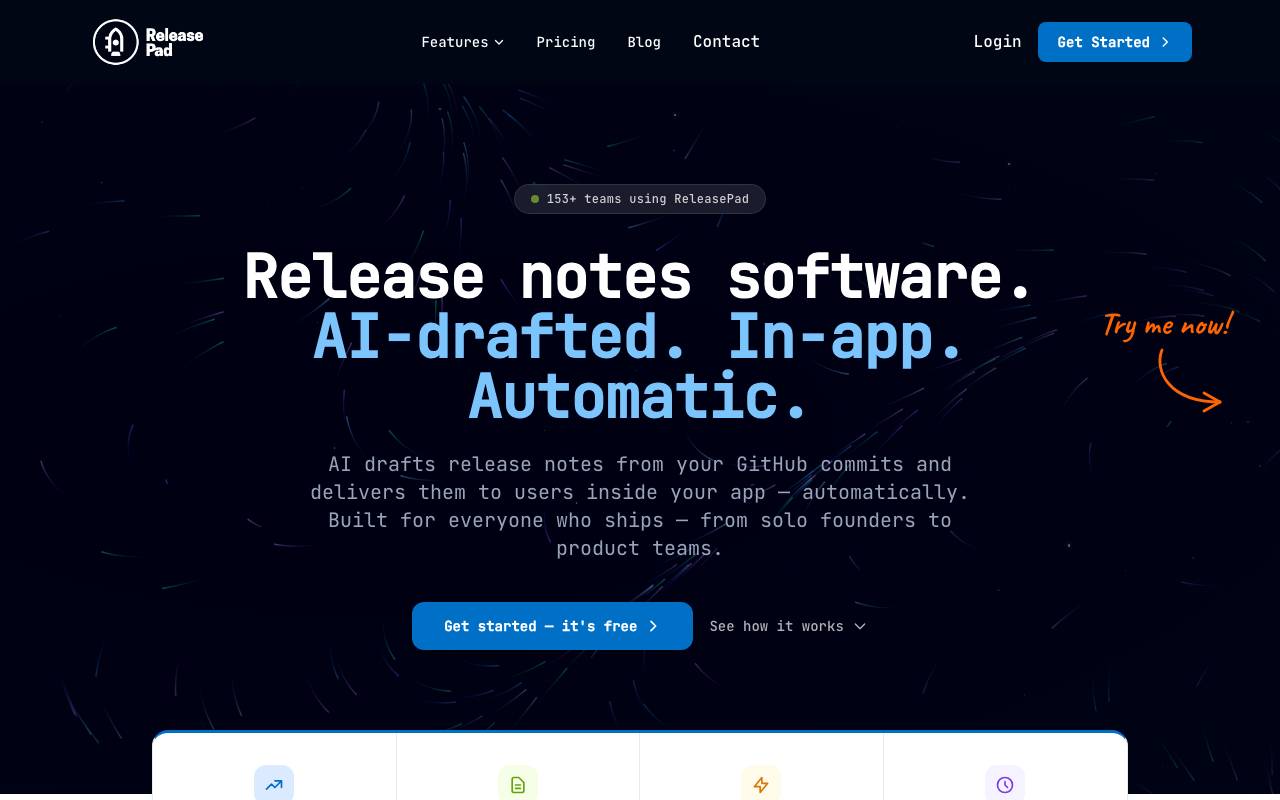
ReleasePad turns commits, pull requests, and issue trackers into polished release notes without the manual write-up. It analyzes code changes and ticket metadata to draft clear, audience-appropriate summaries that teams can review, edit, and publish in minutes. Built for engineering and product teams that ship faster than they communicate, ReleasePad helps maintain a consistent changelog cadence across customers, internal stakeholders, and documentation channels. It bridges the gap between developer activity and the polished updates end users actually read.
Criteria breakdown
- AI-drafted release notes from commits and PRs
- Integrations with Git platforms and issue trackers
- Customizable tone and audience templates
- Editable drafts before publishing
- Changelog history and version tracking

Giselle
An open-source platform enabling teams to create AI agents through a visual node-based interface for automating complex workflows.
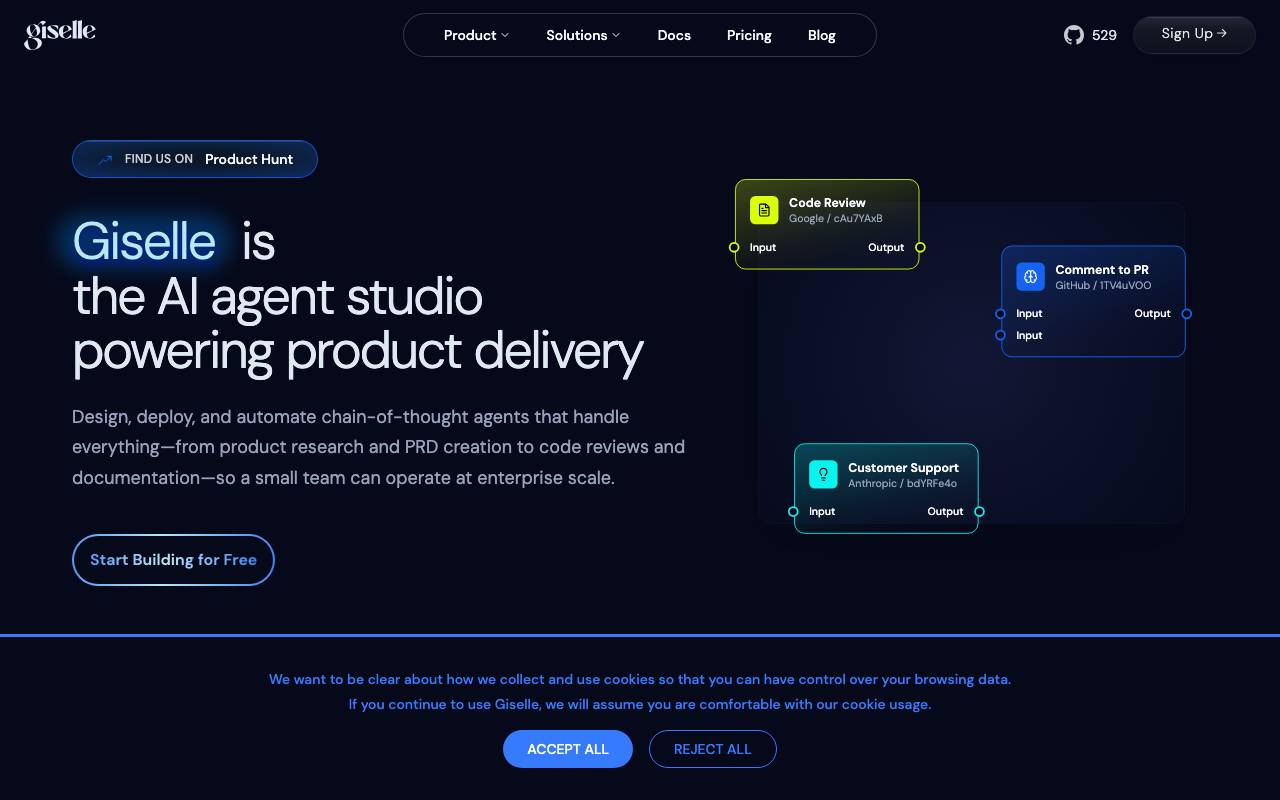
Giselle is an open-source platform designed for AI-native product teams. It allows teams to create AI agents through a visual node-based interface, automating complex workflows and repetitive tasks. This enables teams to focus on high-impact thinking, fast iteration, and bold decisions. Giselle connects to any foundation model, adapting seamlessly without requiring rewrites or friction. It offers a range of tools to streamline product development, including prompt-to-production capabilities, launch without engineering, and built-in security features. The platform provides powerful tools for product teams, such as deep research, code review, PRD generation, and documentation. It also ensures security compliance by default, with ISO/IEC 27001 certification and SOC 2 on the way. With Giselle, teams can accelerate product development in the age of AI. It doesn't replace human creativity but amplifies it by automating repetitive tasks, freeing teams to focus on innovation. Giselle is built for innovative startups aiming to scale with lean, AI-native teams. It reflects the future of product development and amplifies every mind.
Criteria breakdown
- Deep research and competitor analysis
- Code review and analysis
- PRD generation and documentation
- Prompt-to-production capabilities
- Launch without engineering
- Built-in security features

Smol AI Agent
Lightweight autonomous coding agent built for small, focused development tasks.
Smol AI Agent is a minimalist autonomous coding assistant designed to tackle bite-sized programming work without the overhead of larger agent frameworks. Instead of trying to plan and execute sprawling projects, it focuses on well-scoped tasks like generating a script, refactoring a function, or scaffolding a small module. Its compact design makes it easy to run, inspect, and modify, which appeals to developers who want transparency over their automation. By keeping prompts, tools, and execution loops simple, Smol AI Agent aims to deliver predictable results on tasks where heavier agents tend to over-engineer or drift. The tool fits naturally into individual developer workflows, prototyping sessions, and learning environments where understanding what the agent is doing matters as much as the output itself.
Criteria breakdown
- Autonomous task execution loop
- Lightweight codebase and minimal dependencies
- Focused single-task prompting
- Customizable agent behavior
- Developer-friendly local workflow
Flowise
Open-source visual builder for LLM apps, agents, and chatbots using drag-and-drop nodes.
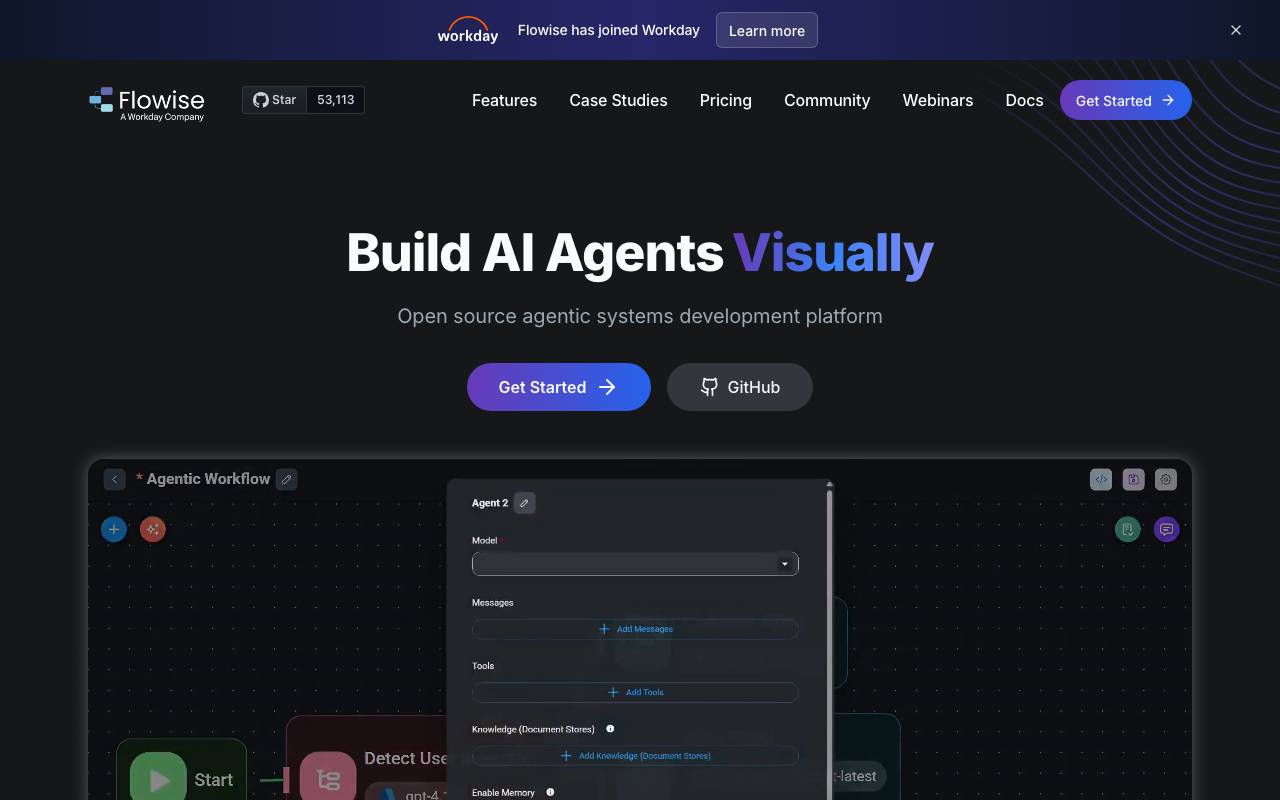
Flowise is an open-source low-code platform for designing AI workflows by connecting nodes on a visual canvas. It wraps popular frameworks like LangChain and LlamaIndex, letting developers prototype chatbots, retrieval-augmented generation pipelines, and autonomous agents without writing extensive glue code. Built flows can be exposed as APIs, embedded as chat widgets, or integrated into existing applications. Flowise supports a wide range of model providers, vector databases, and tools, and can be self-hosted via Docker or run in the cloud for teams that need more control over data and deployment.
Criteria breakdown
- Drag-and-drop flow builder
- LangChain and LlamaIndex node support
- RAG and vector database integrations
- Agent and tool orchestration
- API endpoints and chat embed
- Docker-based self-hosting

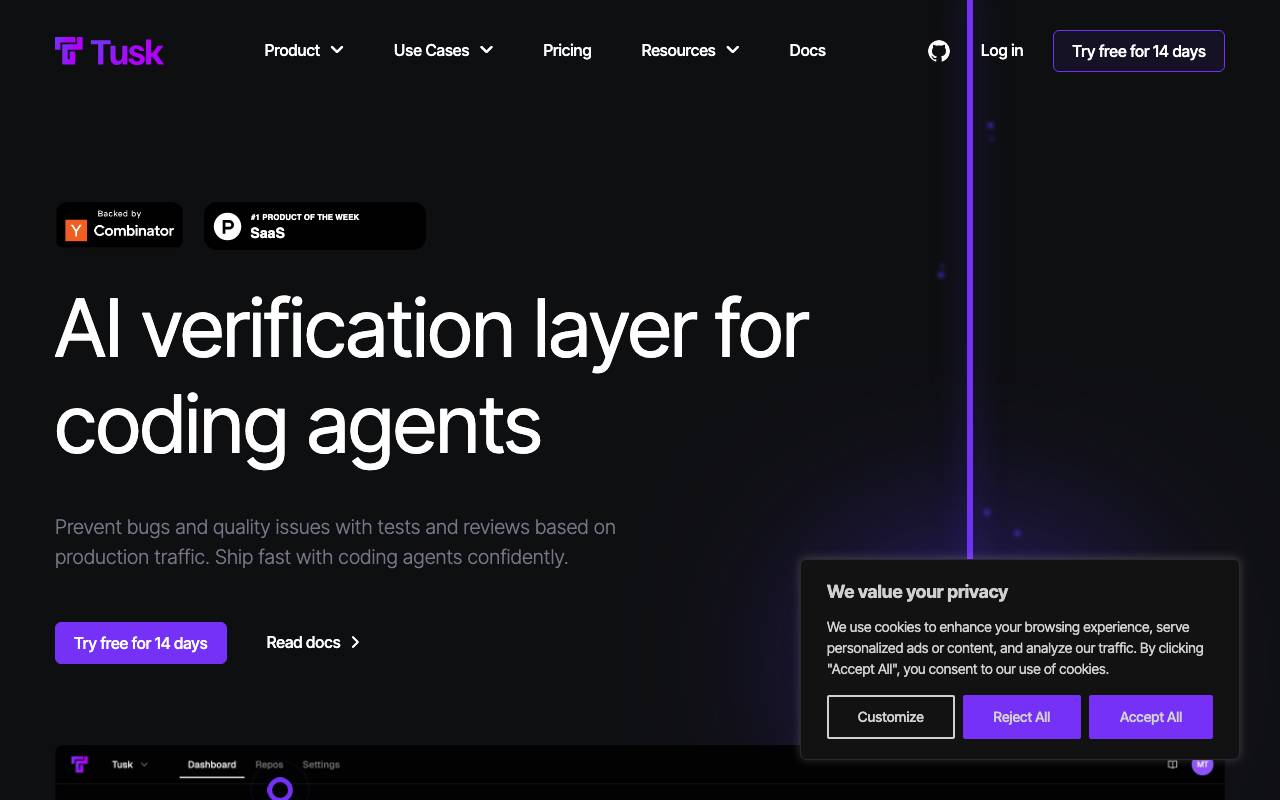
Tusk AI is a tool that helps prevent bugs and quality issues by generating test cases based on production traffic. It integrates with Jira and GitHub to provide a seamless experience for engineers. With Tusk, engineers can cover thousands of edge cases in minutes and catch real-world regressions in 43% of pull requests. The tool also enforces test coverage and code quality requirements without disrupting the engineering workflow. It runs a single CLI command for initial setup and automatically generates tests locally or to an existing branch. Tusk is self-iterating and self-healing, requiring no back-and-forth with an AI copilot. It maintains existing test suites on every commit and generates high-quality tests to reach coverage goals. Overall, Tusk aims to help engineering teams halve their release cycle by catching bugs in pull requests before they get merged.
Criteria breakdown
- Automated PR code reviews
- AI-generated bug fixes
- Jira ticket-to-code linking
- GitHub workflow integration
- Context-aware code suggestions
- Quality and style checks
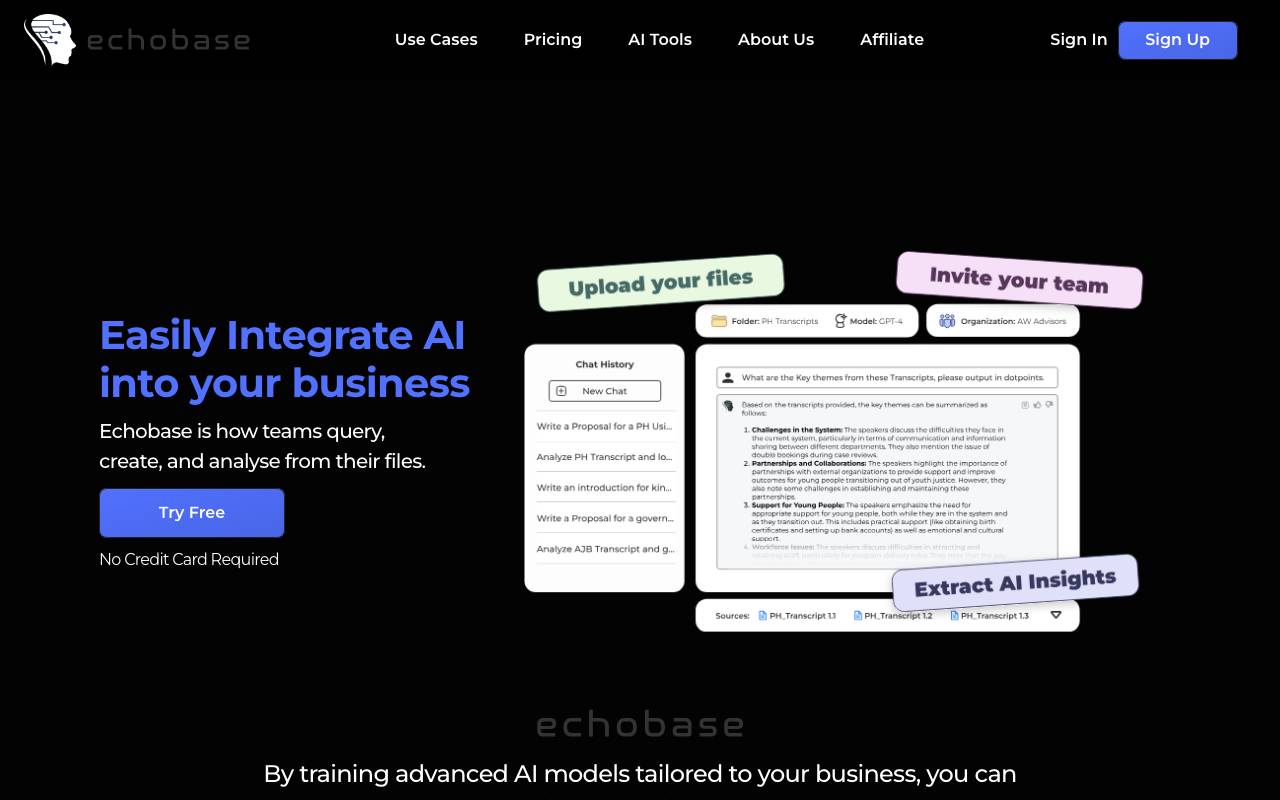
Echobase is an AI platform that lets teams create functional, customizable agents trained on their own data. Users can upload documents, connect knowledge sources, and configure agents to answer questions, analyze content, or automate text-based tasks across an organization. The platform is geared toward collaboration, allowing multiple team members to share workspaces, manage files, and interact with agents from a single dashboard. It supports a range of underlying language models and offers role-based access, making it suitable for businesses that want centralized AI tooling without building infrastructure from scratch.
Criteria breakdown
- Custom AI agent creation
- Document and knowledge base ingestion
- Team collaboration and shared workspaces
- Role-based access controls
- Multi-model support
- Chat-based agent interaction

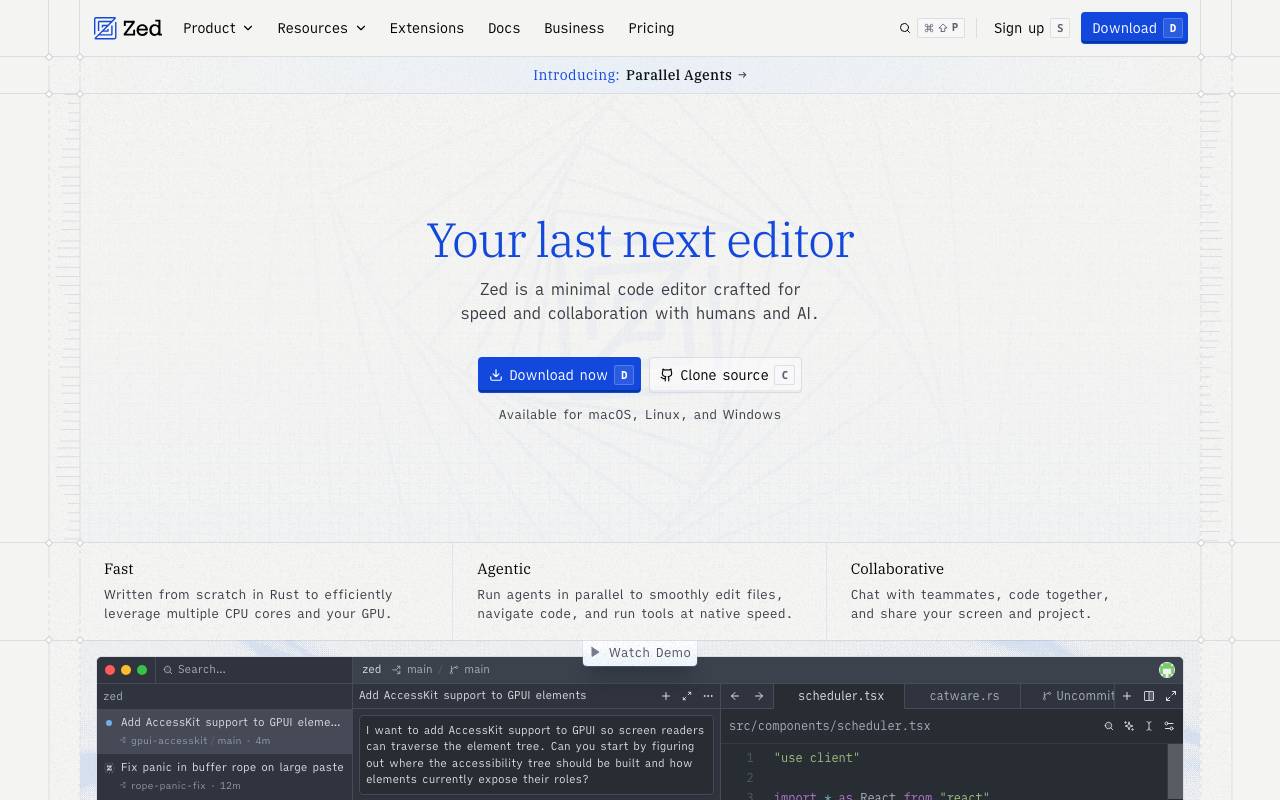
Zed AI is a fast, Rust-built code editor designed for low-latency coding and real-time team collaboration. It combines a responsive native interface with multi-buffer editing, language server support, and integrated AI features that help developers write, refactor, and understand code without leaving the editor. The AI layer connects to large language models for chat-based assistance, inline edits, and context-aware suggestions drawn from the open project. Combined with shared workspaces, voice channels, and live cursors, Zed positions itself as both a solo productivity tool and a pair-programming environment.
Criteria breakdown
- GPU-accelerated native code editor
- Built-in AI assistant and inline edits
- Real-time collaborative editing with shared workspaces
- Language server protocol and Tree-sitter support
- Integrated terminal and Git tooling
- Voice chat and project channels for teams

Aide is an open-source integrated development environment built from the ground up around AI assistance. It combines a familiar editor experience with agentic frameworks that can plan, execute, and iterate on coding tasks across multiple files and steps. Designed for developers who want deeper AI integration than a typical plugin offers, Aide treats AI agents as first-class collaborators inside the editor. Users can hand off larger refactors, multi-file edits, and exploratory tasks to agents while retaining full control over the codebase. Because it is open source, teams can inspect, extend, and self-host Aide to fit their workflows, security requirements, or preferred models.
Criteria breakdown
- AI-native code editor
- Agentic task execution framework
- Multi-file refactoring and edits
- Integrated chat and code generation
- Open-source and extensible architecture
- Support for multiple LLM backends

Zest
AI assistant designed to boost developer productivity in everyday coding workflows
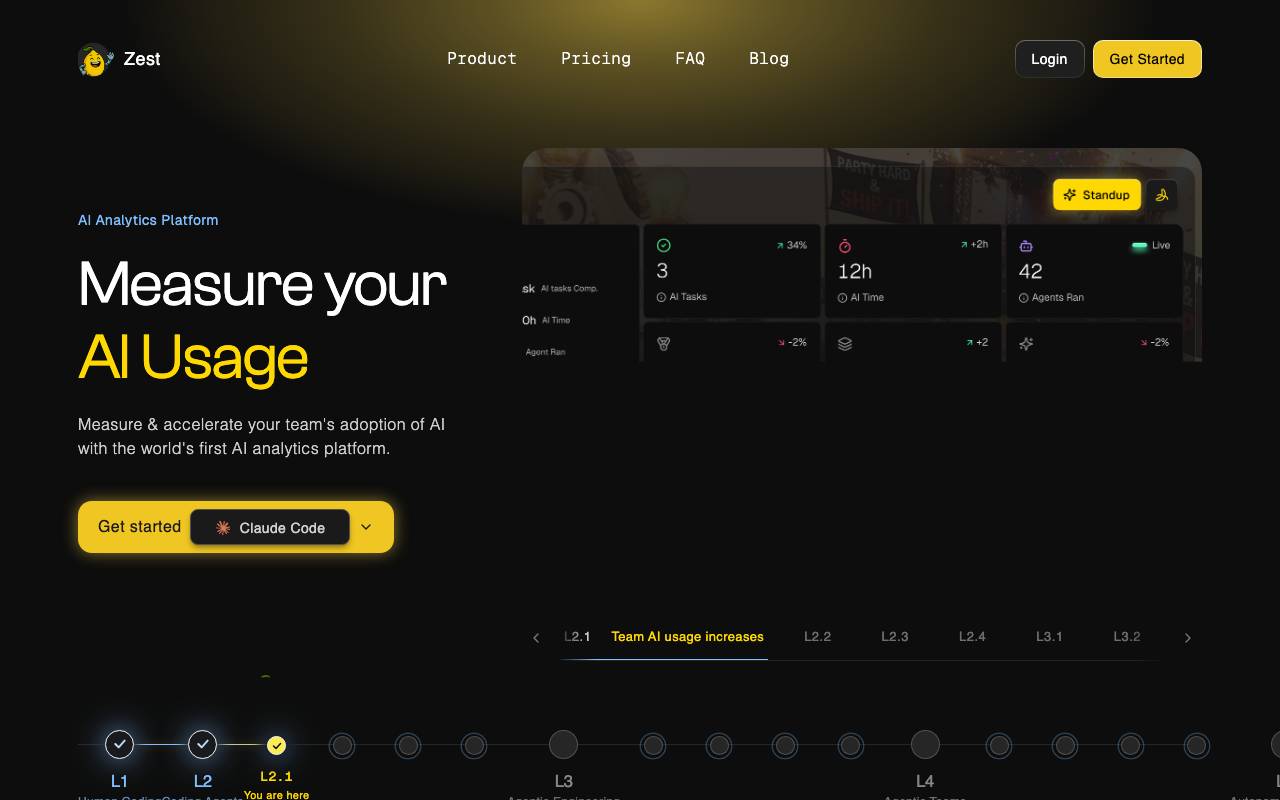
Zest is an AI-powered coding companion built to help developers move faster through routine and complex programming tasks. It integrates into typical development workflows to assist with writing, reviewing, and refining code. The tool aims to reduce friction in common engineering activities by offering contextual suggestions, automating repetitive work, and surfacing relevant information when needed. Developers can use Zest to accelerate iteration cycles without sacrificing code quality. Whether tackling new features, debugging issues, or maintaining existing codebases, Zest positions itself as a productivity layer that complements rather than replaces an engineer's expertise.
Criteria breakdown
- AI-assisted code generation
- Contextual coding suggestions
- Workflow automation for routine tasks
- Support for everyday development activities
- Productivity-focused developer tooling