Past battle · 2024-06-22 UTC
AI Infrastructure & MLOps Showdown — June 22, 2024
From the AI Infrastructure & MLOps category. 26 marks placed across 7 fighters. Foundry took the crown.
Final standings
The line-up
The fighters
Profiles of every tool that competed in this battle, ranked by their final score.

Foundry is a development platform focused on AI agents that operate across the web. It gives builders the infrastructure to design agents, run them against real or simulated browsing tasks, and iterate on their behavior with structured evaluations. Beyond construction, Foundry emphasizes the training and testing loop. Developers can benchmark agent performance, capture failure cases, and refine models or prompts to improve reliability on tasks like navigation, form filling, data extraction, and multi-step workflows. The tool is aimed at teams shipping production-grade browser agents who need repeatable evaluation, debugging visibility, and continuous improvement rather than one-off scripts.
Criteria breakdown
- Agent development environment
- Automated testing on browsing tasks
- Training and fine-tuning workflows
- Performance benchmarking and evals
- Debugging and trace inspection
- Iterative improvement tooling
operators.dev is a platform designed to simplify the creation and deployment of AI agents. It targets developers and teams who want to move quickly from concept to working agent without wrestling with low-level orchestration or boilerplate infrastructure code. The service focuses on streamlining common agent-building tasks such as defining behavior, connecting tools and data sources, and pushing agents into production environments. By abstracting away much of the underlying complexity, it aims to make agent development accessible to a broader range of builders. This makes operators.dev a useful option for prototyping, internal automation, and shipping production-ready agents with less engineering overhead.
Criteria breakdown
- Agent builder interface
- Streamlined deployment pipeline
- Tool and integration support
- Reduced coding requirements
- Suitable for prototyping and production
- Developer-focused workflow
AgentOS
Platform for building and orchestrating specialized AI agents that collaborate on complex tasks.
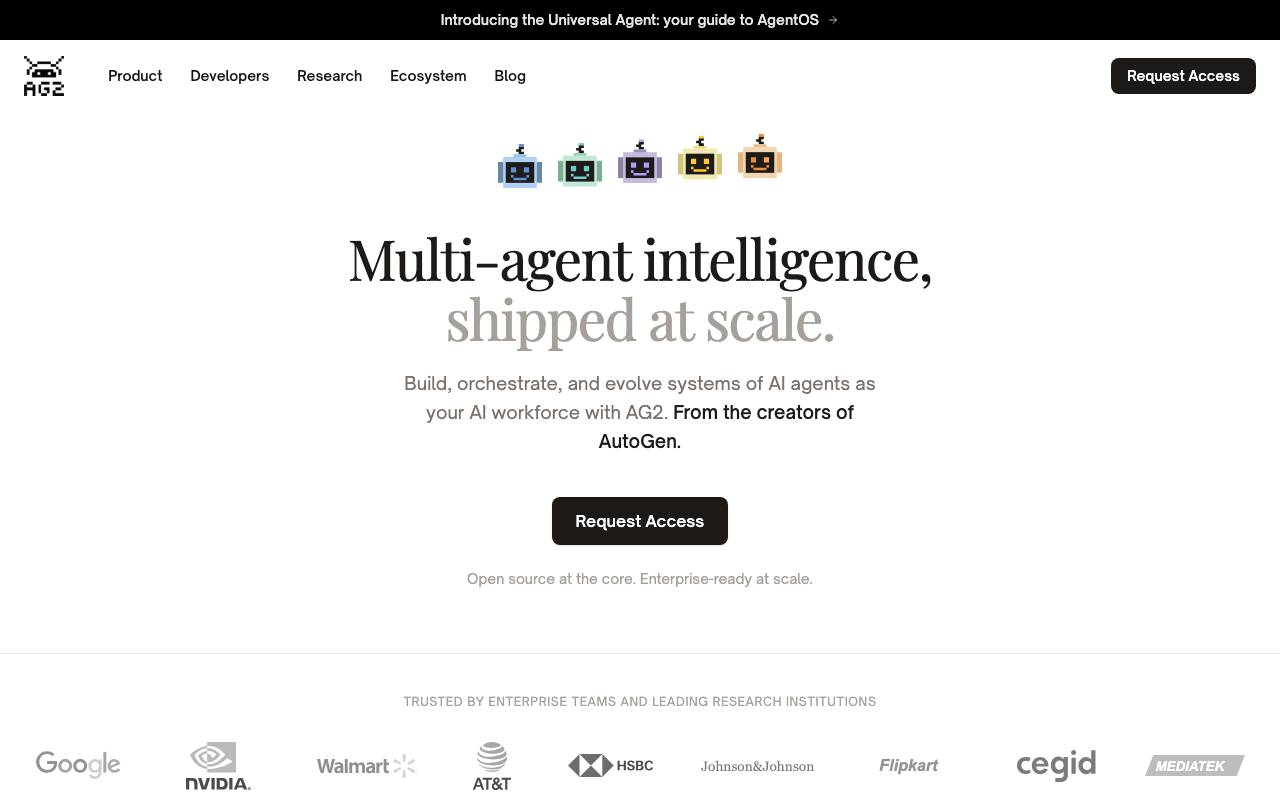
AgentOS is a development platform designed for creating networks of specialized AI agents that work together to complete multi-step workflows. Instead of relying on a single general-purpose model, teams can spin up focused agents that each handle a defined role and coordinate through a shared runtime. The platform emphasizes speed of iteration, giving developers tools to define agent behavior, connect external data sources, and manage how agents pass information between one another. It is aimed at engineers and product teams looking to ship agent-based features without building orchestration infrastructure from scratch.
Criteria breakdown
- Specialized agent creation
- Multi-agent orchestration runtime
- Inter-agent communication
- Integration with external tools and data
- Workflow design and management
- Developer-focused tooling
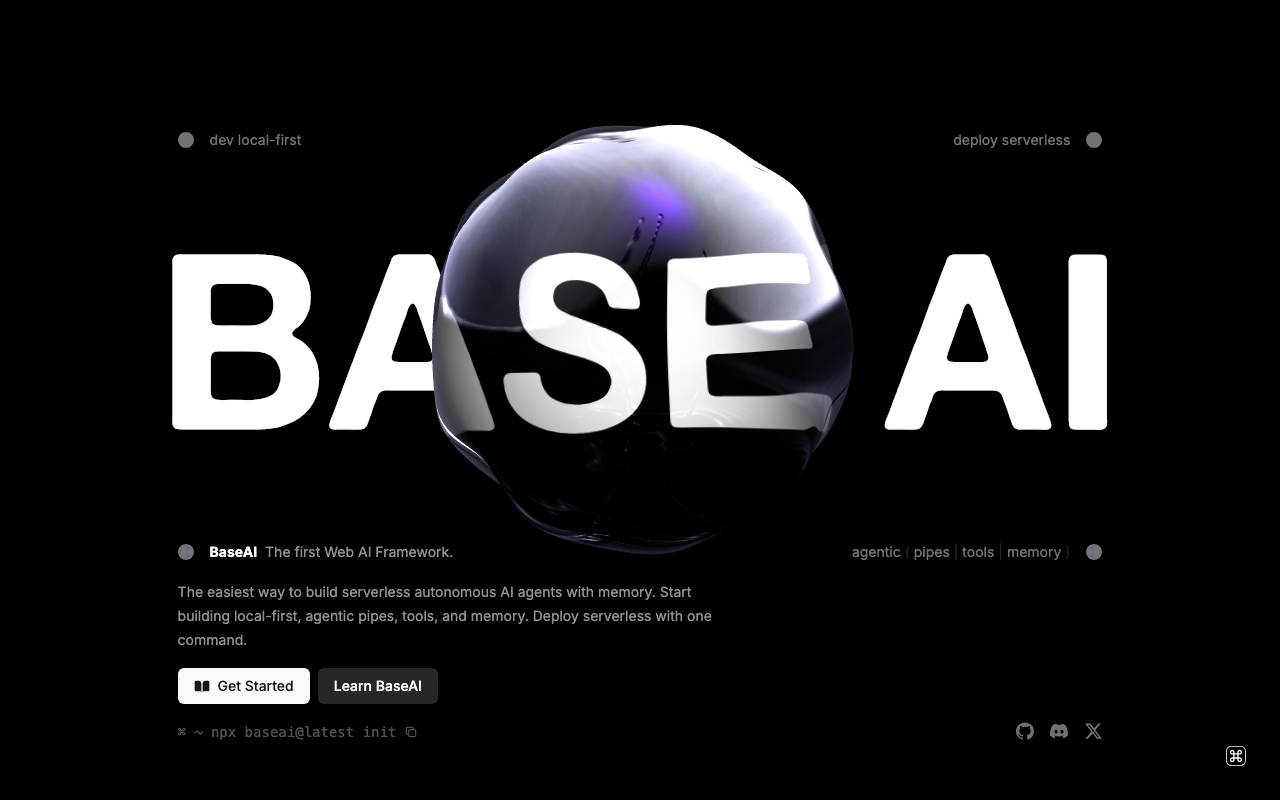
BaseAI is a developer-focused framework for creating serverless AI agents, called pipes, that can be equipped with memory, tools, and access to multiple language models. It emphasizes a local-first workflow, letting developers build, test, and iterate on agents directly from their codebase before deploying them. The framework supports retrieval-augmented generation through built-in memory primitives, integrates with popular LLM providers, and exposes a TypeScript SDK for embedding agents into web and backend applications. Configuration lives in code, making versioning and collaboration straightforward. BaseAI targets teams that want the flexibility of an open-source stack without managing complex agent infrastructure, while still being able to extend functionality through custom tools and integrations.
Criteria breakdown
- Serverless AI agent pipes
- Memory for RAG workflows
- Tool calling support
- TypeScript SDK
- Multi-model LLM compatibility
- Config-as-code setup
Phala
Confidential AI compute and private model inference powered by trusted execution environments.
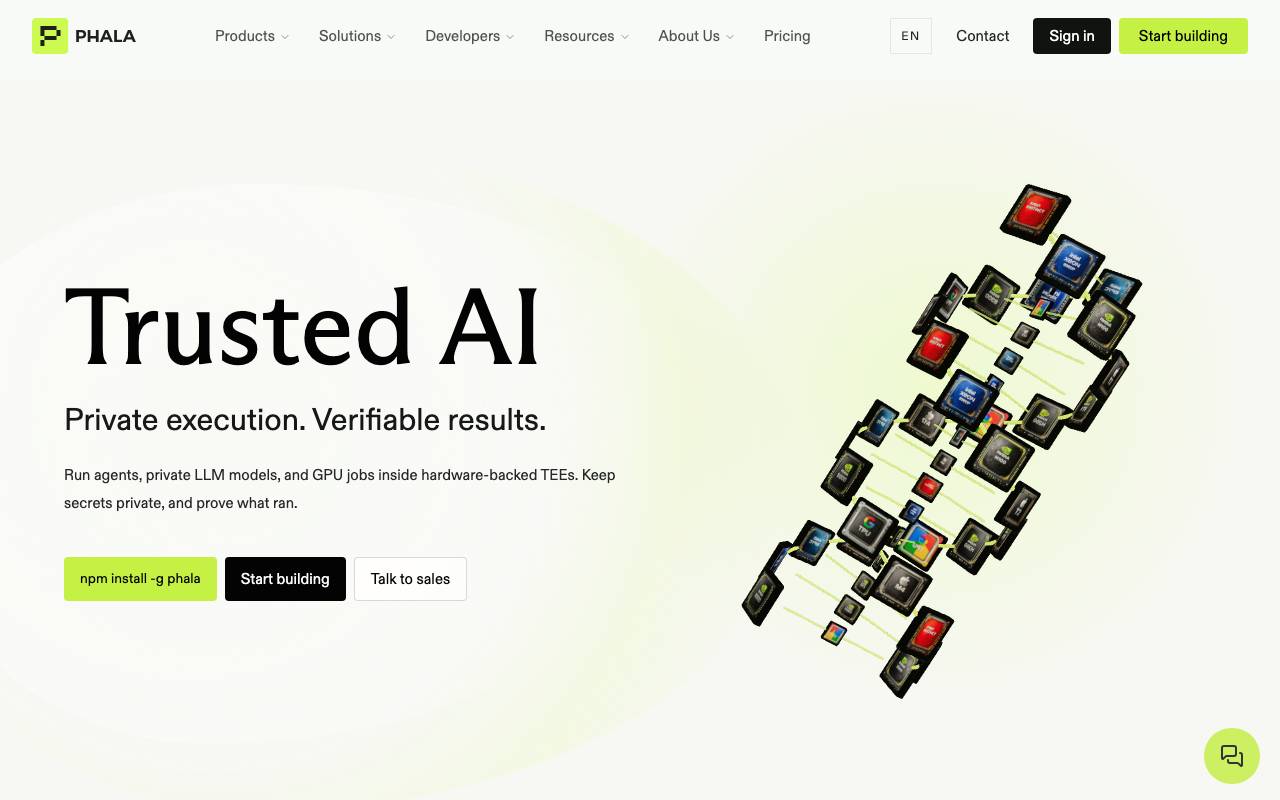
Phala is a decentralized cloud platform that runs AI workloads inside trusted execution environments (TEEs), giving developers verifiable privacy guarantees for both code and data. It lets teams deploy models, agents, and applications where inputs, outputs, and weights remain shielded from the host infrastructure. The platform supports private inference for popular open models, confidential containers for custom workloads, and on-chain attestations that prove computations ran as expected. This makes it suitable for sensitive use cases like healthcare data, financial analysis, autonomous agents handling keys, and AI services that require auditable trust.
Criteria breakdown
- Confidential GPU and CPU compute
- Private LLM inference endpoints
- Remote attestation and proof generation
- Deployable Docker-based workloads
- Integration with Web3 and on-chain agents
- Pay-as-you-go decentralized hosting
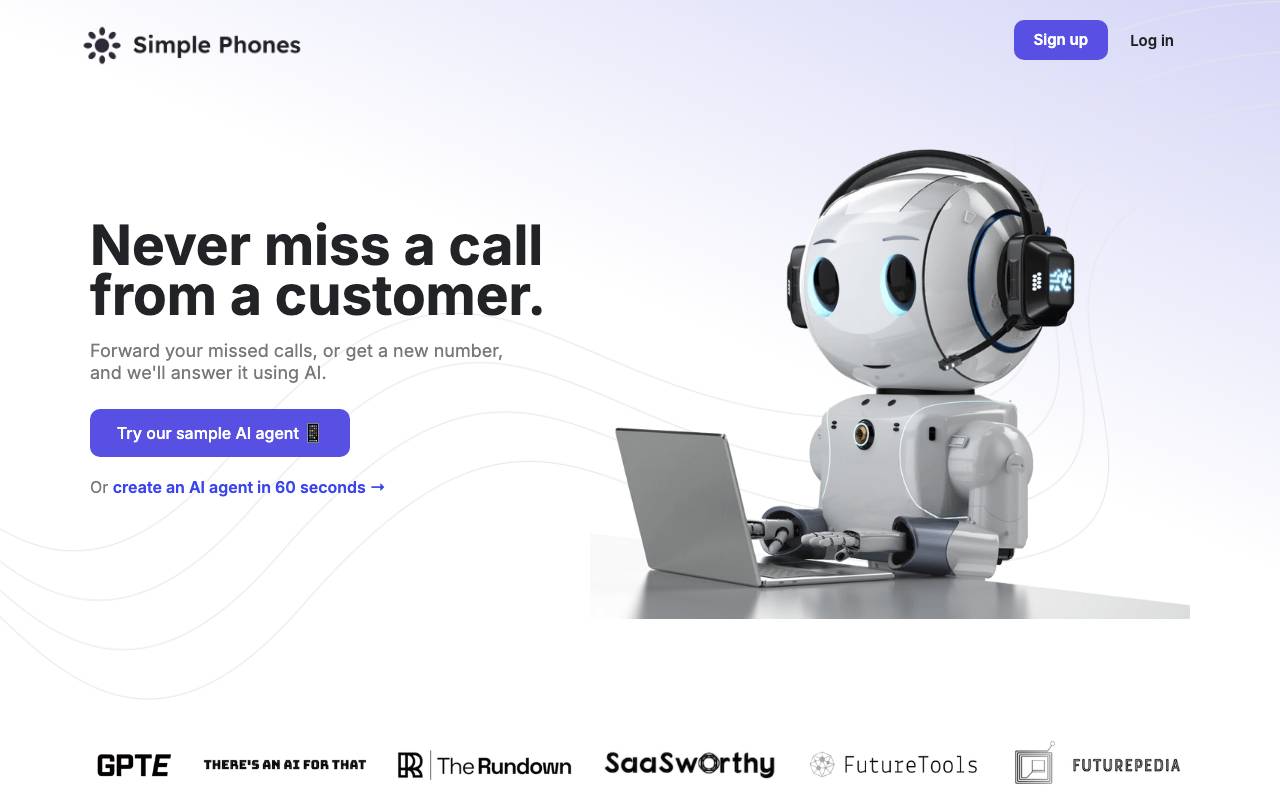
Simple Phones provides AI-powered voice agents that handle inbound and outbound business calls. The service forwards missed or all calls to a custom AI agent that can answer questions, capture lead details, book appointments, and route urgent calls to a human when needed. Businesses set up an agent by describing their company, services, and FAQs, then receive a new phone number or forward an existing one. Each call is logged with a transcript, summary, and recording, making it easy to review interactions and refine the agent over time. It's aimed at small businesses, agencies, and service providers that struggle to keep up with phone volume.
Criteria breakdown
- AI voice agent for inbound calls
- Custom phone number or call forwarding
- Call transcripts, recordings, and summaries
- Appointment booking and lead capture
- Human handoff and call routing
- Continuous agent tuning based on past calls
GaiaHub AI is a no-code platform designed to help users create and launch AI-powered applications without writing any code. It targets entrepreneurs, product teams, and non-technical builders who want to turn ideas into working AI tools in a short timeframe. The platform combines drag-and-drop building blocks with pre-configured AI models, allowing users to design workflows, connect data sources, and publish apps directly from the interface. This streamlines the process of moving from concept to a deployable product. GaiaHub AI is particularly useful for rapid prototyping, internal automation, and small teams that need to ship AI features without hiring specialized developers.
Criteria breakdown
- Visual no-code app builder
- Pre-integrated AI models
- One-click deployment
- Workflow and automation tools
- Data source connectors
- Templates for common use cases