Past battle · 2025-04-24 UTC
Agent Development Showdown — April 24, 2025
From the Agent Development category. 32 marks placed across 7 fighters. DeepOpinion took the crown.
Final standings





The line-up
The fighters
Profiles of every tool that competed in this battle, ranked by their final score.

DeepOpinion
Enterprise AI platform for automating complex knowledge work and unstructured data tasks.
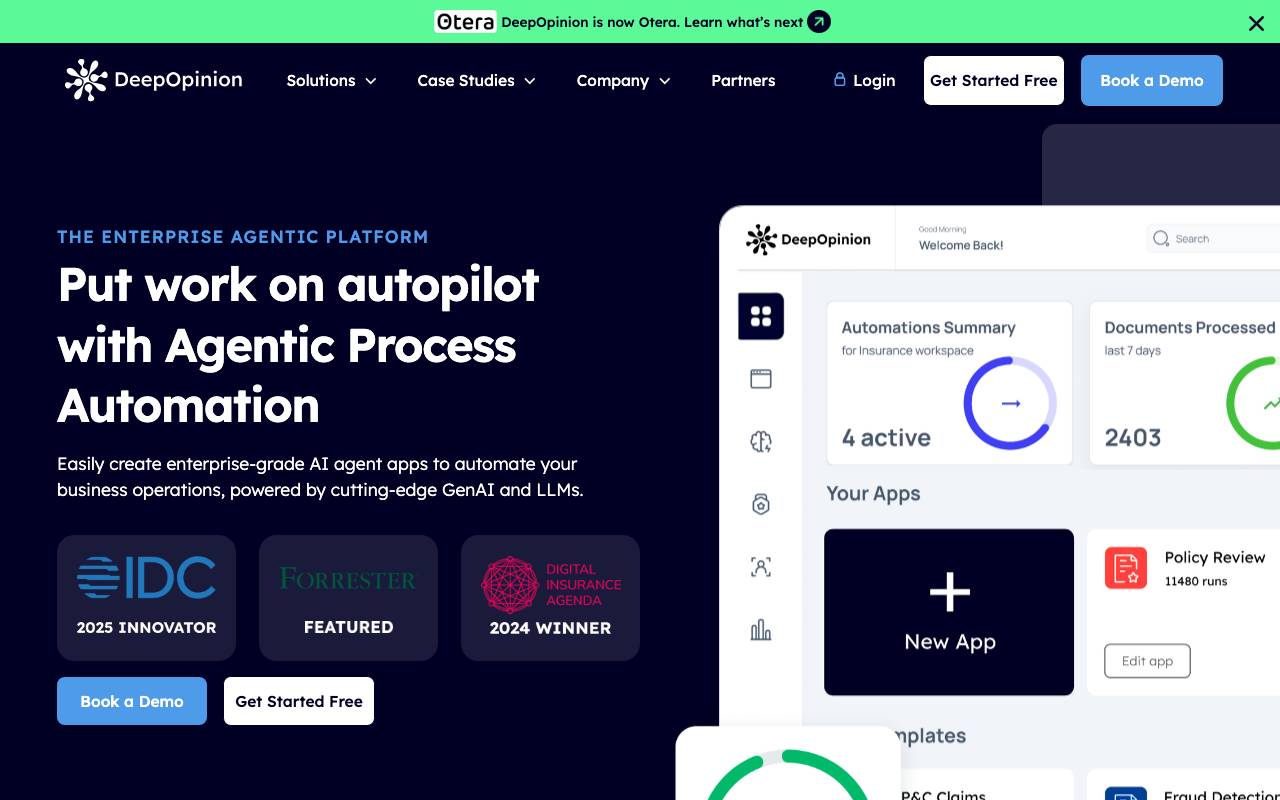
DeepOpinion is an enterprise-focused automation platform designed to handle the kind of complex, document-heavy knowledge work that traditional RPA tools struggle with. It combines large language models with workflow tooling to process unstructured inputs like emails, contracts, invoices, and support tickets at scale. The platform targets teams in finance, insurance, customer service, and operations that need reliable, auditable AI handling of business processes. It allows organizations to build and deploy AI agents that can read, classify, extract, and act on information without extensive custom development. With options for cloud or on-premise deployment, DeepOpinion aims to fit into regulated enterprise environments while reducing manual processing time for repetitive cognitive tasks.
Criteria breakdown
- AI agents for document and text processing
- Workflow automation for knowledge tasks
- Data extraction from unstructured sources
- Enterprise-grade security and deployment options
- Integration with existing business systems
- Human-in-the-loop review controls

Letta AI
An open-source platform for building stateful AI agents with long-term memory and advanced reasoning.
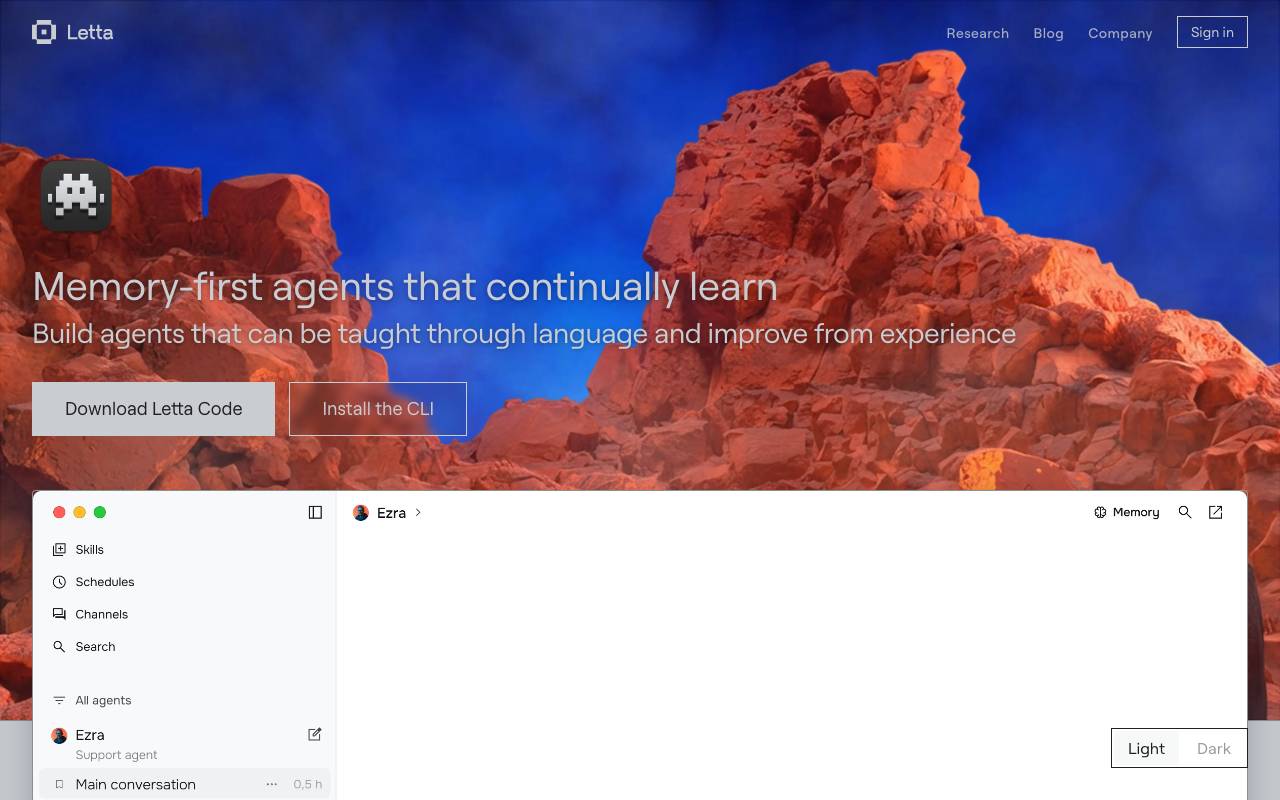
Letta AI is an open-source platform designed for creating stateful AI agents. These agents are equipped with long-term memory and advanced reasoning capabilities. The platform allows developers to build AI agents that can maintain a memory of past interactions, enabling more complex and context-aware decision-making processes. This is particularly useful for applications requiring agents to learn from experiences over time and adapt their responses accordingly. Letta AI targets developers and researchers interested in creating sophisticated AI agents for various applications, from customer service to more intricate problem-solving tasks. By providing long-term memory and advanced reasoning, Letta AI enables the development of AI agents that can handle a wide range of tasks with a higher degree of autonomy and intelligence.
Criteria breakdown
- Stateful AI agents
- Long-term memory
- Advanced reasoning

Botpress
End-to-end platform for building, deploying and managing AI agents and chatbots.
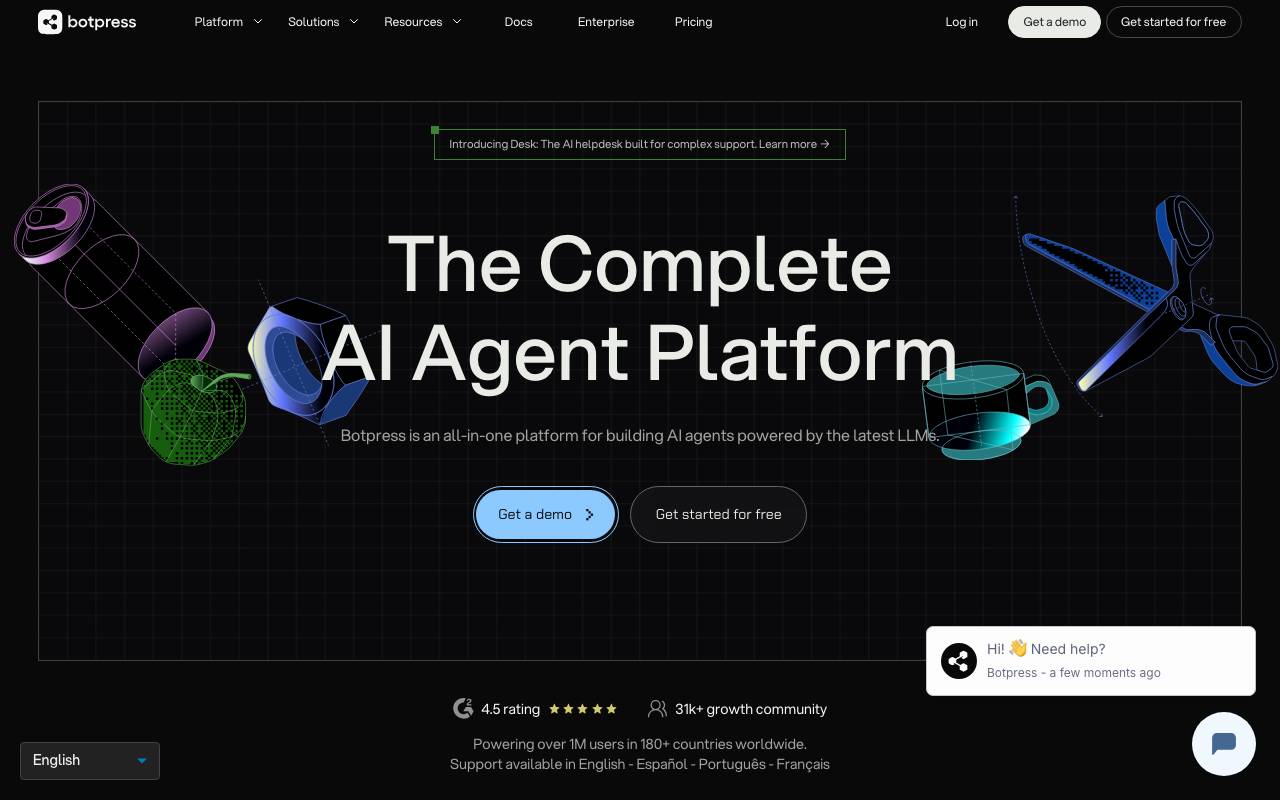
Botpress is a development platform for creating conversational AI agents powered by large language models. It provides a visual flow builder, an SDK, and integrations with popular messaging channels, letting teams design agents that can hold natural conversations, call APIs, and execute multi-step tasks. The platform combines low-code tools with deeper customization options, so both non-technical users and developers can collaborate on the same project. Features like knowledge bases, analytics, and human handoff make it suitable for production use cases such as customer support, lead generation, and internal automation. Botpress offers a free tier for experimentation and paid plans that scale with usage, plus an open-source community edition for self-hosted deployments.
Criteria breakdown
- Drag-and-drop conversation flow editor
- LLM-powered agents with tool use
- Knowledge base ingestion from docs and URLs
- Multi-channel deployment (web, WhatsApp, Slack, etc.)
- Analytics and conversation monitoring
- Human handoff and team collaboration

Gretel AI
Synthetic data platform for generating privacy-safe, AI-ready datasets that mirror real-world data.
Gretel AI is a developer-focused platform for creating synthetic data that statistically resembles real datasets without exposing sensitive information. Teams use it to unblock AI and analytics projects when access to production data is restricted by privacy, compliance, or availability constraints. The platform offers APIs, SDKs, and pre-built models for generating tabular, text, and time-series data, along with tools for evaluating quality and privacy risk. It supports common use cases such as training machine learning models, augmenting underrepresented classes, sharing data across teams, and testing software with realistic but artificial records.
Criteria breakdown
- Generative models for synthetic tabular and text data
- Differential privacy and PII redaction controls
- Quality, accuracy, and privacy scoring reports
- Python SDK and REST API integration
- Pre-trained models and customizable templates
- Cloud and self-hosted deployment options
NetX
Modular economic network combining blockchain infrastructure with AI capabilities.
NetX is a modular economic network designed to bring together blockchain and AI technologies within a unified framework. Its architecture allows developers and organizations to plug in components for decentralized transactions, data exchange, and AI-driven services, supporting a range of use cases across digital economies. The platform aims to bridge traditional blockchain functionality with machine learning workflows, enabling tokenized incentives, smart contract automation, and AI-powered analytics to operate within the same ecosystem. This makes it suitable for teams building Web3 applications that require intelligent processing or data-driven decision making. By emphasizing modularity, NetX seeks to give builders flexibility in how they assemble their stack, choosing the blockchain, AI, and economic primitives that fit their project needs.
Criteria breakdown
- Modular network components
- Blockchain integration layer
- AI service compatibility
- Smart contract support
- Tokenized economic primitives
- Developer-focused tooling

Snorkel Flow
Programmatic data labeling and AI development platform for building production models faster.
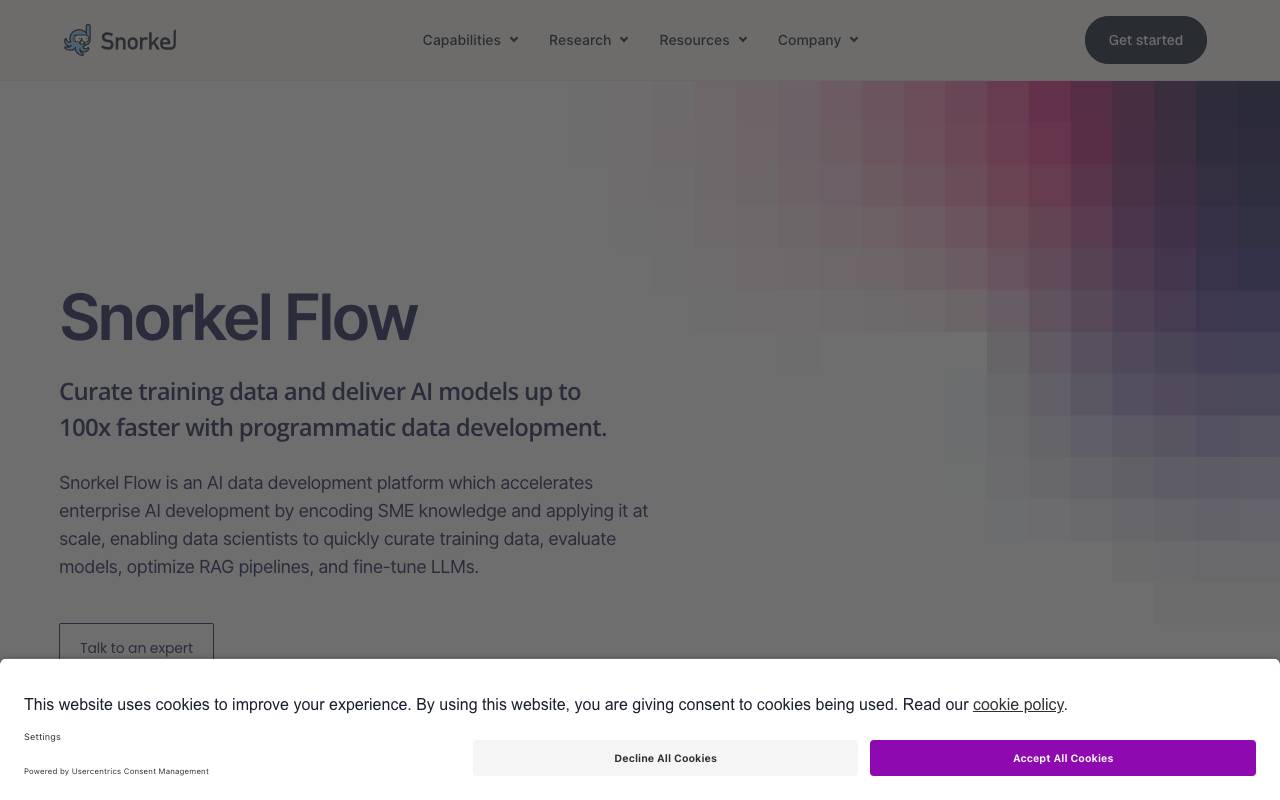
Snorkel Flow is an enterprise platform for programmatic data development, allowing teams to label, curate, and refine training data using labeling functions instead of relying solely on manual annotation. By codifying domain expertise into reusable heuristics, it accelerates the path from raw data to production-ready AI models. The platform combines weak supervision, model training, and error analysis in a single workflow, helping data scientists and subject matter experts iterate on datasets and models collaboratively. It supports a range of use cases including document classification, information extraction, and fine-tuning foundation models for enterprise applications.
Criteria breakdown
- Programmatic labeling with labeling functions
- Weak supervision and label aggregation
- Built-in model training and evaluation
- Error analysis and data slicing tools
- Foundation model fine-tuning support
- Collaboration tools for SMEs and data scientists

LangSmith
Observability, evaluation, and debugging platform for LLM applications from the LangChain team
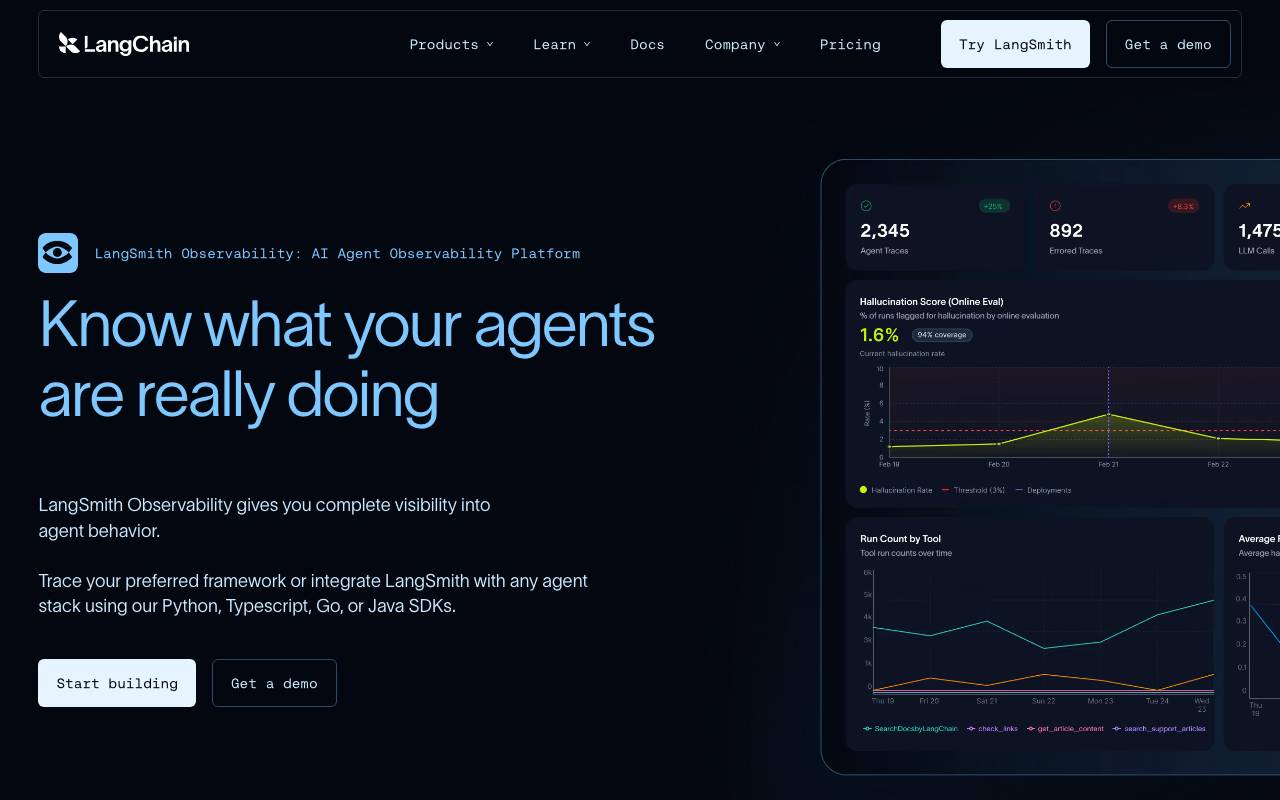
LangSmith is a developer platform built by the team behind LangChain to help teams trace, test, evaluate, and monitor applications powered by large language models. While it integrates tightly with the LangChain and LangGraph frameworks, it is framework-agnostic and can instrument any LLM application through its SDKs and APIs. Its core purpose is to address the inherent unpredictability of LLM-based systems, where outputs are non-deterministic and failures can be subtle, by giving developers visibility into what their chains, agents, and prompts are actually doing at runtime. The platform centers on tracing: each run of an application produces a detailed, nested trace showing every step, including prompts sent, model responses, token usage, latency, tool calls, and intermediate outputs. This makes it easier to debug complex multi-step agents and retrieval-augmented generation pipelines where the source of a bad answer might be buried several layers deep. Developers can inspect individual traces, filter and search across runs, and drill into the exact inputs and outputs at each node. LangSmith also provides evaluation tooling for measuring application quality. Teams can build datasets from production traces or curated examples, run their application against those datasets, and score outputs using built-in evaluators, custom code-based checks, or LLM-as-judge approaches. This supports regression testing when prompts or models change and helps quantify whether changes actually improve results rather than relying on intuition. For production use, it offers monitoring dashboards that track metrics such as latency, cost, error rates, and feedback over time, along with the ability to collect human feedback and user annotations. A prompt management and playground component lets teams iterate on and version prompts, and compare model outputs side by side. LangSmith is aimed primarily at developers and teams shipping LLM features who need to move beyond ad hoc print-statement debugging toward systematic observability and evaluation. Its main strength is the depth of integration with the LangChain ecosystem and the unified workflow connecting tracing, datasets, and evaluation. Honest trade-offs include that the richest experience assumes you are comfortable in the LangChain/LangGraph world, that LLM-based evaluation is itself imperfect and requires careful design, and that it is a hosted commercial product with usage-based pricing, though self-hosting options exist for some plans. It competes with other LLM observability tools such as Langfuse, Helicone, Arize Phoenix, and Weights & Biases Weave.
Criteria breakdown
- Run tracing with step-by-step inputs, outputs, and token usage
- Dataset creation and automated evaluation
- Built-in, code-based, and LLM-as-judge evaluators
- Production monitoring dashboards
- Human feedback and annotation collection
- Prompt management, versioning, and playground