Past battle · 2025-01-11 UTC
AI Agent Development Frameworks Showdown — January 11, 2025
From the AI Agent Development Frameworks category. 38 marks placed across 10 fighters. Mastra took the crown.
Final standings







The line-up
The fighters
Profiles of every tool that competed in this battle, ranked by their final score.
Mastra
Open-source TypeScript framework for building AI agents, workflows, RAG, memory and MCP, with optional cloud studio and observability.
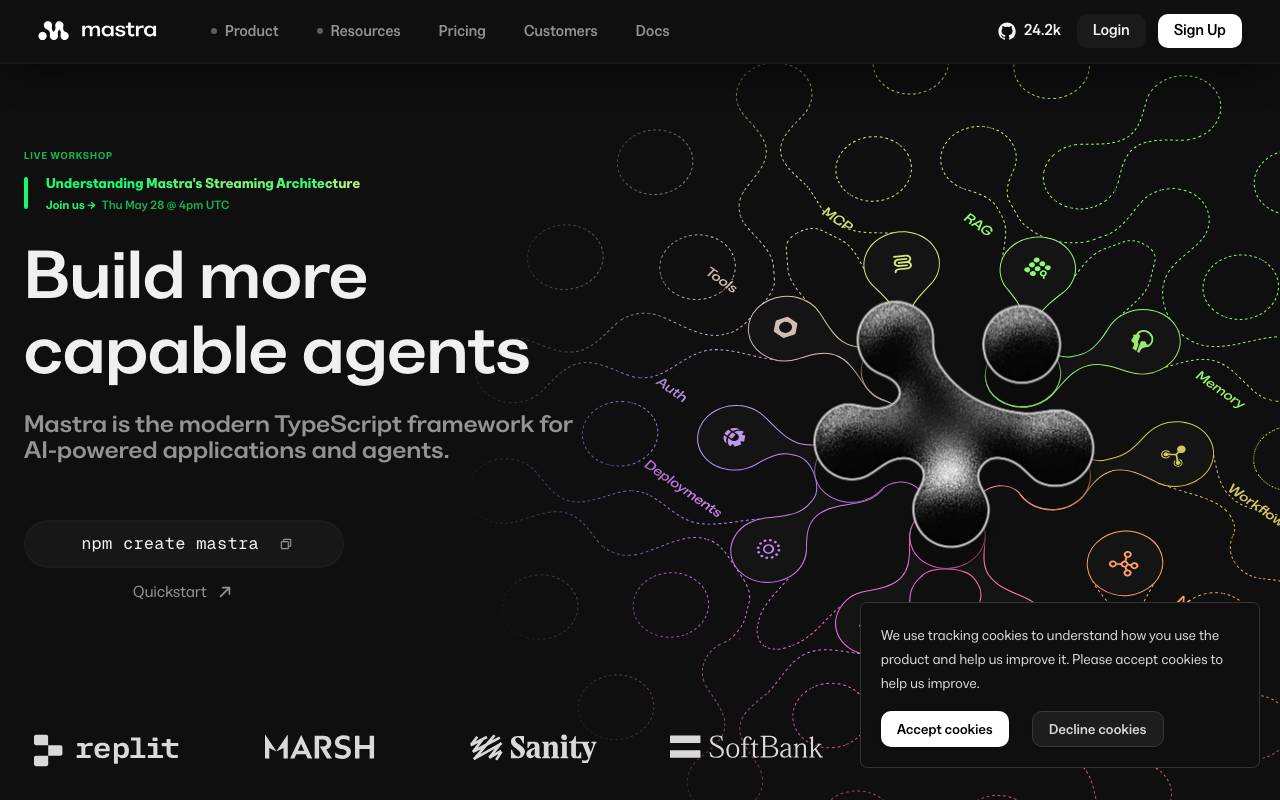
Mastra is an open-source TypeScript framework for building AI-powered applications and agents. It provides a set of tools for developers to go from idea to implementation, including agents, workflows, memory, workspaces, and observability. Mastra integrates with various frontend and backend frameworks and can be deployed as a standalone server. It enables developers to build a range of capabilities, such as internal automation agents, customer-facing agents, and more. Mastra includes features like built-in observability, repeatable checks, and cacheable resumable streams. It is designed to support fast-scaling startups and large global organizations. Mastra's architecture is centered around agents, which can be defined with instructions, models, tools, and runtime behavior. Agents can interact with users, complete tasks, and hand off to product flows. The framework also includes a built-in event system for events, as well as a system for publishing and subscribing to events with Redis Streams and Google Cloud Pub/Sub. Mastra has a rich ecosystem of resources, including books, blogs, and guides. It has a large community of users and is widely adopted in various industries.
Criteria breakdown
- Agents
- Workflows
- Memory
- Workspaces
- Observability
- Built-in event system

AI Legion
An open-source platform for creating autonomous AI agents that collaborate to accomplish tasks.
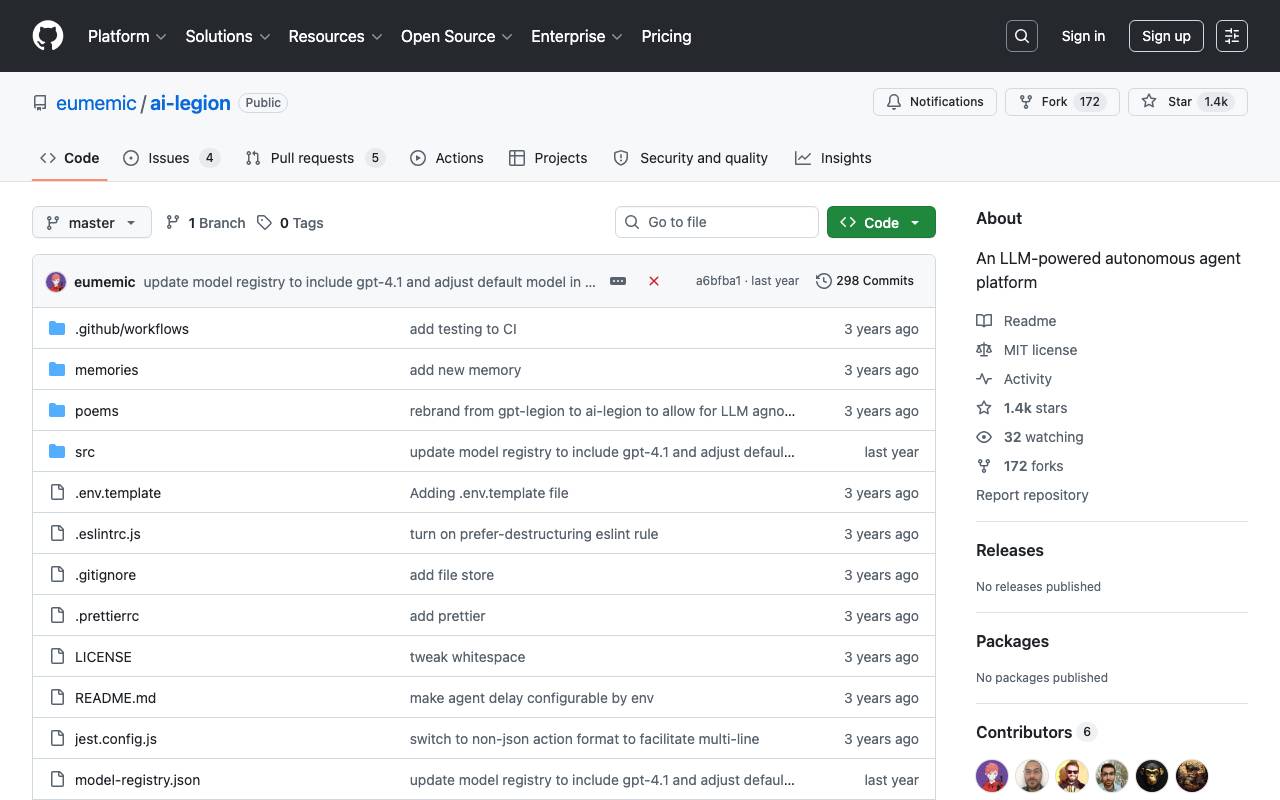
AI Legion is an open-source platform for creating autonomous AI agents that collaborate to accomplish tasks. It uses large language models, such as GPT-3.5-turbo and GPT-4, to enable agents to work together and achieve complex goals. The platform provides a framework for setting up and managing these agents, including configuration files, APIs, and workflows. AI Legion is designed to be extensible and customizable, allowing users to create and integrate their own models, actions, and features. The platform is suitable for a variety of use cases, including research, development, and deployment of autonomous AI systems. Setting up an AI Legion environment involves installing the required dependencies, including Node.js and OpenAI API keys. The agents can then be spun up and interacted with through the console. The platform also includes features for managing agent state, including the ability to delete event logs and restart agents with custom configurations. AI Legion is a powerful tool for building and deploying autonomous AI systems, and its open-source nature makes it accessible to a wide range of users. However, it also requires a significant amount of technical expertise and configuration effort to set up and use effectively. One key benefit of AI Legion is its ability to enable agents to learn and adapt over time, using a combination of machine learning and knowledge graph techniques. This allows the agents to improve their performance and decision-making capabilities as they interact with the environment. However, AI Legion also presents several challenges and limitations, including the need for extensive configuration and management effort, the risk of agent errors and infinite loops, and the potential for high token counts and API usage costs. Additionally, the use of large language models may raise concerns around bias and accuracy. In terms of specific features, AI Legion includes support for web search, custom search engines, and APIs, as well as the ability to manage agent state and restart agents with custom configurations. The platform is also highly extensible, allowing users to create and integrate their own models, actions, and features. Some potential use cases for AI Legion include research and development of autonomous AI systems, deployment of AI-powered workflows and processes, and creation of custom AI-powered tools and applications. Overall, AI Legion is a powerful and extensible platform for building and deploying autonomous AI systems, but it requires significant technical expertise and configuration effort to use effectively.
Criteria breakdown
- Web search
- Custom search engines
- APIs and webhooks for integration
- Agent state management
- Custom model and action creation
- Knowledge graph and machine learning capabilities

AutoML-Agent
Open-source multi-agent LLM framework that automates end-to-end machine learning pipelines.
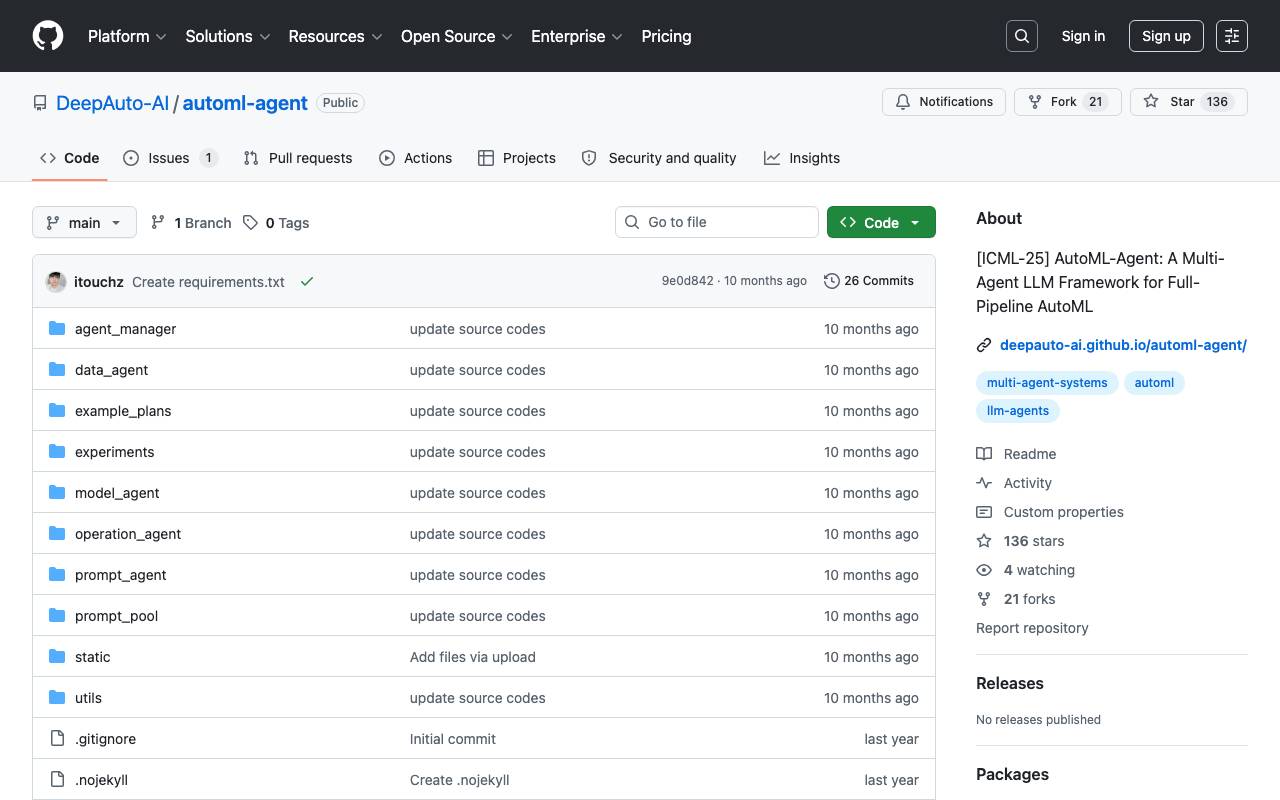
AutoML-Agent is an open-source framework that uses coordinated large language model agents to handle the full machine learning lifecycle. Instead of relying on a single model or script, it delegates tasks like data understanding, preprocessing, model selection, training, and evaluation across specialized agents that collaborate toward a shared goal. The framework is aimed at researchers and developers who want to automate experimentation without writing extensive pipeline code. By describing a dataset and objective in natural language, users can have agents propose, build, and iterate on candidate solutions, surfacing results and reasoning along the way. Because it is open source, AutoML-Agent can be extended with custom agents, tools, or model backends, making it useful both as a practical AutoML system and as a research testbed for multi-agent workflows.
Criteria breakdown
- Multi-agent LLM orchestration
- Automated data preprocessing and feature handling
- Model selection and hyperparameter search
- Training and evaluation pipeline generation
- Natural language task specification
- Extensible architecture for custom agents

Cerebrum: AIOS SDK
An SDK for developing and deploying LLM-based AI agents within the AIOS framework.
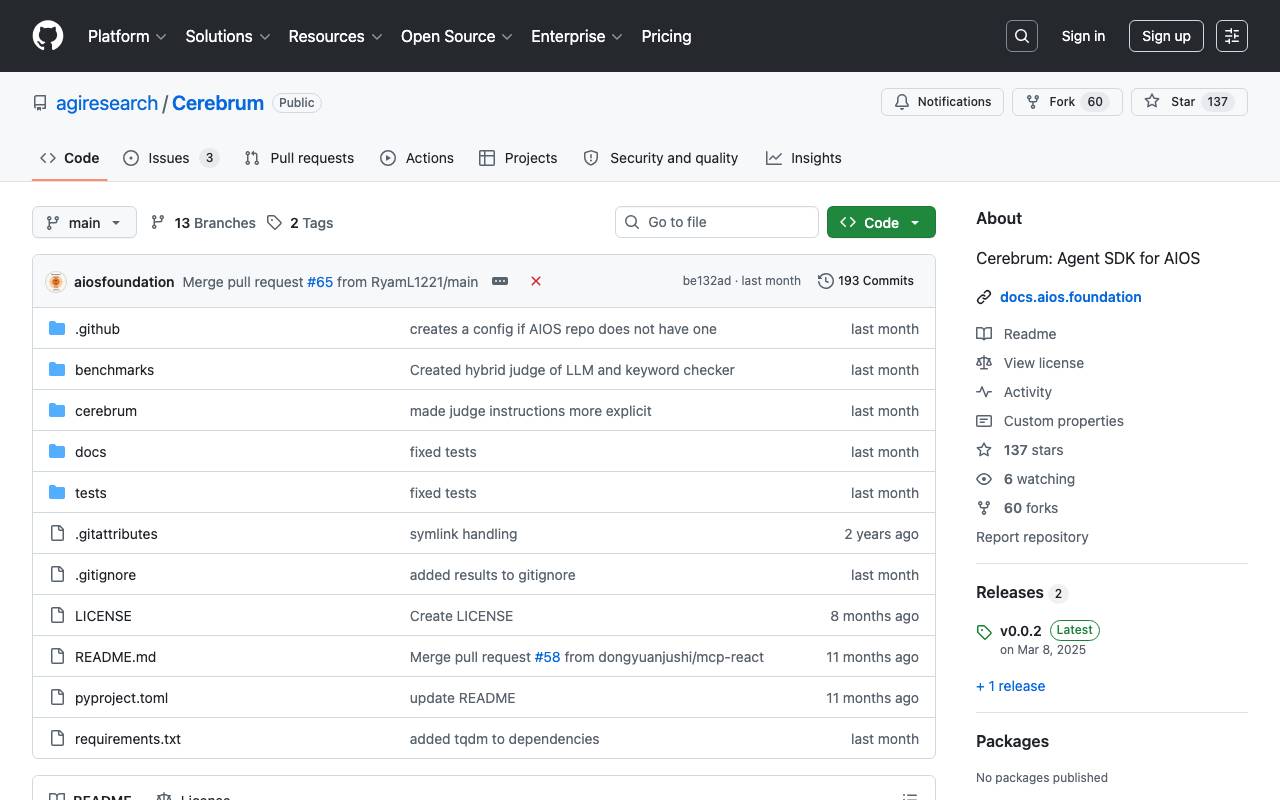
Cerebrum is an SDK for developing and deploying LLM-based AI agents within the AIOS (AI Agent Operating System) framework. AIOS addresses challenges such as scheduling, context switching, memory management, and tool management for LLM-based agents. The Cerebrum SDK allows developers to build and run agent applications by interacting with the AIOS kernel. It supports both Web UI and Terminal UI. The SDK includes features for listing available LLMs, agents, and tools, as well as downloading, uploading, and running agents and tools. Cerebrum is designed for agent users and developers, enabling them to create and deploy AI agent applications.
Criteria breakdown
- Agent development and deployment
- LLM-based AI agent management
- Support for Web UI and Terminal UI
- Agent and tool management
- Listing available LLMs, agents, and tools
- Downloading and uploading agents and tools

Gemma 3
An open-source AI model optimized for single-GPU performance, supporting multimodal inputs and over 140 languages.
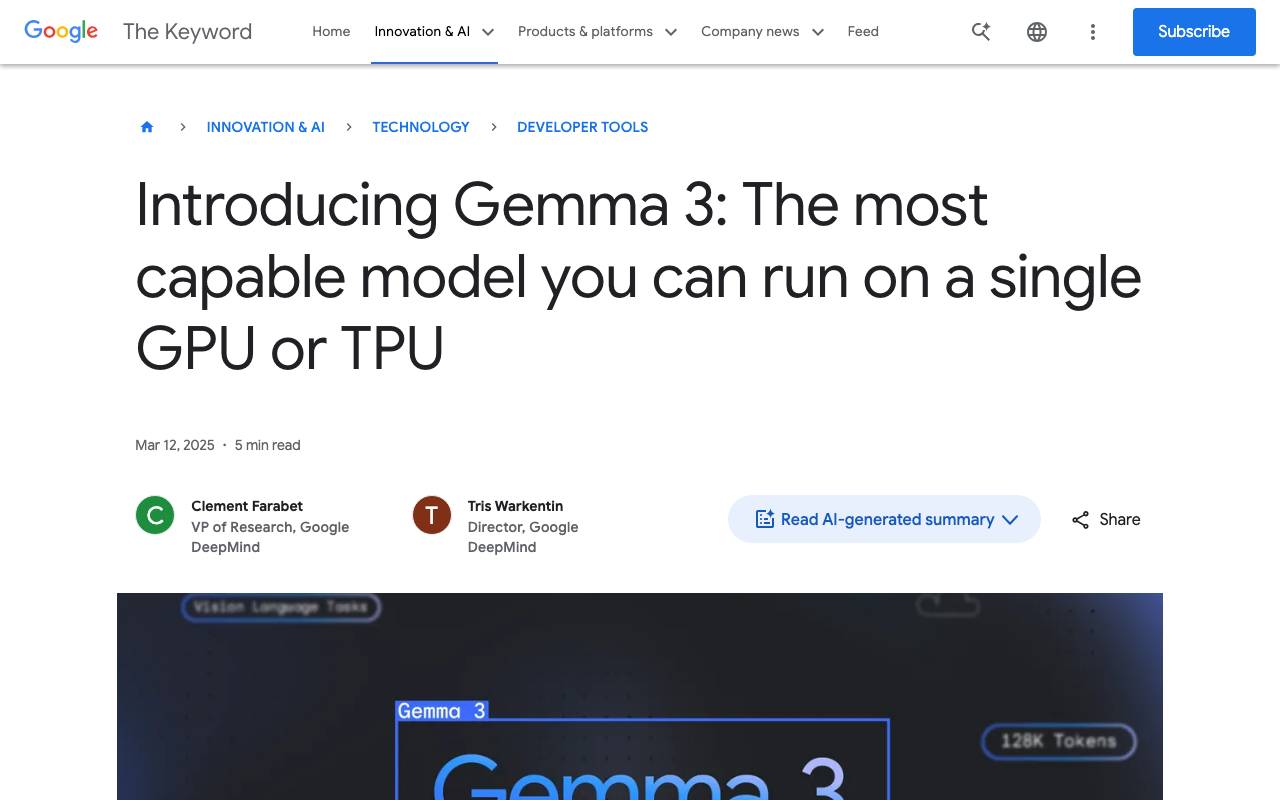
Gemma 3 is a collection of lightweight, state-of-the-art open models designed to run on devices, particularly optimized for single-GPU performance. It supports multimodal inputs and over 140 languages. The model comes in various sizes (1B, 4B, 12B, and 27B), allowing developers to choose the best fit for their hardware and performance needs. Gemma 3 offers advanced text and visual reasoning capabilities, a 128k-token context window, and function calling for complex tasks. It also includes quantized versions for faster performance and reduced computational requirements. The model is part of Google's commitment to making useful AI technology accessible and builds upon the same research and technology that powers their Gemini 2.0 models. Gemma 3 is designed to enable developers to create AI applications that can run directly on devices such as phones, laptops, and workstations. Gemma 3 delivers state-of-the-art performance for its size, outperforming other models like Llama3-405B, DeepSeek-V3, and o3-mini in preliminary human preference evaluations. It allows for global applications with out-of-the-box support for over 35 languages and pretrained support for over 140 languages. The model enables the creation of AI-driven workflows using function calling and structured output. The development of Gemma 3 included rigorous safety protocols, such as extensive data governance, alignment with safety policies via fine-tuning, and robust benchmark evaluations. The Gemma family of open models has seen significant adoption, with over 100 million downloads and a vibrant community that has created more than 60,000 Gemma variants. Gemma 3's capabilities make it suitable for developers looking to create engaging user experiences that can fit on a single GPU or TPU host.
Criteria breakdown
- multimodal AI support
- responsibility-focused development
- extensive fine-tuning
- support for 140 languages
- improved performance

MiniMax‑M1
Open‑source large‑scale reasoning model with 1 million token context and hybrid Mixture‑of‑Experts architecture.
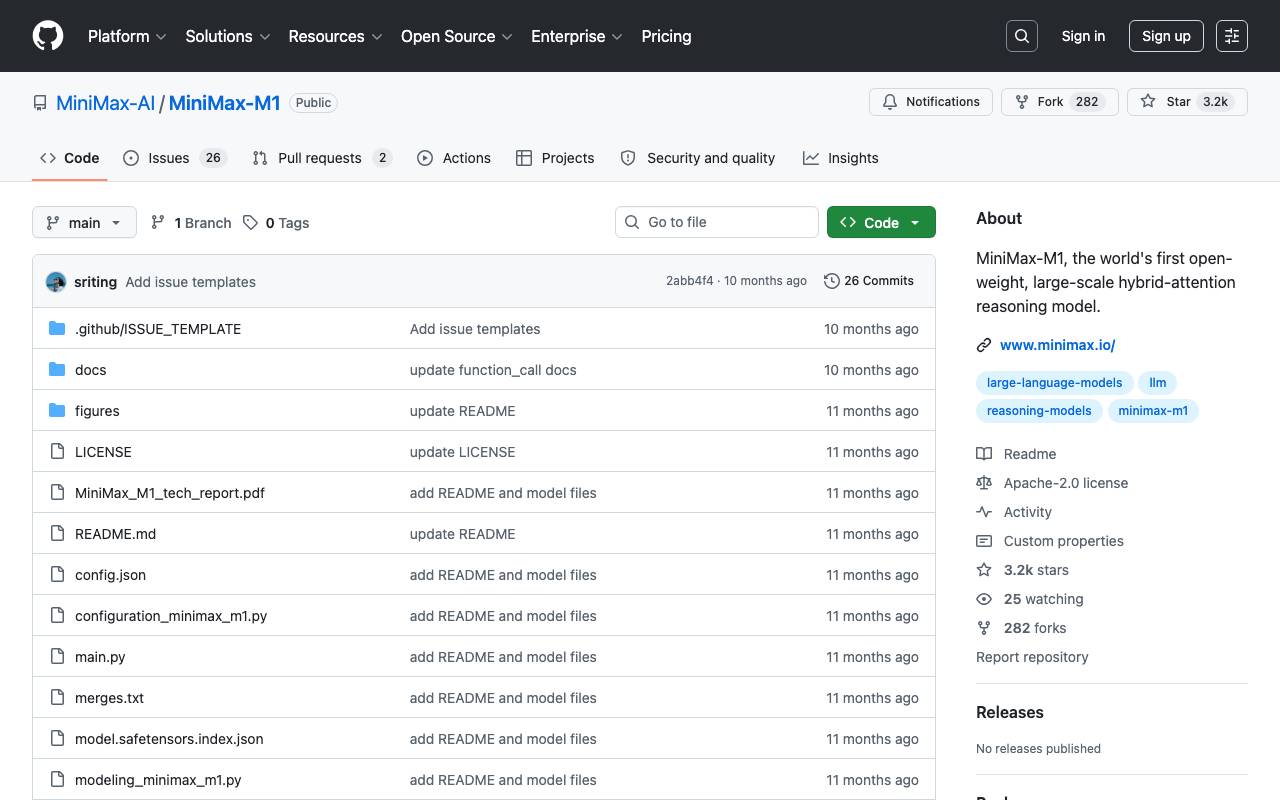
MiniMax-M1 is an open-weight, large-scale hybrid-attention reasoning model. It's powered by a hybrid Mixture-of-Experts (MoE) architecture combined with a lightning attention mechanism, enabling efficient scaling of test-time compute. The model natively supports a context length of 1 million tokens and is trained using large-scale reinforcement learning (RL) on diverse problems. It outperforms other strong open-weight models on complex software engineering, tool using, and long context tasks. Experiments on standard benchmarks show that MiniMax-M1 outperforms other models in category tasks such as mathematics, coding, software engineering, agentic tool use, and long-context understanding. The model is particularly suitable for complex tasks that require processing long inputs and thinking extensively. MiniMax-M1 serves as a strong foundation for next-generation language model agents to reason and tackle real-world challenges. The benchmark performance comparison of leading commercial and open-weight models across different category tasks highlights the model's performance. The technical report provides more information about the model's architecture, training protocol, and evaluation results.
Criteria breakdown
- Hybrid Mixture-of-Experts (MoE) architecture
- Lightning attention mechanism
- Reinforcement learning (RL) scale framework
- Context length of 1 million tokens
- Efficient scaling of test-time compute

ScreenAgent
Open‑source VLM agent to control computer GUIs via mouse/keyboard planning and execution.
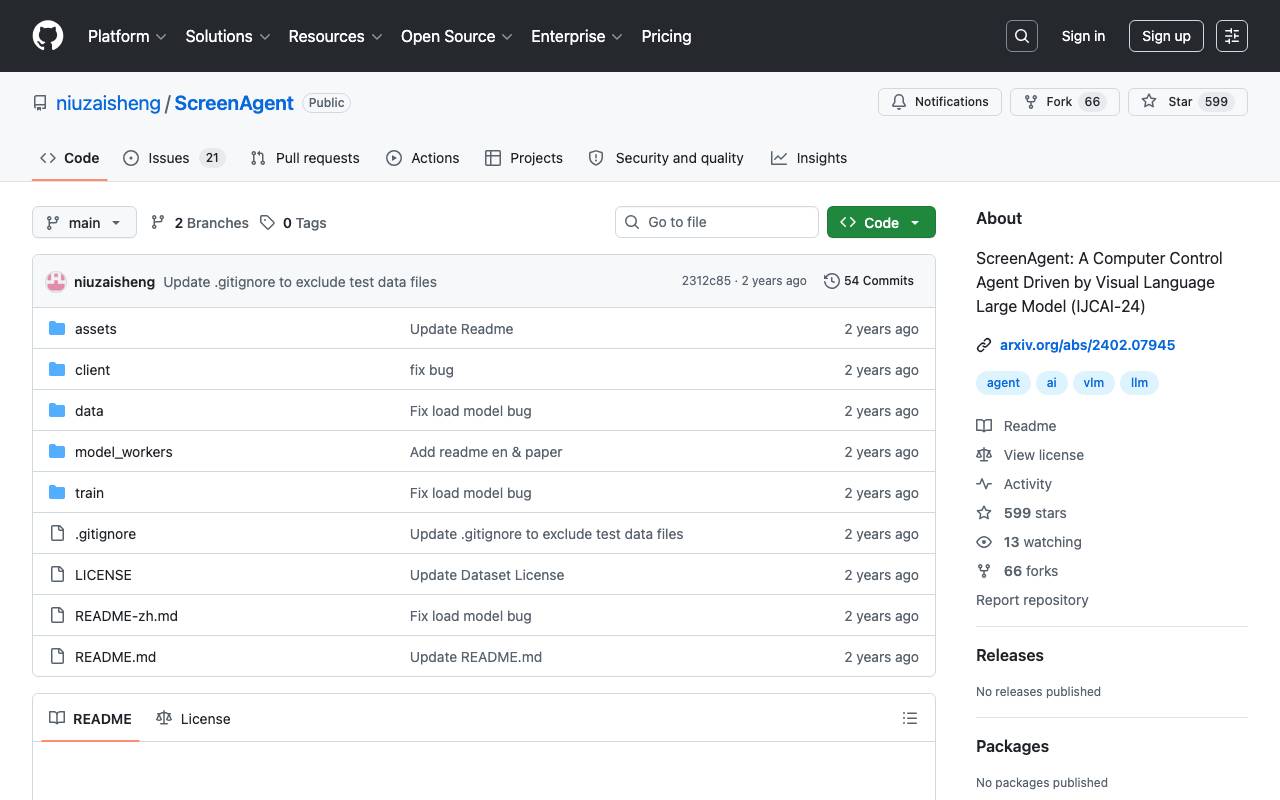
ScreenAgent is an open-source Visual Language Model (VLM) agent designed to control computer GUIs via mouse and keyboard operations. It enables interaction with real computer screens by observing screenshots and executing actions. The project includes a planning-execution-reflection process that guides the agent to complete multi-step tasks. It was created to address the challenge of teaching agents to use computers, requiring capabilities such as task planning, image understanding, and visual positioning. The ScreenAgent dataset, which covers various daily computer tasks, was manually annotated to support the agent's learning. The project consists of a client for controlling the desktop, a dataset, model workers for inference, and training code. It supports basic mouse and keyboard operations and can be applied to different desktop operating systems and applications. ScreenAgent's approach is universal and does not rely on specific APIs, making it versatile.
Criteria breakdown
- Mouse and keyboard operation execution
- Planning-execution-reflection process for task completion
- Support for various desktop operating systems and applications
- Manual annotation of the ScreenAgent dataset for diverse task coverage
- VLM agent for GUI interaction

BabyBeeAGI
An advanced version of BabyAGI with enhanced task management and functionality.
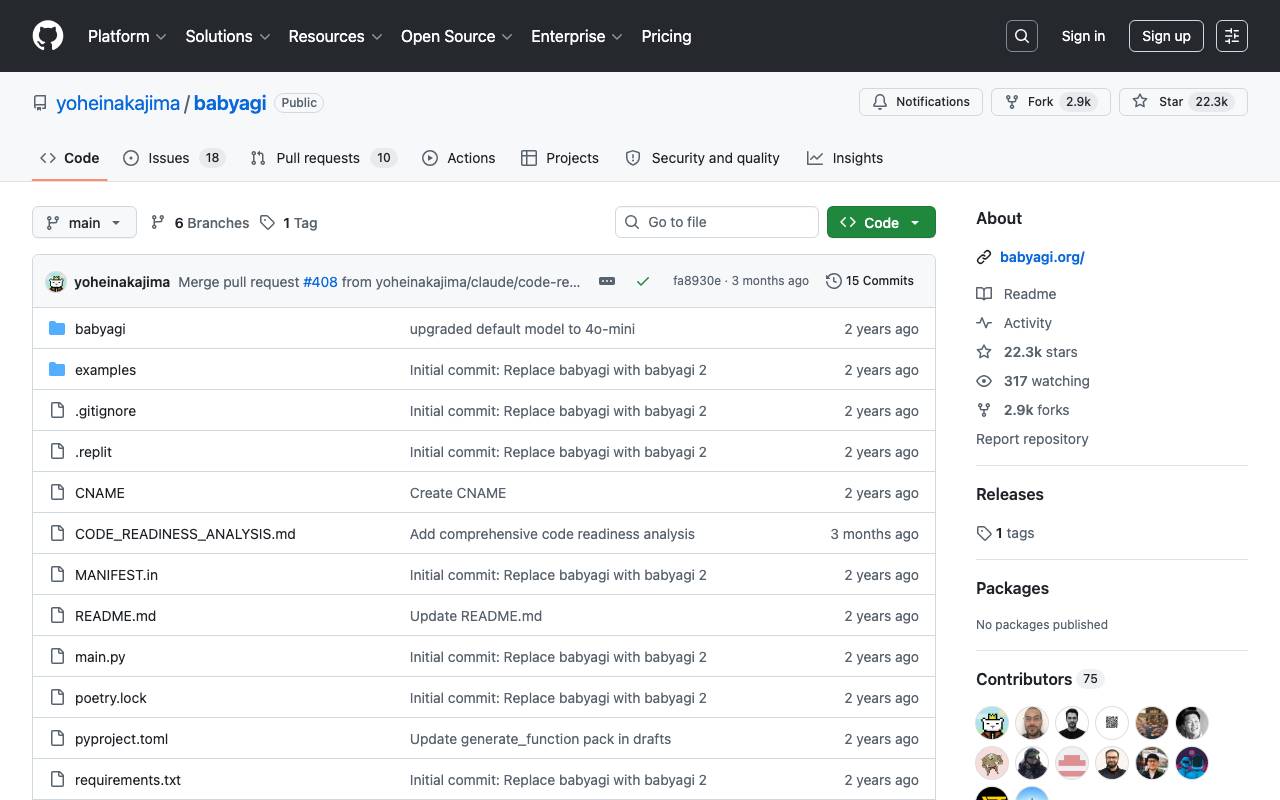
BabyAGI is an experimental framework for building self-building autonomous agents. It was created as an evolution of the original BabyAGI from March 2023, which introduced task planning for autonomous agents. The framework is built around a new function framework called 'functionz' that stores, manages, and executes functions from a database. It features a graph-based structure for tracking imports, dependent functions, and authentication secrets, along with automatic loading and comprehensive logging capabilities. The framework also includes a dashboard for managing functions, running updates, and viewing logs. It's designed to be simple and spark discussion among developers, not for production use. The core idea is to build the simplest thing that can build itself, making it an interesting approach for developing autonomous agents.
Criteria breakdown
- Function registration and metadata management
- Dependency tracking and key dependencies
- Automatic loading and logging
- Dashboard for function management and log viewing

MCP‑Use
Open‑source platform to connect LLMs with MCP servers and build custom AI agents with tool access.
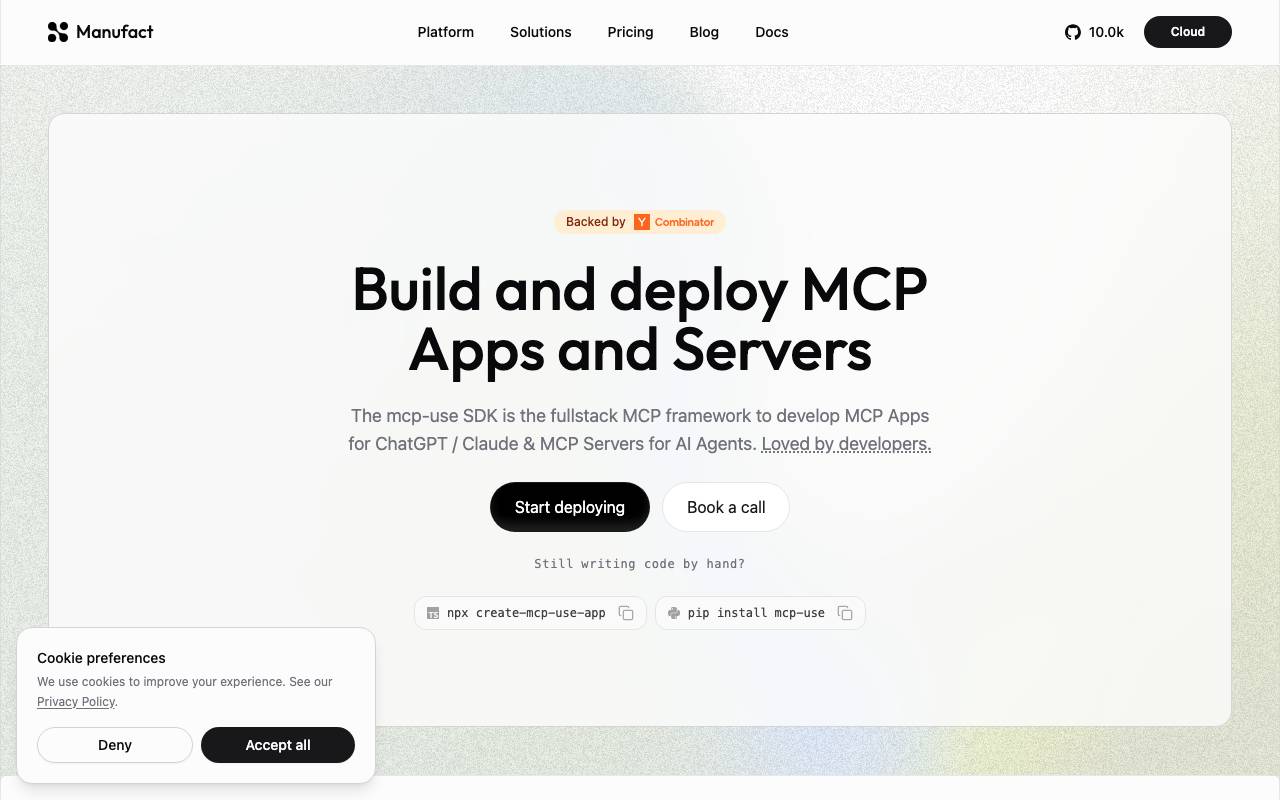
mcp-use is an open-source platform that facilitates the connection of Large Language Models (LLMs) with MCP servers and enables the development of custom AI agents that can interact with these LLMs. The platform provides a full-stack MCP framework (mcp-use SDK) to build ChatGPT Apps, Claude Connectors, and MCP Servers. With mcp-use, developers can leverage a single codebase to deploy their applications on various surfaces where users and agents already work, including ChatGPT, Claude, and Gemini. The platform offers a range of tools and features, such as the ability to scaffold MCP applications in one command, automatic deployment to Manufact Cloud, and built-in analytics and observability. Developers can use the mcp-use SDK to build and deploy MCP servers and applications without requiring additional tools. The platform also provides a Visual Inspector and Sandbox testing capabilities, allowing developers to test their applications without the need for a live LLM. mcp-use aims to simplify the development and deployment of MCP-based applications, making it an attractive option for developers looking to build and deploy custom AI agents and applications.
Criteria breakdown
- MCP server management
- LLM connection and integration
- Custom AI agent development
- Automated deployment and scalability
- Visual Inspector and Sandbox testing
- Built-in analytics and observability

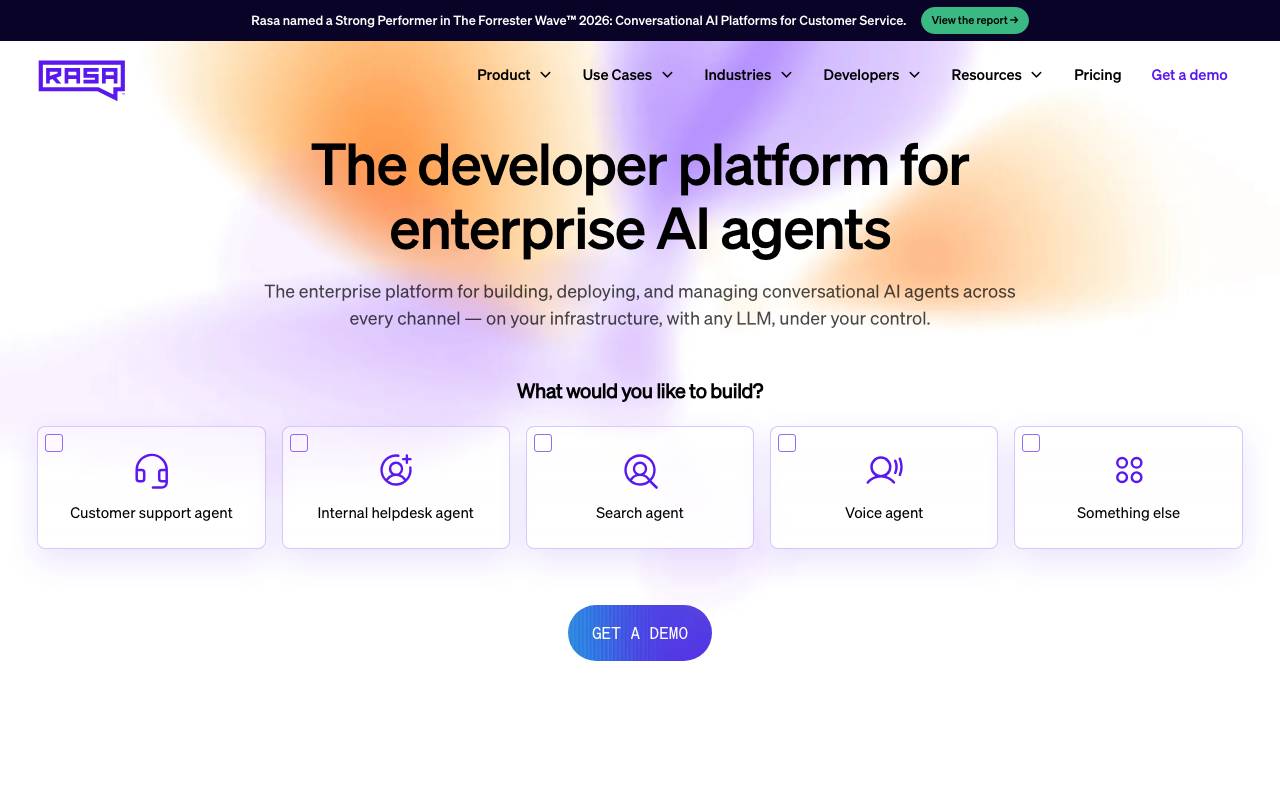
Rasa is a conversational AI platform that helps developers build contextual chat and voice assistants with full control over data, models, and deployment. Its open-source core handles natural language understanding and dialogue management, while Rasa Pro adds enterprise features like analytics, security controls, and scalable infrastructure. Rasa Studio provides a low-code interface for designers and conversation teams to collaborate on training data, flows, and testing without writing code. Together, the tools support hybrid teams shipping assistants across messaging channels, IVR systems, and custom applications. It is commonly used by enterprises in banking, telecom, healthcare, and government where on-premise deployment, compliance, and customization are required.
Criteria breakdown
- Natural language understanding engine
- Dialogue management with custom actions
- Rasa Studio low-code interface
- Voice and multi-channel integrations
- Conversation analytics and testing tools
- Enterprise security and deployment controls