Past battle · 2026-01-03 UTC
AI Agent Development Frameworks Showdown — January 3, 2026
From the AI Agent Development Frameworks category. 28 marks placed across 10 fighters. Cerebrum: AIOS SDK took the crown.
Final standings








The line-up
The fighters
Profiles of every tool that competed in this battle, ranked by their final score.

Cerebrum: AIOS SDK
An SDK for developing and deploying LLM-based AI agents within the AIOS framework.
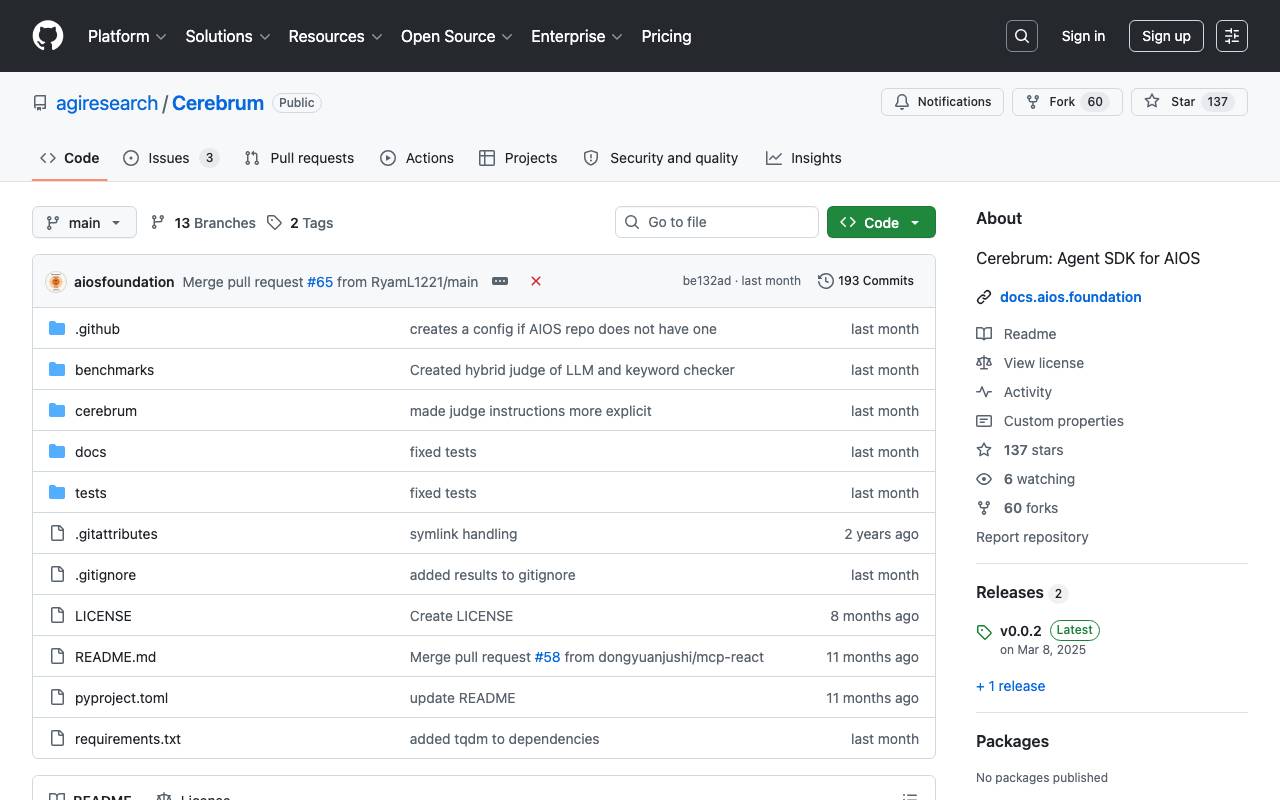
Cerebrum is an SDK for developing and deploying LLM-based AI agents within the AIOS (AI Agent Operating System) framework. AIOS addresses challenges such as scheduling, context switching, memory management, and tool management for LLM-based agents. The Cerebrum SDK allows developers to build and run agent applications by interacting with the AIOS kernel. It supports both Web UI and Terminal UI. The SDK includes features for listing available LLMs, agents, and tools, as well as downloading, uploading, and running agents and tools. Cerebrum is designed for agent users and developers, enabling them to create and deploy AI agent applications.
Criteria breakdown
- Agent development and deployment
- LLM-based AI agent management
- Support for Web UI and Terminal UI
- Agent and tool management
- Listing available LLMs, agents, and tools
- Downloading and uploading agents and tools

Awesome MCP Servers
A curated directory of Model Context Protocol servers for extending AI assistants with tools and data.
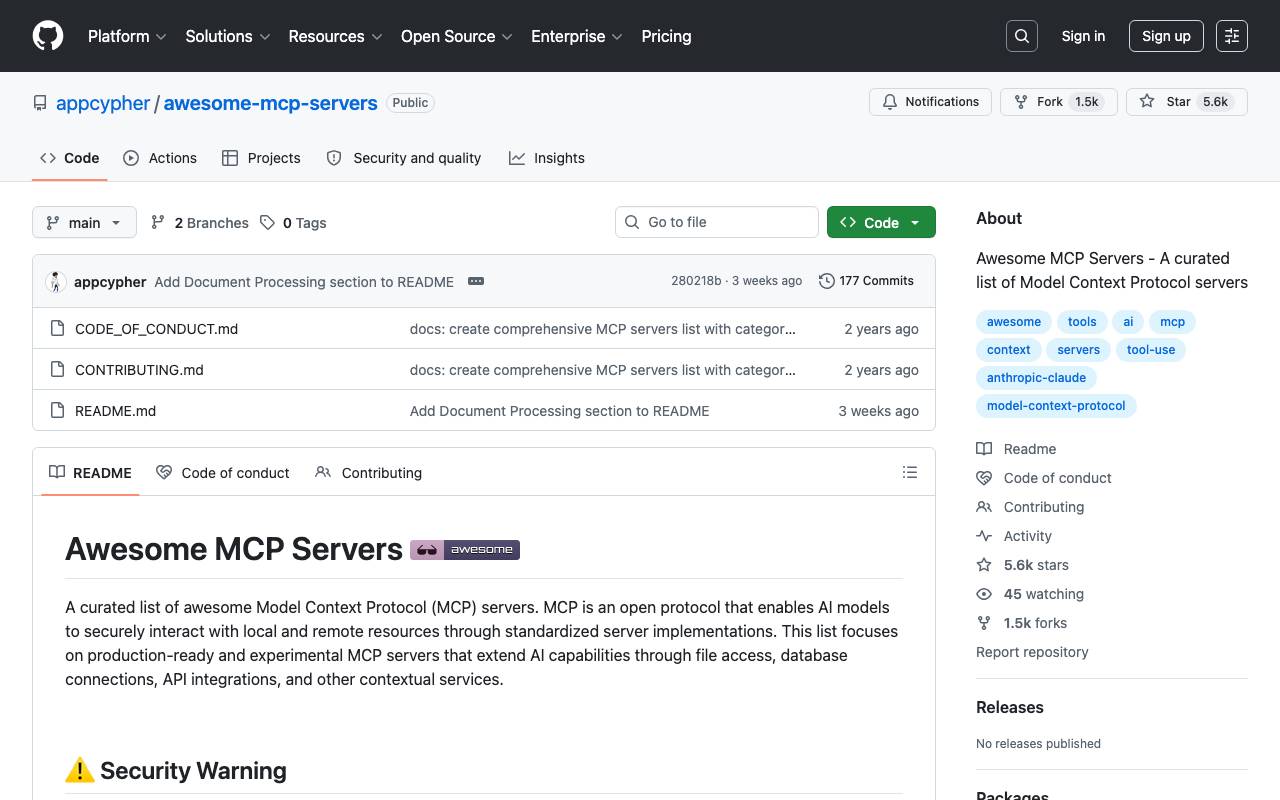
Awesome MCP Servers is a community-maintained list of Model Context Protocol (MCP) servers that connect AI assistants to external systems. It catalogs implementations across categories like databases, file systems, developer tools, productivity apps, and web services, making it easier to discover integrations that expand what models can do. The resource is aimed at developers and AI builders looking to give LLM-based agents access to real-world data and actions without writing every connector from scratch. Entries typically include links to source repositories, brief descriptions, and tags that help users filter by use case or technology. Because it follows the open-source 'awesome list' format, contributions come from the broader MCP ecosystem, and the list evolves alongside the protocol itself.
Criteria breakdown
- Curated list of MCP server implementations
- Categorized by domain and use case
- Links to source repositories and docs
- Covers official and community servers
- Open to community contributions
- Reference for MCP ecosystem exploration

OpenAI Codex SDK
SDK to embed and control Codex agents programmatically via TypeScript, CLI or GitHub Actions.
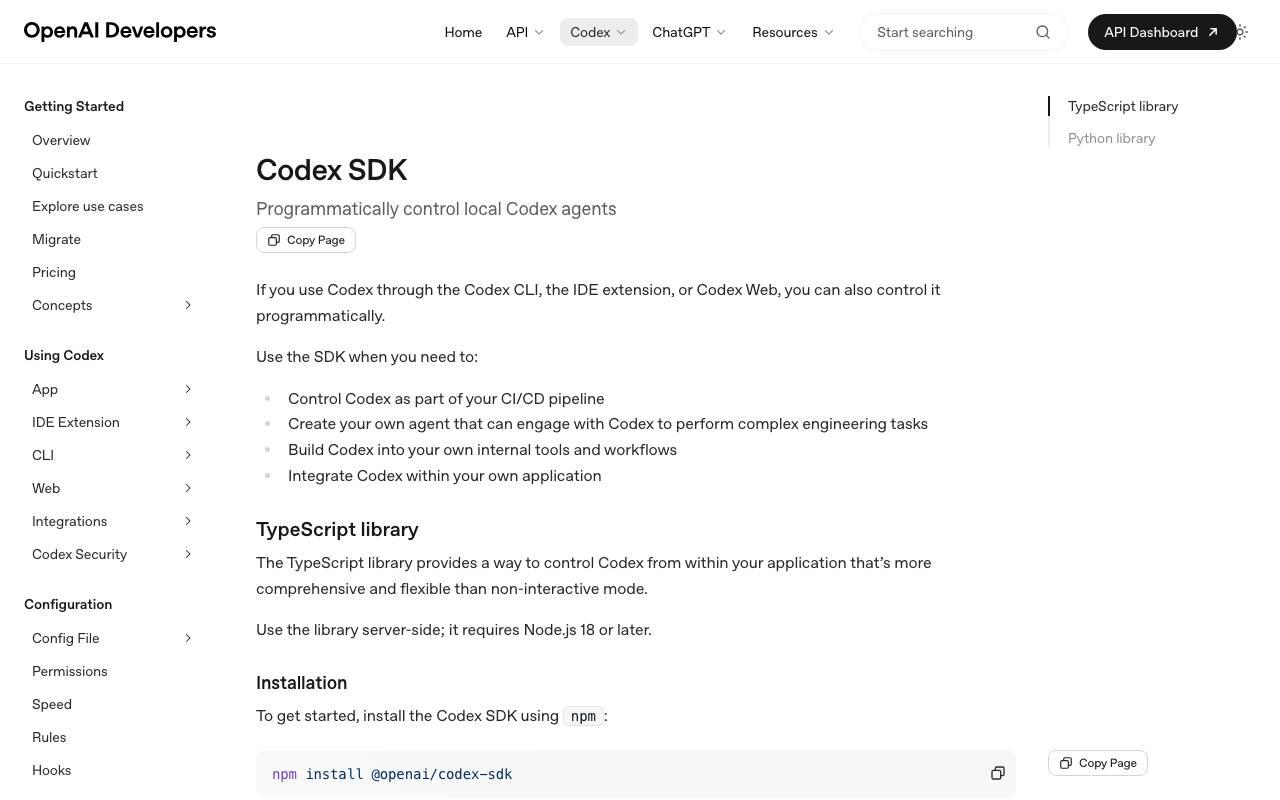
The OpenAI Codex SDK is a software development kit that allows developers to embed and control Codex agents programmatically. It supports multiple interfaces, including TypeScript, CLI, and GitHub Actions. The SDK is designed to provide a flexible way to integrate Codex agents into various applications and workflows. With the Codex SDK, developers can create custom agents, define agent behaviors, and manage agent workflows. The SDK also provides tools for evaluating and optimizing agent performance. It is intended for developers who want to build applications that leverage the capabilities of Codex agents. The SDK offers a range of features, including support for multiple models and providers, agent sandboxing, and integrations with various tools and services.
Criteria breakdown
- Text generation
- Code generation
- Image generation
- Audio and speech generation
- Structured output
- Function calling

BabyBeeAGI
An advanced version of BabyAGI with enhanced task management and functionality.
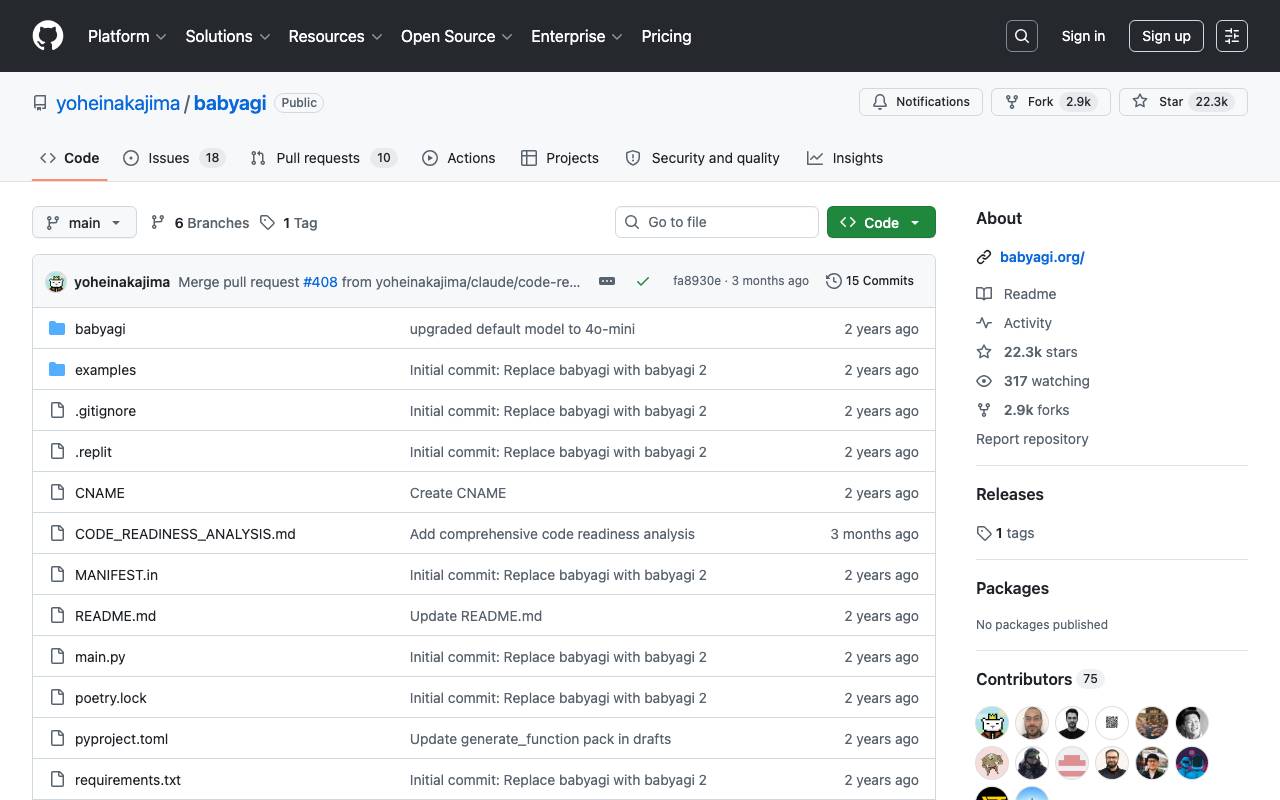
BabyAGI is an experimental framework for building self-building autonomous agents. It was created as an evolution of the original BabyAGI from March 2023, which introduced task planning for autonomous agents. The framework is built around a new function framework called 'functionz' that stores, manages, and executes functions from a database. It features a graph-based structure for tracking imports, dependent functions, and authentication secrets, along with automatic loading and comprehensive logging capabilities. The framework also includes a dashboard for managing functions, running updates, and viewing logs. It's designed to be simple and spark discussion among developers, not for production use. The core idea is to build the simplest thing that can build itself, making it an interesting approach for developing autonomous agents.
Criteria breakdown
- Function registration and metadata management
- Dependency tracking and key dependencies
- Automatic loading and logging
- Dashboard for function management and log viewing

Gemma 3
An open-source AI model optimized for single-GPU performance, supporting multimodal inputs and over 140 languages.
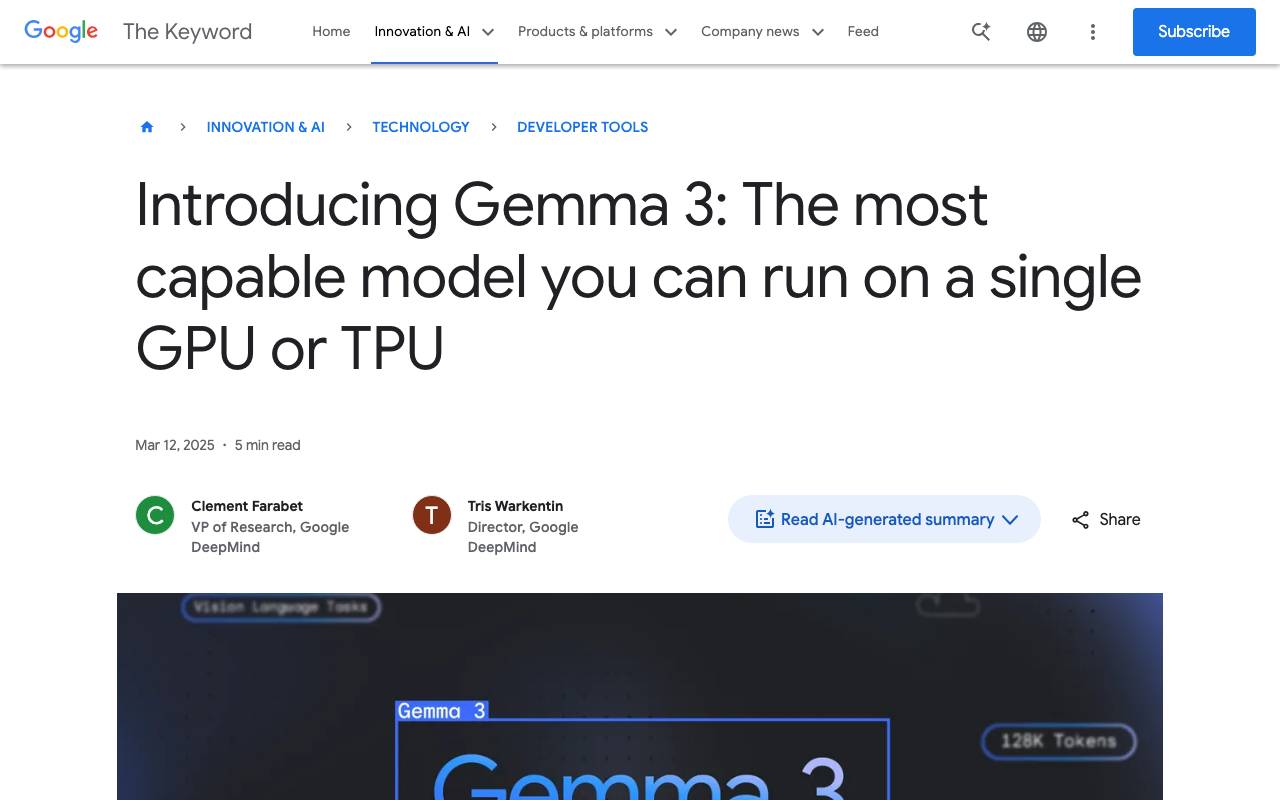
Gemma 3 is a collection of lightweight, state-of-the-art open models designed to run on devices, particularly optimized for single-GPU performance. It supports multimodal inputs and over 140 languages. The model comes in various sizes (1B, 4B, 12B, and 27B), allowing developers to choose the best fit for their hardware and performance needs. Gemma 3 offers advanced text and visual reasoning capabilities, a 128k-token context window, and function calling for complex tasks. It also includes quantized versions for faster performance and reduced computational requirements. The model is part of Google's commitment to making useful AI technology accessible and builds upon the same research and technology that powers their Gemini 2.0 models. Gemma 3 is designed to enable developers to create AI applications that can run directly on devices such as phones, laptops, and workstations. Gemma 3 delivers state-of-the-art performance for its size, outperforming other models like Llama3-405B, DeepSeek-V3, and o3-mini in preliminary human preference evaluations. It allows for global applications with out-of-the-box support for over 35 languages and pretrained support for over 140 languages. The model enables the creation of AI-driven workflows using function calling and structured output. The development of Gemma 3 included rigorous safety protocols, such as extensive data governance, alignment with safety policies via fine-tuning, and robust benchmark evaluations. The Gemma family of open models has seen significant adoption, with over 100 million downloads and a vibrant community that has created more than 60,000 Gemma variants. Gemma 3's capabilities make it suitable for developers looking to create engaging user experiences that can fit on a single GPU or TPU host.
Criteria breakdown
- multimodal AI support
- responsibility-focused development
- extensive fine-tuning
- support for 140 languages
- improved performance

ScreenAgent
Open‑source VLM agent to control computer GUIs via mouse/keyboard planning and execution.
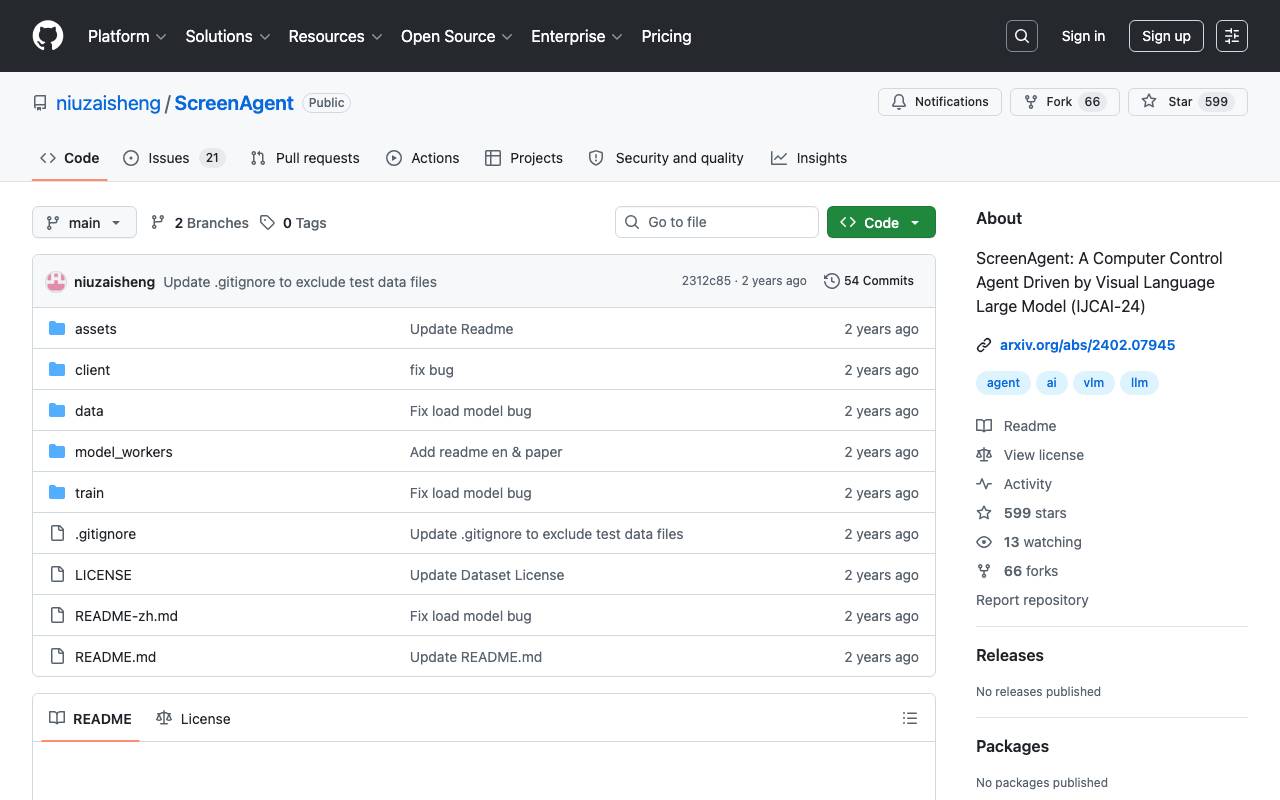
ScreenAgent is an open-source Visual Language Model (VLM) agent designed to control computer GUIs via mouse and keyboard operations. It enables interaction with real computer screens by observing screenshots and executing actions. The project includes a planning-execution-reflection process that guides the agent to complete multi-step tasks. It was created to address the challenge of teaching agents to use computers, requiring capabilities such as task planning, image understanding, and visual positioning. The ScreenAgent dataset, which covers various daily computer tasks, was manually annotated to support the agent's learning. The project consists of a client for controlling the desktop, a dataset, model workers for inference, and training code. It supports basic mouse and keyboard operations and can be applied to different desktop operating systems and applications. ScreenAgent's approach is universal and does not rely on specific APIs, making it versatile.
Criteria breakdown
- Mouse and keyboard operation execution
- Planning-execution-reflection process for task completion
- Support for various desktop operating systems and applications
- Manual annotation of the ScreenAgent dataset for diverse task coverage
- VLM agent for GUI interaction

AIWaves Agents
Open‑source adaptive LLM framework for building, training & deploying autonomous language agents.
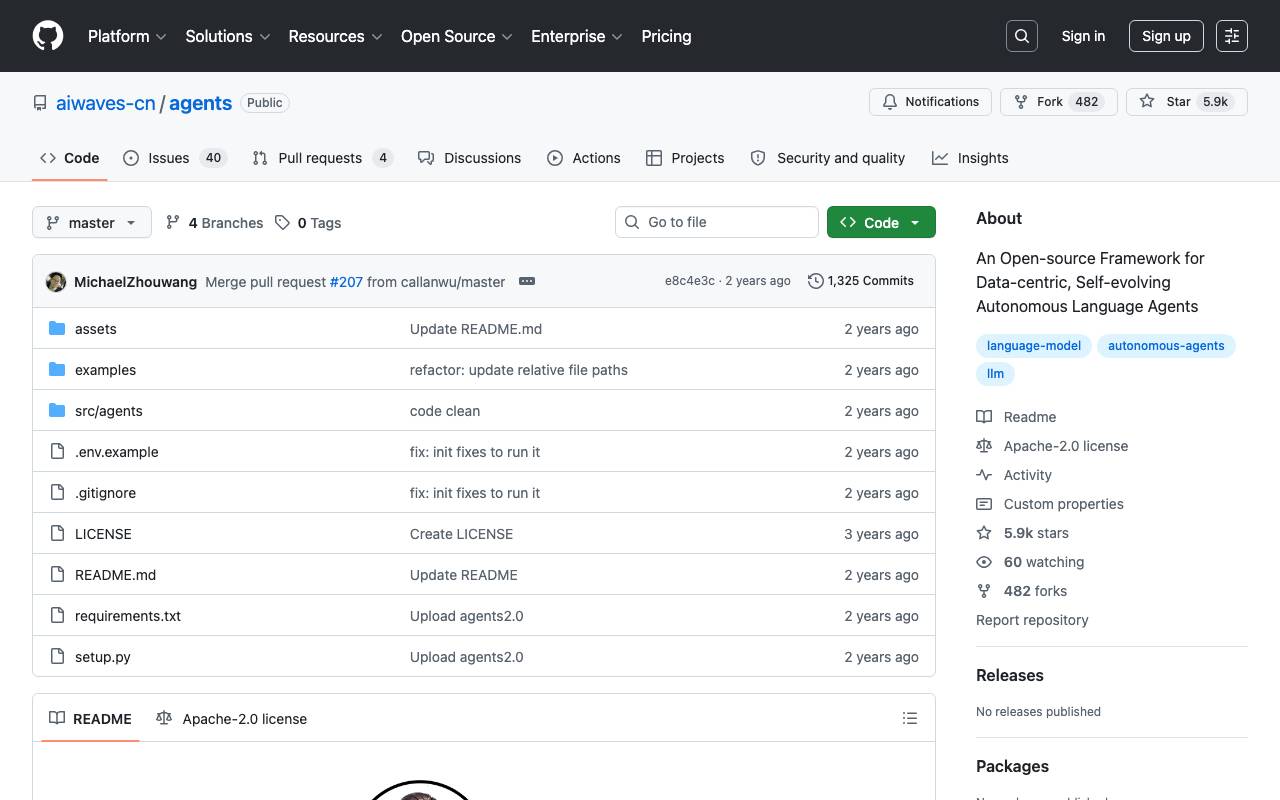
AIWaves Agents is an open-source adaptive LLM framework for building, training, and deploying autonomous language agents. It was updated to Agents 2.0, which adds support for agent learning and evaluation through symbolic learning, a systematic framework inspired by neural network training. This framework allows for the training of language agents by creating an analogy between agent pipelines and neural network computational graphs. The framework works by first executing an agent and storing its trajectory, including inputs, outputs, prompts, and tool usage. It then evaluates the outcome using a language-based loss function, back-propagates the loss to calculate language gradients, and updates the agent's symbolic components accordingly. This process enables agents to learn and adapt over time. Agents 2.0 also supports the optimization of multi-agent systems by treating nodes as different agents or allowing multiple agents to act within a single node. The framework is designed to be flexible and extensible, supporting various applications and research directions. The project provides an installation guide, including options for installing from the Git repository or for local development. It also includes citations for related research papers. The framework's strengths lie in its innovative approach to agent learning and its potential for advancing research in autonomous language agents. However, its complexity and reliance on carefully designed prompt pipelines may present challenges for users.
Criteria breakdown
- Autonomous language agents support
- Language agents training
- Language agents deployment
- Self-evolving agents enabling

Claude MCP Agents
AI agents built on Anthropic's MCP for seamless tool and data integration.
Claude MCP Agents are AI agents that leverage Anthropic's Model Context Protocol (MCP) to connect with a wide range of external data sources, APIs, and developer tools. By standardizing how context flows between Claude and outside systems, these agents can read files, query databases, invoke services, and act on real-time information without bespoke integrations for each source. The approach is aimed at developers and teams building automation, research assistants, and workflow agents that need reliable access to enterprise or personal data. MCP's open specification means the same agent can plug into new tools as connectors emerge, reducing lock-in and integration overhead.
Criteria breakdown
- Model Context Protocol integration
- Connects to files, APIs, and databases
- Extensible via custom MCP servers
- Supports agentic, multi-step workflows
- Compatible with Claude model family
- Open standard for interoperability

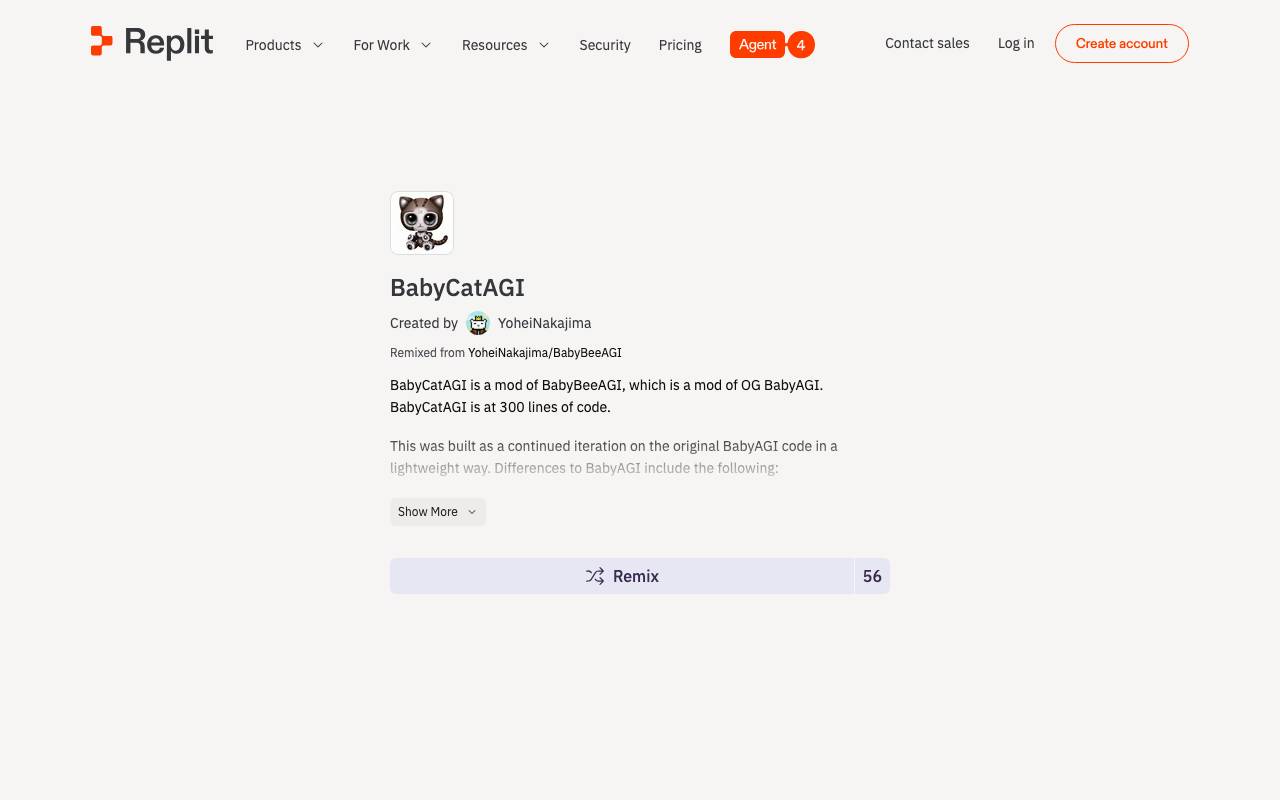
BabyCatAGI is a simplified, modified version of BabyAGI designed to handle complex tasks through autonomous AI agents. It breaks down high-level objectives into manageable subtasks, executes them sequentially, and adapts its plan based on intermediate results, making it suitable for research, content generation, and multi-step problem solving. The framework prioritizes minimal code and readability, making it accessible for developers who want to experiment with agentic AI without the overhead of larger orchestration libraries. It integrates with language models and web search tools to gather context, reason through problems, and produce structured outputs. As an open experimental project, BabyCatAGI is best suited for prototyping agent workflows, learning how task-driven autonomous systems operate, and customizing pipelines for specific automation needs.
Criteria breakdown
- Task list creation and prioritization
- Autonomous subtask execution
- Web search integration for context
- Sequential reasoning workflow
- Lightweight Python implementation
- Customizable objectives and prompts

BabyDeerAGI
A streamlined AI agent framework enabling parallel task execution for enhanced efficiency.
BabyDeerAGI is a streamlined AI agent framework designed to enable parallel task execution for enhanced efficiency. It is aimed at developers and researchers looking to optimize their AI workflows. By allowing multiple tasks to run concurrently, BabyDeerAGI can significantly reduce overall processing time. The framework is built with flexibility in mind, supporting integration with various AI models and tools. However, specific details about its capabilities and limitations are not extensively documented in available sources.
Criteria breakdown
- Parallel task execution
- Flexible integration with AI models
- Streamlined AI agent framework
- Concurrent processing support