opik-mcpModel Context Protocol (MCP) implementation for Opik enabling seamless IDE integration and unified access to prompts, projects, traces, and metrics.

Overview
Key features
- Model Context Protocol (MCP) implementation
- Seamless IDE integration
- Unified access to Opik resources
- Chat interface interaction
- Support for Claude Code and Cursor
Pricing
- Model
- Free
- Category
- MCP Servers
- Rating
- No reviews yet
Use cases
LLM Engineering
Use opik-mcp to interact with Opik through chat interfaces in IDEs, streamlining workflow and enhancing productivity for LLM engineers.
Opik Workspace Management
Use opik-mcp to list and manage Opik projects directly from the chat interface in supported IDEs.
Trace Analysis
Use opik-mcp to read traces and analyze experiment performance, such as identifying why an experiment regressed on factuality.
Pros & Cons
Pros
- Enables seamless IDE integration with Opik
- Unified access to prompts, projects, traces, and metrics
- Supports interaction with Opik through chat interfaces in IDEs
- Designed for LLM engineers already using Opik
Cons
- Requires Python 3.13+
- Configuration requires Opik API key and workspace name
- Currently not published to PyPI, requiring alternative installation methods
- Pre-release limitations and potential changes
Reviews
Sign in to leave a review.
No reviews yet. Be the first!
Q&A
What is a “span”?
A span is a unit of evaluation or tracing data in Opik, representing a structured input-output pair. This could be an LLM call, a tool call, or any tracked function. A single span can contain many tokens.
Asked by Gunnar Eriksson · May 11, 2026
What are the differences between Opik Open Source, Opik Free, Opik Pro, and Opik Enterprise?
The main differences are in usage limits and data retention. All plans include unlimited team members and the full suite of LLM observability and evaluation features. Enterprise plans offer custom hosting and deployment options, advanced identity and authentication management, personalized support plans, increased regulatory compliance, and more.
Asked by Idris Suleiman · Apr 22, 2026
How can I self-host Opik?
Self-hosting the open-source version of Opik is easy! Just download the code from our GitHub repo and follow the README to get started.
Asked by Halime Yalcin · Apr 12, 2026
What is the best way to get started with Opik?
The full Opik featureset is free to use for as long as you like, and it’s easy to get started. You can download and self-host the open-source version, or let us handle the infrastructure with the free cloud version. For most individuals and teams in the application testing and development phases, these free plans come with everything you need. You might want to step up to a paid plan as your application or agent usage scales up in production, and/or if you need user management and compliance-related features, but the free versions really do come with everything you need to get up and running. If you already have an application or agent that makes LLM calls, just follow our Quickstart Guide to integrate Opik with whichever model provider or agent framework you’re already using. And if you’re not ready to log traces yet, we recommend trying out the prompt playground to experiment with user prompts and system prompts and compare models side by side, with no setup steps required.
Asked by Tobias Hartmann · Mar 26, 2026
Is there a free plan for academics?
Yes, Comet offers a free Pro plan for academic users. Researchers, students, and educators can access the full features of our Pro plan at no cost. To apply for the academic Pro plan, please sign up here and follow the instructions on the Academics page to verify your academic status.
Asked by Margaret Whitfield · Mar 25, 2026
Ask a question
MCP Servers alternatives

 Playwright MCPMCP Servers
Open-source MCP server that lets LLMs drive real browsers via Playwright and accessibility snapshots.

Python agent framework from the Pydantic team for building type-safe GenAI apps.
Adaptive memory layer that helps AI agents learn from context over time.

 Inbox ZeroMCP Servers
AI email assistant that organizes, drafts replies, and helps you reach inbox zero faster.

 ScreenpipeMCP Servers
Open-source 24/7 local screen and audio recording for building context-aware AI apps
 AgentKitMCP Servers
TypeScript library for building and orchestrating AI agents with tools, memory, and multi-agent workflows.

 onchain-mcpMCP Servers
Bringing the bankless onchain API to MCP

 markitdownMCP Servers
Python tool for converting files and office documents to Markdown.
Trending now

 Reducto AIAI Agent Development Platforms
Document intelligence API that parses, splits, OCRs, and extracts structured data from complex PDFs, slides, and spreadsheets.
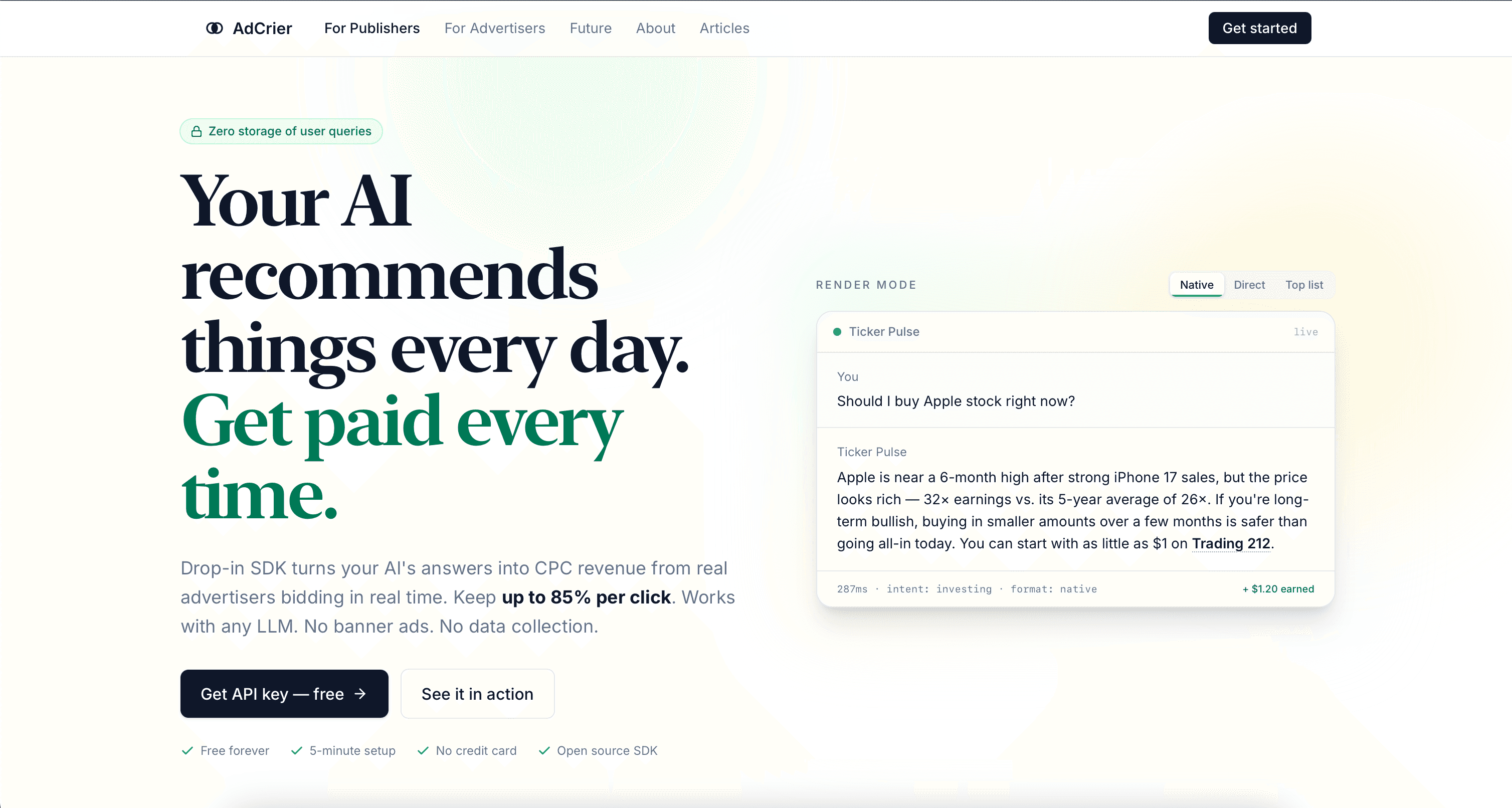
 AdCrierMarketing & Advertising
Sponsored answers, paid per click.

 Biology AIEducation AI
Accurate Homework Help with Full Explanations

 Pixtral 12B 24.09LLM
Open multimodal 12B model handling interleaved images and text with a 128K context window.