RigRust-Framework zur Erstellung von Anwendungen mit Typ-sicheren, LLM-gestützten Ergonomie

Übersicht
Hauptfunktionen
- Multi-Provider-LLM-Client-Abstraktionen
- Einbindungen und Vektor-Speicher-Integrationen
- Agent- und Tool-Calling-Primitives
- RAG-Pipeline-Building-Blocks
- Asynchron-first, typsichere API
- Open-Source-Rust-Crate
Preise
- Modell
- Free
- Kategorie
- Framewerke für künstliche Agenten
- Bewertung
- 4.4 / 5 (5)
Anwendungsfälle
Produktions-LLM-Dienste in Rust erstellen
Backend-Teams können LLM-Erweiterte und Chat in Hochleistungs-Rust-Diensten mit Typsicheren-APIs und garantierten Sicherheitsmerkmalen einbauen.
RAG-Anwendungsströme implementieren
Verwenden Sie Rigs-Einbettungen und -Vektorspeicher-Integrationen, um Retrieval-augmentierte Generation-Pipelines für Such-, Q&A- oder Assistent-Assistenten zu erstellen.
Schnell zwischen LLM-Anbietern umschalten
Nutzen Sie die einheitlichen Clientabstraktionen zur Wechsel- oder Kombination von mehreren LLM-Anbietern, ohne Anpassungen an provider-spezifischen SDK-Codes erforderlich zu sein.
AI-Agenten mit Werkzeugaufrufen entwickeln
Verwenden Sie Rigs-Agenten- und Werkzeugaufruf-Grundlagen, um autonome Workflows aufzubauen, die externe Werkzeuge und APIs von einer Rust-Anwendung aufrufen.
Pro & Contra
Pro
- Einbindung von Native-Rust-Leistung und -Sicherheit
- Einheits-API über multiple LLM-Anbieter
- Integrierte Unterstützung für RAG und Vektorspeicher
- Offene Quellen und erweiterbar
- Gemeinschaft
Contra
- Eingeschränkt auf den Rust-Umgebung
- Kleine Community im Vergleich zu Python-AI-Frameworks
- Steiler Lernschwung für Nicht-Rust-Entwickler
Schlacht-Bilanz
Aus 1 Schlacht im Pantheon.
Last battle
Bewertungen
Durchschnitt aus 5 Bewertungen.
Melde dich an, um eine Bewertung abzugeben.

Solid for our team
We rolled this out across the team last quarter and built-in support for RAG and vector stores. RAG pipeline building blocks fits neatly into how we already work, and agent and tool-calling primitives removed a step we used to do by hand. but it has held up under daily use.
Skeptical, then convinced
I went in skeptical — most tools in this space overpromise. It actually delivers on open-source Rust crate, and built-in support for RAG and vector stores caught me off guard. Steeper learning curve for non-Rust developers is why this isn't a perfect score, still, I'd recommend giving it a real trial.
Compared a few options
Evaluated this against two competitors. Where it wins: embeddings and vector store integrations and open source and extensible. Where it lags: steeper learning curve for non-Rust developers. On balance the feature set — especially embeddings and vector store integrations — justifies the 4 stars for our use case.
Years in this space
I've evaluated a lot of these over the years. What stands out here is multi-provider LLM client abstractions — handled better than most — and open source and extensible. Smaller community than Python AI frameworks is my one real gripe. Worth the time if this is your use case.
Years in this space
I've evaluated a lot of these over the years. What stands out here is multi-provider LLM client abstractions — handled better than most — and unified API across multiple LLM providers. Steeper learning curve for non-Rust developers is my one real gripe. Worth the time if this is your use case.
Fragen & Antworten
Is Rig suitable for teams not familiar with Rust?
Rig is optimized for Rust developers; its type‑safe builder pattern and compile‑time checks require Rust knowledge. While non‑Rust teams can adopt it, the learning curve is steeper compared to Python‑based AI frameworks, and community support is smaller.
Asked by Ravi Kapoor · Apr 9, 2026
What are the performance and deployment advantages of using Rig in production?
Because Rig is written in Rust, it delivers native performance, memory safety, and efficient concurrency. You can compile your application to a single binary or to WASM for edge or browser deployment, and the async‑first, type‑safe API helps maintain low latency and reliable scaling in production AI services.
Asked by Nadia Petrova · Apr 4, 2026
Can Rig be used for Retrieval‑Augmented Generation (RAG) and what vector stores are compatible?
Yes, Rig includes built‑in RAG pipeline blocks. It supports provider‑agnostic embeddings and pluggable vector stores, allowing you to attach a vector index to an agent so relevant documents are fetched at prompt time. Specific store implementations are provided as crates you can add to your Cargo project.
Asked by Amara Chukwu · Mar 13, 2026
Which LLM providers does Rig support and how is the integration handled?
Rig offers a unified API for about 20 providers, including OpenAI, Anthropic, Gemini, Bedrock, Groq, and Cohere. You create a provider client (e.g., `openai::Client::from_env`) and the library abstracts away each provider’s SDK, letting you switch or combine models with the same Rust builder pattern.
Asked by Fernando Rojas · Feb 3, 2026
Frage stellen
Alternativen zu Framewerke für künstliche Agenten
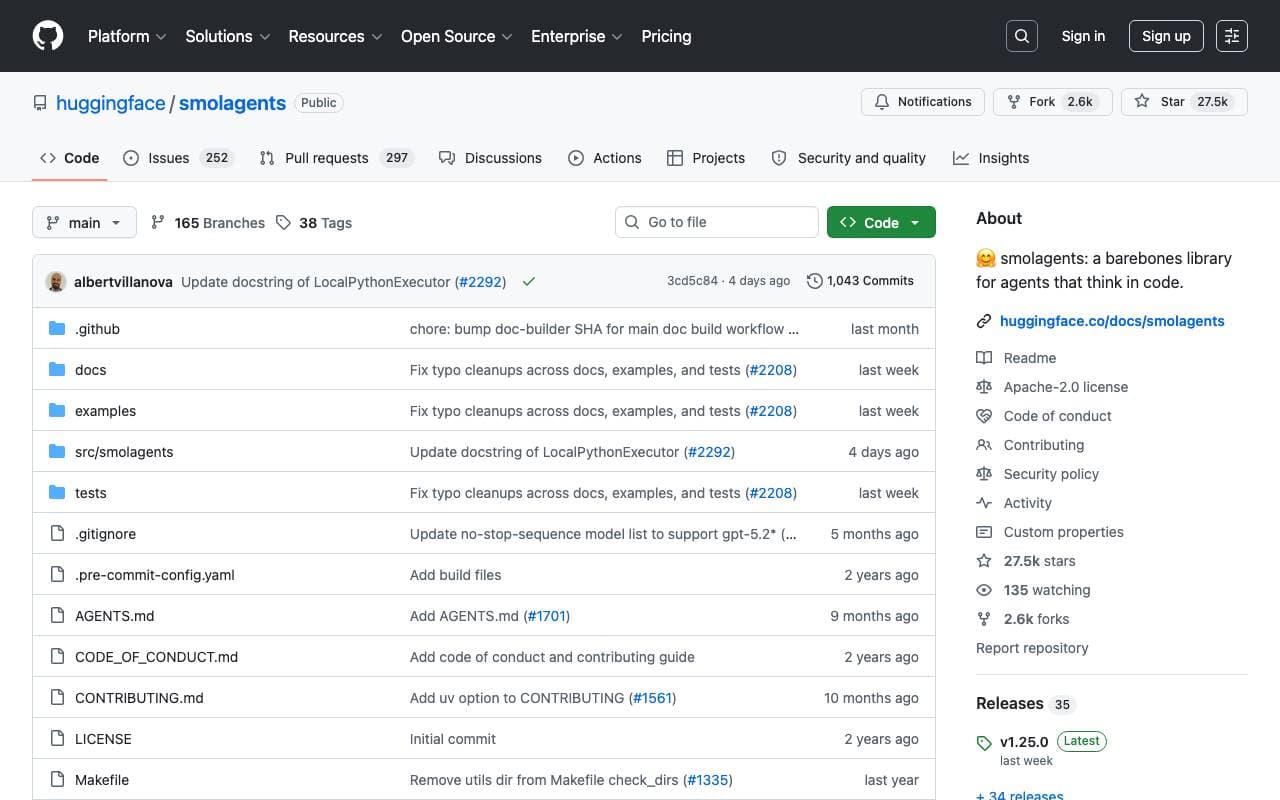

smolagents
Framewerke für künstliche Agenten
Ein minimalistisches Python-Bibliotheksframework von Hugging Face für die Erstellung von code-first-AI-Agenten in nur wenigen Zeilen


Mini LLM Flow
Framewerke für künstliche Agenten
Minimalistisches 100-Linien-LLM-Framework für die Erstellung selbstprogrammierender Agenten-Workflows

upsonicAI
Framewerke für künstliche Agenten
Öffentliches Agent Framework für die Erstellung von taskorientierten digitalen Arbeitnehmern und vertikalen KI-Agenten.


AI-Powered RAG Workflow for n8n
Framewerke für künstliche Agenten
Stelle Fragen und erhalte Antworten, die auf deinen Google-Drive-Dateien basieren, mithilfe von n8n.


ControlFlow
Framewerke für künstliche Agenten
Python-Framework zum Erstellen agentischer KI-Workflows mit einer aufgabenorientierten Gestaltung.


roboneo art
Framewerke für künstliche Agenten
AI-Bildgenerator, der Textanfragen innerhalb von Sekunden in hochwertige Bilder verwandelt.

Agent Genesis
Framewerke für künstliche Agenten
Open-Source, copy‑paste-Code-Snippets für die schnelle Entwicklung von KI-Agenten.


Eclat Institute
Framewerke für künstliche Agenten
IP- und JC-Unterricht, der auf den Aufbau dauerhafter Fachkompetenz ausgerichtet ist
Trending now


Reducto AI
Plattformen für die Entwicklung von Agenten mit künstlicher Intelligenz
Intelligenter Dokument API zur Analyse, Trennung, OCR-Analyse und Strukturierung von komplexen PDFs, Präsentationen und Tabellenkalkulationen.

AdCrier
Marketing & Werbung
Gepflichtete Antworten mit Provision pro Klick.


Biology AI
Bildung AI
Genaue Hilfe bei Hausaufgaben mit ausführlichen Erklärungen

Pin AI
Arbeitsablaufautomatisierung
Agentic AI Recruiter, der Sourcing, Screening und Outreach automatisiert, um den Einstellungsprozess zu beschleunigen.