Best Agent Memory (2026)

3 min read
If you sign up through a link on this page, we may earn a commission — it never affects our rankings.
A curated guide to the best Agent Memory tools, which give AI agents persistent context, recall, and long-term knowledge across sessions and tasks.
The Problem with Forgetful AI Agents
As we delve into the world of conversational AI, one thing becomes glaringly apparent: most agents are utterly forgetful. They recall the conversation at hand, perhaps, but that's where their memory ends. It's as if they have a Post-it Note on their desk that reads 'Conversation with John' and nothing more. But what if you wanted your AI agents to retain context, learn from interactions, and recall relevant information across multiple conversations? Sounds like a no-brainer, right? That's where Agent Memory comes in.
Choosing the Right Agent Memory Tool
When it comes to selecting the perfect Agent Memory solution, there are a few key factors to consider. Persistence is the most obvious one – can your AI agent retain its memory across conversations, or does it reset as soon as the chat ends? Some tools, like LangMem from LangChain, are designed specifically to give AI agents long-term memory that adapts and persists across conversations.
Another crucial aspect is scalability. If your conversational AI is going to be handling a high volume of interactions, you'll need a solution that can scale with it. Neon AI, for example, is a serverless Postgres that's built exactly with this in mind – developers who ship fast and need a database that can keep up.
Data structure is also worth considering. Some Agent Memory tools use relational databases, while others might rely on graph databases or even NoSQL solutions. Understand how your chosen tool stores and retrieves data to ensure it aligns with your AI's data needs.
Common Pitfalls and Pricing Patterns
One common pitfall when choosing an Agent Memory tool is underestimating the importance of data security. Since Agent Memory solutions deal with sensitive information, ensuring the security and integrity of that data is paramount. Some tools, like LangMem, offer robust security features to address these concerns.
When it comes to pricing, Agent Memory tools often follow a freemium model. This means that LangMem, for instance, offers a basic plan for free, while more advanced features require a paid subscription. Neon AI, on the other hand, is also a freemium solution that allows developers to start using its serverless Postgres for free and upgrade as needed.
Putting Agent Memory to Work
By choosing the right Agent Memory tool, you set your conversational AI up to thrive in conversations that go beyond the initial query. Whether you're building a chatbot for customer support or a conversational UI for your web application, an Agent Memory solution is crucial to success.
In practice, this means selecting a tool that aligns with your AI's particular memory needs, from persistence to scalability. With the right Agent Memory tool by your side, you'll unlock a world of possibilities for your conversational AI. It's time to give your AI a memory they'll never forget.
Agent Memory by the numbers
Pricing mix
Best Agent Memory (2026)


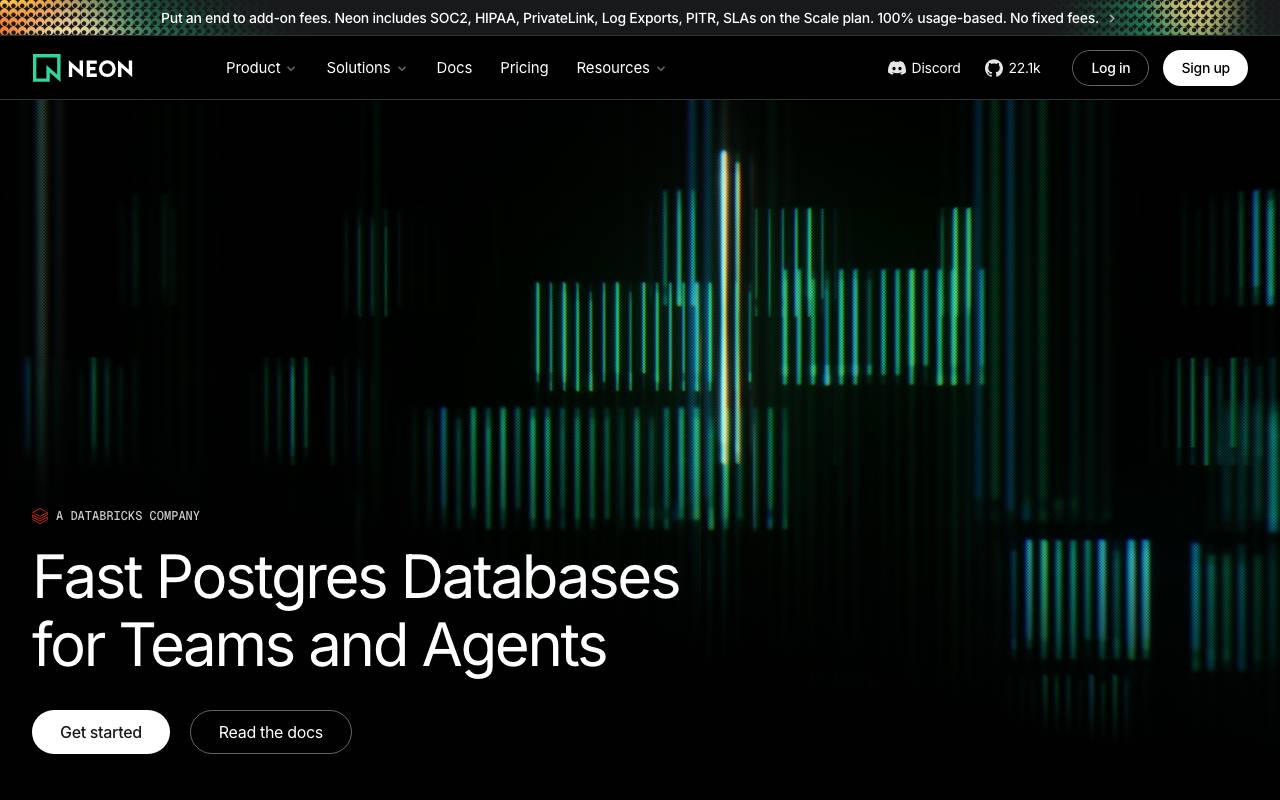
Neon AI is a serverless Postgres platform designed to support modern application development, including workloads driven by AI agents. It offers instant database provisioning, branching similar to Git, and automatic scaling, making it well suited for teams that need to spin up, test, and tear down environments quickly. The service is positioned for developers building AI-powered applications, with features like pgvector support for embeddings, copy-on-write branches for experimentation, and an API that lets agents create and manage their own databases programmatically. Neon separates storage from compute, which enables scale-to-zero pricing and fast cold starts. Teams typically use Neon to back SaaS products, multi-tenant apps, preview environments, and agent-driven workflows where many short-lived databases are needed on demand.
- Serverless Postgres with autoscaling compute
- Git-style database branching and point-in-time restore
- pgvector extension for embeddings and similarity search
- Separation of storage and compute
- Developer API for programmatic database management
- Preview environments and CI/CD integration

LangMem
An SDK from LangChain for giving AI agents long-term memory that persists and adapts across conversations
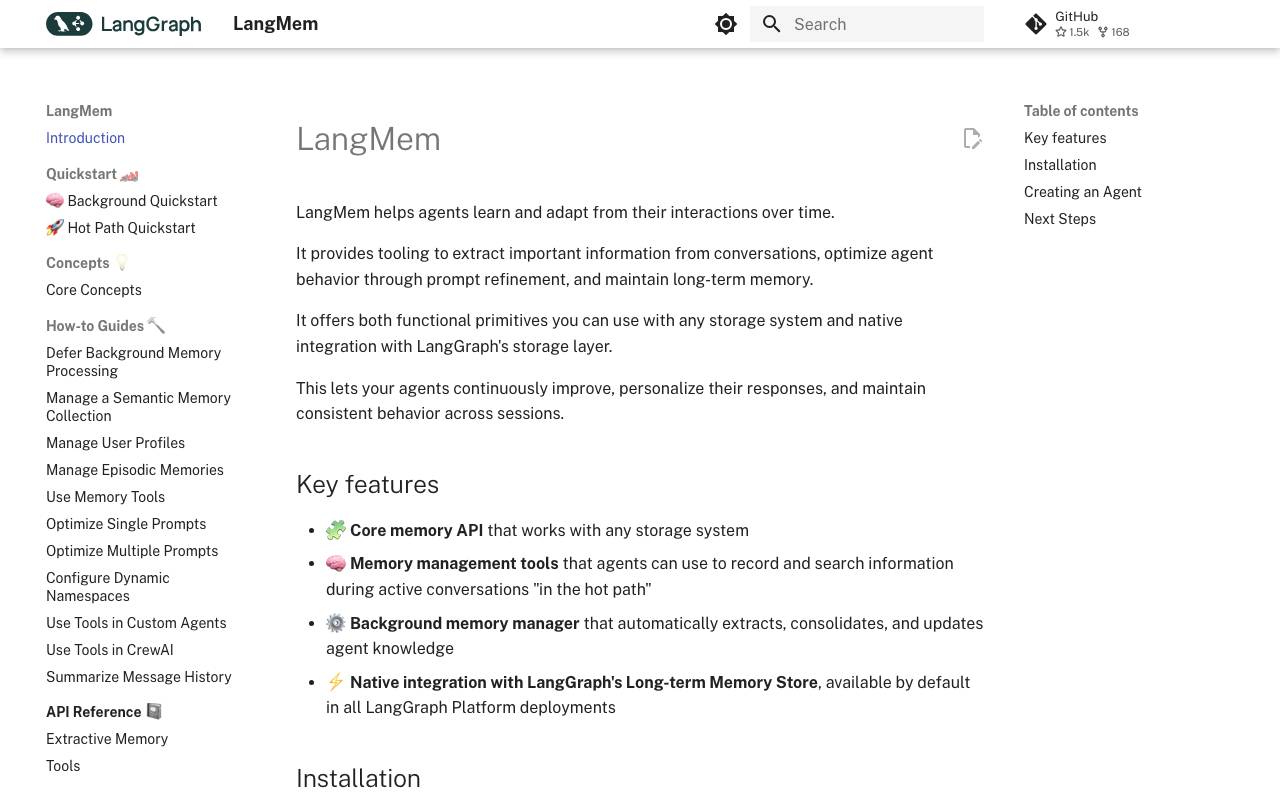
LangMem is a software development kit produced by the LangChain team that focuses on equipping AI agents with long-term memory. Where most LLM applications are limited to the context window of a single session, LangMem addresses the problem of persistence: how an agent can retain useful information across many interactions and use it to behave more consistently and personally over time. The SDK provides tools for extracting, storing, and retrieving memories from agent conversations. Rather than simply logging raw transcripts, it is designed to distill interactions into structured or semantic memories that can be searched and reused later. This lets an agent recall facts about a user, accumulated preferences, or prior decisions, and incorporate them into future responses. LangMem distinguishes between different kinds of memory, conceptually borrowing from cognitive ideas such as semantic memory (facts and knowledge), episodic memory (past events and interactions), and procedural memory (learned behaviors or instructions). It exposes utilities for forming these memories and for updating them as new information arrives, so an agent's understanding can evolve instead of remaining static. It is built to work within the broader LangChain and LangGraph ecosystem, and integrates with persistent storage backends so memories survive beyond a single process. This makes it a natural fit for teams already building agents with those frameworks who want to add a memory layer without assembling the retrieval and consolidation logic from scratch. As with most emerging agent-memory tooling, LangMem is aimed primarily at developers comfortable with Python and the LangChain stack rather than no-code users, and the field of long-term agent memory is still maturing, so patterns and APIs around it continue to evolve.
- Memory extraction from agent conversations
- Storage and semantic retrieval of memories
- Semantic, episodic, and procedural memory concepts
- Memory updating and consolidation over time
- Integration with persistent storage backends
- Compatibility with LangGraph agents
Browse all 2 Agent Memory tools
The complete, searchable directory — ranked by real user reviews.
| # | Tool | Rating | Pricing | View tool |
|---|---|---|---|---|
| 1 |  Neon AIServerless Postgres built for AI agents and developers who ship fast Neon AIServerless Postgres built for AI agents and developers who ship fast4.5 (4) | 4.5 (4) | freemium | View tool |
| 2 |  LangMemAn SDK from LangChain for giving AI agents long-term memory that persists and adapts across conversations LangMemAn SDK from LangChain for giving AI agents long-term memory that persists and adapts across conversations4.0 (4) | 4.0 (4) | freemium | View tool |