Best Speech Recognition (2026)

3 min read
If you sign up through a link on this page, we may earn a commission — it never affects our rankings.
A buyer's guide to the best speech recognition tools, covering platforms that convert spoken audio into accurate text for transcription, dictation, captioning, and voice-driven applications.
Solving the Voice Assistant Paradox
As anyone who's tried to give their smart speaker a list of grocery items can attest, speech recognition technology has come a long way. But there's a gap between what we can do with these virtual assistants and what we need to take our daily lives to the next level. Want to create apps that truly understand voice input? You need a speech recognition tool that goes beyond the bare minimum and integrates seamlessly with your tech stack.
Choosing the Right Speech Recognition Tool
When selecting a speech recognition tool, it's essential to focus on the following key factors:
- Accuracy and reliability: Do they handle various accents, noise levels, and dialects well? Can they keep up with real-time conversations?
- Flexibility and customization: Can you fine-tune their models to adapt to your specific use case or industry requirements?
- Scalability and ease of integration: How well do they integrate with your existing infrastructure, and what kind of support do they offer for high-traffic applications?
- Cost-effectiveness: Be aware of any potential long-term costs, such as per-transaction fees or subscription models
Avoiding Common Pitfalls
Some tools might promise the world but deliver inconsistent results, charge exorbitant costs for each request, or leave you with a headache-inducing integration process. Look for tools that:
- Transparency: Clearly outline their pricing, feature limitations, and limitations in their documentation and support channels
- Community support: Engage with the developers, users, and forums to get a sense of their customer support and overall community dynamics
- Flexibility and open architecture: Ensure that their platform can adapt to changing needs and allow for seamless integrations with other services
Real-World Examples
When exploring speech recognition tools, I've had the opportunity to experiment with various platforms. I was impressed by Deepgram, which offers robust speech-to-text capabilities, including a free tier that makes it perfect for small-scale projects. For more complex applications, OpenAI Advanced Voice provides seamless integration with ChatGPT, enabling real-time, natural voice conversations. Ultravox AI takes this a step further, providing a comprehensive voice AI platform that goes beyond transcription and includes conversational agents.
In contrast, ElevenLabs focuses on lifelike AI text-to-speech and voice cloning capabilities, catering to developers who require high-fidelity audio outputs, while OmniAudio takes a different approach, focusing on compact on-device audio language models for fast, private edge deployment. These options cater to distinct use cases and highlight the diversity of speech recognition tools available.
Tips for Success
When working with a speech recognition tool, remember:
- Start small: Begin with a limited project to get a feel for the tool and its quirks before scaling up.
- Communicate clearly: Make sure you understand their pricing, feature limitations, and potential biases before diving in.
- Monitor and adapt: Keep an eye on performance, tuning as needed to optimize your results.
- Explore beyond the basics: Uncover the hidden features and capabilities of these tools to take your projects to the next level
Speech Recognition by the numbers
Pricing mix
Best Speech Recognition (2026)
- 1
 RimeHuman-like AI voices built for real-time customer conversations5.0 (6)
 - 2
 AITernetA voice-activated AI browser that executes user commands by automating web interactions.5.0 (4)
 - 3
 Read PDF AloudTurn PDFs into natural-sounding audio with AI voices for hands-free reading.5.0 (4)
 - 4
 AIVocalAll-in-one AI vocal assistant for generating, editing, and enhancing vocal audio.5.0 (4)
 - 5
 PhonicEnd-to-end platform for building lifelike, reliable voice AI agents.5.0 (4)
 - 6
 Fliki AITurn text, scripts, and ideas into narrated videos with AI voices and avatars.4.8 (6)
 - 7
 ElevenLabsLifelike AI text-to-speech and voice cloning in dozens of languages.4.8 (6)
 - 8
 ClaudefastPrebuilt Claude Code setups to skip configuration and start shipping faster.4.8 (6)
 - 9
 WithAudioOne-time purchase text-to-speech reader for Mac and Windows with natural AI voices.4.8 (6)
 - 10
 Play.htRealistic AI voice generation and conversational voice agents for apps, content, and calls.4.8 (6)

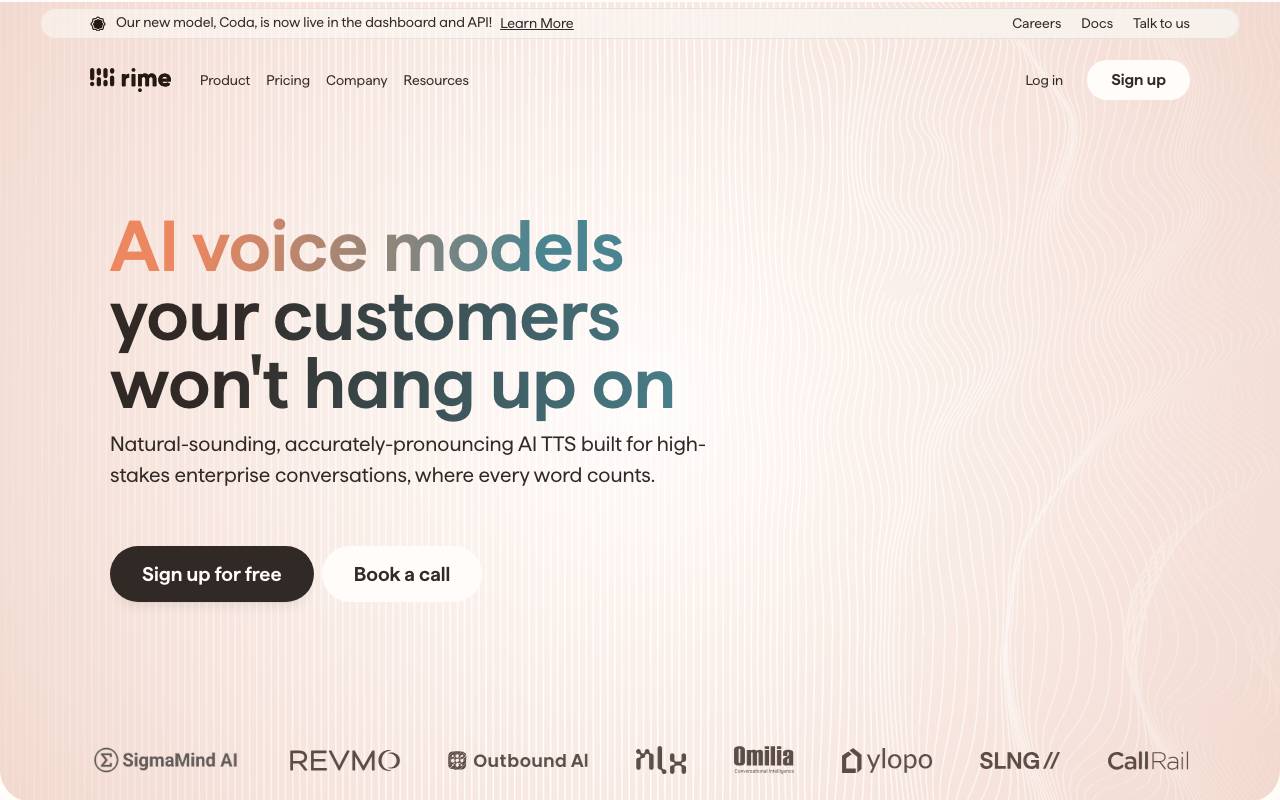
Rime is an AI voice model platform designed for real-time customer conversations. It offers natural-sounding, accurately-pronouncing text-to-speech (TTS) voices built for high-stakes enterprise conversations. The platform provides voice models that maintain a natural tone, rhythm, and subtle imperfections of real speech, including breaths, pauses, and emphasis. This helps create genuine conversations and builds trust with customers. Rime's voice models are designed for various industries, including healthcare, food ordering, finance, and telecom. The platform offers features such as pronunciation control, SpeechQA for flagging low-confidence words, and multilingual support. These capabilities aim to improve customer engagement, increase sales, and drive better business results. The platform is enterprise-grade, offering on-premises, VPC, or cloud API deployment with SOC 2 and HIPAA compliance. Rime's voice models are built for production environments, where accurate pronunciation and natural speech patterns are crucial. The platform has been used by Fortune 500 clients, resulting in significant improvements in call containment rates, engagement, and sales. Rime's strengths lie in its ability to provide authentic voices, easy pronunciation correction, and high-quality voice models that keep callers engaged. However, specific limitations and comparisons to alternative solutions are not detailed on the website.
- Natural text-to-speech voices
- Real-time streaming audio
- Diverse speaker library
- API for app and phone integration
- Conversational pacing and intonation
- Customizable voice selection per use case

AITernet
A voice-activated AI browser that executes user commands by automating web interactions.
AITernet is a voice-activated AI browser designed to automate web interactions based on user commands. It aims to provide a hands-free experience, allowing users to navigate the web and execute tasks using voice instructions. The tool is intended for individuals seeking to improve their productivity or requiring assistive technology for accessibility purposes. AITernet's functionality involves interpreting voice commands and translating them into actions on the web, such as filling out forms, clicking buttons, or scrolling through pages. By automating these tasks, AITernet strives to make web browsing more efficient and accessible. The tool's capabilities and limitations are shaped by its ability to understand natural language and accurately replicate user intentions on the web. As a voice-activated browser, AITernet Differentiates itself from traditional browsers by offering a unique interaction method. However, its dependence on voice recognition technology and web page compatibility may pose challenges. In comparison to other assistive technologies, AITernet's focus on voice-activated web automation positions it as a specialized tool for specific user needs. The workflow of AITernet involves a user speaking a command, which the AI then interprets and executes on the web. This process relies on advanced natural language processing and machine learning algorithms to understand the nuances of human language and perform the desired actions accurately. The integration of AITernet with various web services and its ability to handle complex commands can significantly enhance user experience. However, the complexity of web pages and the variability in voice commands can sometimes lead to errors or misunderstandings. One of the standout capabilities of AITernet is its potential to revolutionize the way people interact with the web, especially for those with disabilities or preferences for hands-free control. By providing an alternative to traditional mouse and keyboard inputs, AITernet opens up new possibilities for web accessibility and usability. The tool's ability to learn from user behavior and adapt to preferences over time can further enhance its effectiveness. Despite its innovative approach, AITernet faces challenges related to the accuracy of voice recognition, compatibility with diverse web page structures, and the need for continuous updates to keep pace with evolving web technologies. Addressing these challenges will be crucial for AITernet to realize its full potential and provide a seamless, efficient experience for its users. In the context of existing browsers and assistive technologies, AITernet occupies a unique space by combining AI-driven automation with voice-activated control. Its success will depend on its ability to deliver reliable, intuitive performance and to expand its compatibility with a broad range of web applications and services. As the tool continues to develop, it is likely to play an increasingly important role in shaping the future of web interaction and accessibility.
- Voice-activated web navigation
- Automation of web interactions
- Compatibility with various web services
- Natural language processing for command interpretation
- Adaptive learning for personalized user experience

Read PDF Aloud
Turn PDFs into natural-sounding audio with AI voices for hands-free reading.
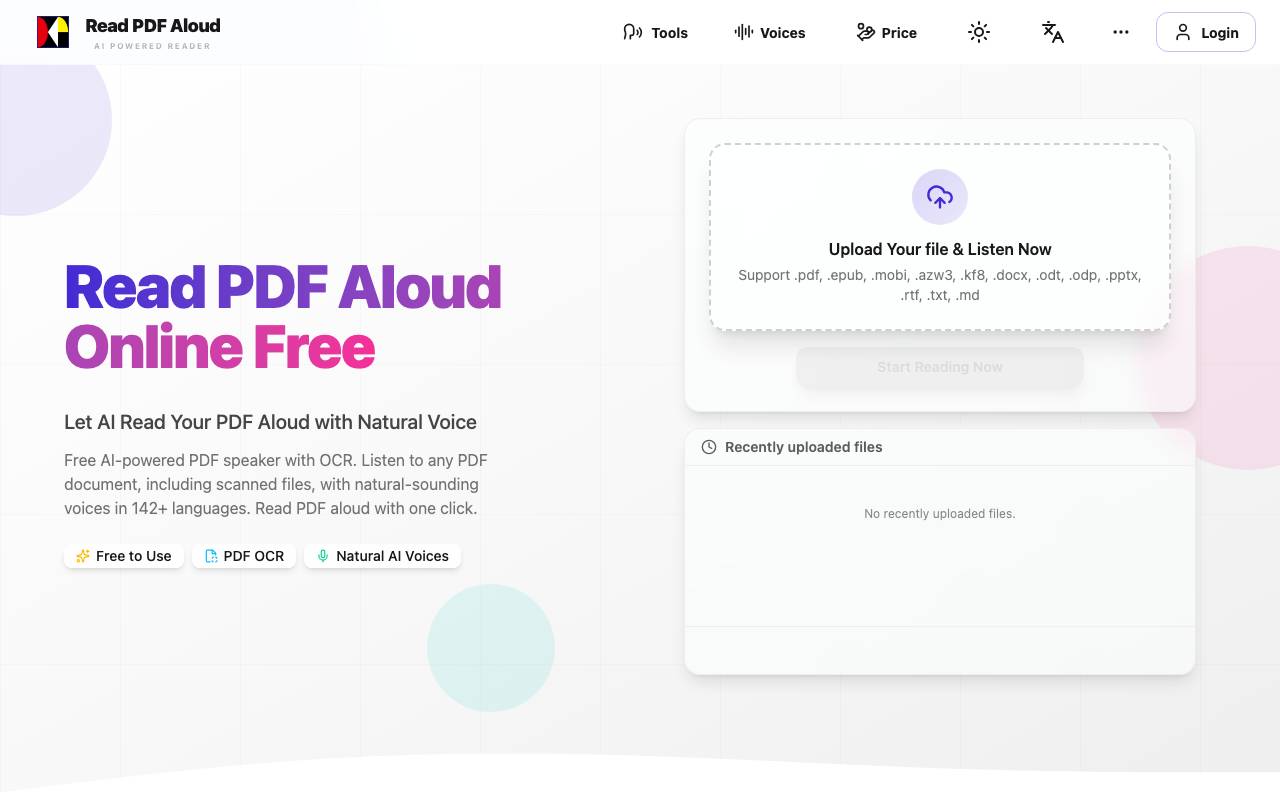
Read PDF Aloud is an AI-powered tool that converts PDF documents into spoken audio using natural, human-like voices. Users upload a PDF and the tool reads the text aloud, making it useful for multitasking, accessibility, language learning, or reviewing long documents without staring at a screen. The tool is aimed at students, professionals, and anyone who prefers listening over reading. By leveraging modern text-to-speech models, it offers smoother intonation and pacing than traditional screen readers, helping users absorb information from reports, papers, ebooks, and other PDF content more comfortably.
- AI text-to-speech for PDFs
- Natural voice narration
- Direct PDF upload support
- Hands-free document listening
- Useful for studying and accessibility
- Plays back long-form content smoothly

AIVocal
All-in-one AI vocal assistant for generating, editing, and enhancing vocal audio.
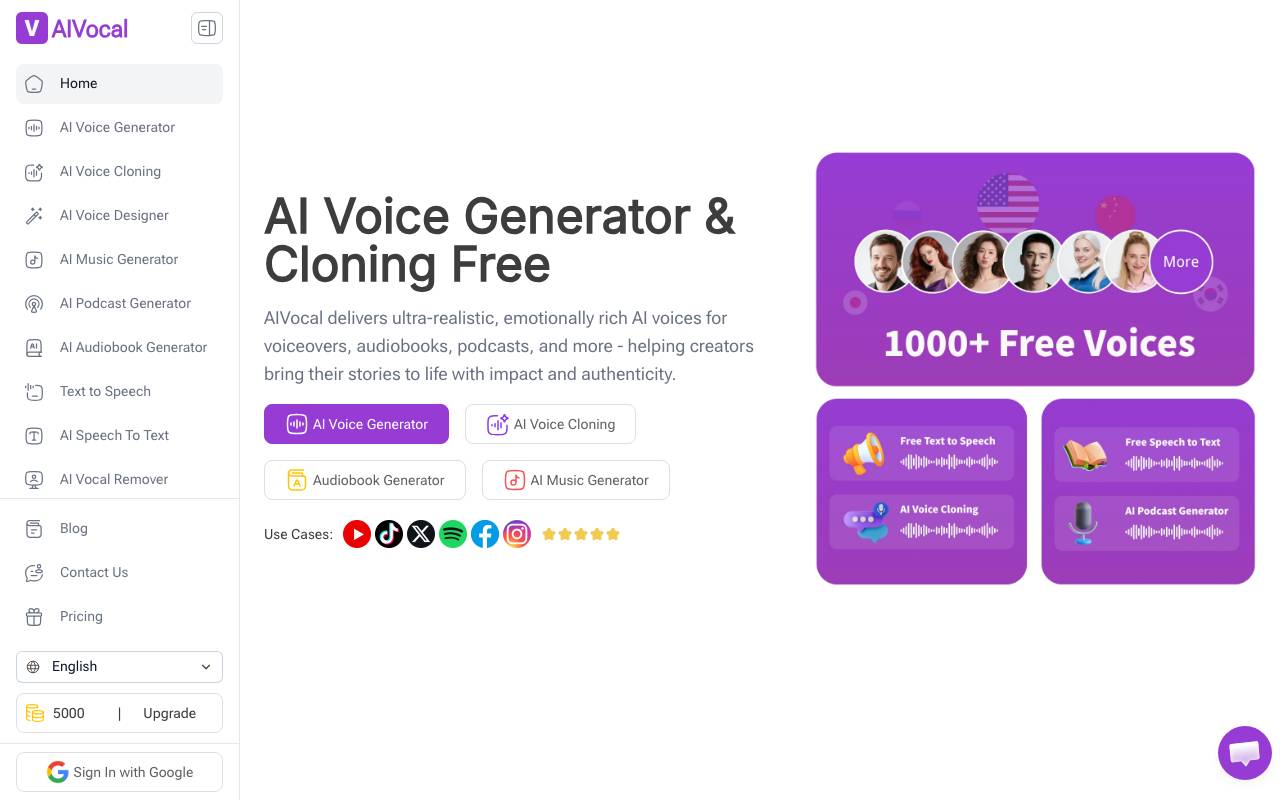
AIVocal is an all-in-one AI vocal assistant for generating, editing, and enhancing vocal audio. It offers a range of tools for voiceovers, audiobooks, podcasts, and more, aiming to help creators bring their stories to life with impact and authenticity. The platform simplifies voice workflows with AI tools for podcasting, speech writing, voice editing, and transcription. AIVocal provides various free online tools, including an AI voice generator for lifelike speech in 140+ languages, an AI podcast generator to transform notes into natural-sounding podcasts, and an MP3 to text converter for transcribing audio files. It also features an AI vocal remover to isolate instrumental tracks or extract vocals from songs. The platform supports real-time transcription and accurate transcriptions from uploaded audio or video files in multiple languages. Users can generate realistic AI voices from text or clone their own voice for personalized speech content. AIVocal is available on both web and mobile platforms, allowing users to capture and manage voice content anytime, anywhere. AIVocal offers a free trial with core features and flexible paid plans for creators, teams, and enterprises.
- AI vocal generation
- Vocal editing and modification
- Audio enhancement and cleanup
- Browser-based workflow
- Support for music and content projects

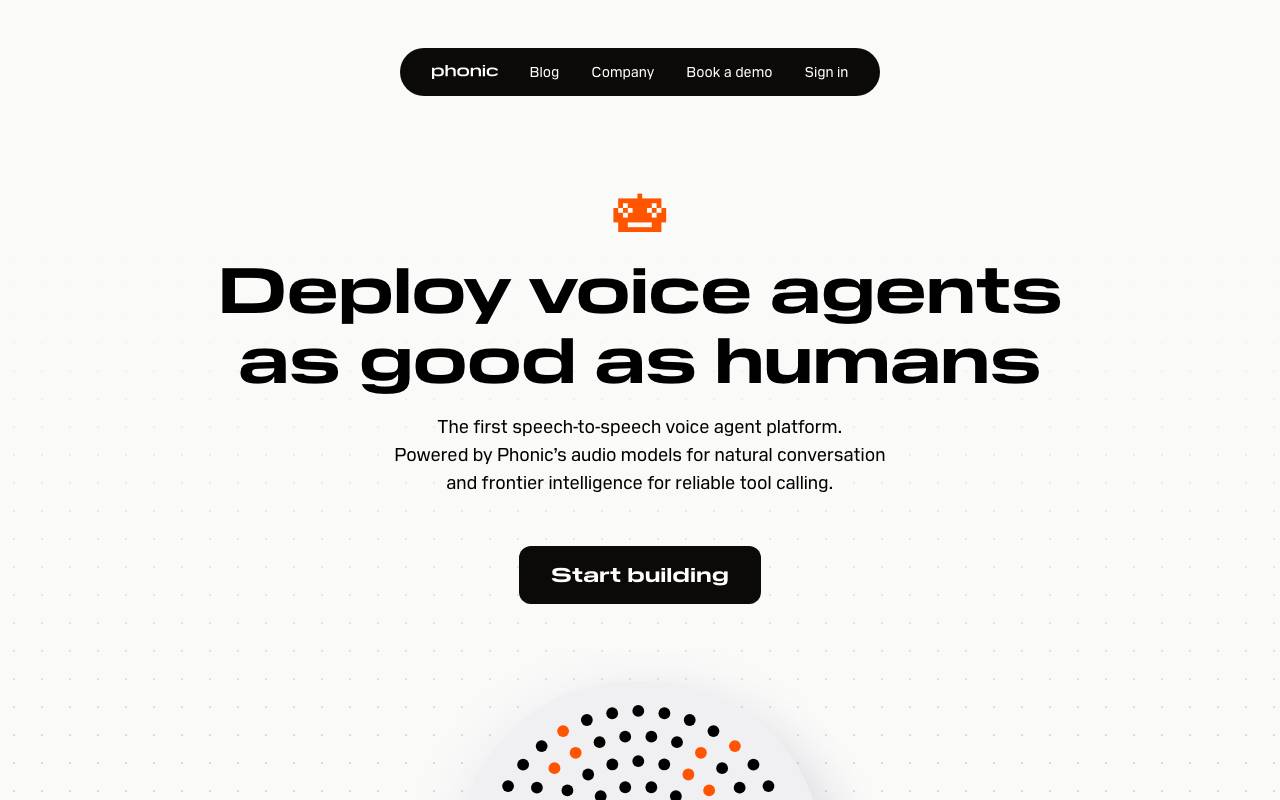
Phonic is a voice AI platform designed for teams building production-grade conversational agents. It combines speech recognition, natural-sounding voice synthesis, and orchestration tooling so developers can deploy agents that handle real phone calls and live interactions without stitching together multiple vendors. The platform focuses on reliability and latency, with infrastructure aimed at consistent uptime, low response times, and predictable behavior across long or complex conversations. Developers can configure agent logic, voices, and integrations through a unified workflow, then monitor performance once agents are live. Phonic is suited to use cases like customer support automation, outbound calling, scheduling, and other voice-driven workflows where naturalness and accuracy directly affect outcomes.
- Speech-to-text and text-to-speech in one stack
- Lifelike conversational voices
- Agent orchestration and call handling
- Low-latency real-time pipeline
- Monitoring and analytics for live agents
- APIs for custom integrations

Fliki AI
Turn text, scripts, and ideas into narrated videos with AI voices and avatars.
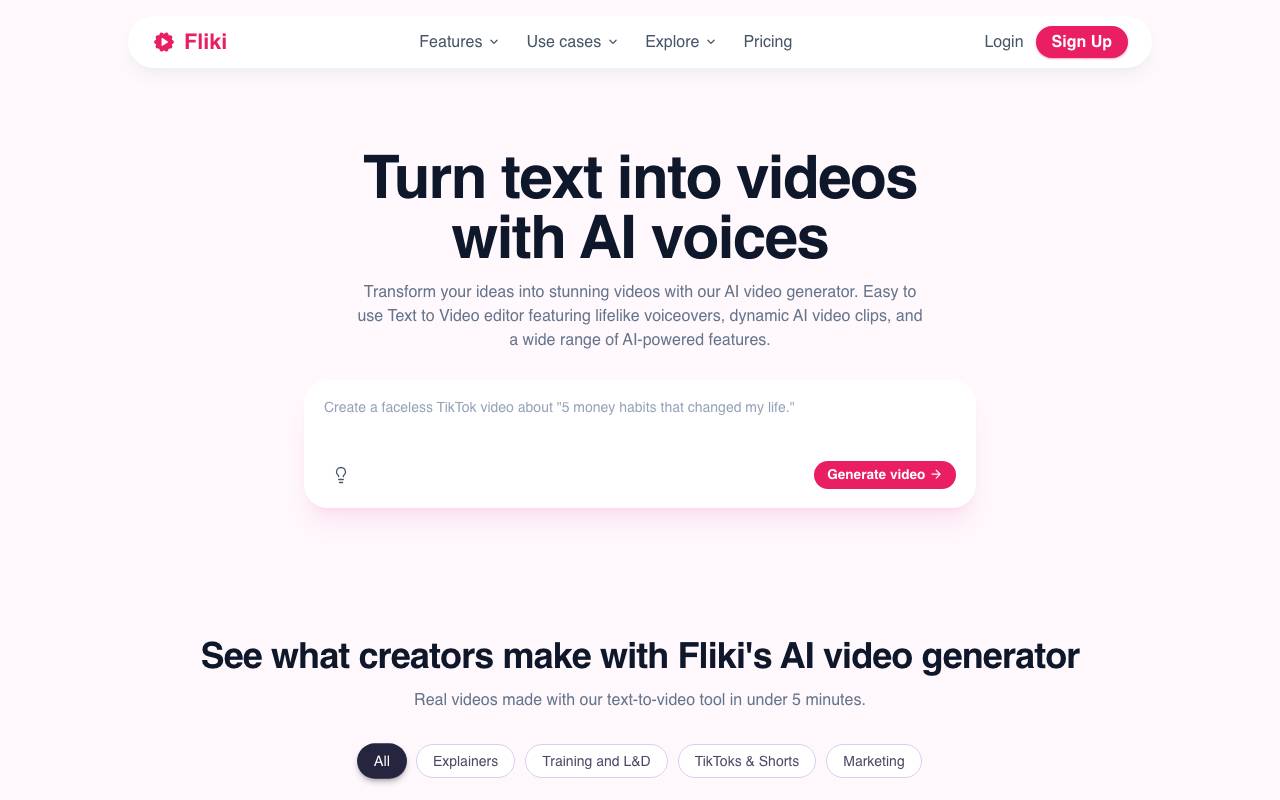
Fliki AI is a text-to-video platform that helps creators, marketers, and educators produce videos without filming or complex editing. Users paste a script, blog post, or prompt, and the tool generates a video with synchronized voiceover, stock visuals, captions, and background music. It offers a large library of lifelike AI voices across many languages and accents, along with AI avatars that can present content on camera. Built-in editing lets users swap clips, adjust timing, tweak voice delivery, and brand videos with logos and fonts. Fliki is commonly used for social media shorts, YouTube content, product explainers, training material, and localized marketing videos, with export options suited to different platforms and aspect ratios.
- Text-to-video generation from scripts or URLs
- Lifelike AI voiceovers in 75+ languages
- AI avatars for on-screen presenters
- Auto-generated subtitles and captions
- Built-in stock footage, images, and music
- Brand kits and multi-format video export

ElevenLabs is a voice AI platform that turns written text into natural-sounding speech, with control over tone, emotion, and pacing. It supports a wide range of languages and accents, and offers voice cloning that can replicate a speaker's vocal identity from a short audio sample. The tool is used by creators, studios, and developers for audiobooks, video narration, podcasts, dubbing, game characters, and accessibility features. Voices can be accessed through a web app or integrated into products via an API, with options for streaming, low-latency generation, and project-based long-form editing.
- Text-to-speech with emotion control
- Instant and professional voice cloning
- Multilingual speech generation
- Long-form project editor for audiobooks
- Real-time streaming API
- Dubbing and translation tools

Claudefast
Prebuilt Claude Code setups to skip configuration and start shipping faster.
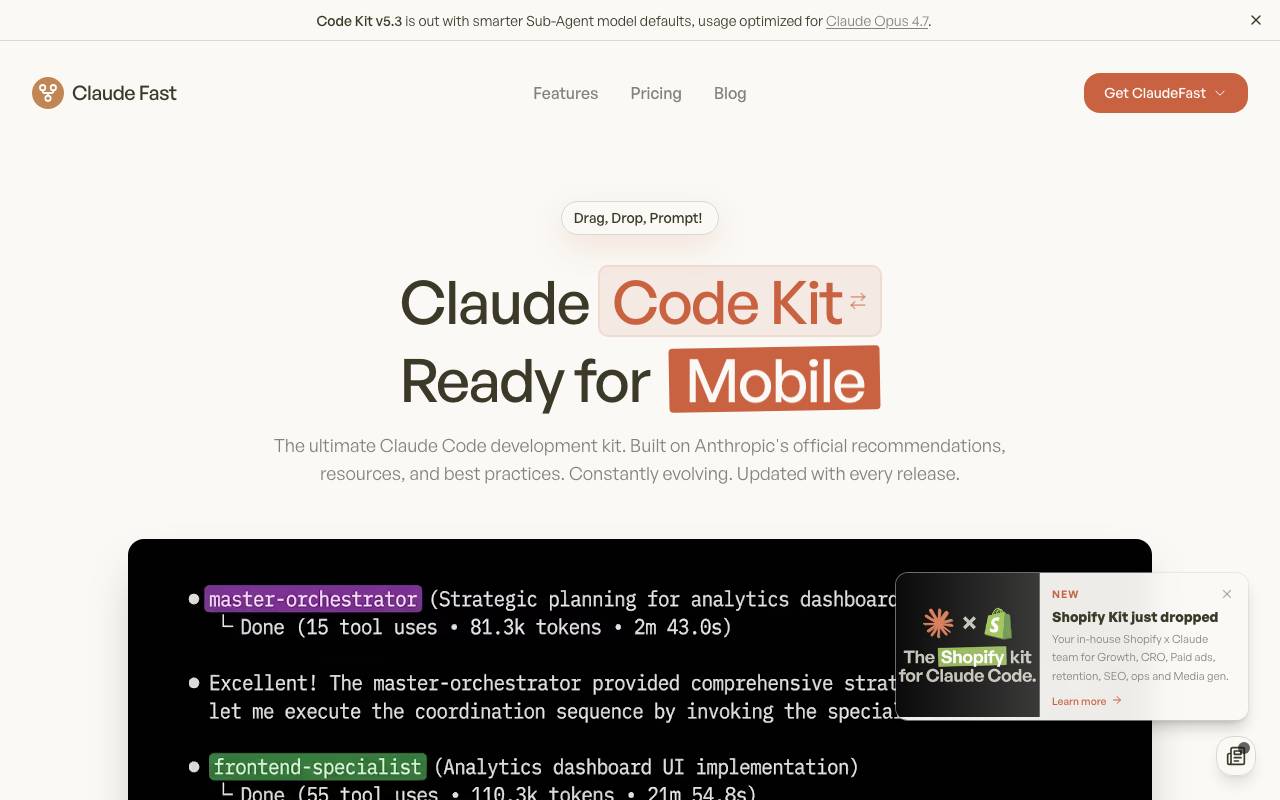
Claudefast provides prebuilt Claude Code setups designed to skip configuration and enable faster deployment. It is based on Anthropic's official recommendations and best practices for Claude Code development. The kit includes various features such as Skill Activation Hook for auto-appending skill recommendations, Permission Hook for LLM-powered auto-permission approval, and a Context Economy that conserves resources by delegating tasks to sub-agents. Additionally, it offers session management, task tracking, intelligent routing, and a self-improvement loop. Claudefast also includes an Infra Master Skill for deploying and securing VPS and a supercharged development environment aimed at reducing the time spent on debugging and rewriting prompts. The tool is marketed towards developers and founders looking to accelerate their Claude Code development process. It is offered with a one-time purchase model that includes lifetime access to future updates.
- Prebuilt Claude Code configurations
- Templates for different project types
- Quick-start onboarding for AI coding
- Consistent setup patterns for teams
- Reduced manual prompt and rule tuning

WithAudio
One-time purchase text-to-speech reader for Mac and Windows with natural AI voices.
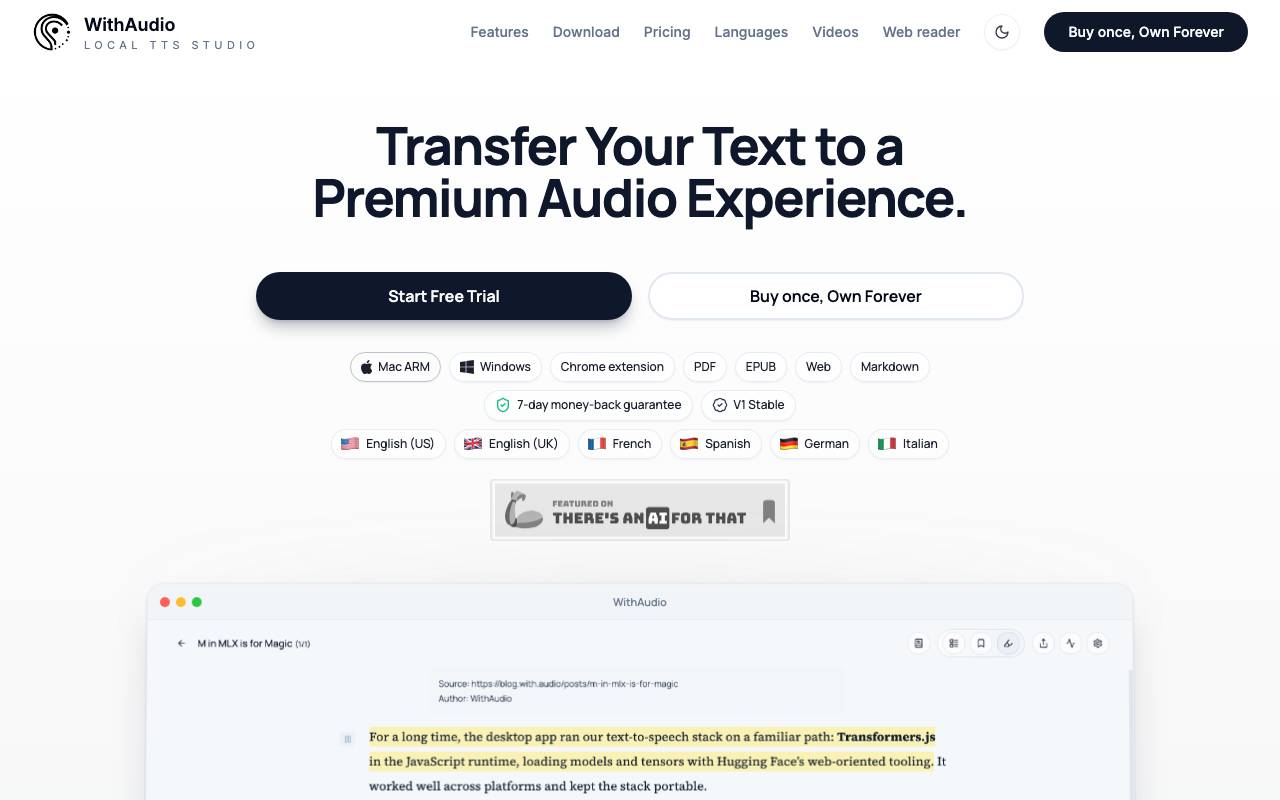
WithAudio is a desktop text-to-speech application for Mac and Windows that converts written content into spoken audio. Users can paste text, load documents, or import articles and have them read aloud using a selection of AI-generated voices, making it useful for proofreading, accessibility, and hands-free reading. Unlike most TTS tools that rely on monthly subscriptions, WithAudio is offered as a one-time purchase, which appeals to readers and writers who want predictable costs. The app focuses on a straightforward listening experience rather than complex audio production, with playback controls and the ability to export generated audio for later use.
- Text-to-speech conversion with AI voices
- Cross-platform support for macOS and Windows
- Audio export for offline listening
- Document and text input options
- Adjustable playback controls
- One-time license activation

Play.ht
Realistic AI voice generation and conversational voice agents for apps, content, and calls.
Play.ht is an AI voice platform that turns text into lifelike speech and powers real-time conversational voice agents. It offers a large library of synthetic voices across many languages and accents, plus tools for voice cloning, long-form narration, and low-latency streaming for interactive use cases. The platform is used by creators for podcasts, audiobooks, videos, and ads, and by developers building IVR systems, customer support bots, and AI characters that can listen, understand, and respond in natural-sounding voices. APIs and SDKs make it possible to integrate speech generation and voice agents into web, mobile, and telephony workflows.
- Text-to-speech with hundreds of AI voices
- Instant and high-fidelity voice cloning
- Conversational voice agents with NLU
- Real-time streaming TTS API
- Multilingual support across 100+ languages
- Studio editor for long-form audio projects
Browse all 50 Speech Recognition tools
The complete, searchable directory — ranked by real user reviews.


