Best Model Serving (2026)

3 min read
If you sign up through a link on this page, we may earn a commission — it never affects our rankings.
A curated guide to the best model serving platforms for deploying machine learning and AI models into production, with comparisons on performance, scalability, and developer experience.
If you've ever tried to share an AI-powered feature with a colleague or teammate, only to have it break because of a misconfigured deployment or a subtle incompatibility, you know the pain of model serving. This is what model serving tools aim to solve: making it easy to share and deploy AI models, so that anyone in your organization can use them without needing to be experts in machine learning.
Choosing a Model Serving Tool
When choosing a model serving tool, there are a few key things to consider. First, think about the scoping and control of your models. Do you want to run them in a secure cloud sandbox, like E2B, or integrate them into a larger workflow? Some tools, like Eidolon AI, focus on the latter, offering enterprise-grade frameworks for building and deploying AI agents.
Another key consideration is performance and scalability. If you're working with large models or expecting high loads, you may want to look into specialized hardware solutions like Groq, which offer high-performance AI inference platforms. On the other hand, if you're working with smaller models or more experimental ideas, free and open-source options like Fast360 or LM Studio might be a better fit.
Beyond the Hype: Pricing and Limitations
It's also worth taking a closer look at prices and limitations. While many model serving tools seem to offer free tiers, these can often come with significant limitations, such as capped usage or restricted access to features. LlamaCloud, for example, is free to use, but may have limitations on document parsing or indexing. APIPASS API Marketplace and FloppyData, though offering free options, typically charge extra for increased scalability, while Eidolon AI has a tiered system with free and paid plans.
Pricing patterns tend to vary greatly, ranging from entirely free offerings like the ones above to high-end, enterprise-grade solutions that come with significant costs. Be sure to carefully read the fine print to avoid surprises down the line.
Pitfalls and Tips
One common pitfall to watch out for is getting caught up in over-engineering, where you invest in a complex model serving solution that's not actually needed for your use case. Don't do this; stick with the tools that fit your needs, and don't be afraid to start simple.
Another important consideration is data security and control. If you're working with sensitive data or models, be sure to choose a tool that offers robust security features, such as E2B's secure cloud sandboxes.
Ultimately, when choosing a model serving tool, start with your needs, and work from there. Take a close look at the tools available to you, and be willing to experiment and adjust as needed. With a little care and consideration, model serving can be a powerful and accessible part of your organization's toolkit.
Model Serving by the numbers
Pricing mix
Best Model Serving (2026)
- 1
 APIPASS API MarketplaceUnified marketplace for connecting to multiple APIs through a single integration point.5.0 (5)
 - 2
 Fast360Open-source arena for benchmarking OCR models on PDF-to-Markdown conversion4.8 (5)
 - 3LLlamaCloudManaged document parsing and indexing platform for building accurate RAG and agent workflows.4.8 (4)
- 4EEidolon AIOpen-source framework for rapidly building and deploying enterprise AI agents.4.7 (6)
- 5EE2BSecure cloud sandboxes for running AI-generated code and autonomous agents4.5 (4)
- 6
 FloppyDataHigh-speed residential and mobile proxies for web scraping and data collection4.5 (4)
 - 7
 GroqA company specializing in high-performance AI inference solutions, offering hardware and software platforms for rapid AI application deployment.4.5 (4)
 - 8LLM StudioDesktop app for running local LLMs offline with full data privacy4.3 (6)

APIPASS API Marketplace
Unified marketplace for connecting to multiple APIs through a single integration point.
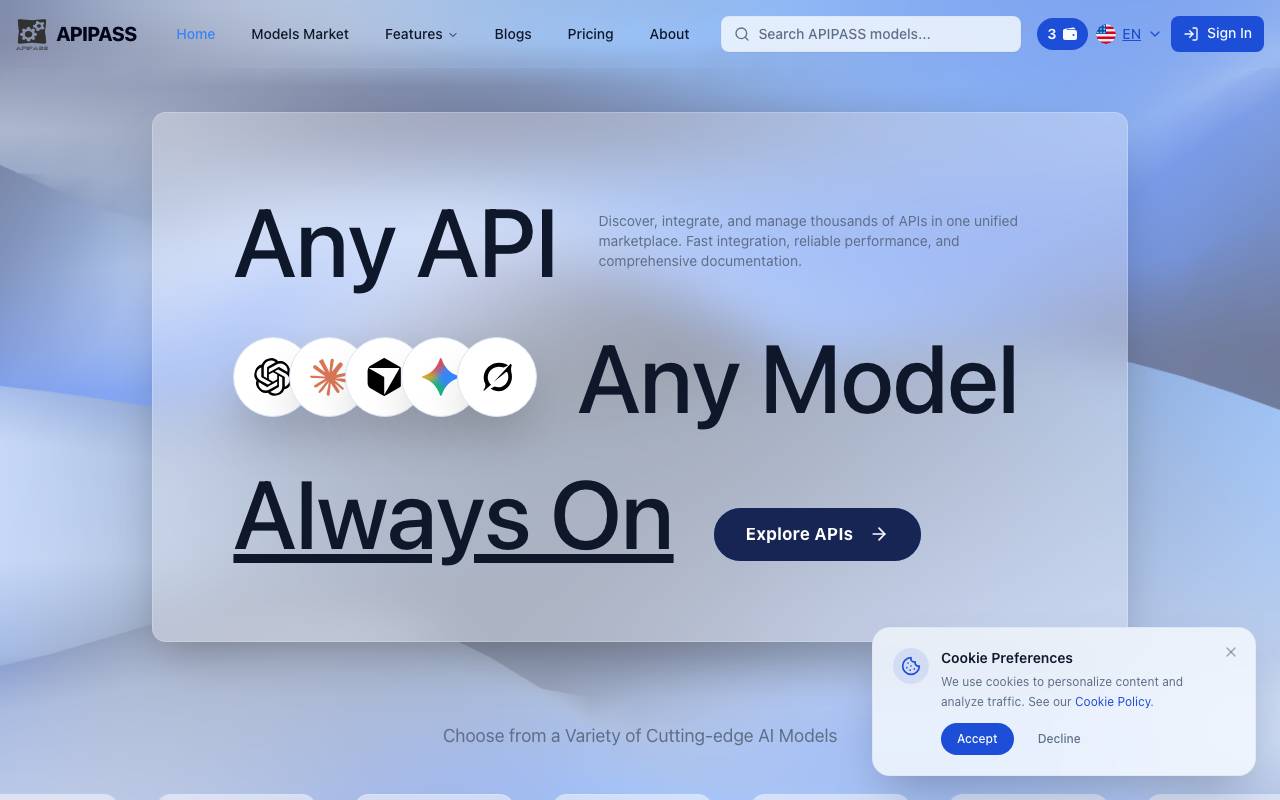
APIPASS API Marketplace is a platform that aggregates a wide range of APIs and exposes them through a unified interface. Instead of managing separate credentials, billing, and SDKs for each provider, developers can authenticate once and access many services from a single hub. The marketplace is aimed at teams building AI applications, automations, and integrations that need to consume external data or functionality without spending weeks on individual onboarding. By standardizing how APIs are discovered, called, and billed, APIPASS reduces the overhead of working with multiple vendors. It suits developers, startups, and product teams that want to prototype quickly, swap providers easily, or expand their integration surface without rebuilding connectors for every new service.
- Aggregated API catalog
- Unified API key and access management
- Centralized usage and billing
- Standardized request format
- Developer documentation and examples
- Support for multiple service categories

Fast360 is an open-source platform positioned as the first dedicated arena for comparing OCR models, with a particular focus on converting PDF documents into clean Markdown. It lets users pit different OCR engines against each other on the same source files and inspect how each handles layout, tables, formulas, and mixed content. The project is aimed at developers, researchers, and teams building document-processing pipelines who need an objective way to choose an OCR backend. By centering on Markdown output, Fast360 reflects modern use cases such as feeding parsed documents into LLMs, RAG systems, and knowledge bases. Because the codebase is open source, users can run evaluations locally, plug in new models, and adapt the arena to their own document types and quality metrics.
- OCR model comparison arena
- PDF-to-Markdown conversion pipeline
- Support for multiple OCR backends
- Side-by-side output evaluation
- Open-source and extensible codebase
- Designed for LLM and RAG ingestion
LlamaCloud
Managed document parsing and indexing platform for building accurate RAG and agent workflows.
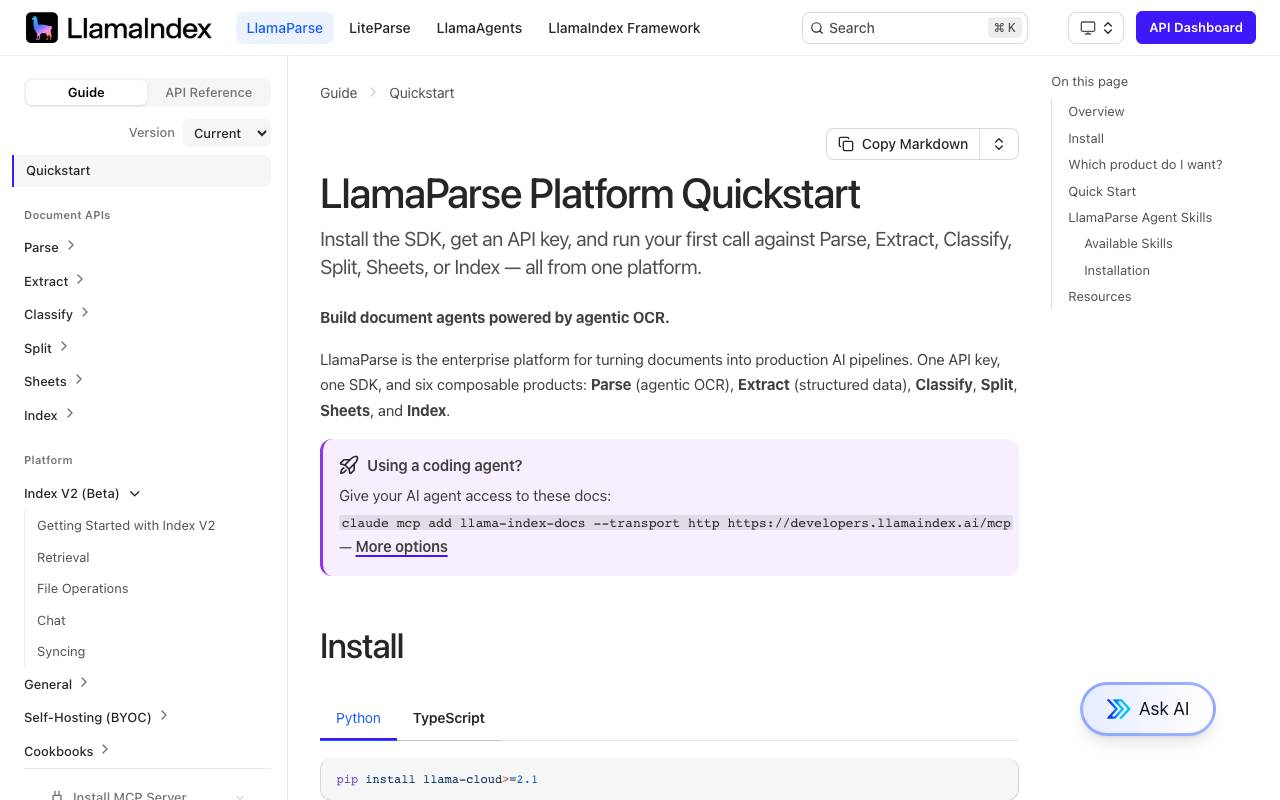
LlamaCloud is a hosted service from the team behind LlamaIndex that handles the heavy lifting of turning messy enterprise documents into clean, queryable data. It combines advanced parsing, extraction, and indexing so developers can plug high-quality context into LLM applications without managing the underlying pipeline. The platform is designed for complex source material like PDFs with tables, charts, and scanned content, where naive text extraction typically breaks. Teams can connect data sources, define schemas, and expose the processed knowledge to agents or search interfaces through APIs and SDKs. It targets engineering teams building production RAG systems, internal knowledge assistants, and document-heavy AI workflows who want managed infrastructure instead of custom ETL.
- LlamaParse for advanced PDF and document parsing
- Structured data extraction with custom schemas
- Managed vector indexing and retrieval APIs
- Connectors for common data sources and storage
- SDKs for Python and TypeScript
- Integration with LlamaIndex agents and workflows
Eidolon AI
Open-source framework for rapidly building and deploying enterprise AI agents.
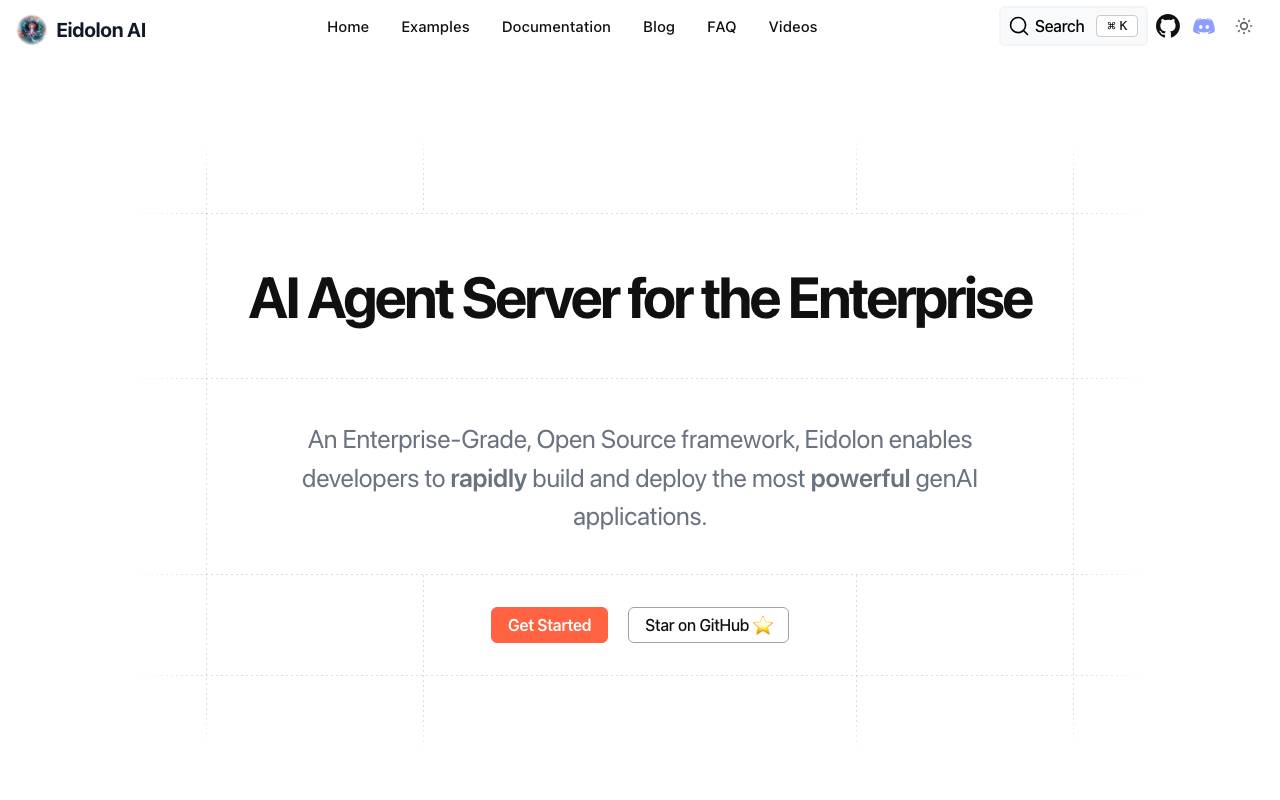
Eidolon AI is a developer-focused platform for designing, building, and deploying AI agents tailored to business workflows. It provides a modular framework that lets teams compose agents from configurable components rather than writing custom orchestration code from scratch. The platform emphasizes flexibility and production readiness, with support for swapping LLMs, tools, and memory backends as requirements evolve. Agents can be deployed as services and integrated into existing applications, making it suitable for companies looking to move beyond prototypes into operational AI systems. With an open-source core and an enterprise offering, Eidolon AI targets developers and organizations that want control over their agent stack while still benefiting from prebuilt patterns, observability, and deployment tooling.
- Agent definition via configuration
- Pluggable LLM and tool integrations
- Multi-agent orchestration support
- Memory and state management
- Deployable as API services
- Open-source framework with enterprise options

E2B provides isolated cloud environments designed specifically for executing code produced by large language models and AI agents. Each sandbox spins up quickly, giving developers a safe, ephemeral runtime where untrusted or experimental code can run without risking the host system. The platform is aimed at teams building agentic applications, code interpreters, data analysis assistants, and developer tools that need to execute arbitrary code at scale. SDKs in Python and JavaScript make it straightforward to integrate sandboxes into existing AI workflows, while customizable templates let teams preconfigure dependencies and tooling. E2B is open source at its core, with managed cloud infrastructure available for production use, making it suitable for both prototyping and large-scale deployments.
- Isolated cloud sandbox environments
- SDKs for Python and JavaScript
- Custom environment templates
- File system and process access
- Long-running session support
- Designed for AI agents and code interpreters

FloppyData
High-speed residential and mobile proxies for web scraping and data collection
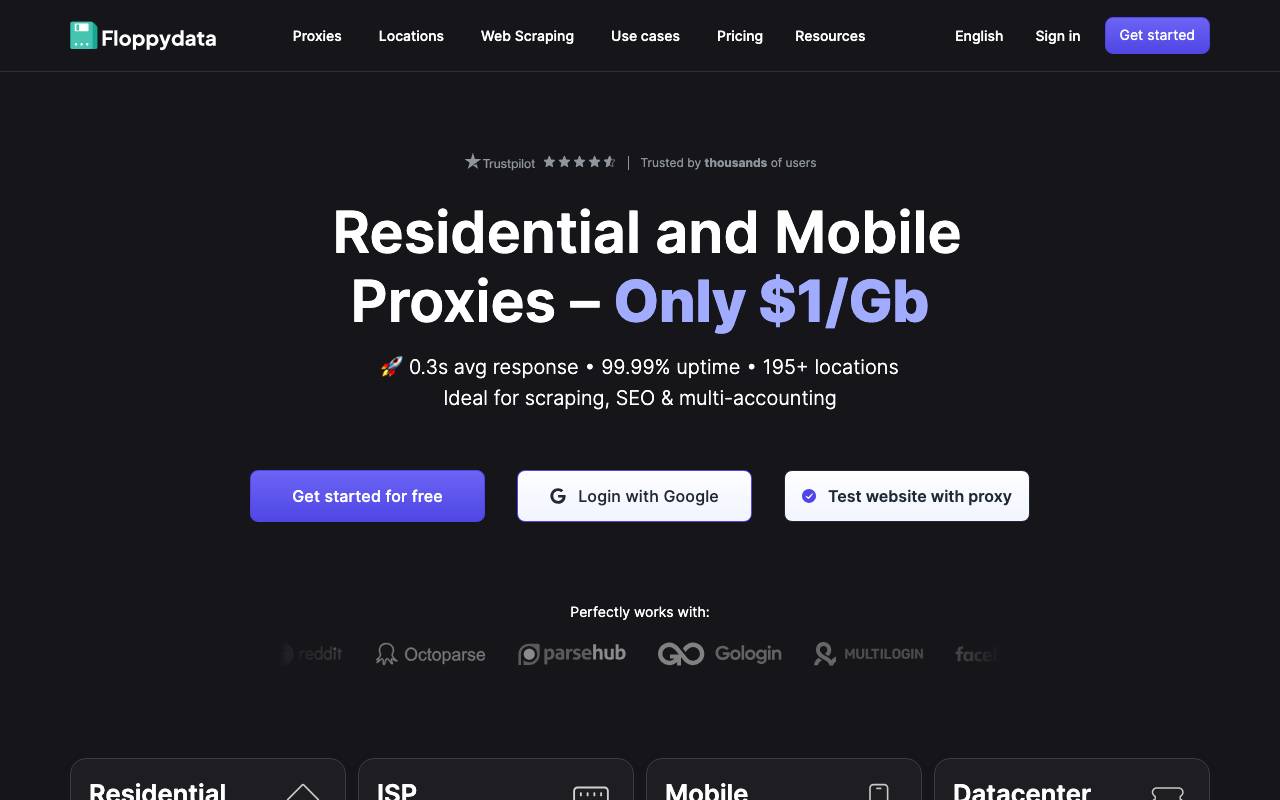
FloppyData is a proxy service provider focused on residential and mobile IP networks designed for large-scale web scraping, data gathering, and online anonymity tasks. The platform routes traffic through real user devices, helping requests appear as organic visitors and reducing the likelihood of being blocked by target sites. The service is aimed at developers, data teams, and businesses that need reliable IP rotation, geographic targeting, and consistent uptime when collecting public web data. Users can typically choose between rotating and sticky sessions, select locations, and integrate the proxies with existing scraping stacks or automation tools. With an emphasis on speed and pool size, FloppyData positions itself as an option for teams handling high request volumes across e-commerce monitoring, SEO research, ad verification, and market intelligence workflows.
- Residential proxy network
- Mobile proxy network
- IP rotation and sticky sessions
- Country and city-level targeting
- HTTP/HTTPS and SOCKS support
- Dashboard for managing usage

Groq
A company specializing in high-performance AI inference solutions, offering hardware and software platforms for rapid AI application deployment.
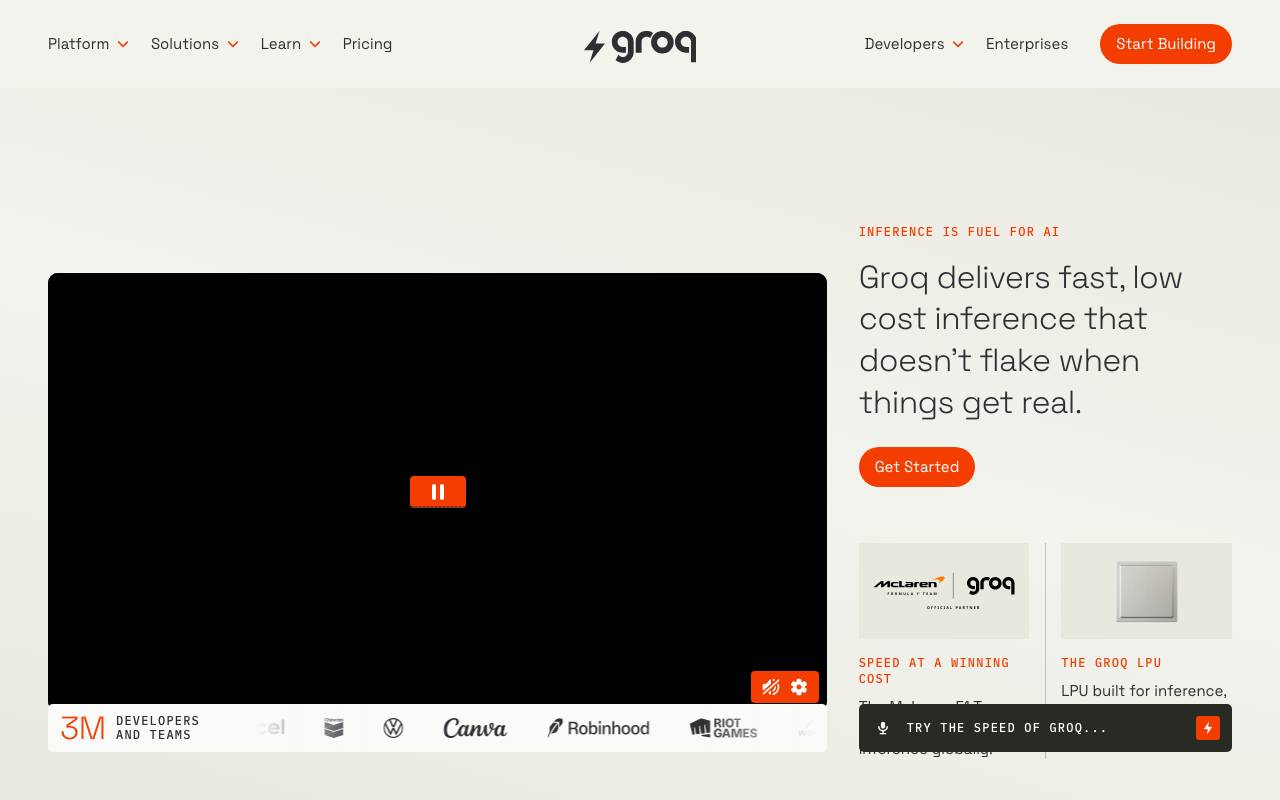
Groq is a company that specializes in high-performance AI inference solutions. It offers hardware and software platforms designed to accelerate the deployment of AI applications, providing fast and low-cost inference without compromising performance. The company's technology is based on its custom silicon, the LPU (Logic Processing Unit), which was pioneered by Groq in 2016 as the first chip purpose-built for inference. Groq's LPU is designed to keep intelligence fast and affordable at scale, focusing on delivering exceptional speed and low latency. This is particularly important for applications that require real-time insights and decision-making, such as the McLaren Formula 1 Team, which has chosen Groq for its inference needs globally. The Groq platform, including GroqCloud, allows developers to deploy AI models worldwide, ensuring low-latency responses from even the most intelligent models. It supports instant intelligence deployment and is compatible with major AI models, including OpenAI. The emphasis is on seamless integration, with the ability to start using Groq with just a few lines of code. One of the standout capabilities of Groq is its ability to significantly enhance performance while reducing costs. Customer testimonials highlight the platform's effectiveness in surging chat speeds and slashing costs, demonstrating its potential for real-world applications. Groq's commitment to providing a high-performance, cost-effective inference solution positions it as a notable player in the AI industry. Groq's approach and technology are designed to address the limitations of traditional GPU-based inference solutions. By leveraging custom silicon and a cloud-based deployment model, Groq aims to make AI more accessible and affordable for a broader range of users and applications. Whether for real-time analytics, model deployment, or enhancing existing infrastructure, Groq presents a compelling option for those seeking to harness the power of AI efficiently.
- High-Performance AI Inference
- Custom Silicon (LPU) for Inference
- Low-Latency Response
- Seamless Integration
- Compatibility with Major AI Models
- Instant Intelligence Deployment
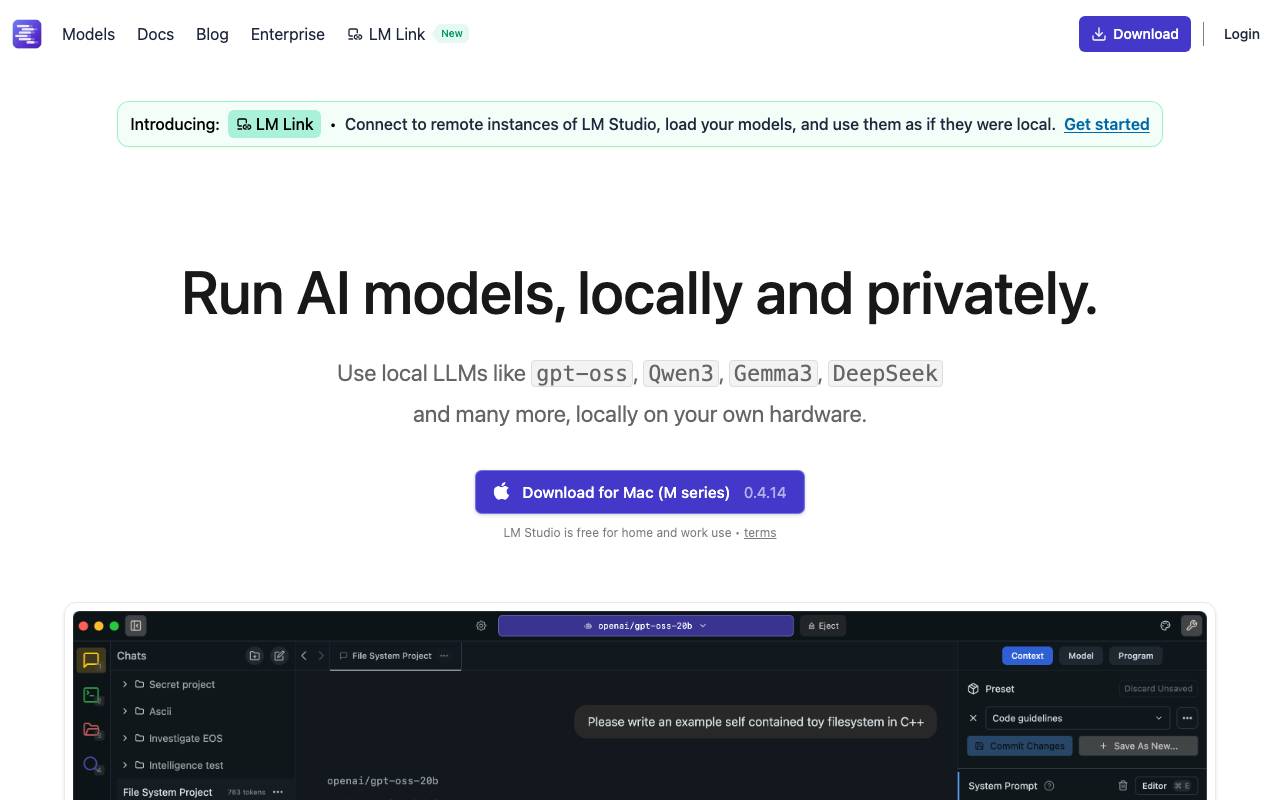
LM Studio is a desktop application that lets users download, run, and chat with open-source large language models directly on their own computer. It supports a wide range of models from Hugging Face, including Llama, Mistral, Gemma, and Qwen variants, and works across Windows, macOS, and Linux. The app provides a built-in chat interface, model discovery tools, and a local server that mimics the OpenAI API, making it easy to integrate local models into existing applications and workflows. Because everything runs on-device, conversations and documents never leave the user's machine. LM Studio is free for personal use and aimed at developers, researchers, and privacy-conscious users who want to experiment with or deploy LLMs without relying on cloud services.
- In-app model browser and downloader
- Local chat interface for any installed model
- OpenAI-compatible local API server
- GPU acceleration and configurable inference settings
- Support for GGUF and MLX model formats
- Document chat with local retrieval
Browse all 8 Model Serving tools
The complete, searchable directory — ranked by real user reviews.


