Best Coding Agent (2026)

3 min read
If you sign up through a link on this page, we may earn a commission — it never affects our rankings.
Coding agents automate software development tasks—writing, refactoring, debugging, and shipping code with varying degrees of autonomy. This guide compares the best options for developers and teams.
I still remember the countless nights spent staring at a blank screen, wondering how to turn my half-baked idea into a functional product. The frustrating reality of traditional coding methods – writing, testing, refining, repeat – can be a major roadblock for aspiring developers and entrepreneurs. That's where a 'Coding Agent' comes in – a game-changing tool that generates code based on natural language prompts, saving time and streamlining the development process.
But with so many Coding Agents in the market, how do you choose the right one for your needs? Here are a few key considerations to make the process easier.
First and foremost, understand the scope of your project. Some Coding Agents, like Shipper.now, can generate complete, deployable apps from a single prompt. Others, like K G, offer a more comprehensive experience as fullstack AI coding agents that understand your entire codebase end-to-end. If you need to build multiple projects or tackle complex tasks, a more robust solution like K G might be the way to go.
Next, consider the type of project you're working on. Some Coding Agents, like Bolt, excel in building and deploying full-stack web apps in the browser, while others, like HeroUI, specialize in creating reusable UI components. If you're focused on mobile app development, Appacella is a promising option that turns app ideas into working mobile apps in seconds with AI. On the other hand, if you're looking to integrate coding agents directly into your team's workflow, Blocks Team is worth exploring.
Another crucial factor is your team's size and experience. If you're a solo developer or a small team just starting out, a simple, user-friendly solution like Shipper.now or Bolt might be enough. However, if you're part of a larger organization with multiple projects and developers, a more advanced tool like Blocks Team or Devra might be more suitable.
When evaluating Coding Agents, it's also essential to watch out for limitations and constraints. Some of these tools come with limitations on usage or features, while others might have more flexible pricing models. For instance, Bolt offers a free plan with restricted features, while K G provides a free plan with access to its full range of features.
Regarding pricing, freemium models are common in this category. Many Coding Agents offer a free plan or a limited trial period, which can be a great way to test their capabilities and see if they fit your needs. Some tools, like Zugabot, offer on-demand AI dev team functionality on a pay-per-use basis, while others, like Devra, operate on a subscription model.
In terms of typical pricing patterns, expect to see tiered plans with varying levels of features, support, and usage limits. Keep an eye out for additional costs, such as charges for excess usage, storage, or advanced features.
Now that you have a better understanding of how to choose a Coding Agent, here are some practical tips to help you make the most of these tools:
- Before diving in, start with a proof-of-concept project to test the waters and get a feel for the tool's capabilities.
- Read reviews, documentation, and community forums to understand the tool's strengths and weaknesses.
- Familiarize yourself with the tool's user interface and features to ensure a smooth workflow.
- Start with a simple project and gradually work your way up to more complex tasks.
- Integrate the Coding Agent with other development tools and services to enhance your workflow.
By following these guidelines and understanding the capabilities and limitations of Coding Agents, you can unlock the full potential of these tools and accelerate your development process.
Coding Agent by the numbers
Pricing mix
Best Coding Agent (2026)
- 1
 FlootAI-powered no-code builder for turning plain-language prompts into working apps and websites.5.0 (5)
 - 2
 AppacellaTurn app ideas into working mobile apps in seconds with AI5.0 (4)
 - 3
 devlo AIAI teammate that automates coding tasks across your repos and dev workflows5.0 (4)
 - 4
 JulesGoogle's asynchronous AI coding agent that tackles bugs and tests inside your GitHub workflow.5.0 (4)
 - 5
 Blocks TeamBring coding agents directly into your team's development workflow4.8 (5)
 - 6
 HeroUIReusable UI component library for building polished web interfaces quickly.4.8 (5)
 - 7FFineRapidly build, test, and deploy AI-powered applications without heavy setup.4.8 (5)
- 8
 DeepSiteAI-powered document processing for automated data extraction and workflow integration.4.8 (5)
 - 9
 Shipper.nowGenerate complete, deployable apps from a single natural-language prompt.4.8 (4)
 - 10
 BoltBuild and deploy full-stack web apps from a single AI prompt in the browser.4.8 (4)

Floot
AI-powered no-code builder for turning plain-language prompts into working apps and websites.
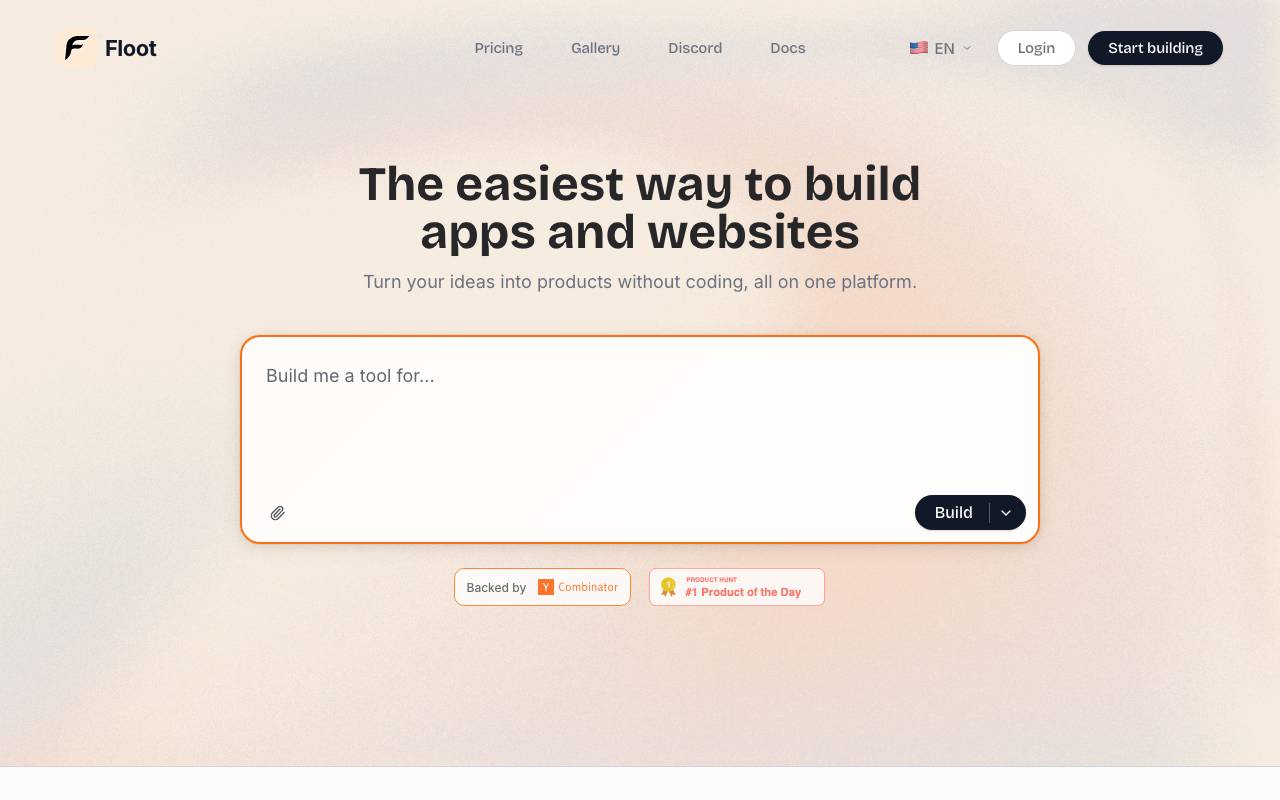
Floot is an AI app and website builder designed for 'vibe coding'—describing what you want in natural language and letting the platform generate a functional product. It targets makers, founders, and non-technical creators who want to ship working software without writing code from scratch. Users can prompt Floot to scaffold full applications, iterate on designs, and adjust functionality through conversation. The tool handles UI generation, basic logic, and deployment steps, aiming to compress the path from idea to live app. It fits early-stage prototyping, internal tools, landing pages, and MVPs where speed matters more than custom-engineered architecture.
- Natural-language app generation
- No-code visual editing
- Website and web app support
- Conversational iteration on designs
- Built-in deployment
- Templates for common use cases

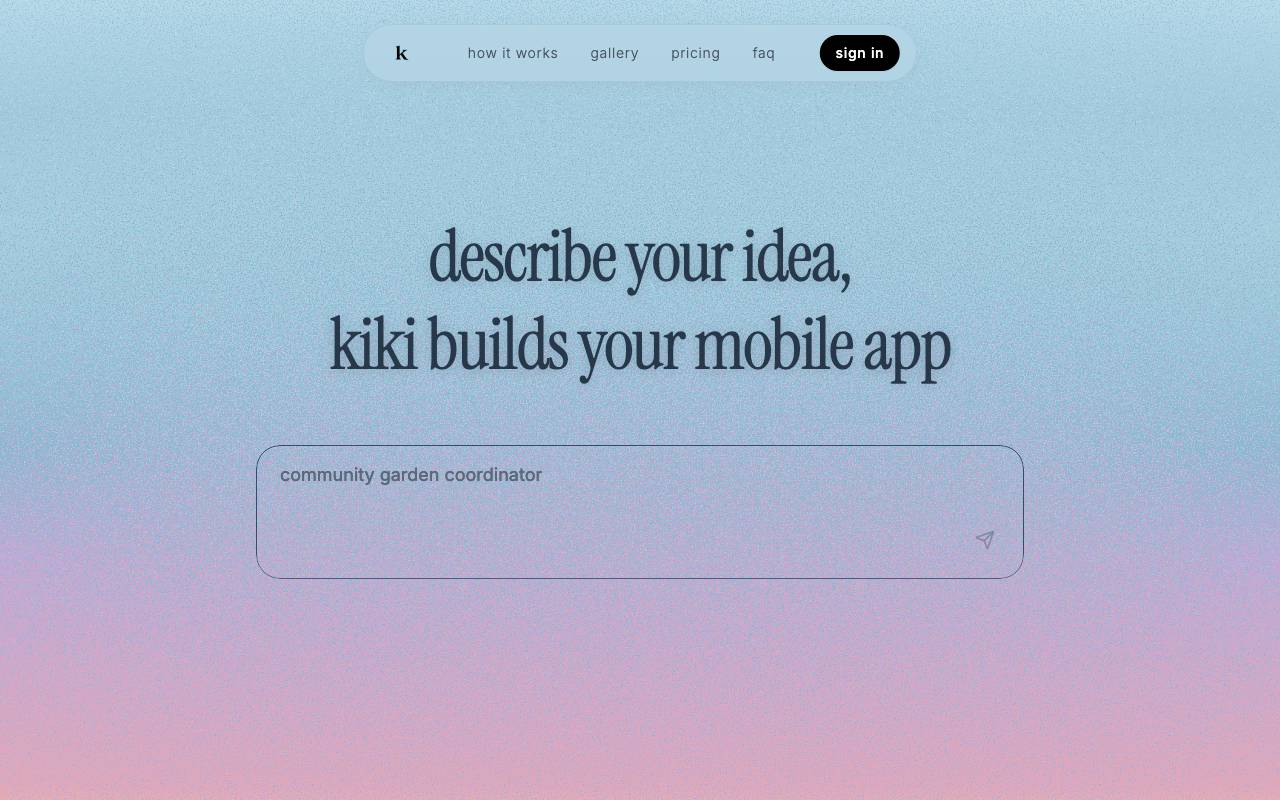
Appacella allows users to turn app ideas into working mobile apps in seconds with AI assistance. To get started, users describe their idea in one sentence, and Appacella's AI handles the rest, including scaffolding features, data, and UI in minutes. Once built, users can publish their app instantly to the web, with mobile deployment coming soon. The platform has been used by thousands of creators to ship real apps, with support available through a Discord community. However, it is essential to note that new project creation will end on July 10, and users should export their apps before then.
- AI-generated mobile app scaffolding
- Prompt-to-app workflow
- Editable screens and components
- Quick MVP creation
- Designed for non-developers
- Iterative refinement of generated apps

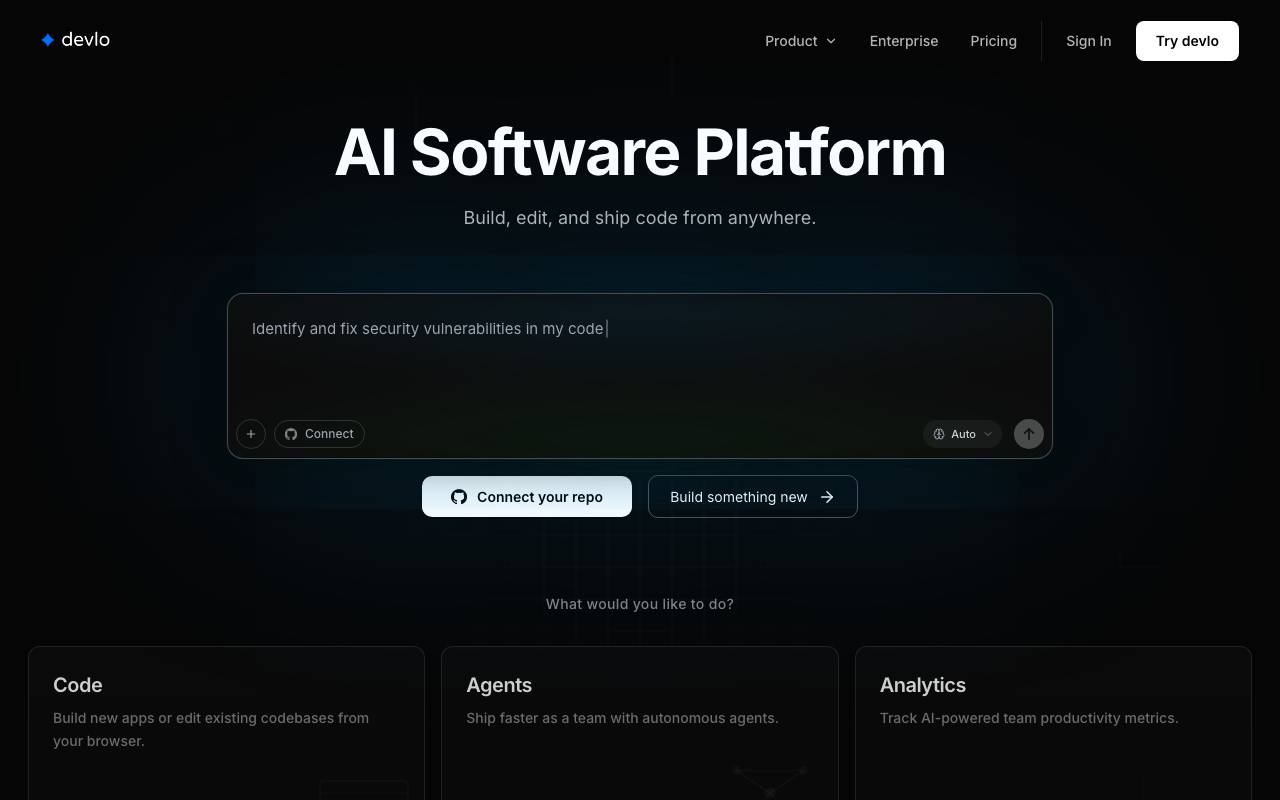
devlo AI is a software development platform that acts as an AI teammate embedded in your engineering workflow. It connects to source control and issue trackers to help teams tackle bugs, write tests, review pull requests, and ship smaller tasks without context switching. Designed to plug into existing tools like GitHub, devlo can be assigned issues or PRs much like a human collaborator. It analyzes repository context, proposes code changes, and opens pull requests for review, aiming to reduce the time engineers spend on routine maintenance work. The platform is targeted at development teams looking to offload repetitive tasks, accelerate code review, and improve test coverage while keeping humans in control of final merges.
- Automated bug fixing and code changes
- Pull request review assistance
- Test generation and coverage improvements
- GitHub and issue tracker integration
- Repo-aware code understanding
- Assignable AI teammate workflow

Jules
Google's asynchronous AI coding agent that tackles bugs and tests inside your GitHub workflow.
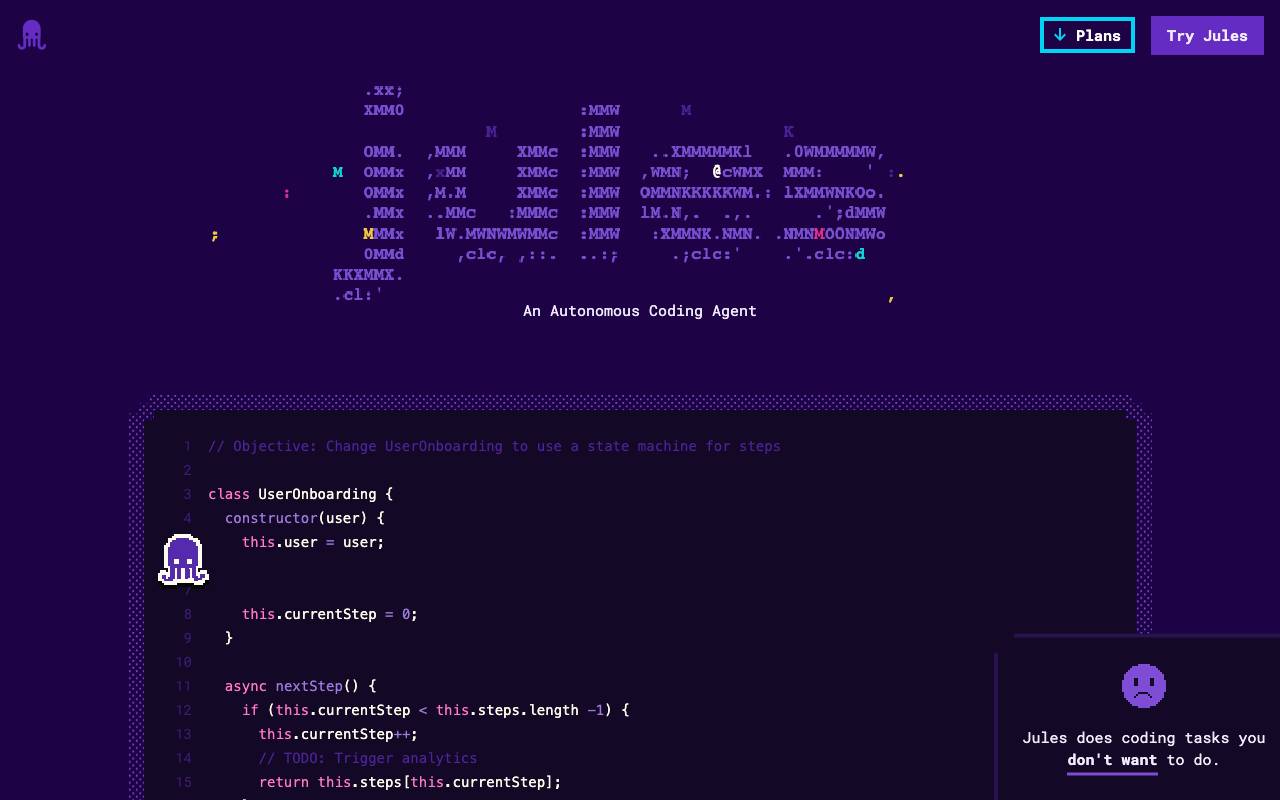
Jules is an asynchronous coding agent from Google designed to take on routine software engineering tasks without constant developer supervision. It plugs into GitHub repositories, reads the codebase, and works through assigned issues such as bug fixes, refactors, dependency updates, and test creation in the background. Rather than acting as a chat-based pair programmer, Jules operates more like a remote teammate: you hand it a task, it plans an approach, executes changes in an isolated environment, and returns a pull request for human review. This makes it well suited for offloading maintenance work while developers focus on higher-impact problems. Because it runs asynchronously and integrates with existing review processes, teams can use Jules to parallelize work across multiple issues and keep humans in control through standard PR workflows.
- Autonomous task execution in isolated environments
- Pull request-based change delivery
- Automated bug fixing and patching
- Unit test generation and updates
- Dependency and version upgrades
- GitHub repository integration

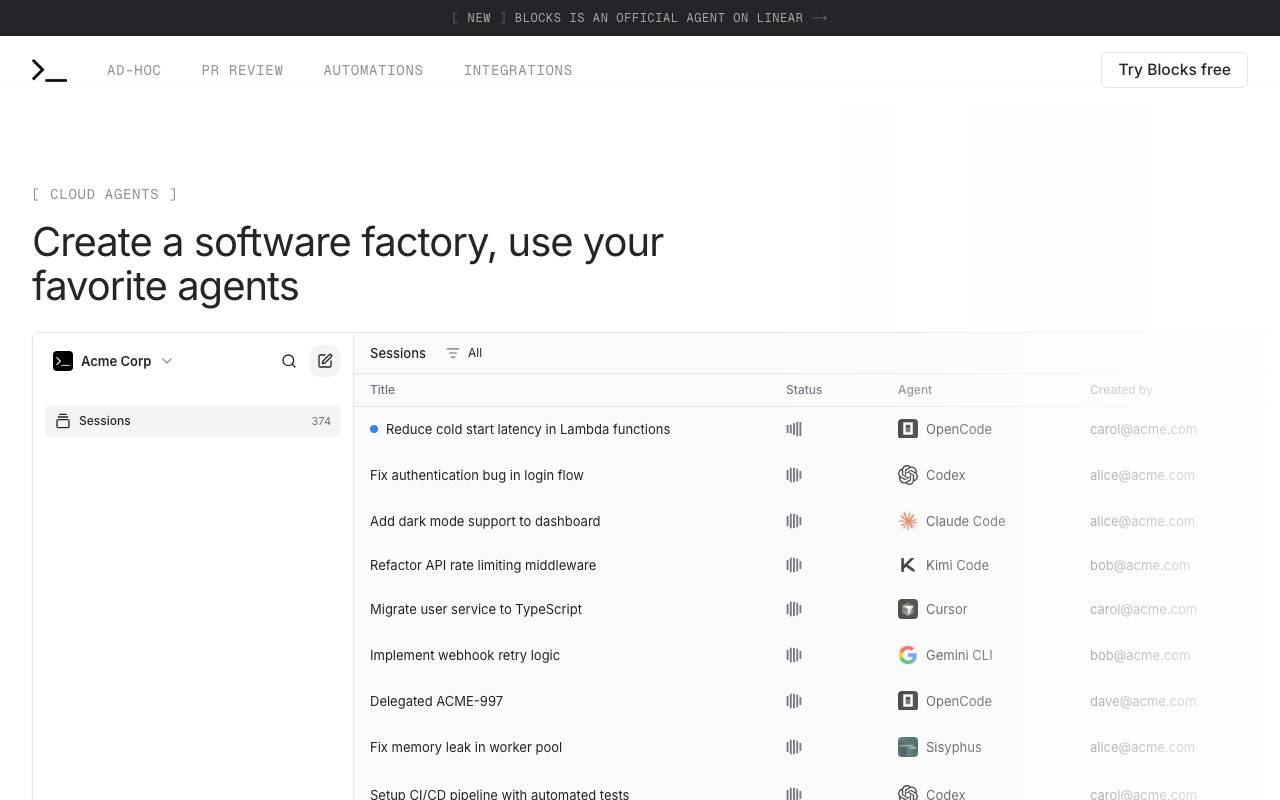
Blocks Team is a platform that brings coding agents directly into your team's development workflow. It supports various development tools such as GitHub, GitLab, Bitbucket, Slack, and Linear. Blocks enables you to create a software factory and use your favorite agents to automate tasks, review pull requests, and implement custom security checks. It also provides automations for custom security checks, CI failures, Playwright testing, and more. The platform ensures reliability with 800k+ tasks executed and 99.99% uptime, built by experts in HPC orchestration.
- AI coding agents for development tasks
- Workflow integration with existing tools
- Team collaboration features
- Automated code generation and edits
- Support for repository-based projects

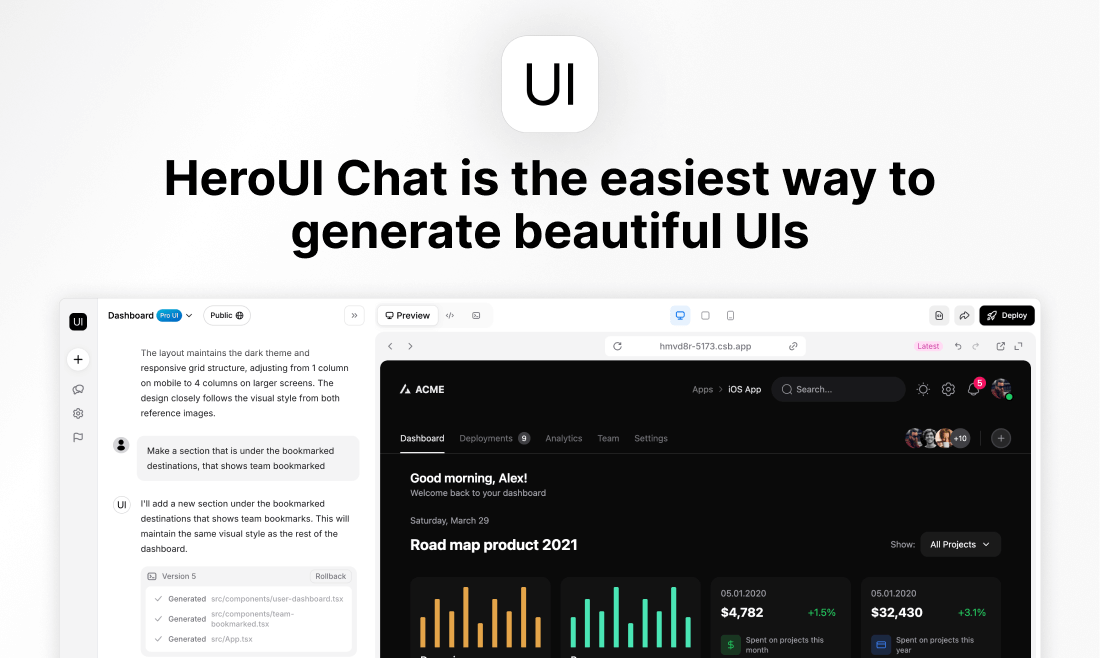
HeroUI is a reusable UI component library designed to help developers build polished web interfaces efficiently. It offers a range of pre-built components that are customizable to suit various design needs. HeroUI enables rapid prototyping and development of web applications, allowing developers to focus on core functionality rather than repetitive UI design tasks. By using a library like HeroUI, developers can maintain consistency in their application's visual identity and streamline their workflow, thereby improving overall productivity. HeroUI can be particularly beneficial for projects with strict design requirements or those that require a high level of customizability.
- Library of reusable UI components
- Responsive and accessible defaults
- Theme and style customization
- Developer-friendly APIs
- Integrates with modern web frameworks
- Designed for fast iteration

Fine is a development platform that enables users to quickly build, test, and deploy AI-powered applications. It aims to simplify the process of integrating AI capabilities into software projects. The platform is designed for developers and businesses looking to leverage AI without extensive setup or infrastructure requirements. Fine provides a streamlined workflow for creating and deploying AI-driven applications, focusing on ease of use and rapid development. While specific features and integrations are not detailed, Fine's primary goal is to make AI application development more accessible and efficient.
- AI application scaffolding
- Integrated testing environment
- One-click or streamlined deployment
- Rapid prototyping workflow
- Support for AI model integration

DeepSite
AI-powered document processing for automated data extraction and workflow integration.
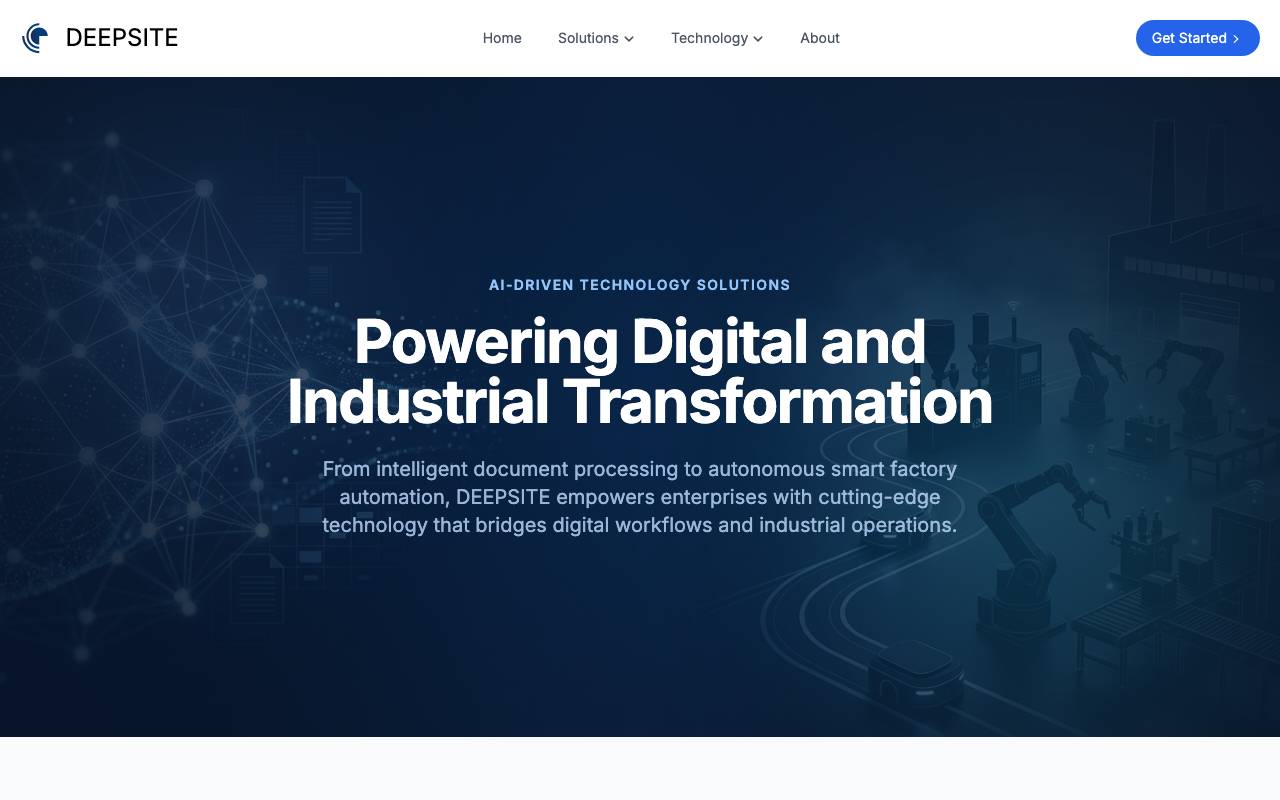
DeepSite is a document processing platform that uses AI to read, classify, and extract structured data from a wide range of business documents. It aims to replace manual data entry by turning invoices, contracts, forms, and reports into usable information that can flow directly into downstream systems. The platform connects with common business tools and workflows, allowing teams to route extracted data into ERPs, CRMs, databases, or custom applications. Built-in validation and review steps help maintain accuracy while reducing the time spent handling repetitive paperwork. DeepSite is geared toward operations, finance, and back-office teams looking to automate document-heavy processes without building custom machine learning pipelines from scratch.
- AI-based data extraction from documents
- Workflow automation and routing
- Pre-built integrations with business tools
- Validation and human-in-the-loop review
- Support for structured and unstructured documents
- Scalable batch processing


Shipper.now is an AI-powered app builder that turns a single prompt into a working application. Instead of scaffolding projects manually, users describe what they want and the tool generates the codebase, UI, and core logic in one pass. It targets founders, indie hackers, and product teams who need to move from idea to prototype quickly. By collapsing setup, boilerplate, and initial implementation into a single step, Shipper.now aims to shorten the path between concept and shippable product.
- Single-prompt app generation
- Full-stack code output
- Built-in UI scaffolding
- Rapid prototyping workflow
- Natural-language project specification

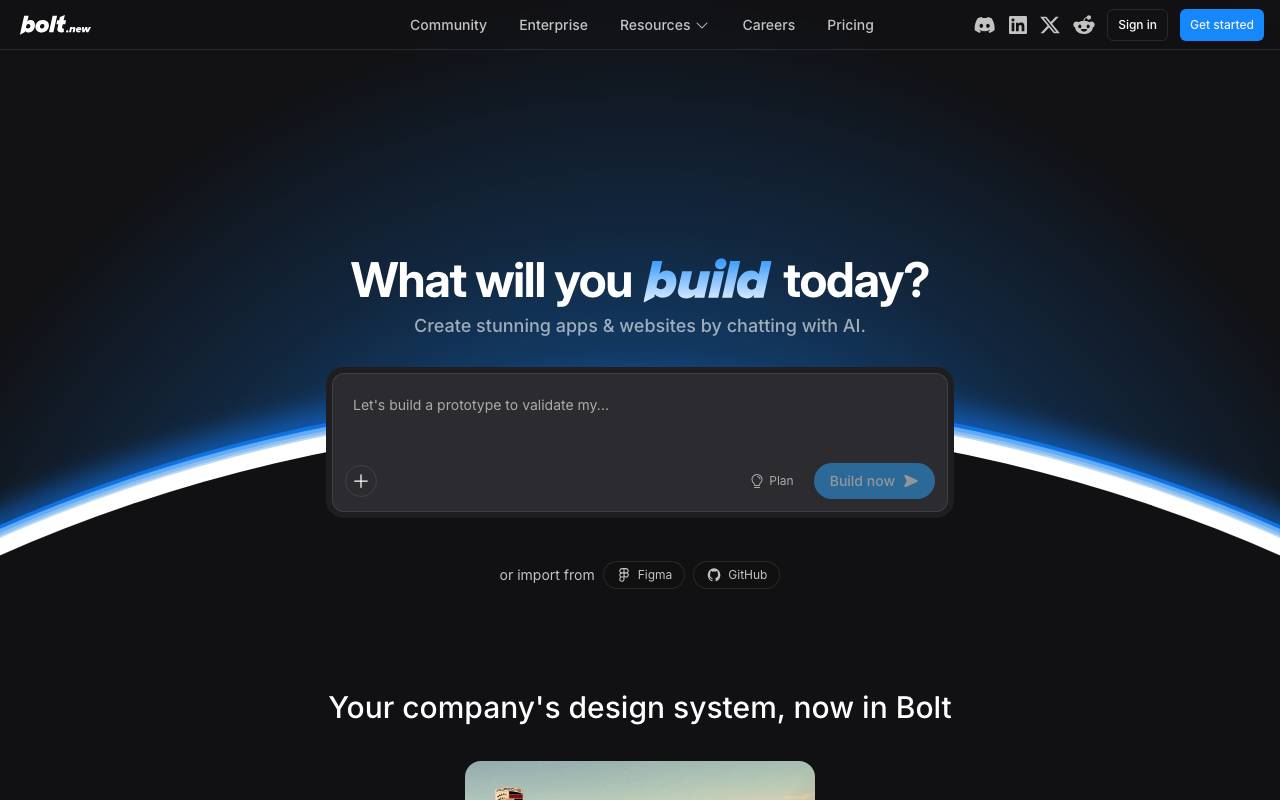
Bolt is an AI-powered web development platform that lets users generate, edit, run, and deploy full-stack applications directly from the browser. By describing what they want in natural language, developers and non-developers alike can scaffold projects with frameworks like React, Next.js, Astro, and Vue without manual setup. The environment combines a chat-based AI assistant with a live code editor, terminal, and preview, so iteration happens in one place. Bolt can install npm packages, run servers, troubleshoot errors, and push finished projects to hosting providers, making it useful for prototyping, MVPs, and rapid client work.
- Natural-language project generation
- In-browser code editor and terminal
- Live app preview and hot reload
- AI-assisted debugging and refactoring
- Package installation and backend support
- Direct deployment to the web
Browse all 22 Coding Agent tools
The complete, searchable directory — ranked by real user reviews.


