Past battle · 2025-01-23 UTC
Software Development Showdown — January 23, 2025
From the Software Development category. 13 marks placed across 7 fighters. Qdrant AI took the crown.
Final standings




The line-up
The fighters
Profiles of every tool that competed in this battle, ranked by their final score.

Qdrant AI
Open-source vector database for fast, scalable similarity search and AI retrieval.
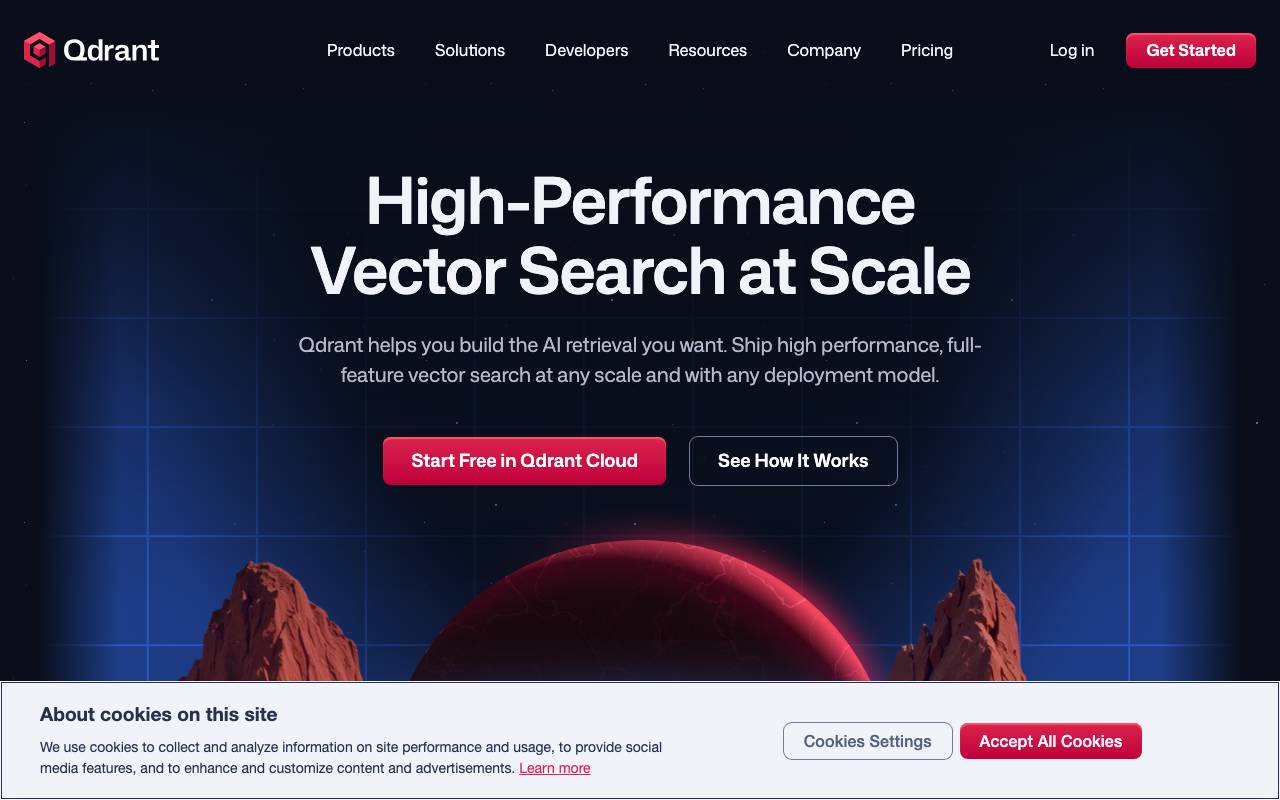
Qdrant is an open-source vector database and similarity search engine designed for production AI workloads. It stores high-dimensional embeddings alongside structured payloads, enabling applications like semantic search, recommendation systems, retrieval-augmented generation, and anomaly detection. Built in Rust for performance, Qdrant supports filtered vector search, horizontal scaling, and cloud-managed deployments. Developers can interact with it through REST and gRPC APIs, along with client libraries for Python, JavaScript, Go, and Rust. It integrates with popular AI frameworks such as LangChain and LlamaIndex, making it a common choice for teams building LLM-powered applications that require fast, reliable retrieval at scale.
Criteria breakdown
- Approximate nearest neighbor search (HNSW)
- Payload-based metadata filtering
- Horizontal scaling and sharding
- REST and gRPC APIs
- Managed Qdrant Cloud service
- Integrations with LangChain and LlamaIndex

All Hands AI
Open-source AI software engineering agents that automate developer workflows.
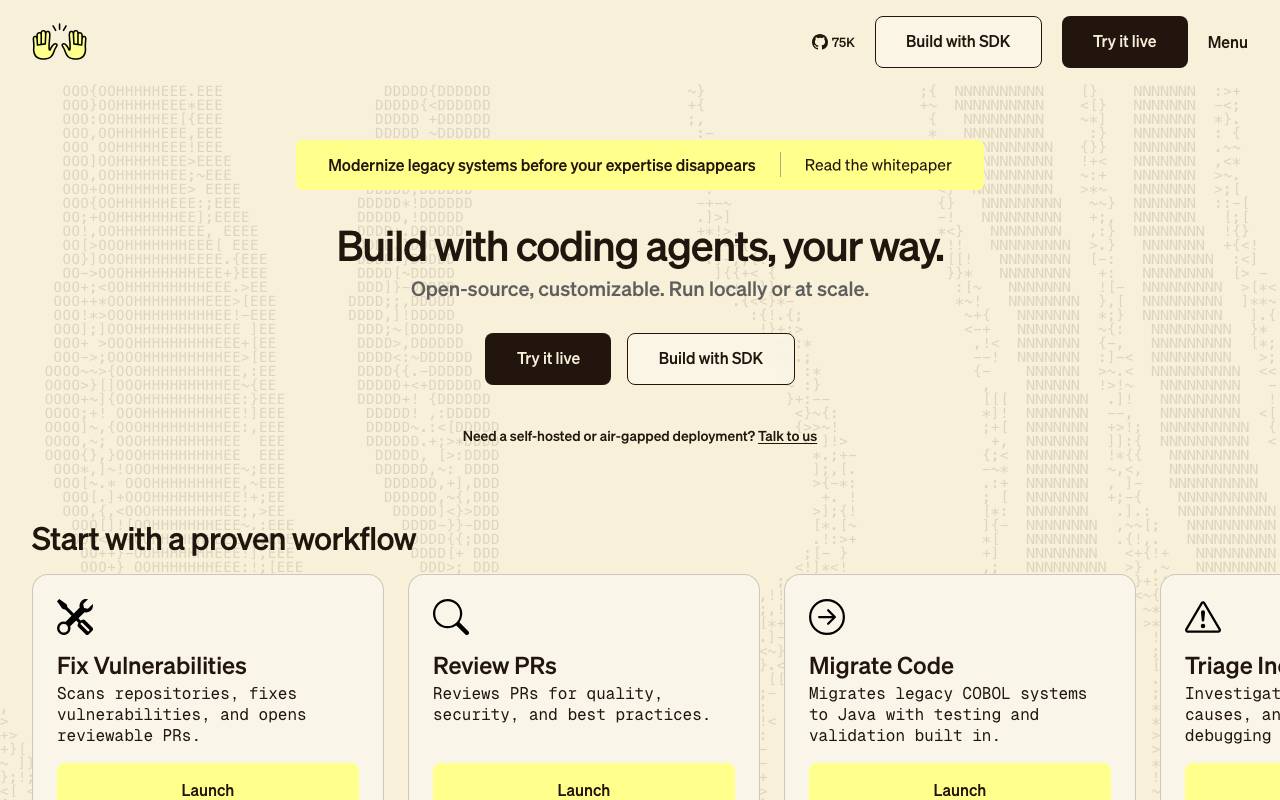
All Hands AI builds open-source autonomous agents designed to take on real software engineering tasks. The agents can read codebases, write and modify files, run commands in a sandboxed environment, browse the web, and interact with APIs to complete development work alongside human engineers. Originally known as OpenDevin, the project has grown into a community-driven platform with both a self-hostable open-source version and a managed cloud offering. It supports multiple LLM backends, integrates with GitHub and other tools, and is aimed at developers who want transparent, customizable AI coding agents instead of closed proprietary assistants.
Criteria breakdown
- Autonomous coding agents with sandboxed execution
- File editing, terminal, and browser tool use
- GitHub integration and pull request workflows
- Pluggable LLM backends (Anthropic, OpenAI, local models)
- Self-hosted or managed cloud deployment
- Open-source codebase with extensible architecture

Langfuse
An open-source LLM engineering platform offering observability, metrics, evaluations, and prompt management to debug and enhance large language model applica...
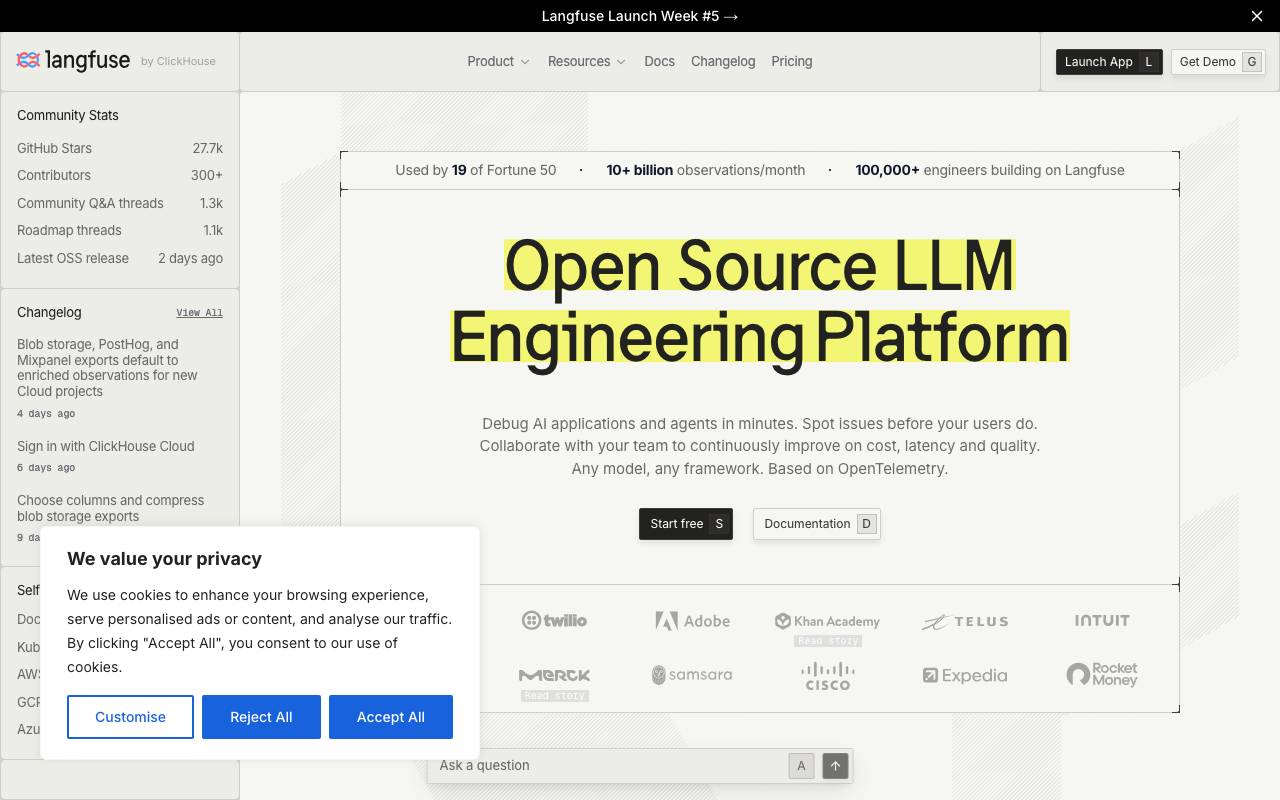
Langfuse is an open-source LLM (Large Language Model) engineering platform designed to help developers build, debug, and enhance AI agents and applications. It provides a comprehensive set of tools for observability, metrics, evaluations, and prompt management, allowing teams to collaborate and continuously improve the quality, cost, and latency of their AI products. Langfuse supports the entire LLM engineering loop, from prototype to production, by integrating observability, prompt management, evaluations, experiments, and human annotation into a single workflow. The platform offers features such as hierarchical tracing, which captures every LLM call, tool invocation, and retrieval step, and allows filtering by user, session, cost, latency, or custom metadata. It also supports various evaluation methods, including LLM-as-a-judge, heuristic functions, and human review. Additionally, Langfuse provides a prompt management system with one-click deployments and rollbacks, a playground for testing prompts, and experiment definition and comparison tools. Langfuse works with any language and framework that supports OTel instrumentation and has over 100 integrations with popular agent frameworks, model providers, and other tools. It is an open platform with an MIT license, allowing users to self-host at scale and contribute to the community. Langfuse is used by over 100,000 engineers and 19 of the Fortune 50 companies, handling over 10 billion observations per month.
Criteria breakdown
- Model observability and metrics for monitoring performance
- Evaluations and testing for assessing model quality and accuracy
- Prompt management for refining model output and handling edge cases

LeanSentry
AI-powered diagnostics and monitoring for IIS and ASP.NET performance issues.
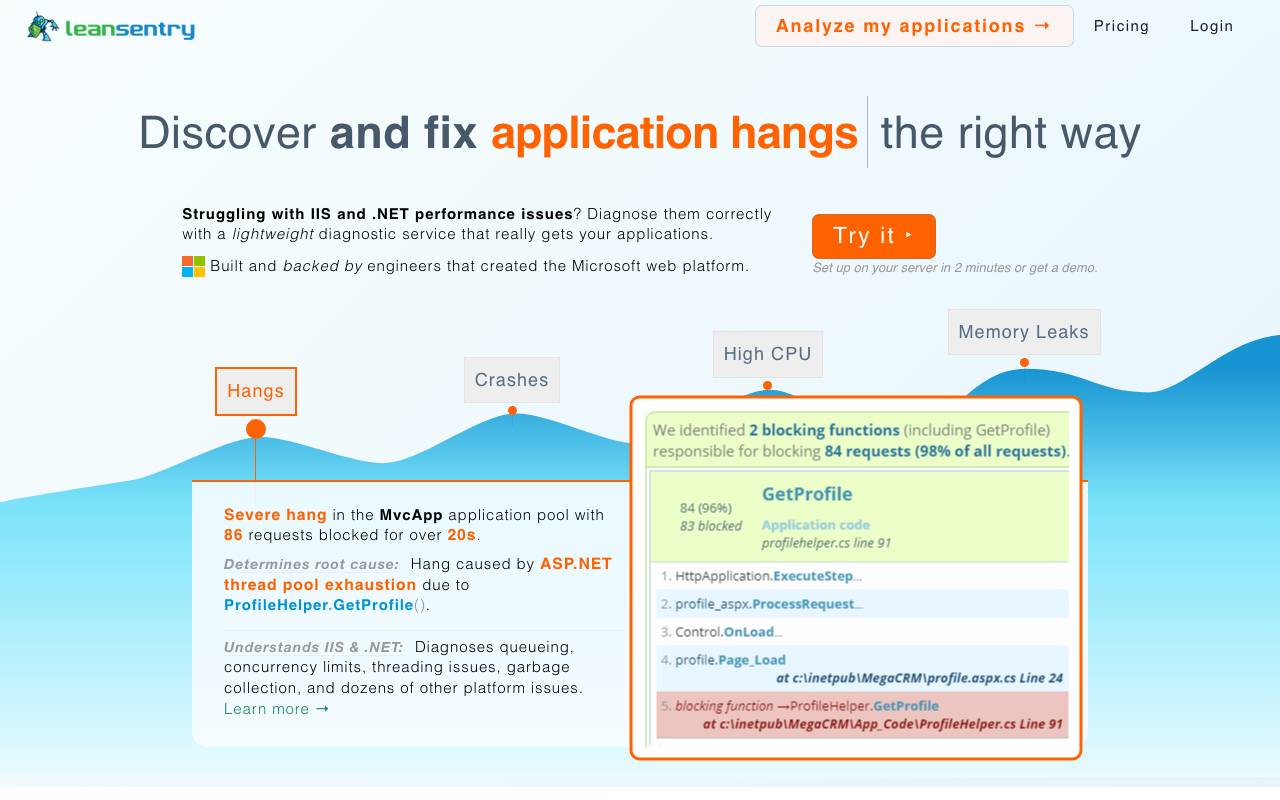
LeanSentry is a specialized monitoring and diagnostics platform built for Windows web stacks, focusing on IIS, ASP.NET, and SQL Server workloads. It uses automated analysis to detect, diagnose, and explain performance problems such as slow requests, high CPU usage, memory leaks, and application hangs. Rather than just surfacing metrics, the platform applies expert diagnostic logic to pinpoint root causes and recommend specific fixes. This helps operations and development teams resolve production incidents faster, even when they lack deep expertise in IIS internals or .NET profiling. LeanSentry is typically used by teams running mission-critical .NET applications who need ongoing visibility into server health and want actionable guidance during outages or performance regressions.
Criteria breakdown
- Automated IIS and ASP.NET performance diagnostics
- Hang and crash detection with stack trace analysis
- Memory leak and high CPU investigation
- Slow request and SQL query monitoring
- Alerting with guided remediation steps
- Historical incident reports and trend tracking
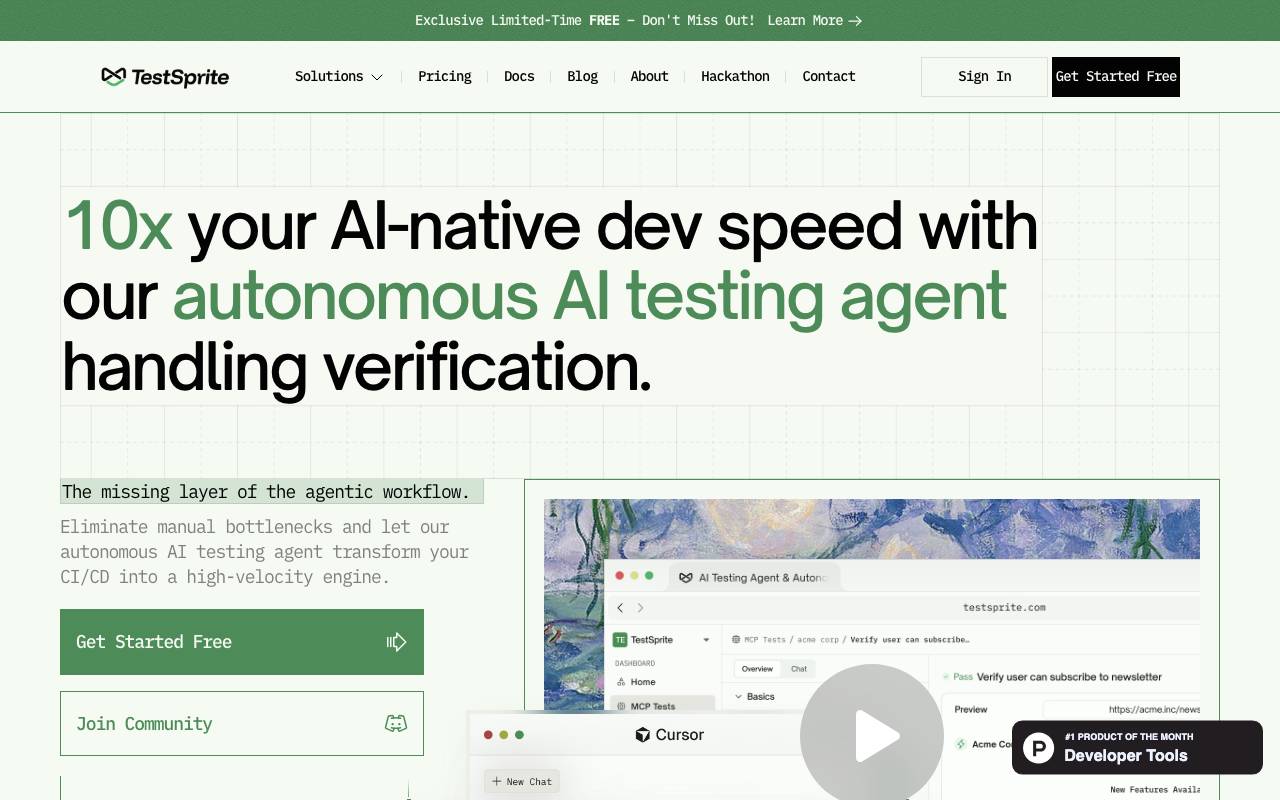
TestSprite is an AI-driven, no-code automation tool for end-to-end web app testing. It uses your app like a real user, allowing your coding agent to fix its own work before bugs reach you. TestSprite reads your designs, code, and tickets, integrating with the tools you already use. The tool aims to address the verification gap in coding, where agents may report work as done even if it hasn't been properly tested. TestSprite uses a fleet of agents to open your live app, click through every feature like a real user, and drive a real browser or hit a live API. TestSprite provides a failure bundle when something fails, which includes the failing step, screenshots, DOM snapshots, test source, a root-cause hypothesis, and a recommended fix. This allows your agent to read, fix the code, and rerun. The tool also auto-heals repairs tests when the UI drifts and provides machine-readable verdicts. TestSprite works in four steps: install and connect, learn your app, run on your live app, and fix, rerun, and grow. It offers a no-code web app for QA teams, a CLI for autonomous agents, an MCP server in your IDE, and a gate in CI. The tool aims to help teams ship code faster and with greater reliability, reducing the bottleneck from writing code to proving it works.
Criteria breakdown
- AI-powered test case generation
- No-code test authoring interface
- Automated end-to-end web testing
- Self-healing test maintenance
- Detailed bug and run reports
- CI/CD workflow integration
MetaGPT
Multi-agent AI framework that turns one-line ideas into working software projects
MetaGPT is an open-source multi-agent framework that simulates a software company by assigning specialized AI roles such as product manager, architect, engineer, and QA. Given a short prompt describing what you want to build, the agents collaborate to produce requirements documents, design specs, code, and tests. The system encodes standard operating procedures into agent workflows, aiming to reduce hallucinations and keep outputs consistent across roles. Developers can run it locally, plug in different LLM backends, and inspect intermediate artifacts to guide or refine the build process. It is best suited for prototyping, exploring AI agent orchestration, and generating starting points for small to mid-sized projects rather than shipping production-ready systems unsupervised.
Criteria breakdown
- Simulated software team of AI agents
- One-line prompt to full project pipeline
- Generates PRDs, system designs, and code
- Configurable roles and SOPs
- Compatible with GPT, Claude, and local models
- CLI and Python API

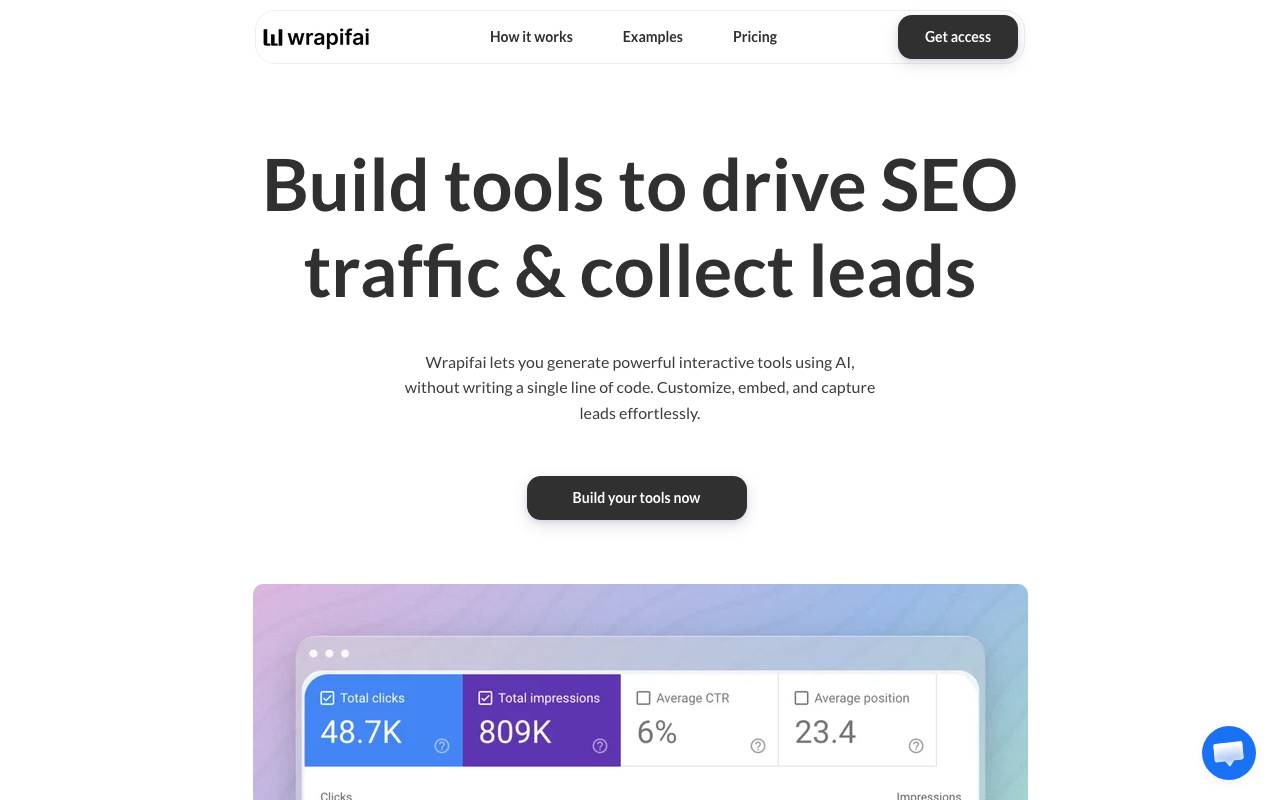
Wrapifai is a platform that enables users to build and deploy mini AI tools without requiring coding knowledge. These tools are designed to attract SEO traffic and capture leads. The process involves describing the tool idea, generating the tool instantly using AI, customizing its appearance, configuring settings, and embedding it on a website or sharing it via a link. Wrapifai is positioned as a no-code solution for creating lead-generating tools, allowing users to focus on business growth rather than technical development. The platform provides a range of features, including AI-powered tool generation, customization options, and integration capabilities. Users can create and launch multiple tools to scale their SEO efforts and online presence. Wrapifai is suitable for individuals and businesses looking to enhance their digital marketing strategies and engage with their audience through interactive tools.
Criteria breakdown
- Drag-and-drop AI tool builder
- Custom input fields and prompts
- Embed and standalone page options
- Built-in lead capture forms
- SEO-friendly tool pages
- Usage analytics dashboard