Past battle · 2026-04-06 UTC
AI Agent Development Frameworks Showdown — April 6, 2026
From the AI Agent Development Frameworks category. 15 marks placed across 5 fighters. ScreenAgent took the crown.
Final standings



The line-up
The fighters
Profiles of every tool that competed in this battle, ranked by their final score.

ScreenAgent
Open‑source VLM agent to control computer GUIs via mouse/keyboard planning and execution.
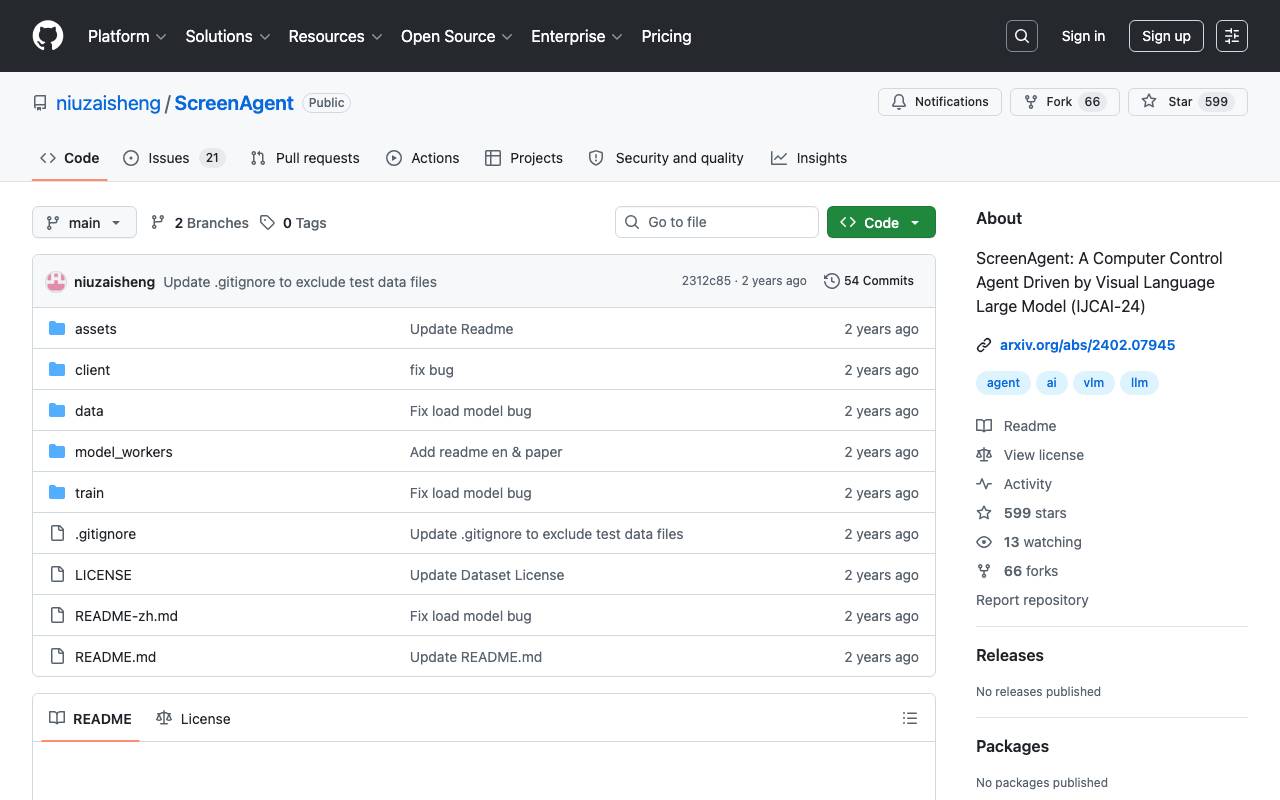
ScreenAgent is an open-source Visual Language Model (VLM) agent designed to control computer GUIs via mouse and keyboard operations. It enables interaction with real computer screens by observing screenshots and executing actions. The project includes a planning-execution-reflection process that guides the agent to complete multi-step tasks. It was created to address the challenge of teaching agents to use computers, requiring capabilities such as task planning, image understanding, and visual positioning. The ScreenAgent dataset, which covers various daily computer tasks, was manually annotated to support the agent's learning. The project consists of a client for controlling the desktop, a dataset, model workers for inference, and training code. It supports basic mouse and keyboard operations and can be applied to different desktop operating systems and applications. ScreenAgent's approach is universal and does not rely on specific APIs, making it versatile.
Criteria breakdown
- Mouse and keyboard operation execution
- Planning-execution-reflection process for task completion
- Support for various desktop operating systems and applications
- Manual annotation of the ScreenAgent dataset for diverse task coverage
- VLM agent for GUI interaction

Google Agent Development Kit
A modular framework for building, deploying, and managing AI agents across diverse workflows.
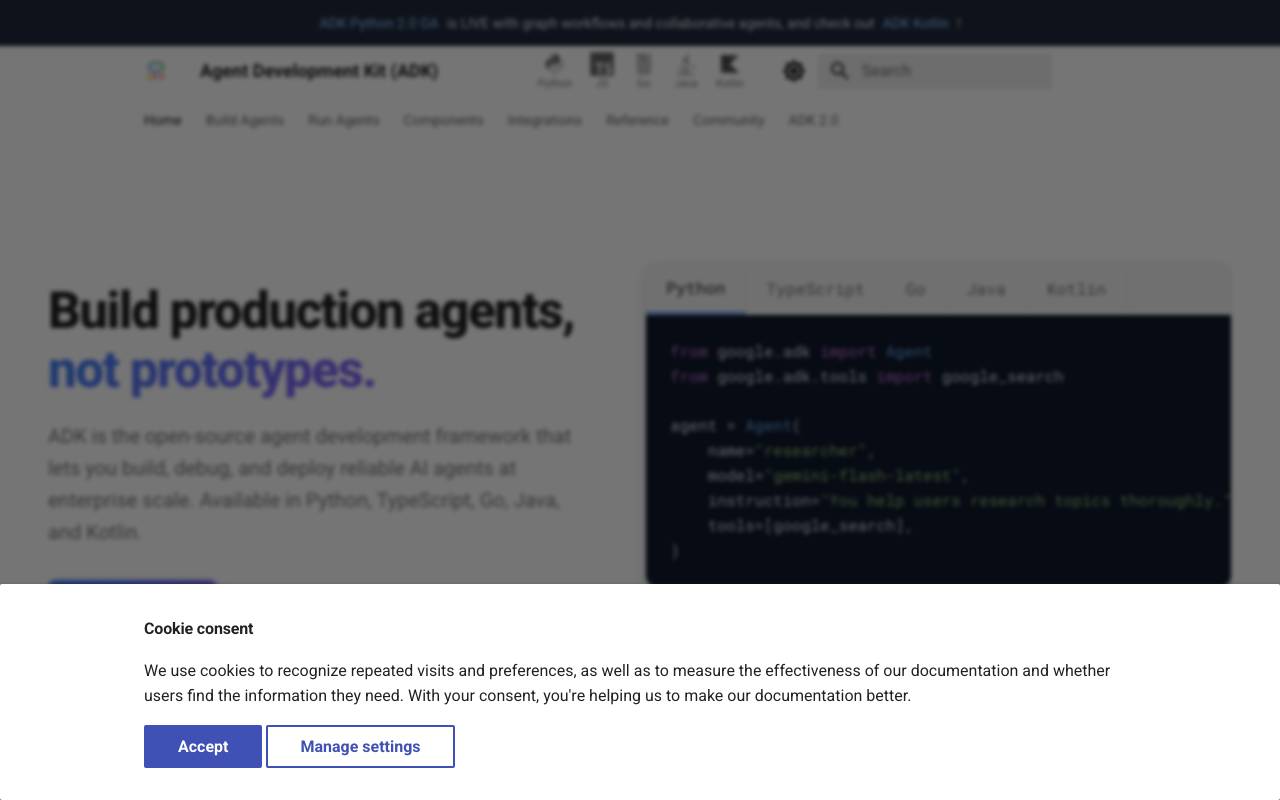
The Google Agent Development Kit (ADK) is an open-source framework for building, deploying, and managing AI agents across diverse workflows. It allows developers to create reliable AI agents at enterprise scale, with support for multiple programming languages including Python, TypeScript, Go, Java, and Kotlin. ADK provides a modular architecture for building agents, enabling developers to start with simple prompts and tool calls and scale up to multi-agent orchestration and graph-based workflows. ADK is designed to be used by both humans and AI, allowing developers to generate agents in seconds using their favorite coding assistant. The framework provides easy access to various AI models, including Gemini, and supports integration with existing apps and services. ADK also features a powerful CLI tool, Agents CLI, which enables developers to scaffold, build, test, evaluate, and deploy agents quickly. One of the key features of ADK is its graph-based workflow architecture, which allows developers to orchestrate complex tasks through structured and predictable execution paths. This enables developers to create reliable and intelligent agents that can reason and adapt to changing conditions. ADK also provides a range of tools and resources for developers, including comprehensive training, videos, and community support. ADK is part of a growing ecosystem of open-source tools and services for building and deploying AI agents. The framework is designed to be extensible and customizable, allowing developers to add new features and capabilities as needed. With ADK, developers can create production-ready AI agents that can be deployed at scale, making it a powerful tool for businesses and organizations looking to leverage the power of AI. The ADK community is active and growing, with a range of resources available for developers, including guides, tutorials, and community support. The framework is also constantly evolving, with new features and capabilities being added regularly. Overall, ADK is a powerful and flexible framework for building and deploying AI agents, and is well-suited for developers looking to create reliable and intelligent agents at scale. ADK has several strengths, including its modular architecture, support for multiple programming languages, and ease of use. However, it also has some limitations, such as the need for significant development expertise and resources to deploy at scale. Additionally, ADK is a relatively new framework, and as such, it may not have the same level of maturity and stability as more established frameworks. In comparison to other frameworks, ADK offers a unique combination of flexibility, scalability, and ease of use. Its graph-based workflow architecture and support for multiple AI models make it well-suited for complex and dynamic applications. However, it may not be the best choice for simple or trivial applications, where a more lightweight framework may be more suitable. Overall, ADK is a powerful and flexible framework for building and deploying AI agents, and is well-suited for developers looking to create reliable and intelligent agents at scale. With its modular architecture, support for multiple programming languages, and ease of use, ADK is an attractive choice for businesses and organizations looking to leverage the power of AI. ADK has a number of potential use cases, including customer service, language translation, and data analysis. Its ability to integrate with existing apps and services makes it a versatile tool for a wide range of applications. Additionally, its support for multiple AI models and graph-based workflow architecture make it well-suited for complex and dynamic applications. In conclusion, ADK is a powerful and flexible framework for building and deploying AI agents. Its modular architecture, support for multiple programming languages, and ease of use make it an attractive choice for developers looking to create reliable and intelligent agents at scale. While it has some limitations, such as the need for significant development expertise and resources to deploy at scale, it offers a unique combination of flexibility, scalability, and ease of use that makes it well-suited for a wide range of applications. ADK is constantly evolving, with new features and capabilities being added regularly. The framework is designed to be extensible and customizable, allowing developers to add new features and capabilities as needed. With its active and growing community, comprehensive training and resources, and powerful CLI tool, ADK is a powerful tool for businesses and organizations looking to leverage the power of AI. The ADK ecosystem is also growing, with a range of open-source tools and services available for building and deploying AI agents. The framework is designed to be open and extensible, allowing developers to add new features and capabilities as needed. With its support for multiple AI models, graph-based workflow architecture, and ease of use, ADK is well-suited for a wide range of applications, from simple chatbots to complex and dynamic systems. Overall, ADK is a powerful and flexible framework for building and deploying AI agents, and is well-suited for developers looking to create reliable and intelligent agents at scale. Its unique combination of flexibility, scalability, and ease of use make it an attractive choice for businesses and organizations looking to leverage the power of AI.
Criteria breakdown
- Graph-based workflow architecture
- Support for multiple AI models
- Modular architecture
- Agents CLI
- Integration with existing apps and services
- Comprehensive training and resources

Claude MCP Agents
AI agents built on Anthropic's MCP for seamless tool and data integration.
Claude MCP Agents are AI agents that leverage Anthropic's Model Context Protocol (MCP) to connect with a wide range of external data sources, APIs, and developer tools. By standardizing how context flows between Claude and outside systems, these agents can read files, query databases, invoke services, and act on real-time information without bespoke integrations for each source. The approach is aimed at developers and teams building automation, research assistants, and workflow agents that need reliable access to enterprise or personal data. MCP's open specification means the same agent can plug into new tools as connectors emerge, reducing lock-in and integration overhead.
Criteria breakdown
- Model Context Protocol integration
- Connects to files, APIs, and databases
- Extensible via custom MCP servers
- Supports agentic, multi-step workflows
- Compatible with Claude model family
- Open standard for interoperability

Agent S
Open-source GUI agent framework that lets an LLM use your computer like a human via an Agent-Computer Interface.
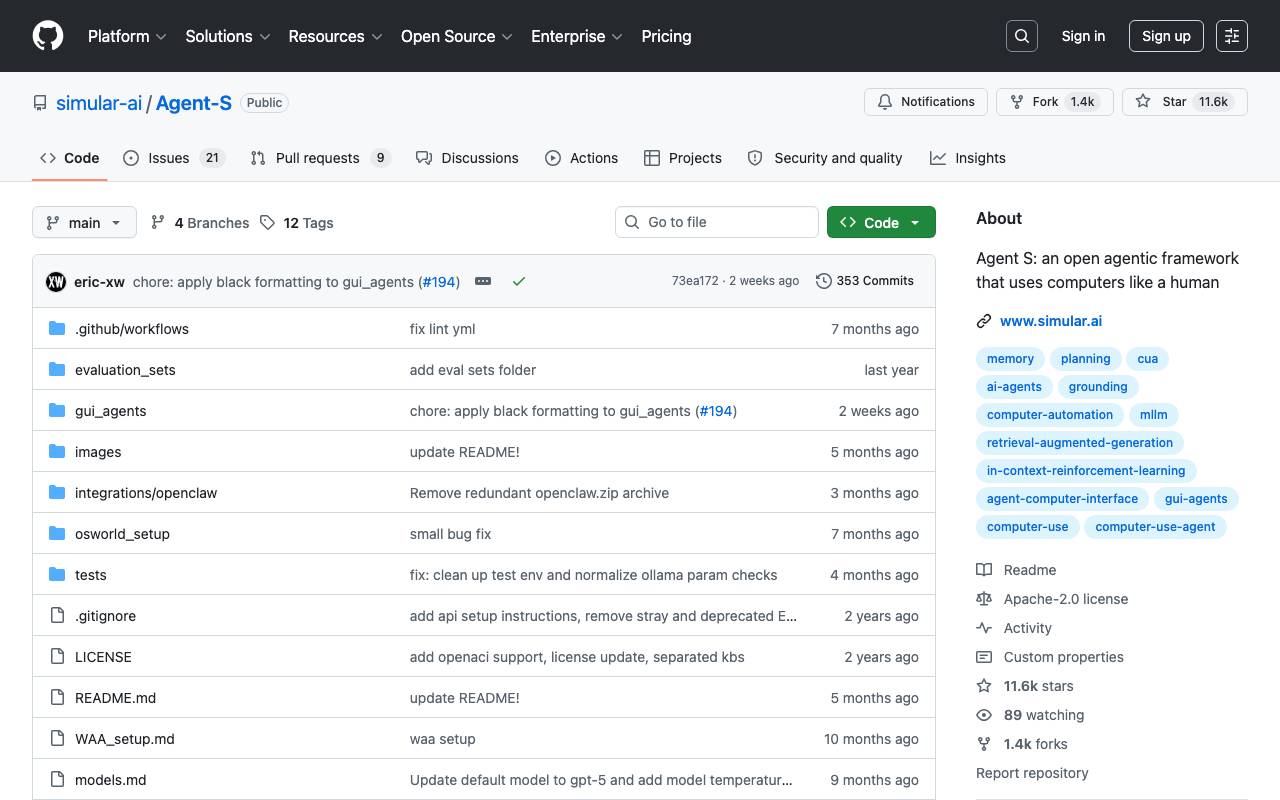
Agent S is an open-source GUI agent framework that enables large language models (LLMs) to interact with computers like humans via an Agent-Computer Interface. The framework allows LLMs to learn from past experiences and perform complex tasks autonomously on a computer. Agent S is designed for single-monitor screens and supports Linux, Mac, and Windows platforms. The framework has achieved state-of-the-art results on various benchmarks, including OSWorld, WindowsAgentArena, and AndroidWorld. Agent S3, the latest version, has surpassed human-level performance on OSWorld with a score of 72.60%. It has also demonstrated strong zero-shot generalization capabilities. Agent S provides a flexible and modular architecture for building GUI agents. The framework includes a library called gui-agents, which allows users to easily integrate Agent S with their applications. The library supports multiple platforms and provides a simple installation process. The development of Agent S is focused on advancing the capabilities of autonomous GUI agents. The framework has the potential to be used in various applications, including automation, AI research, and computer vision. However, users should exercise caution when running Agent S, as it controls the computer by running Python code.
Criteria breakdown
- Autonomous interaction with computers
- Agent-Computer Interface
- Supports Linux, Mac, and Windows
- Python-based code control
- Behavior Best-of-N performance enhancement
- GUI-agents library

BabyBeeAGI
An advanced version of BabyAGI with enhanced task management and functionality.
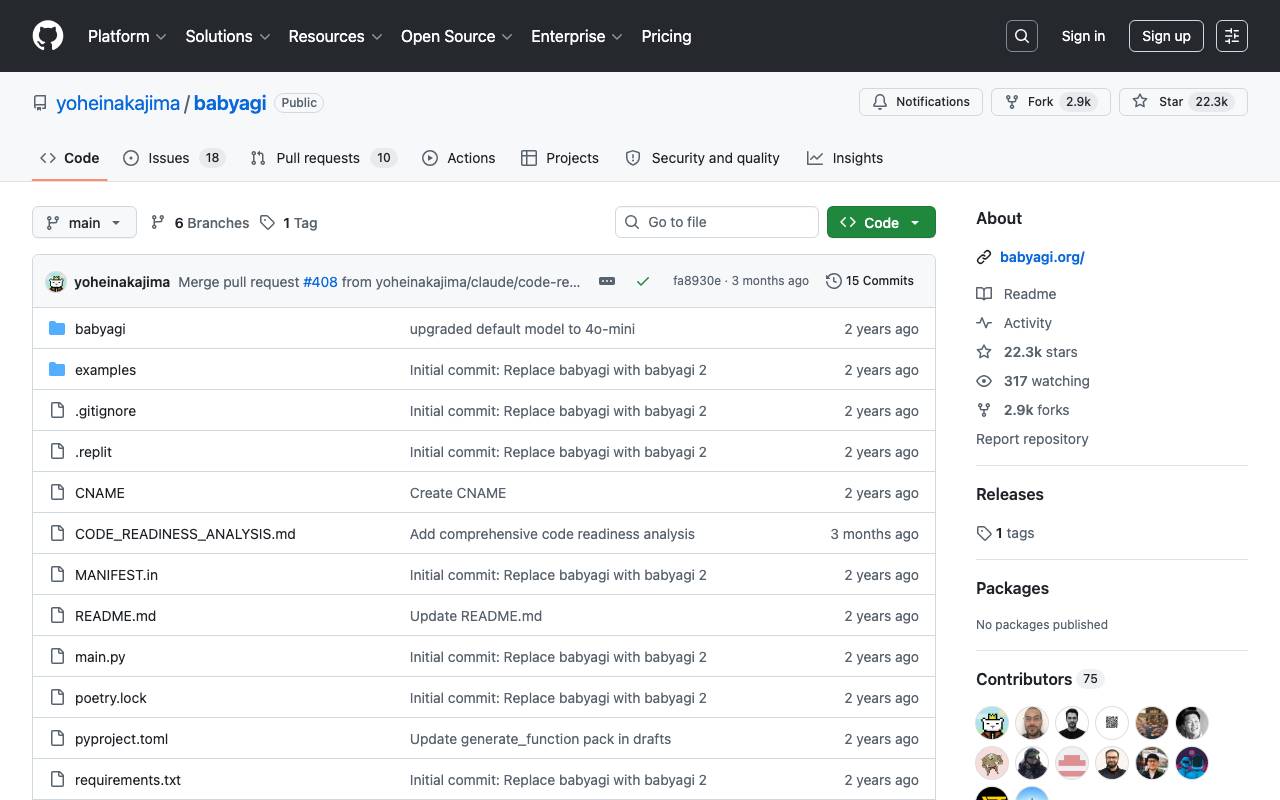
BabyAGI is an experimental framework for building self-building autonomous agents. It was created as an evolution of the original BabyAGI from March 2023, which introduced task planning for autonomous agents. The framework is built around a new function framework called 'functionz' that stores, manages, and executes functions from a database. It features a graph-based structure for tracking imports, dependent functions, and authentication secrets, along with automatic loading and comprehensive logging capabilities. The framework also includes a dashboard for managing functions, running updates, and viewing logs. It's designed to be simple and spark discussion among developers, not for production use. The core idea is to build the simplest thing that can build itself, making it an interesting approach for developing autonomous agents.
Criteria breakdown
- Function registration and metadata management
- Dependency tracking and key dependencies
- Automatic loading and logging
- Dashboard for function management and log viewing