Past battle · 2024-11-12 UTC
Personal AI Assistants Showdown — November 12, 2024
From the Personal AI Assistants category. 13 marks placed across 4 fighters. NullClaw took the crown.
Final standings

The line-up
The fighters
Profiles of every tool that competed in this battle, ranked by their final score.
NullClaw
Ultra-light OpenClaw-style assistant runtime in Zig: 678KB static binary, ~1MB RAM, <2ms boot, with tools, memory, channels, and providers.
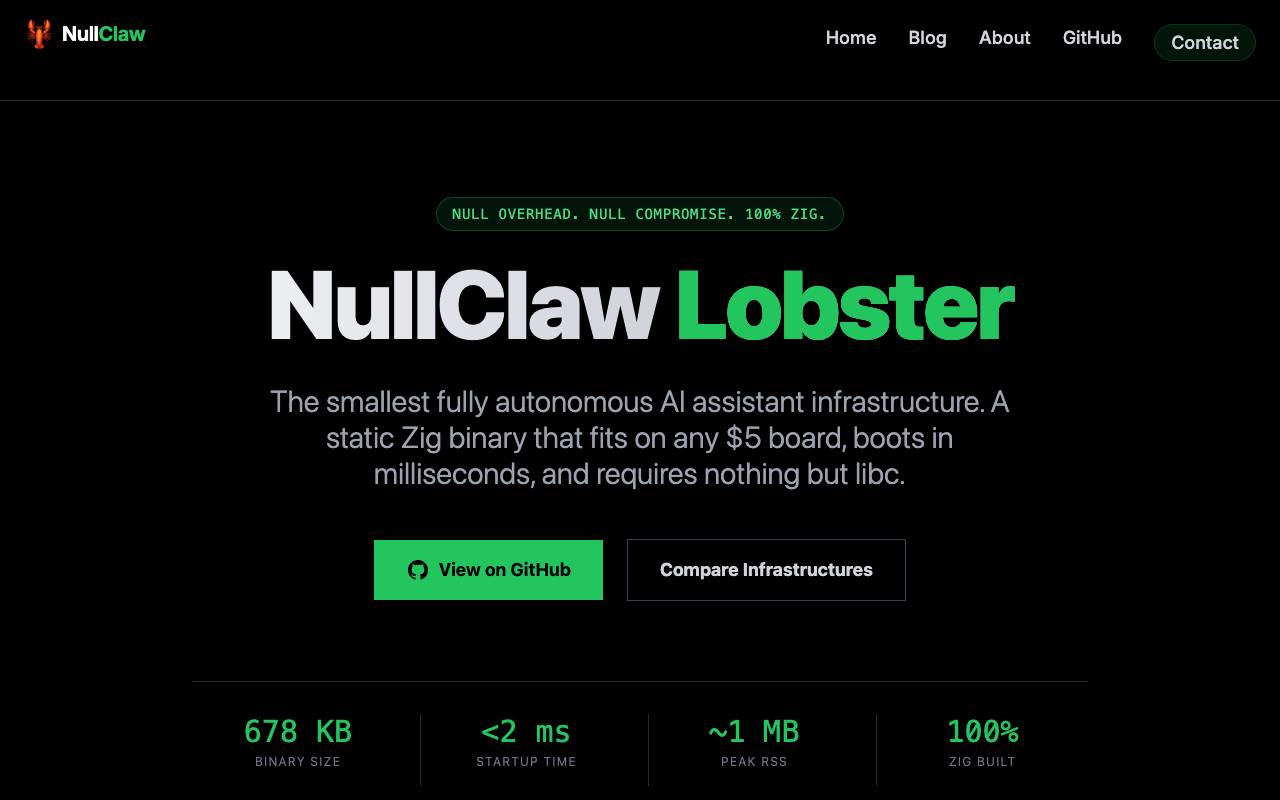
NullClaw is an ultra-lightweight AI assistant runtime built in Zig. It"s designed to be small, with a 678KB static binary, ~1MB RAM usage, and a boot time of under 2ms. The project emphasizes a "lean by default" approach, eliminating allocator overhead and runtime dependencies. This results in a high-performance runtime that can run on minimal hardware. NullClaw features a range of capabilities, including tools for file manipulation, shell command execution, and memory operations. It also supports hybrid memory engines, omnichannel routing, and is fully swappable. The project is designed to be extensible and customizable, with a focus on security and reliability. Key differentiators of NullClaw include its tiny footprint, fast startup times, and wide range of integrations, including support for 22 API providers. The project also includes a deep security engine and provides tools for working with hardware peripherals. Overall, NullClaw aims to provide a flexible and secure platform for building autonomous AI assistants, with a focus on performance and reliability. Some potential use cases for NullClaw include: * Edge AI applications, where minimal hardware requirements are essential * Deploying AI assistants in resource-constrained environments * Building customized AI workflows with a focus on performance and reliability
Criteria breakdown
- Tools for file manipulation, shell command execution, and memory operations
- Hybrid memory engines
- Omnichannel routing (CLI, Telegram, Discord, Slack, etc.)
- Fully swappable architecture
- Support for hardware peripherals (Serial connections, Arduino devices, etc.)
- Agnostic tunnels and runtimes (Docker, WASM, Native environments)

CoPaw
Open-source personal agent workstation to run your own AI assistant locally or in the cloud, with multi-channel chat, tools, and memory control.
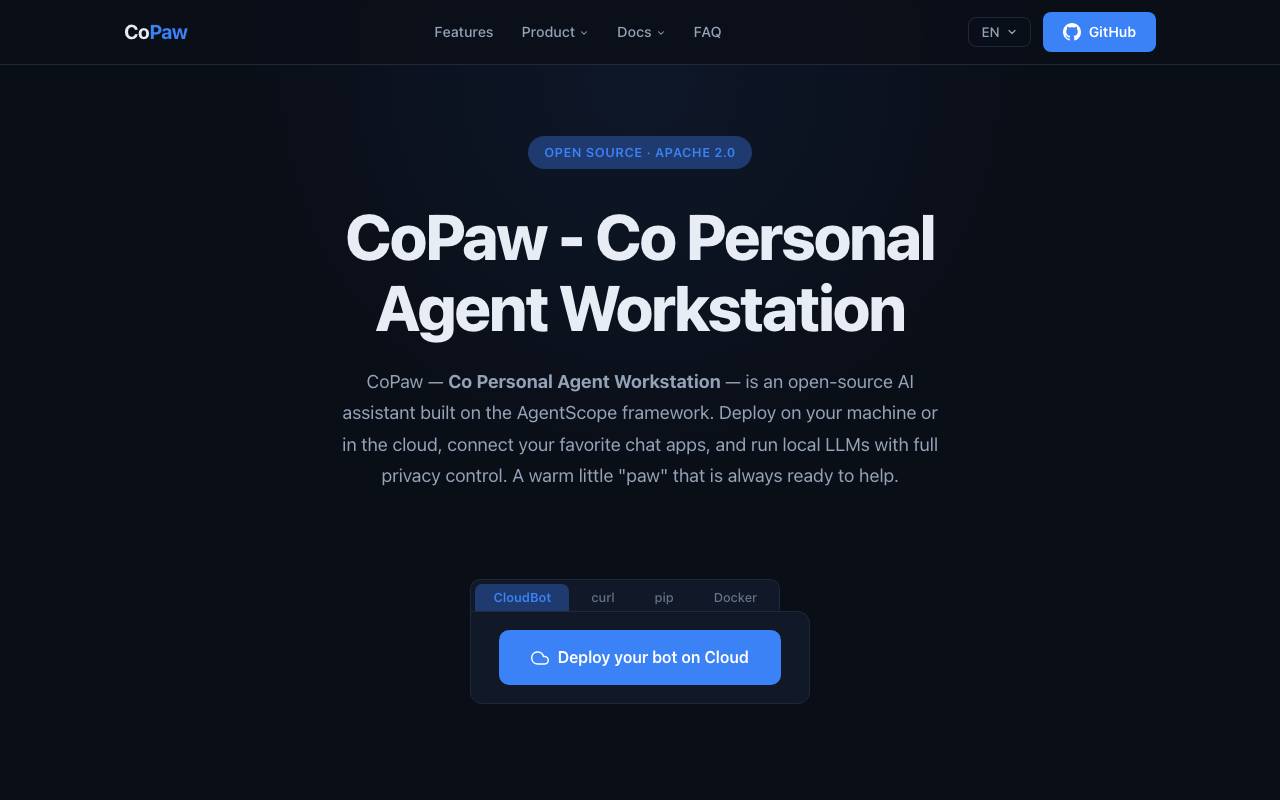
CoPaw is an open-source personal agent workstation that allows users to run their own AI assistant locally or in the cloud. It provides a platform for multi-channel chat, integrating various tools and features. One of the key aspects of CoPaw is its ability to control memory, which enables more efficient management of AI processes. This tool is designed for individuals who want a customizable and private AI assistant. CoPaw's open-source nature allows developers to modify and extend its capabilities. The workstation supports running AI models locally, which can be beneficial for users concerned about data privacy. Additionally, it can be deployed in the cloud for users who prefer a more scalable solution. CoPaw's multi-channel chat feature enables interaction with the AI assistant through various interfaces. Overall, CoPaw offers a flexible and customizable solution for users who want to run their own AI assistant. Its open-source nature and ability to run locally or in the cloud make it an attractive option for those looking for a personalized AI experience.
Criteria breakdown
- Multi-channel chat support
- Tools and memory control for AI management
- Local and cloud deployment options
- Open-source community-driven development
- Customizable AI experience
- Conversation management and AI service tools

ChatGPT Atlas
AI browser with a ChatGPT sidebar, memory, and agent mode to summarize, search, and act across the web; macOS app, free with upgrades.
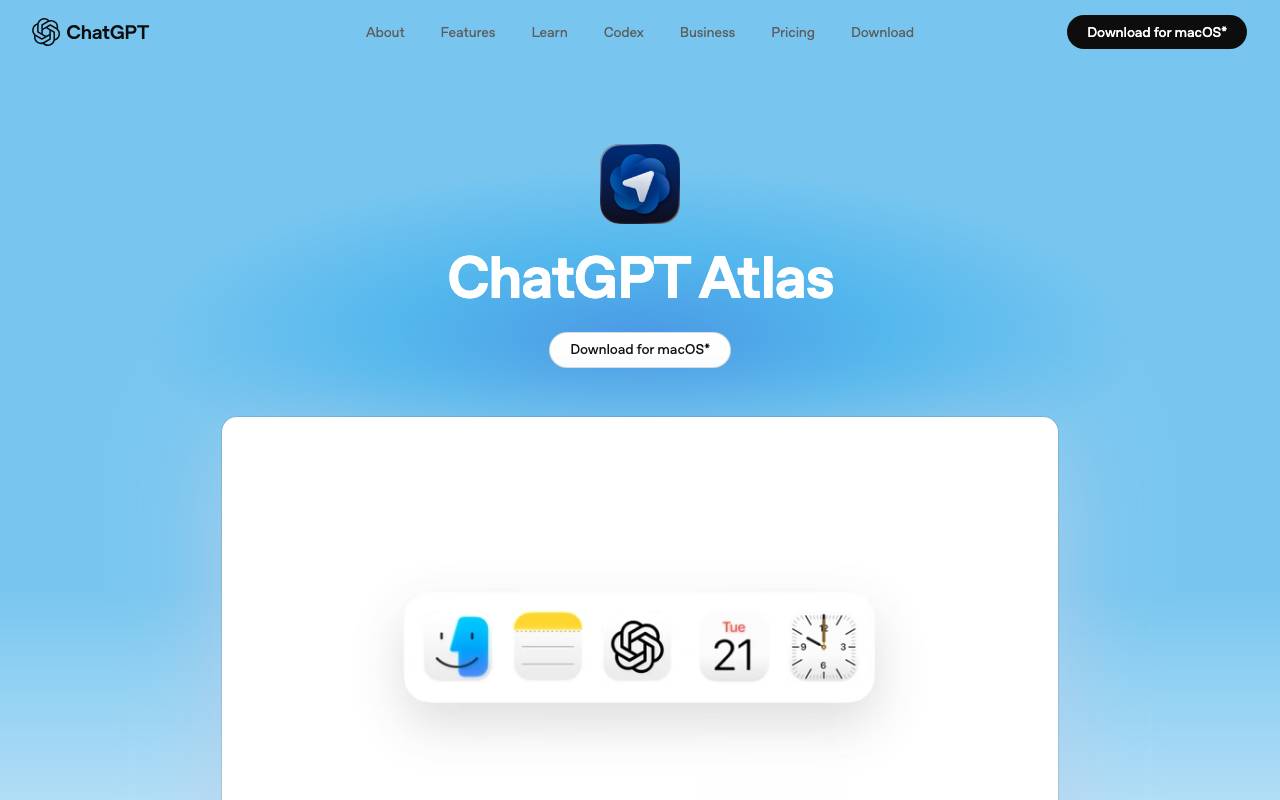
ChatGPT Atlas is likely a desktop application designed to integrate the capabilities of ChatGPT, a large language model, into a user's workflow, allowing for easy access to information and task automation. It may provide features such as a sidebar for quick interactions with ChatGPT, memory to store and recall previous conversations and context, and an agent mode to perform actions on behalf of the user across the web. The application may also allow users to search, summarize, and organize information from various sources. As a macOS app, it is intended for users who want to leverage the power of AI to enhance their productivity and efficiency. ChatGPT Atlas may offer a free version with optional upgrades for additional features or capabilities. The application could potentially be used for a variety of tasks, such as research, content creation, and task management. Its integration with other tools and services, such as email and file management systems, may also be a key aspect of its functionality. However, without more specific information, the full range of its capabilities and limitations is uncertain. The application may have undergone development and testing to ensure its stability and usability. Overall, ChatGPT Atlas appears to be a tool aimed at enhancing user productivity and efficiency through AI-driven capabilities. It is likely designed to be user-friendly and accessible, even for those without extensive technical expertise. The application's potential impact on workflow and productivity could be significant, depending on its specific features and how they are utilized by users. The target audience for ChatGPT Atlas may include professionals, researchers, and individuals looking to streamline their workflow and improve their productivity. It could also be useful for those who need to perform repetitive tasks or require assistance with organization and time management. The application's interface and user experience are likely designed to be intuitive and easy to navigate, allowing users to quickly access the features and capabilities they need. The development and maintenance of ChatGPT Atlas may involve ongoing efforts to improve its performance, add new features, and ensure its compatibility with various systems and devices. The application's potential for integration with other tools and services could be a key factor in its adoption and use, as it may allow users to leverage its capabilities in a variety of contexts and workflows.
Criteria breakdown
- ChatGPT sidebar for quick interactions
- Memory for storing and recalling context
- Agent mode for performing actions across the web
- Search and summarization capabilities
- Integration with email and file management systems
- Optional upgrades for additional features or capabilities

Khanmigo (Khan Academy)
Khan Academy's AI tutor and teacher assistant offering Socratic-style learning support.
Khanmigo is an AI-powered tutor and teaching assistant developed by Khan Academy. Instead of handing students answers, it uses a Socratic approach, asking guiding questions to help learners think through problems in math, science, humanities, and more. It's tightly integrated with Khan Academy's existing lessons and exercises. For teachers, Khanmigo provides classroom-focused tools such as lesson planning support, rubric and quiz creation, student progress insights, and writing feedback. It's positioned as a safer, education-first AI built around Khan Academy's nonprofit mission. Khanmigo is available to individual learners and families for around $4 per month, while teachers in supported regions can access it for free through Khan Academy's educator program.
Criteria breakdown
- Socratic AI tutoring across subjects
- Teacher tools for lesson planning and rubrics
- Writing coach and debate practice
- Student progress and activity insights
- Integration with Khan Academy courses
- Kid-friendly safety guardrails