Past battle · 2024-08-24 UTC
Programming Assistants Showdown — August 24, 2024
From the Programming Assistants category. 44 marks placed across 9 fighters. gstack took the crown.
Final standings






The line-up
The fighters
Profiles of every tool that competed in this battle, ranked by their final score.
gstack
Open-source workflow layer that adds planning, review, QA, and shipping skills to Claude Code and Codex.
gstack is an open-source workflow system designed to extend AI coding assistants like Claude Code and Codex with structured engineering practices. Instead of treating AI as a freeform chat partner, it introduces explicit skills for planning work, reviewing changes, running QA, and shipping code, helping teams move from prototype prompts to repeatable development loops. By codifying common stages of a software project into reusable skills, gstack aims to make AI-assisted development more predictable and auditable. It fits into existing repositories and developer workflows, letting engineers invoke the right skill at the right step rather than reinventing prompts for each task.
Criteria breakdown
- Structured planning skill
- Code review skill
- QA and testing workflows
- Shipping and release helpers
- Integration with Claude Code and Codex
- Open-source and extensible

Kimi‑Dev
Open‑source coding LLM optimized for automated debugging and issue resolution tasks.
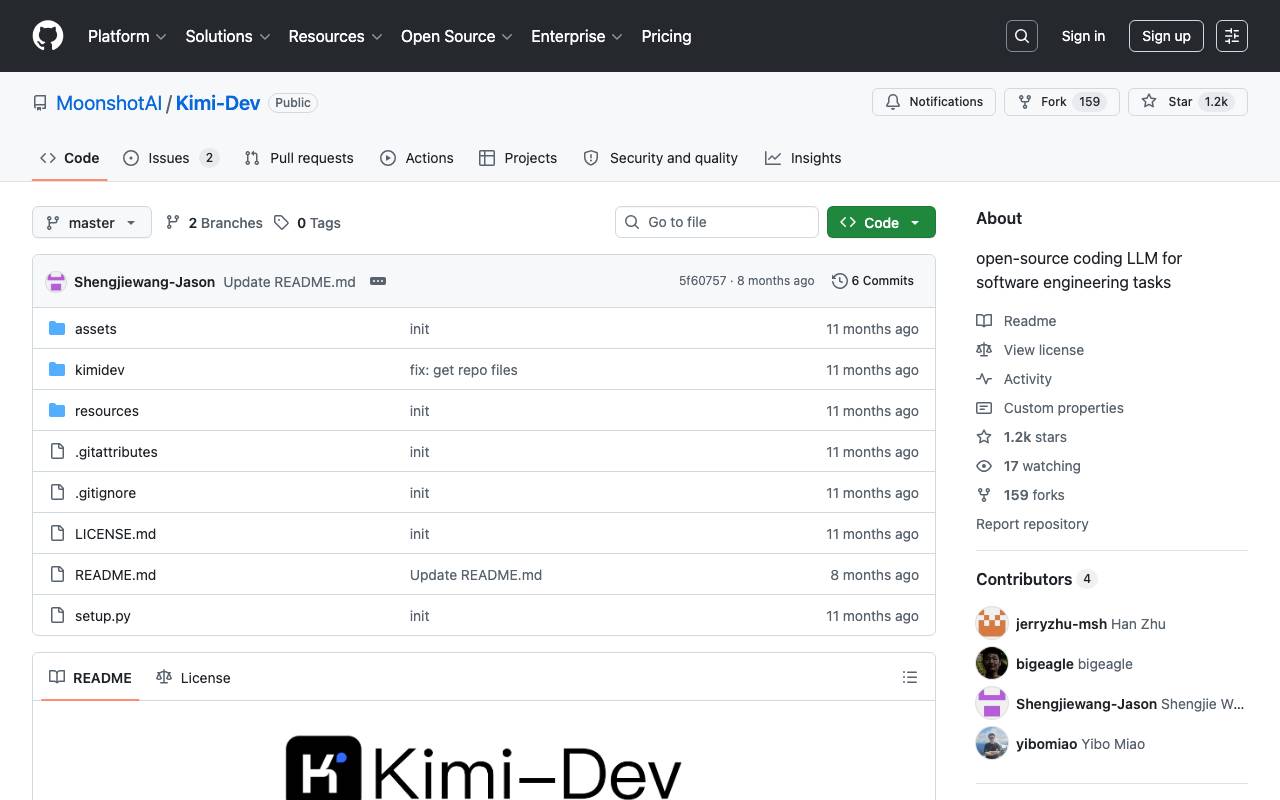
Kimi-Dev is an open-source coding Large Language Model (LLM) optimized for automated debugging and issue resolution tasks in software engineering. It uses a simplified two-stage framework to handle code repair and test writing tasks, consisting of file localization and code editing. Kimi-Dev achieves a new state-of-the-art on SWE-bench Verified, surpassing the runner-up among open-source models. It is optimized via large-scale reinforcement learning and is available for download and deployment on Hugging Face and GitHub. The model is trained to autonomously patch real repositories in Docker and gain rewards only when the entire test suite passes, ensuring correct and robust solutions. Kimi-Dev is designed to be easily deployable and maintainable, with a roll-out script provided for demonstration. Kimi-Dev's capabilities make it suitable for developers and researchers who want to explore its potential and contribute to its development.
Criteria breakdown
- File localization
- Code editing
- Bug fixes
- Unit test insertions
- Large-scale reinforcement learning
- Autonomous patching of real repositories

Moddy is an AI agent built to work across many repositories at once, helping engineering teams understand and modernize sprawling codebases. Instead of treating each repo in isolation, it reasons about shared dependencies, patterns, and cross-cutting changes that typically slow down large migrations. The tool focuses on practical modernization tasks such as upgrading frameworks, refactoring legacy patterns, replacing deprecated APIs, and aligning code with current standards. It is aimed at platform teams, staff engineers, and architects responsible for keeping large software estates maintainable. By automating repetitive analysis and edits while keeping humans in the loop for review, Moddy aims to shorten modernization cycles that would otherwise take quarters or years.
Criteria breakdown
- Cross-repository code analysis
- Automated modernization and refactoring
- Framework and dependency upgrade support
- Detection of deprecated patterns and APIs
- Bulk change orchestration across codebases
- Human-in-the-loop review workflows

GitNexus
Zero-server code intelligence engine that builds an in-browser knowledge graph over a repo and includes a Graph RAG agent for exploration.
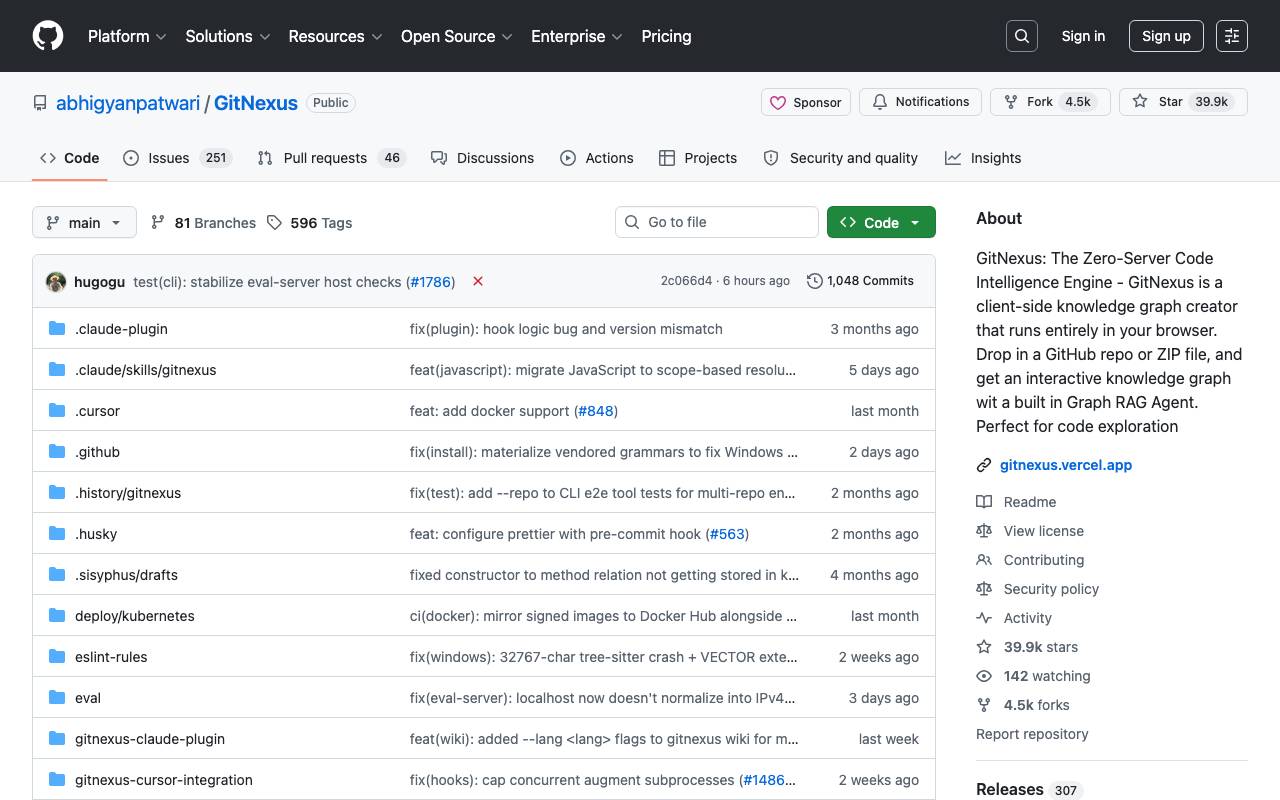
GitNexus is a zero-server code intelligence engine that builds an in-browser knowledge graph over a repository. It includes a Graph RAG agent for exploration. The tool indexes any codebase into a knowledge graph, tracking every dependency, call chain, cluster, and execution flow, then exposes it through smart tools so AI agents can analyze the code reliably. GitNexus offers two primary modes of use: a CLI + MCP for making AI agents reliable by providing a deep architectural view of the codebase, and a Web UI for quick chat and exploration of repositories. It's designed to help developers and AI agents understand codebases, especially for daily development with Cursor, Claude Code, Antigravity, Codex, and similar tools.
Criteria breakdown
- In-browser knowledge graph
- Graph RAG agent for exploration
- Indexes codebase dependencies and call chains
- Exposes code through smart tools for AI agents
- CLI + MCP for reliable AI agent integration
- Web UI for quick repo analysis and chat

GPT Engineer
An open-source AI tool that generates codebases from user-provided project descriptions through interactive dialogues.
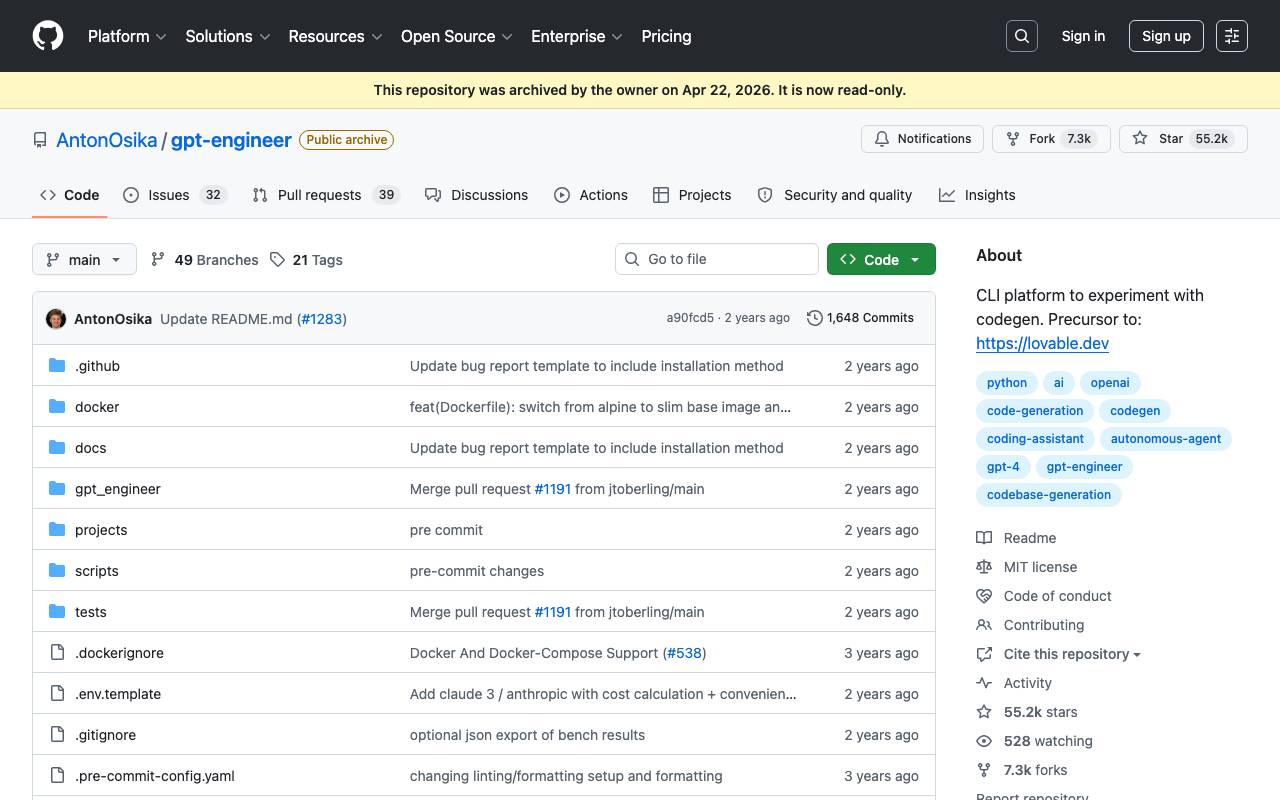
GPT Engineer is an open-source AI tool that generates codebases from user-provided project descriptions through interactive dialogues. It allows users to specify software requirements in natural language and have an AI write and execute the code. The tool also supports implementing improvements to existing codebases. GPT Engineer is aimed at developers and programmers looking to streamline their workflow and increase productivity. The tool is available for installation via pip and can be run using a command-line interface. It currently supports Python 3.10-3.12 and requires an OpenAI API key for functionality. The project is no longer actively maintained, having been archived by its owner on April 22, 2026.
Criteria breakdown
- Code generation from natural language
- Interactive dialogue interface
- Improvement of existing codebases
- Support for OpenAI API key
- Command-line interface
- Benchmarking of custom agents
OpenCode
Open-source AI coding agent for terminal, desktop, and IDEs—plans changes, edits code, and can run tasks in GitHub via comments.
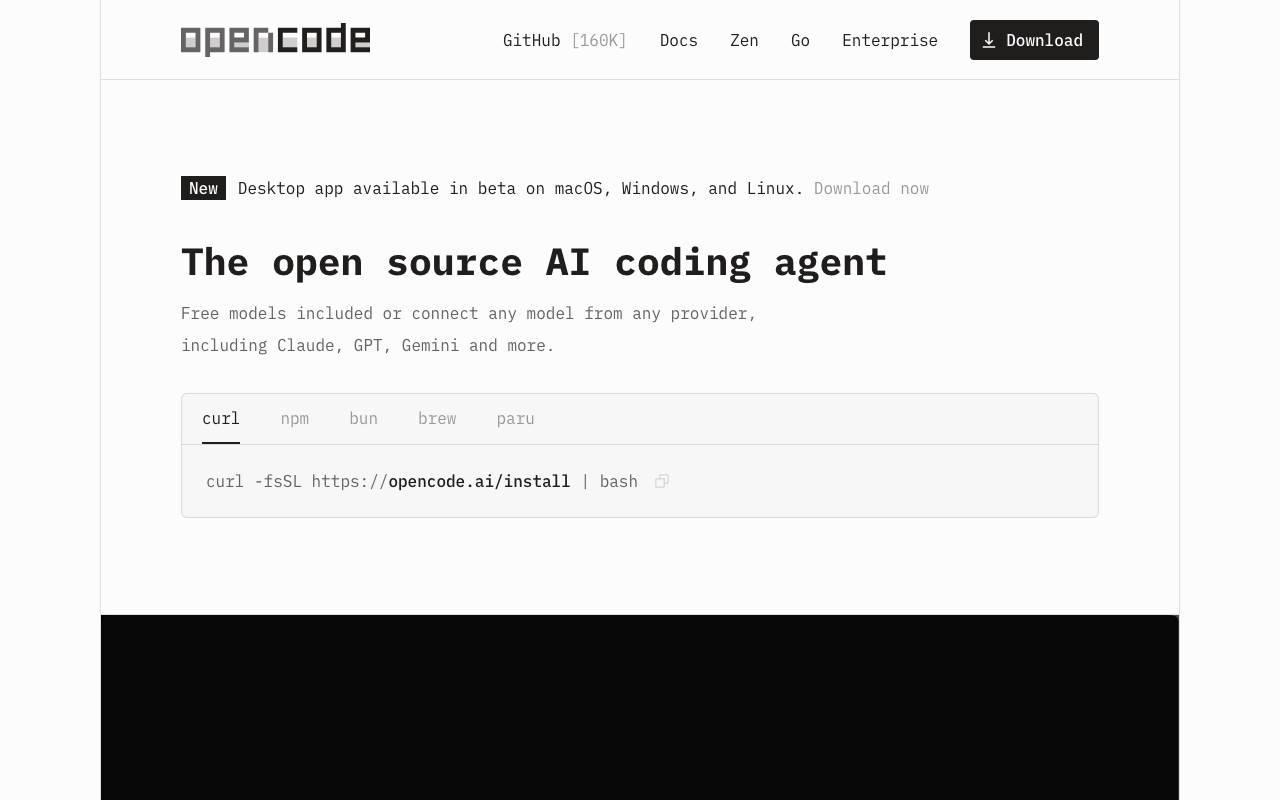
OpenCode is an open-source AI coding agent that assists developers in writing code within their terminal, IDE, or desktop environment. It is designed to work with various models from different providers, including Claude, GPT, and Gemini, allowing users to choose the model that best suits their needs. OpenCode also supports multi-session functionality, enabling developers to start multiple agents in parallel on the same project, and includes features such as automatic loading of the right Language Server Protocols (LSPs) for the chosen model. One of the key benefits of OpenCode is its ability to integrate with popular platforms like GitHub, allowing users to log in with their GitHub account and use their Copilot account. Additionally, it supports connections to ChatGPT Plus or Pro accounts through OpenAI. This versatility, combined with its availability as a terminal interface, desktop app, and IDE extension, makes OpenCode a highly adaptable tool for a wide range of development environments. OpenCode prioritizes privacy, ensuring that it does not store any of the user's code or context data. This makes it suitable for use in environments where data privacy is a significant concern. With a large community of contributors and users, OpenCode has gained trust among over 7.5 million developers who use it every month. The tool also offers access to optimized models through its Zen feature, which provides a handpicked set of AI models tested and benchmarked specifically for coding agents. This eliminates the need for users to worry about inconsistent performance and quality across different providers. In terms of its development and community, OpenCode has a significant presence on GitHub, with over 160,000 stars and 900 contributors, indicative of its popularity and the active community that supports it. OpenCode's features and integrations make it a valuable resource for developers looking to leverage AI in their coding workflow. Its commitment to privacy and its open-source nature further contribute to its appeal. However, the effectiveness of OpenCode can depend on the specific model chosen and the complexity of the coding tasks at hand. OpenCode's model-agnostic approach allows developers to experiment with different models to find the one that best fits their needs. The community-driven aspect of OpenCode, with its large number of contributors and users, ensures that the tool is continuously improved and supported. Overall, OpenCode represents a significant advancement in AI-assisted coding, offering a flexible, privacy-conscious, and community-driven solution for developers.
Criteria breakdown
- Code planning and editing
- Integration with GitHub via comments
- Task automation

PearAI
An open-source AI-powered code editor integrating top AI tools for enhanced coding efficiency.
PearAI is an open-source AI-powered code editor designed to enhance coding efficiency by integrating top AI tools. It aims to bring ideas to life by providing the best AI code editor experience. The editor is backed by Combinator and offers features such as the PearAI Router, which automatically connects users to the highest-performing AI models for coding across all tools. The PearAI Router allows users to access the best AI models on the market with a single subscription. The editor also features the PearAI Model, which is powered by various AI models, including GPT-4, Meta Llama 3.1, and Claude 3 Opus. Additionally, PearAI offers features such as PearAI Creator, PearAI Agent, and PearAI Login, which are designed to create new projects from scratch, automatically code features and fix bugs, and handle user login, respectively. PearAI is designed for makers of any technical level, from beginners to experienced developers. It has been praised by users for its ability to understand codebase and file context, making the development process more streamlined. The editor has also helped users learn new programming languages and increase their productivity. One of the key benefits of using PearAI is its ability to integrate multiple AI tools into a single platform. This allows users to access a wide range of AI models and features without having to manage multiple subscriptions. The editor is also open-source, which means that it is free to use and modify. Overall, PearAI is a powerful tool for developers who want to enhance their coding efficiency and productivity. Its integration of top AI tools and features such as the PearAI Router and PearAI Model make it an attractive option for developers of all levels. PearAI has been praised by users for its ability to help them learn new programming languages and increase their productivity. For example, one user reported that PearAI helped them go from being a complete beginner in Swift iOS to having senior engineer productivity in less than a month. Another user praised PearAI for its ability to understand their codebase and file context, making the development process more streamlined.
Criteria breakdown
- PearAI Router
- PearAI Model
- PearAI Creator
- PearAI Agent
- PearAI Login
- Integration with multiple AI models, including GPT-4 and Meta Llama 3.1

Refact.ai
An open-source AI coding assistant offering context-aware code completions, refactoring, and in-IDE chat across major IDEs.
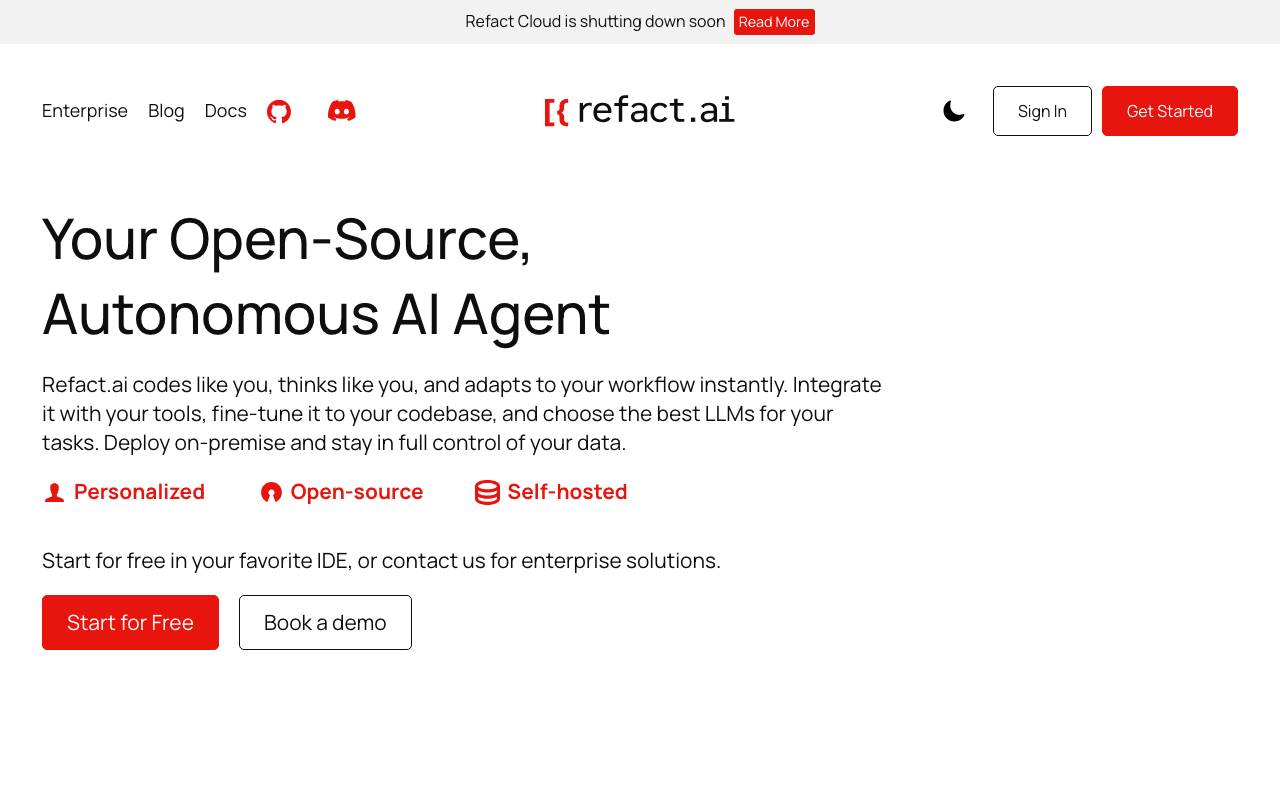
Refact.ai is an open-source AI coding assistant that offers context-aware code completions, refactoring, and in-IDE chat across major IDEs. It is designed to work like another developer in your IDE, integrating with your codebase and stack, while allowing you to preview and control the process. Refact.ai can handle tasks end-to-end, from completing code in real-time to searching and analyzing repositories for accurate execution. It also connects with GitHub, databases, CI/CD pipelines, and more. The tool is personalized, open-source, and self-hosted, allowing users to fine-tune it to their codebase and choose the best LLMs for their tasks. Refact.ai aims to automate coding tasks, enabling developers to focus on high-level guidance while the AI handles the rest.
Criteria breakdown
- Context-aware code completions
- In-IDE chat for asking, editing, debugging, and generating code
- Autonomous task execution with step-by-step reasoning
- Repository analysis and search for accurate execution
- Integration with GitHub, databases, CI/CD pipelines, and more

Windframe
AI-powered Tailwind CSS builder for rapid UI design, prototyping, and code export to HTML, React, or Vue.

Windframe is an AI-powered Tailwind CSS builder for rapid UI design, prototyping, and code export to HTML, React, or Vue. It allows users to create polished UIs using Apple's design style and offers a range of features to streamline the design process. With Windframe, users can generate designs using AI or prebuilt templates, customize them in a powerful visual editor, and export production-ready Tailwind CSS code. The tool is designed for developers, engineers, and designers who want to create stunning UIs and websites quickly and efficiently. Windframe offers a range of benefits, including beautiful design defaults, a visual editor, and clean production code.
Criteria breakdown
- AI-powered design generation
- Prebuilt templates
- Visual editor
- Production-ready code export
- Support for multiple frameworks
- Import and customization of existing Tailwind CSS projects