Past battle · 2025-02-07 UTC
Multimodal AI Showdown — February 7, 2025
From the Multimodal AI category. 19 marks placed across 5 fighters. Omniverse Audio2Face took the crown.
Final standings




The line-up
The fighters
Profiles of every tool that competed in this battle, ranked by their final score.

Omniverse Audio2Face
NVIDIA's AI-driven tool for generating real-time, voice-synced 3D facial animation
Omniverse Audio2Face is an NVIDIA application that automatically generates 3D facial animation from an audio source. Using a pre-trained deep neural network, it analyzes voice input and drives the facial expressions, lip sync, and emotion of a 3D character in real time, eliminating much of the manual keyframing typically required in animation pipelines. The tool runs inside NVIDIA Omniverse and supports export to standard DCC platforms like Maya, Unreal Engine, and Blender through formats such as USD and blendshapes. It works with custom character meshes via a retargeting workflow, making it useful for game developers, animators, virtual production teams, and creators building digital humans or interactive avatars. Audio2Face supports both offline processing for cinematic work and live streaming for interactive applications, with adjustable emotion controls and multilingual audio handling.
Criteria breakdown
- Audio-driven facial animation via deep learning
- Real-time lip sync and emotion control
- Character retargeting to custom meshes
- Blendshape and USD export pipelines
- Live streaming mode for interactive avatars
- Multilingual voice input support

Humane AI Pin
Wearable AI assistant designed as a screen-free alternative to the smartphone.
The Humane AI Pin is a small, magnetically attached wearable device that uses voice, gesture, and a laser-projected display to provide assistant-style interactions without a traditional screen. It pairs onboard cameras, microphones, and sensors with large language models to answer questions, translate languages, capture photos, summarize messages, and identify objects in view. Marketed as an ambient computing device, the Pin aims to reduce reliance on phones by surfacing information only when needed. It runs on its own cellular plan rather than tethering to a smartphone, and supports natural-language commands instead of apps. The product received mixed reviews at launch for battery life, latency, and accuracy, and Humane has since adjusted its roadmap. It remains a notable early experiment in standalone, AI-first wearable hardware.
Criteria breakdown
- Voice-controlled AI assistant
- Laser ink projected display on palm
- Real-time language translation
- Photo and short video capture
- Contextual object and scene recognition
- Standalone cellular data plan

Project Astra
Google DeepMind's universal AI agent that sees, hears, and reasons about the world in real time.
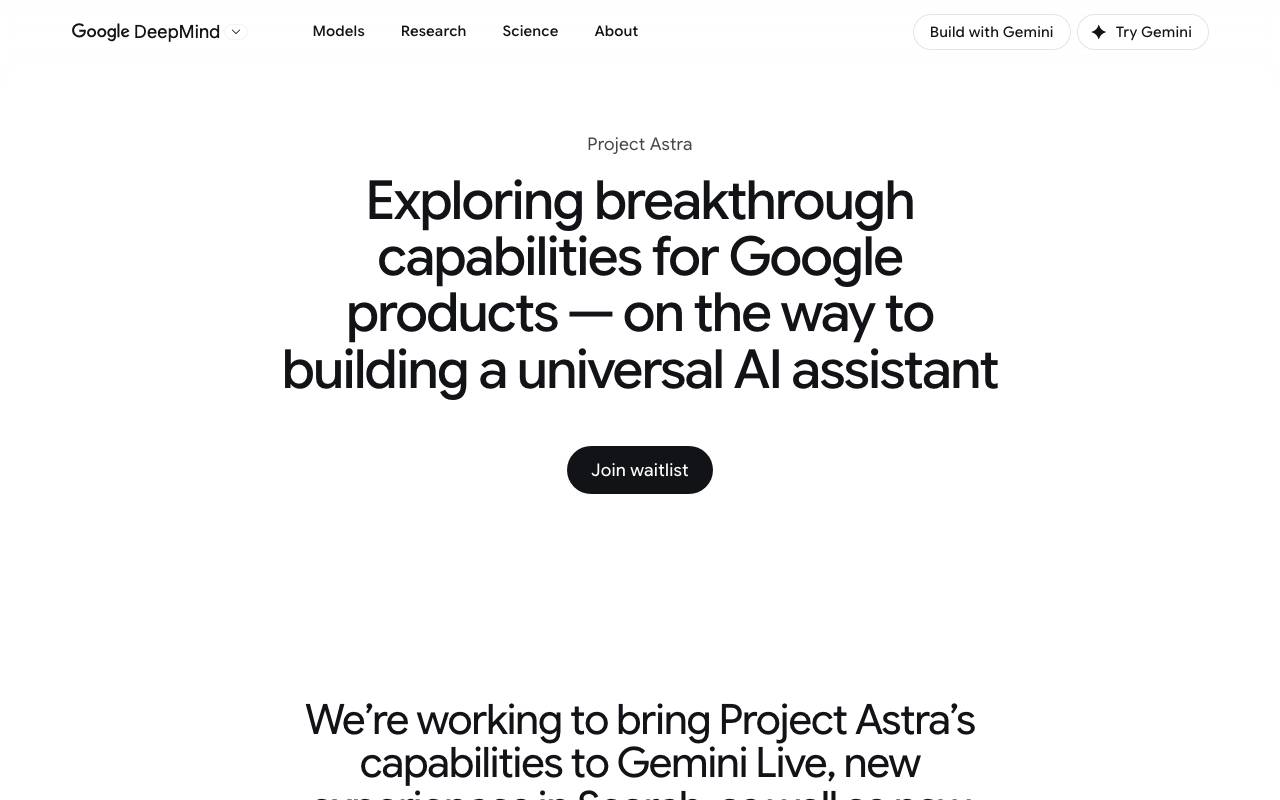
Project Astra is an experimental universal AI assistant from Google DeepMind designed to help with everyday tasks by understanding the world the way people do. It processes video, audio, images, and text simultaneously, allowing users to point a camera or speak naturally and receive context-aware responses. Built on Google's Gemini models, Astra is engineered for low-latency, conversational interaction with persistent memory of recent context. It is positioned as a research prototype exploring how a general-purpose agent could eventually run across phones, smart glasses, and other ambient devices. While not yet a publicly available product, Astra signals Google's direction for agentic AI that can observe surroundings, recall what it has seen, and take helpful actions on a user's behalf.
Criteria breakdown
- Live video and image comprehension
- Voice-based conversational interface
- Persistent contextual memory
- Multimodal reasoning across text, audio, and visuals
- Integration with Gemini model family
- Prototype support for smart glasses and phones
Hume AI
Emotionally intelligent voice AI that speaks and listens with human-like nuance
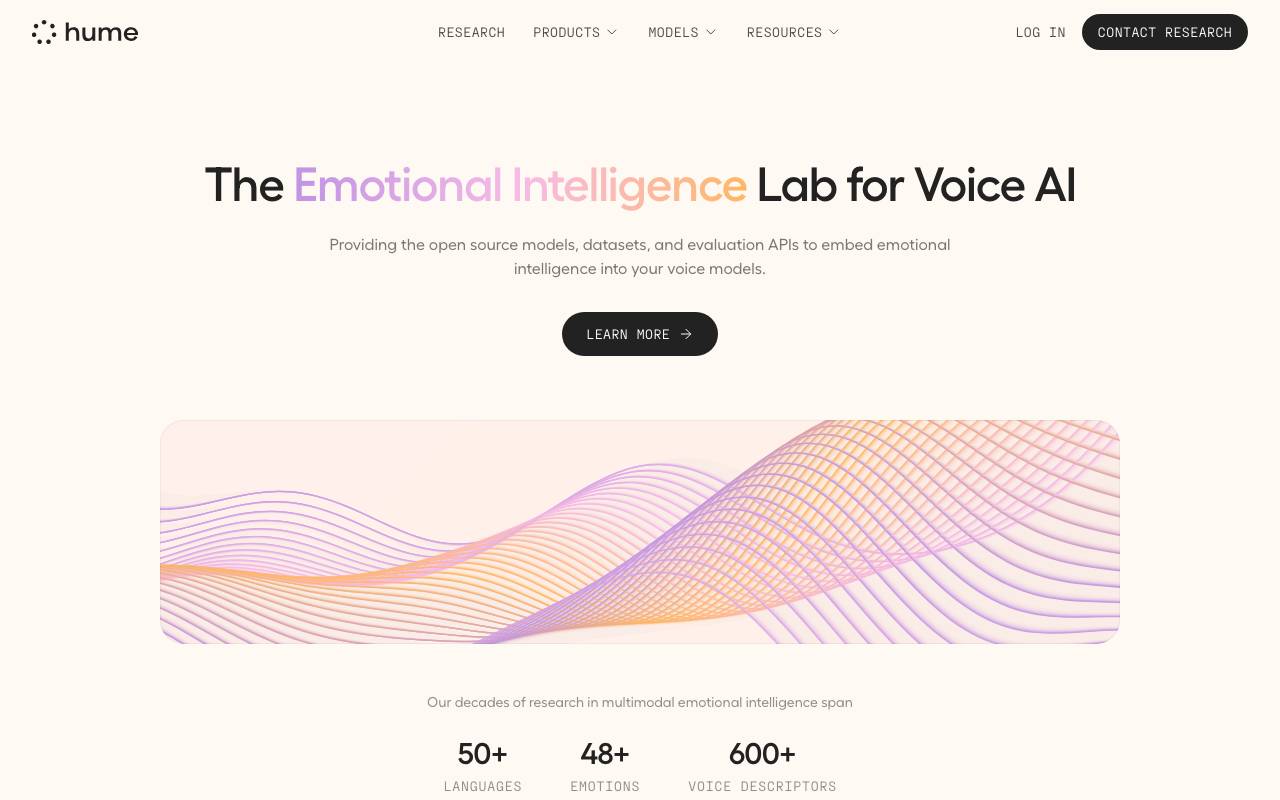
Hume AI develops voice and language models designed to interpret and respond to emotional cues in human speech. Its flagship Empathic Voice Interface (EVI) combines expressive speech synthesis with real-time analysis of tone, prosody, and sentiment, enabling conversations that feel more natural than typical voice assistants. Developers can access Hume's capabilities through APIs and SDKs to build applications in areas like mental health support, customer service, accessibility, and interactive entertainment. The platform also offers expression measurement tools for analyzing emotional signals in voice, face, and language data. Hume positions itself around responsible deployment, publishing research on affective computing and adhering to ethical guidelines for emotion AI use.
Criteria breakdown
- Empathic Voice Interface (EVI)
- Expression measurement across voice, face, and text
- Customizable voice personalities
- Low-latency conversational streaming
- REST and WebSocket APIs
- Ethical use guidelines and documentation

Alaya AI
Web3 data marketplace linking AI developers with global contributors via gamified incentives.
Alaya AI is a decentralized platform that bridges AI model developers with distributed data providers through a Web3 community structure. It focuses on sourcing diverse, high-quality training data for machine learning by tapping into a global network of contributors who label, validate, and submit datasets. The platform uses gamification, tokens, and NFTs to motivate participation, turning data collection and annotation into an engaging activity rather than a chore. Contributors earn rewards based on the quality and quantity of their work, while developers gain access to scalable, varied datasets suited for training niche or culturally specific models. By combining blockchain transparency with social swarm intelligence, Alaya AI aims to make AI data pipelines more equitable, traceable, and accessible to smaller teams that lack large in-house labeling resources.
Criteria breakdown
- Decentralized data collection and labeling network
- Token and NFT-based reward system
- Gamified tasks and community challenges
- Swarm intelligence for distributed annotation
- Support for diverse and niche dataset needs
- On-chain tracking of contributions