Past battle · 2025-01-06 UTC
Agent Observability Tools Showdown — January 6, 2025
From the Agent Observability Tools category. 11 marks placed across 2 fighters. Crawl4AI took the crown.
Final standings

The line-up
The fighters
Profiles of every tool that competed in this battle, ranked by their final score.
Crawl4AI
Open-source web crawler and scraper that produces clean, LLM-ready output for AI agents and pipelines
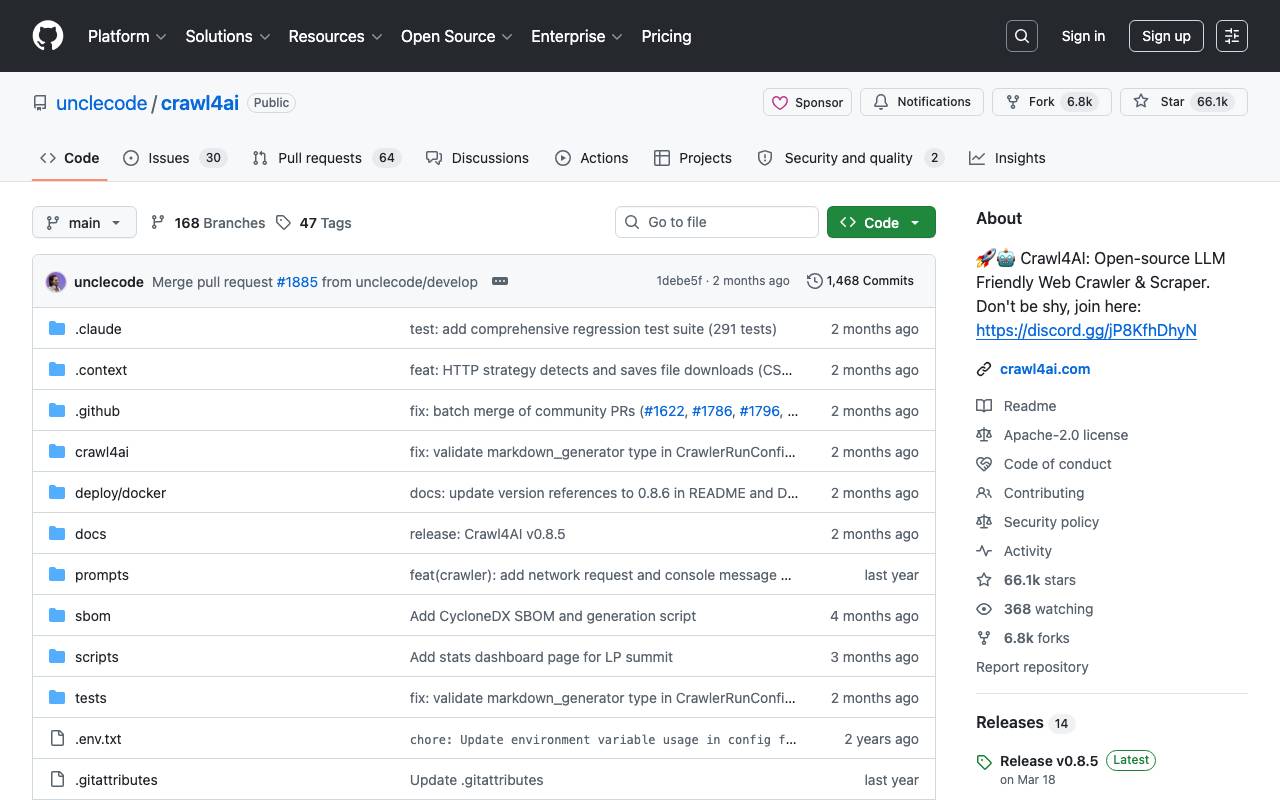
Crawl4AI is an open-source Python library for crawling and scraping web pages with output tailored for large language models and AI workflows. Rather than returning raw HTML, it focuses on producing clean, structured content — most notably Markdown — that can be fed directly into LLM prompts, retrieval pipelines, or training and fine-tuning datasets. It is distributed under an open-source license on GitHub, where it has gained significant traction within the AI developer community. The tool is aimed at developers, data engineers, and builders of AI agents who need to gather web content programmatically without paying for or being rate-limited by commercial scraping APIs. It is positioned as a self-hostable, free alternative to hosted services, giving users full control over how pages are fetched, rendered, and transformed. Under the hood, Crawl4AI uses a headless browser (built on Playwright) to render JavaScript-heavy pages, then applies extraction and filtering strategies to convert the rendered DOM into usable content. It supports generating Markdown with options to prune boilerplate and noise, as well as structured extraction using either CSS/XPath selectors or LLM-based extraction strategies that return data according to a schema. Asynchronous operation allows concurrent crawling of many URLs. Standout capabilities include configurable content filtering to reduce irrelevant text, the ability to extract structured JSON via schemas, session and browser management for handling logins or dynamic interactions, support for hooks and custom JavaScript execution, and media/link extraction. It can be run as a library within a Python application or deployed via Docker for service-style use. In a typical workflow, Crawl4AI sits at the ingestion stage of a RAG or agent pipeline: it fetches and cleans pages, and the resulting Markdown or structured data is chunked, embedded, or passed to an LLM. Its LLM-friendly output reduces the preprocessing usually needed when scraping for AI use cases. Its main strengths are that it is free, self-hosted, actively developed, and purpose-built for AI consumption rather than general scraping. Trade-offs include the operational overhead of running headless browsers at scale, the inherent fragility of scraping against changing site structures and anti-bot measures, and the learning curve of its configuration options. Compared to hosted alternatives like Firecrawl or Apify, it shifts cost and maintenance to the user in exchange for control and no usage fees.
Criteria breakdown
- Markdown generation with content filtering
- CSS/XPath and LLM-based structured extraction
- Playwright-based headless browser rendering
- Asynchronous concurrent crawling
- Session, hook, and custom JavaScript support
- Docker deployment for service use

CICube
An AI DevOps agent that monitors GitHub Actions workflows, detects anomalies, and provides actionable fixes.
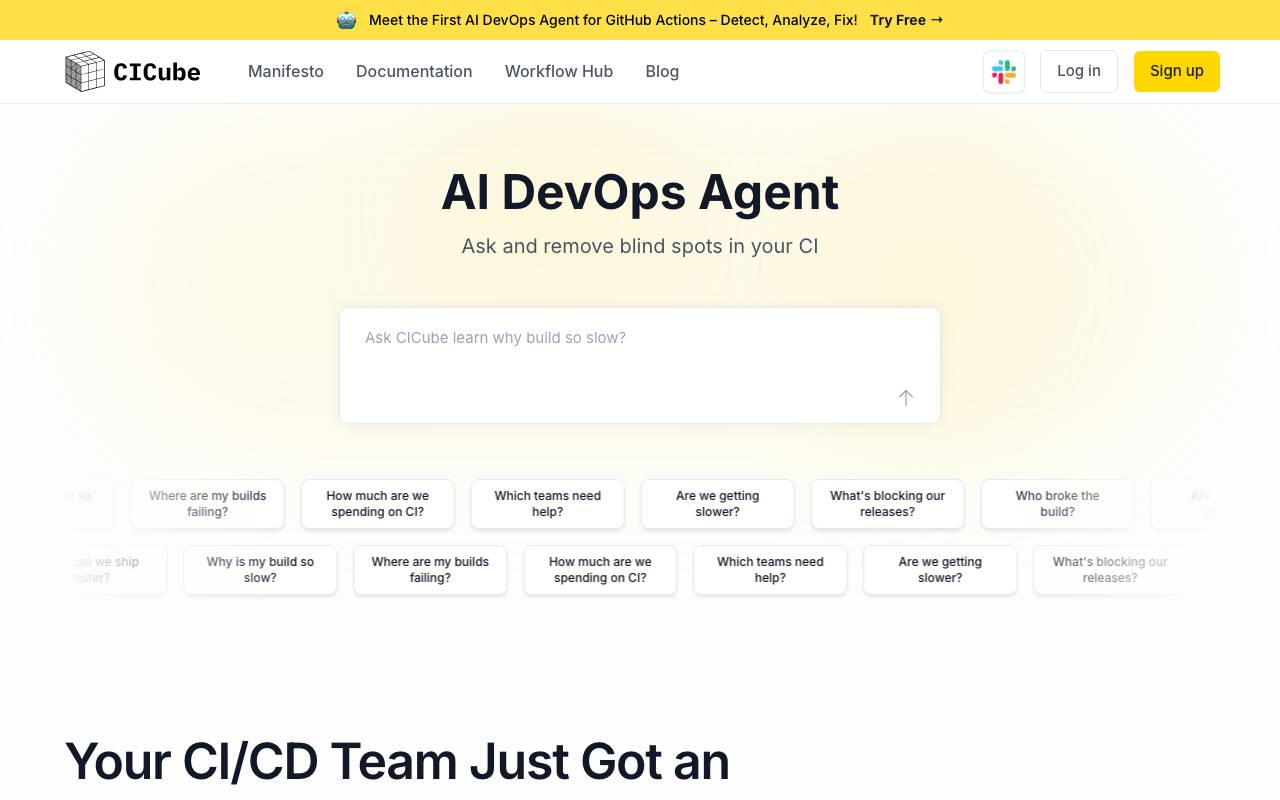
CICube operates as an AI-driven observability platform specifically designed for GitHub Actions workflows. It addresses the common challenge of CI/CD pipelines often acting as "black boxes" lacking detailed insights, which leads to time-consuming debugging and inefficient operations. The tool aims to make CI pipelines transparent, providing DevOps teams with intelligence to reduce costs, fix inefficiencies, and improve performance. The platform utilizes AI agents to continuously monitor GitHub Actions, detect anomalies, and identify root causes of failures. A key capability is its AI Root Cause Analysis, which automatically pinpoints issues and suggests intelligent fixes, reducing the need for manual investigation. It also incorporates a conversational interface powered by large language models (LLMs), allowing users to ask natural language questions about their CI data, such as "Why is my build so slow?", and receive immediate answers. CICube goes beyond traditional CI metrics by emphasizing cost optimization, particularly by calculating and mitigating the hidden costs associated with developer context switching. It argues that frequent interruptions from failed builds or CI notifications significantly impact developer productivity. The platform offers detailed insights into CI costs and provides weekly reports to help teams track and optimize their spending. The tool leverages "CubeScore™" to evaluate CI lifecycle performance against North Star Metrics like Mean Time To Recovery (MTTR), Success Rate, Throughput, and Duration. It provides AI-powered insights and alerts to address issues such as decreasing success rates or increasing pipeline durations, with the goal of reducing MTTR. Integration is designed with security in mind, utilizing read-only permissions for GitHub Actions data.
Criteria breakdown
- AI Root Cause Analysis
- LLM-powered conversational CI data interface
- AI-driven CI insights and alerting
- CubeScore™ with North Star Metrics (MTTR, Success Rate, Throughput, Duration)
- CI cost optimization and reporting
- Real-time GitHub Actions monitoring