Past battle · 2025-11-03 UTC
Research Showdown — November 3, 2025
From the Research category. 14 marks placed across 3 fighters. Slate took the crown.
Final standings



The line-up
The fighters
Profiles of every tool that competed in this battle, ranked by their final score.

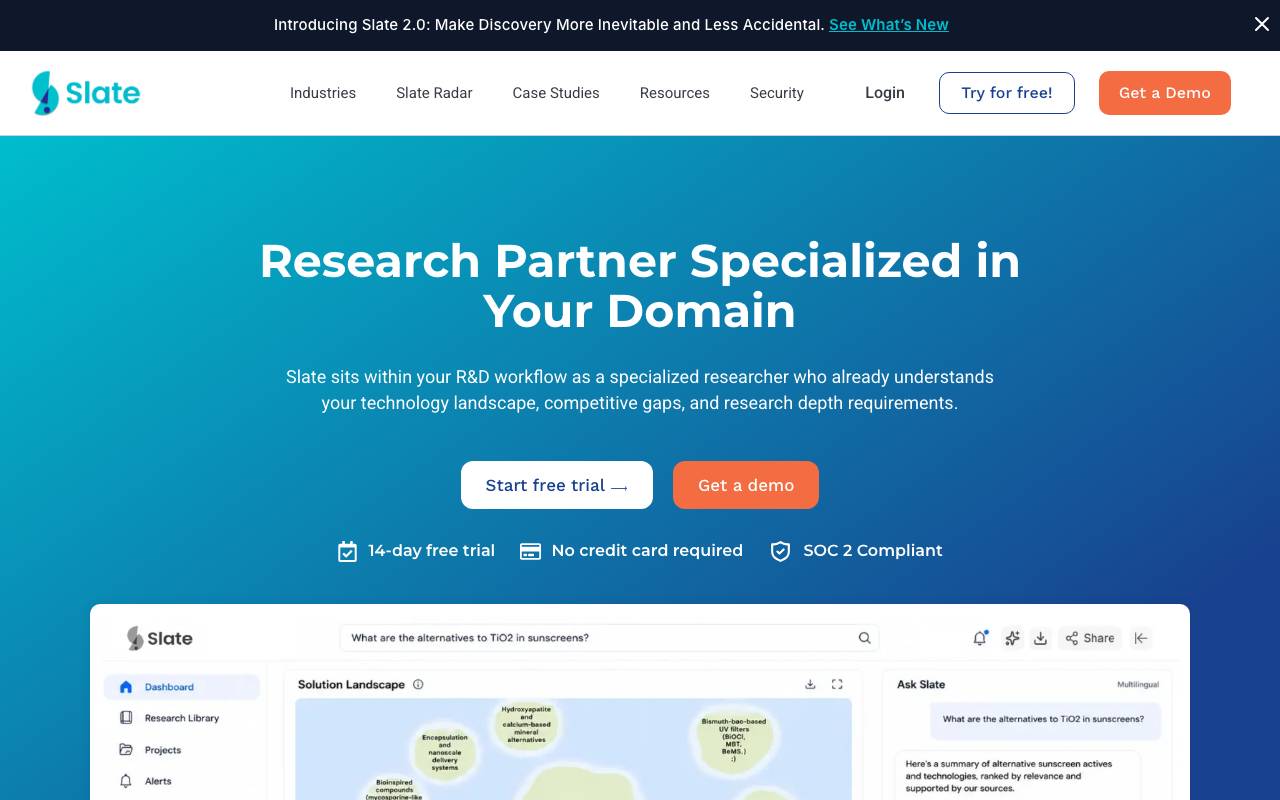
Slate is an AI-powered structured research database designed to organize knowledge and support R&D workflows. It serves as a specialized researcher, understanding the user's technology landscape, competitive gaps, and research depth requirements. The platform unifies research by integrating relevant papers, patents, and product information documents into a single interface, connecting every research area. Slate offers various features, including a customized, AI-powered knowledge base for centralizing and organizing research resources and intellectual property. It provides tools for competitor monitoring, technology watch, AI research assistance, ingredients discovery, state-of-the-art discovery, whitespace analysis, trend forecasting, and company scouting. The platform is designed for researchers and R&D teams, aiming to solve complex, constraint-based R&D challenges. It utilizes an AI assistant, called Slate Prism, which breaks down queries, scans patents and papers, and delivers evidence-backed insights. Key benefits of using Slate include accelerated research discovery, minimized trial risks, and data-driven decision-making. The platform has been recognized as an award-winning, trusted expertise, including being named the best content management platform by SIIA Codie Awards 2023. Users of Slate have reported improved efficiency, with one company achieving 40% faster trend identification and spotting 20% more emerging ingredients. The platform has fundamentally changed how companies approach product development, allowing them to lead trends rather than chase them.
Criteria breakdown
- Structured database for research entries
- AI-assisted data extraction from sources
- Custom fields and schemas
- Cross-entry search and filtering
- Document and web content ingestion
- Synthesis and summarization tools

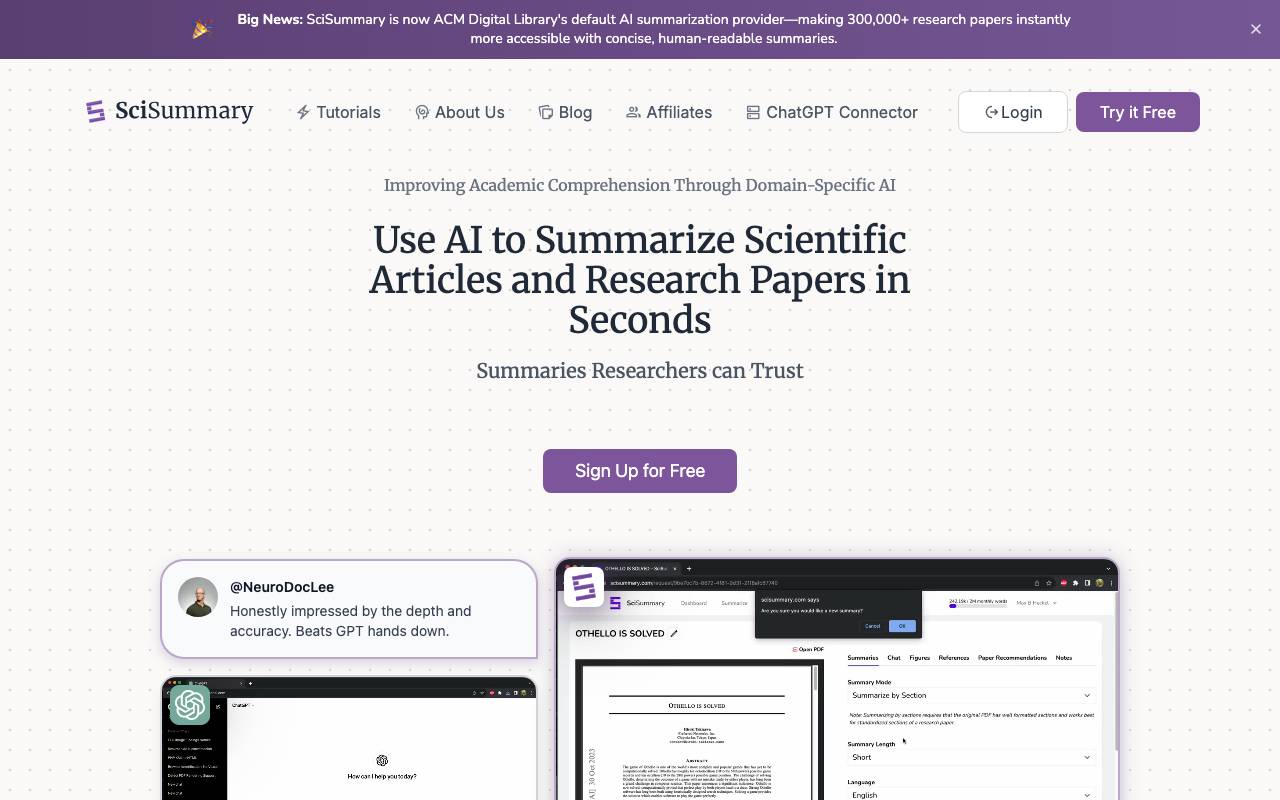
SciSummary is an AI-powered tool designed to help researchers understand and summarize scientific articles and research papers. It was created to address the limitations of general-purpose AI models like ChatGPT in handling academic literature, particularly in extracting context, structure, and citations. SciSummary breaks down papers into clearly labeled sections, including abstracts, methods, results, and conclusions, and highlights key findings in a way that aligns with how researchers read. The tool supports bulk paper summarization, comparing multiple papers using AI, and organizing research libraries with folders and tags. It also provides interpretations of figures and data. SciSummary offers various plans, including a free trial, a student plan, and a pro plan, with features such as unlimited summaries, figure analysis, and article searches. The tool is used by over 900,000 researchers who have summarized more than 2,200,000 papers since March 2023.
Criteria breakdown
- AI summarization of scientific PDFs and articles
- Email-based document submission
- Support for figures and equation explanations
- Chat-style Q&A on uploaded papers
- Bulk and history management of past summaries
- Shareable summary outputs

Deep Research Agent
AI research assistant that turns prompts into expert-level reports in minutes
Deep Research Agent is an AI-powered research assistant designed to compress hours of reading, browsing, and synthesis into a few minutes of automated work. Given a topic or question, it gathers information from multiple sources, evaluates relevance, and produces structured, citation-backed reports suitable for analysts, students, and knowledge workers. The tool aims to mirror the workflow of a human researcher: scoping the question, exploring sources, cross-checking findings, and organizing conclusions into a readable narrative. It is positioned as a productivity layer for anyone who regularly needs to brief themselves on unfamiliar subjects or produce written summaries on tight timelines. Users can iterate on outputs by refining prompts, narrowing scope, or asking follow-up questions, making it useful for both quick exploratory dives and deeper, multi-stage investigations.
Criteria breakdown
- Automated multi-source research
- Expert-style report generation
- Citations and references in outputs
- Topic scoping and refinement
- Follow-up question support
- Fast turnaround on complex queries