Past battle · 2026-03-07 UTC
AI Robotics Showdown — March 7, 2026
From the AI Robotics category. 9 marks placed across 3 fighters. Aurora Innovation took the crown.
Final standings



The line-up
The fighters
Profiles of every tool that competed in this battle, ranked by their final score.

Aurora Innovation
Self-driving technology platform powering autonomous trucking and ride-hailing at scale.

Aurora Innovation develops the Aurora Driver, a self-driving system designed to operate across multiple vehicle types and use cases, from heavy-duty trucks to passenger vehicles. The platform combines proprietary sensors, including long-range FirstLight lidar, with machine learning and a virtual testing suite to navigate complex highway and urban environments. The company partners with major OEMs and logistics providers to integrate its driver into commercial fleets, with an initial focus on autonomous freight along U.S. interstate corridors. Aurora aims to improve road safety, ease driver shortages, and increase efficiency in long-haul transportation. Rather than selling a consumer product, Aurora offers its technology as a service to vehicle manufacturers and fleet operators, building toward driverless commercial operations in trucking and ride-hailing markets.
Criteria breakdown
- Aurora Driver autonomy platform
- FirstLight FMCW lidar sensing
- Virtual Testing Suite for simulation
- Autonomous trucking pilots on U.S. highways
- Driver-as-a-Service business model
- Integration with major OEM vehicle platforms

NVIDIA Cosmos
Generative world foundation models for building physical AI systems like robots and autonomous vehicles.
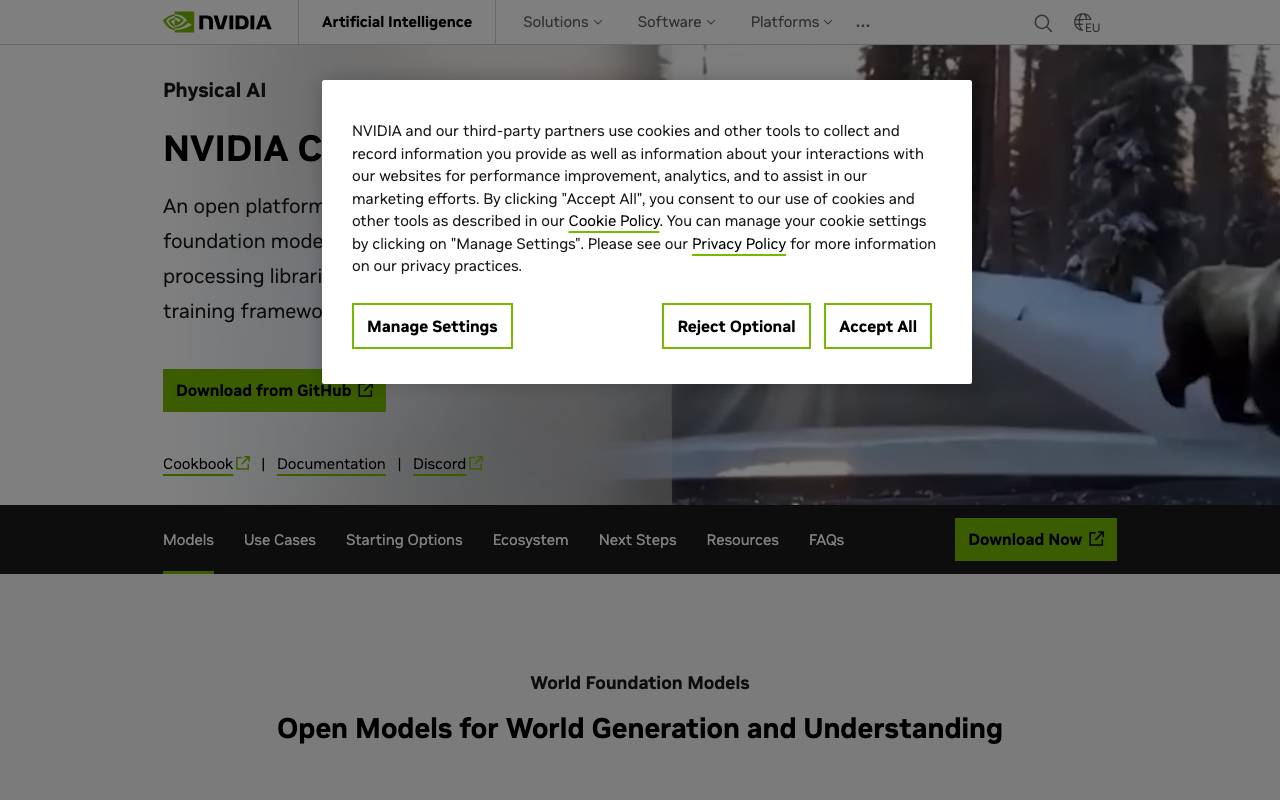
NVIDIA Cosmos is a platform of pretrained generative world foundation models (WFMs) designed to accelerate the development of physical AI. By simulating realistic, physics-aware environments and predicting future world states from text, image, or video inputs, it helps developers train and validate systems such as autonomous vehicles, humanoid robots, and industrial automation. The platform includes tokenizers, guardrails, and an accelerated data processing pipeline, allowing teams to fine-tune models on their own datasets or use them out of the box. Cosmos integrates with NVIDIA's broader robotics and simulation stack, including Omniverse and Isaac, to enable large-scale synthetic data generation and policy evaluation. Released with open model weights and permissive licensing, Cosmos targets researchers and enterprises building real-world AI agents that must understand spatial dynamics, motion, and physical interaction.
Criteria breakdown
- Pretrained generative world foundation models
- Video and image tokenizers for efficient processing
- Built-in safety guardrails
- Accelerated data curation pipeline
- Fine-tuning support for custom domains
- Compatible with Omniverse and Isaac simulation

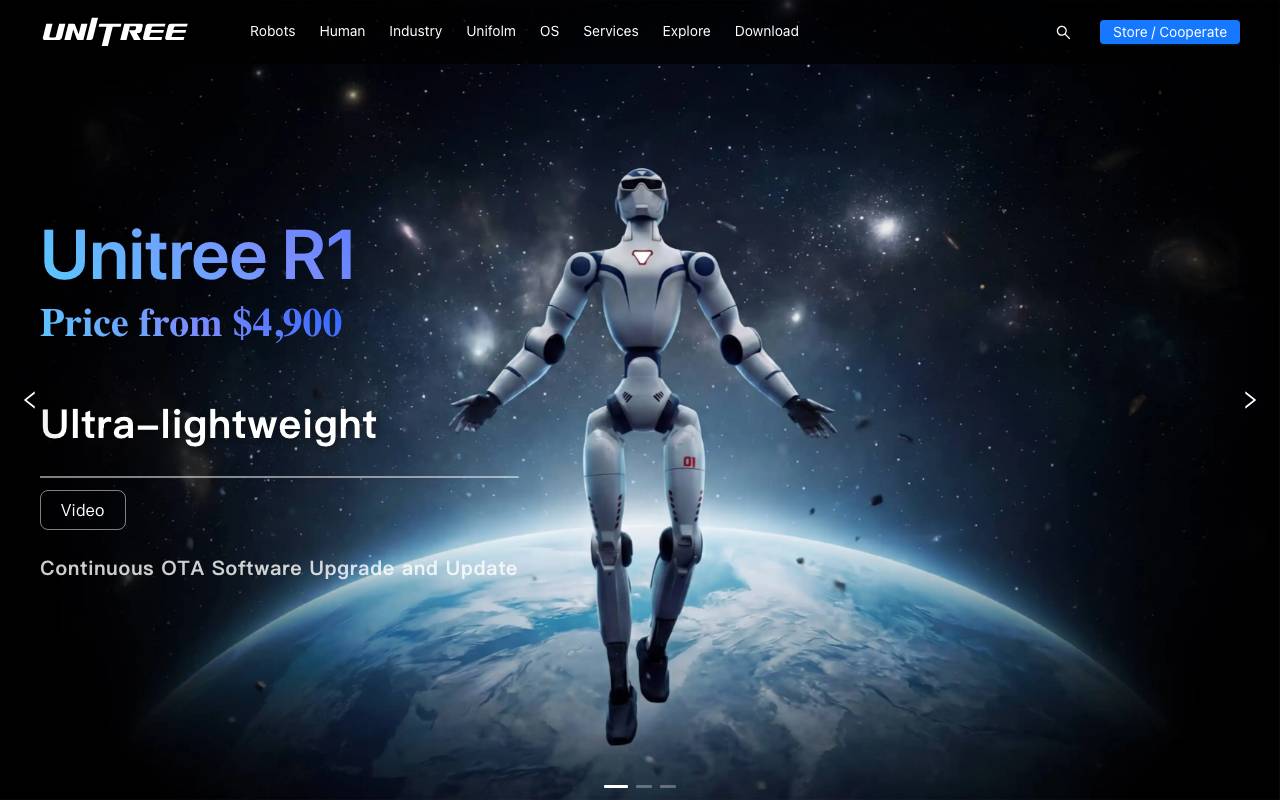
Unitree R1 is an ultra-lightweight humanoid robot designed to make advanced robotics accessible to researchers, educators, and developers. With 26 articulated joints, it can perform a wide range of dynamic movements while remaining portable and manageable in lab or classroom settings. The platform integrates multimodal AI capabilities, allowing it to process visual, auditory, and contextual inputs for interaction and learning tasks. Its accessible price point relative to industrial humanoids positions it as a practical tool for teaching robotics fundamentals, prototyping algorithms, and exploring embodied AI. R1 fits into curricula and research programs focused on locomotion, manipulation, computer vision, and human-robot interaction, offering a tangible platform for experimentation without the overhead of larger systems.
Criteria breakdown
- 26 articulated joints
- Ultra-lightweight humanoid form factor
- Multimodal AI processing
- Research- and education-focused pricing
- Programmable motion and behavior
- Support for embodied AI experimentation