Past battle · 2025-12-26 UTC
AI Data Analysts Showdown — December 26, 2025
From the AI Data Analysts category. 23 marks placed across 6 fighters. Together Open Data Scientist took the crown.
Final standings



The line-up
The fighters
Profiles of every tool that competed in this battle, ranked by their final score.

Together Open Data Scientist
Open-source ReAct agent that runs Python to explore data, build models, and generate analysis reports
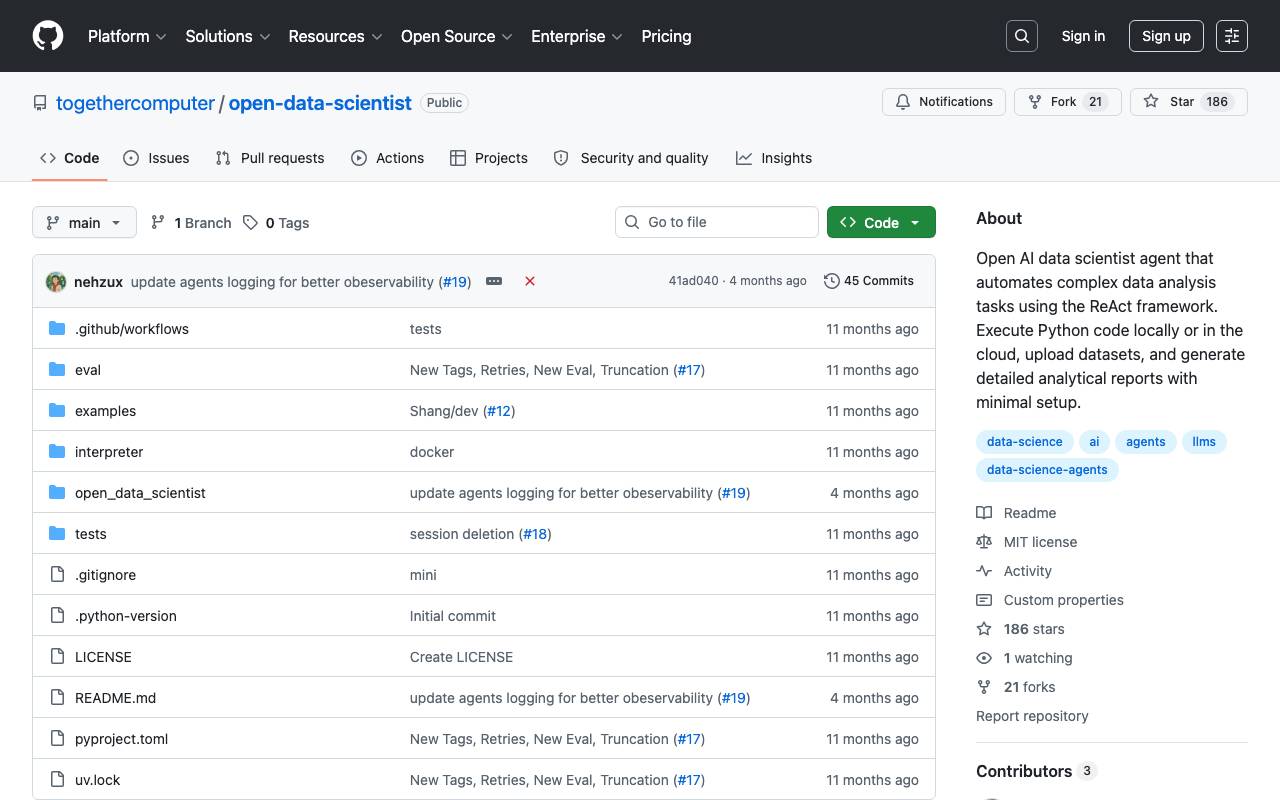
Together Open Data Scientist is an open-source, AI-powered data analysis agent released by Together AI on GitHub. It follows the ReAct (Reasoning + Acting) framework, alternating between language-model reasoning steps and concrete Python code execution to carry out end-to-end data science tasks such as exploring datasets, computing summary statistics, building models, and producing detailed written analysis reports. The agent can execute Python in one of two modes. The "internal" mode runs code locally inside a Docker container, which is suited to single-user local development, while the "tci" mode offloads execution to Together Code Interpreter (TCI), a cloud sandbox accessed through the Together AI API. Users can upload a data directory for automatic ingestion, set a maximum number of reasoning iterations, and pick which underlying model drives the agent — DeepSeek-V3 is the default, but Llama models and others available through Together's platform can be specified. It is distributed as a pip-installable package (open-data-scientist) and exposes both a command-line interface and a Python API. The CLI supports options such as --write-report to generate a Markdown analysis report, --save-trace to log the full query and execution trace, and session reuse via session IDs. The Python API centers on a ReActDataScienceAgent class that takes a natural-language task and returns results. The project is explicitly labeled experimental software. Because all code and analysis are AI-generated, outputs may contain errors or suboptimal approaches and are best treated as a starting point for exploration and learning rather than production decision-making. The maintainers stress that human oversight and validation are required, especially for critical business or research applications. Compared with commercial AI data-analysis assistants like ChatGPT's Advanced Data Analysis or notebook copilots, Together Open Data Scientist is differentiated by being fully open source, self-hostable, model-agnostic within Together's ecosystem, and capable of autonomously chaining many code-execution steps toward a complete report rather than a single one-shot answer.
Criteria breakdown
- ReAct reasoning-and-acting agent loop
- Two execution modes: local Docker or Together Code Interpreter cloud
- Automatic data directory upload for analysis
- Markdown report generation with --write-report
- Configurable model and maximum reasoning iterations
- Command-line interface and programmatic Python API

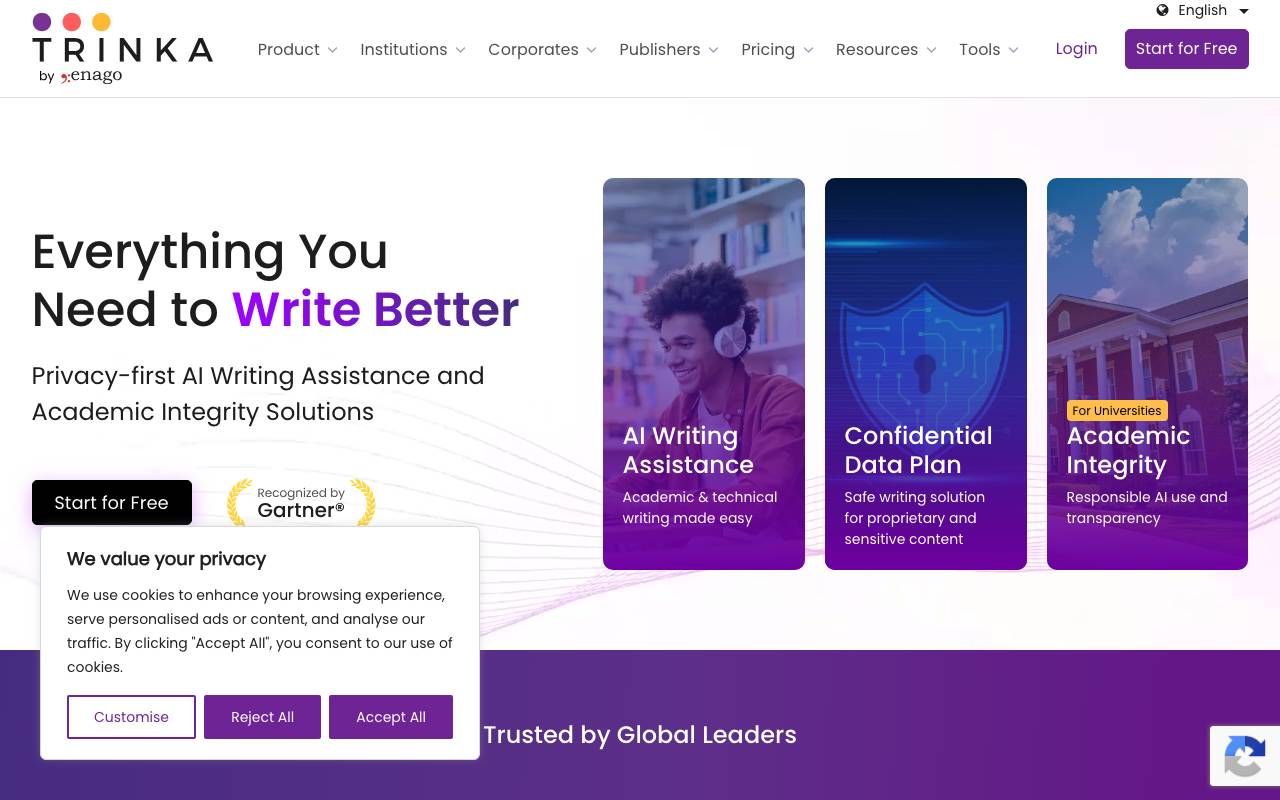
Trinka AI is a writing assistant designed specifically for researchers, students, and technical professionals. Beyond standard grammar and spelling checks, it focuses on the conventions of scholarly writing, flagging issues like inconsistent terminology, unclear sentence structure, and tone problems common in academic manuscripts. The tool offers subject-aware suggestions across hundreds of disciplines and can help with tasks such as paraphrasing, consistency checks, and ensuring compliance with publication style guides. It integrates with Microsoft Word, browsers, and through cloud editors, making it usable across typical research workflows. Trinka also includes specialized features for manuscript preparation, such as journal-readiness checks, plagiarism detection, and citation verification, positioning it as more than a general-purpose grammar checker.
Criteria breakdown
- Advanced grammar and style checks
- Academic tone and clarity enhancements
- Paraphrasing and consistency tools
- Plagiarism and citation checking
- Journal submission readiness reports
- Browser, Word, and cloud integrations

Fyva AI
AI copilot that helps analysts generate equity research reports from filings and market data.
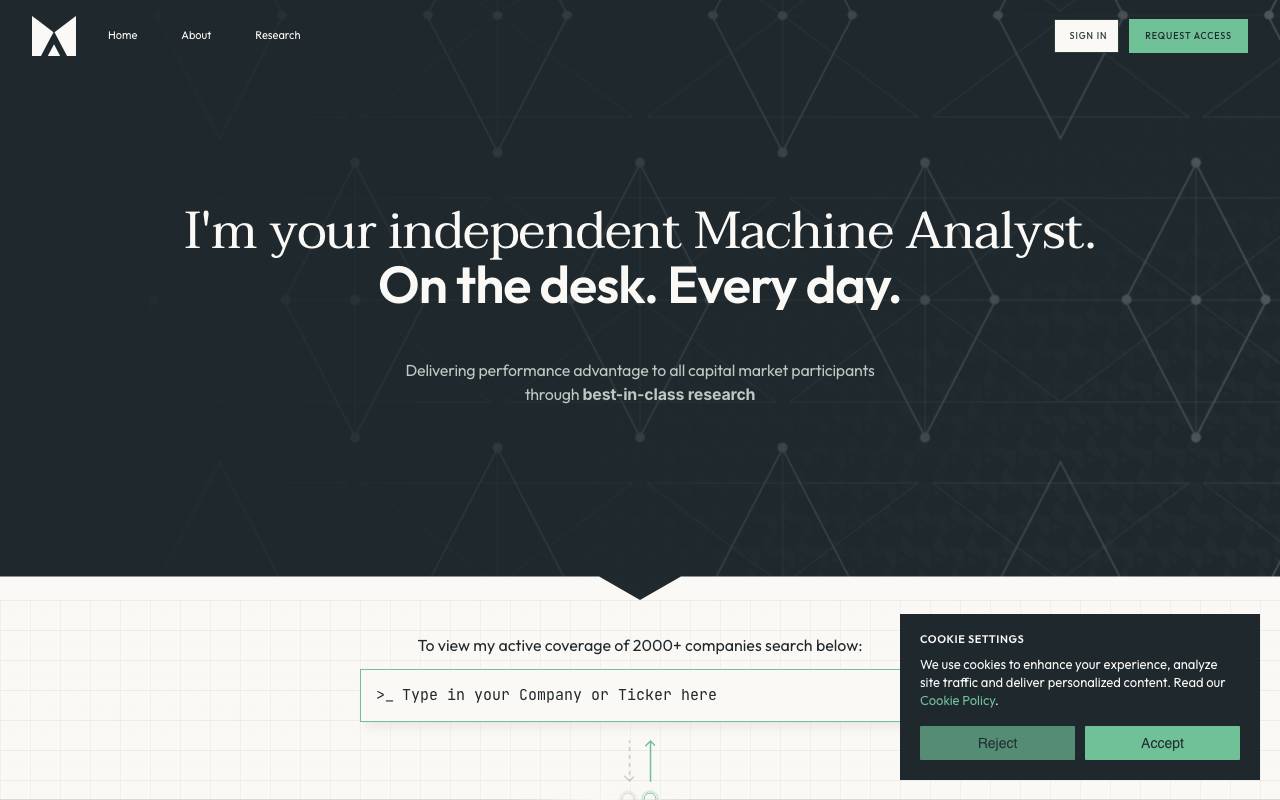
Fyva AI is a research assistant built for equity analysts, investment teams, and finance professionals. It ingests company filings, financial data, and other source material to help users draft research notes, summaries, and investment insights more quickly than manual workflows allow. The tool focuses on accelerating repetitive parts of the research process, such as extracting key figures from 10-Ks and 10-Qs, summarizing earnings calls, and structuring initial report drafts. Analysts can then refine the AI-generated output with their own judgment and proprietary views before publishing internally or to clients.
Criteria breakdown
- Automated equity report generation
- Filings and document analysis
- Earnings and financial data summarization
- Insight extraction for investment theses
- Analyst-focused research workspace

Anamap
AI analyst that investigates GA4 or Amplitude data to explain product and growth metric changes and recommend next steps
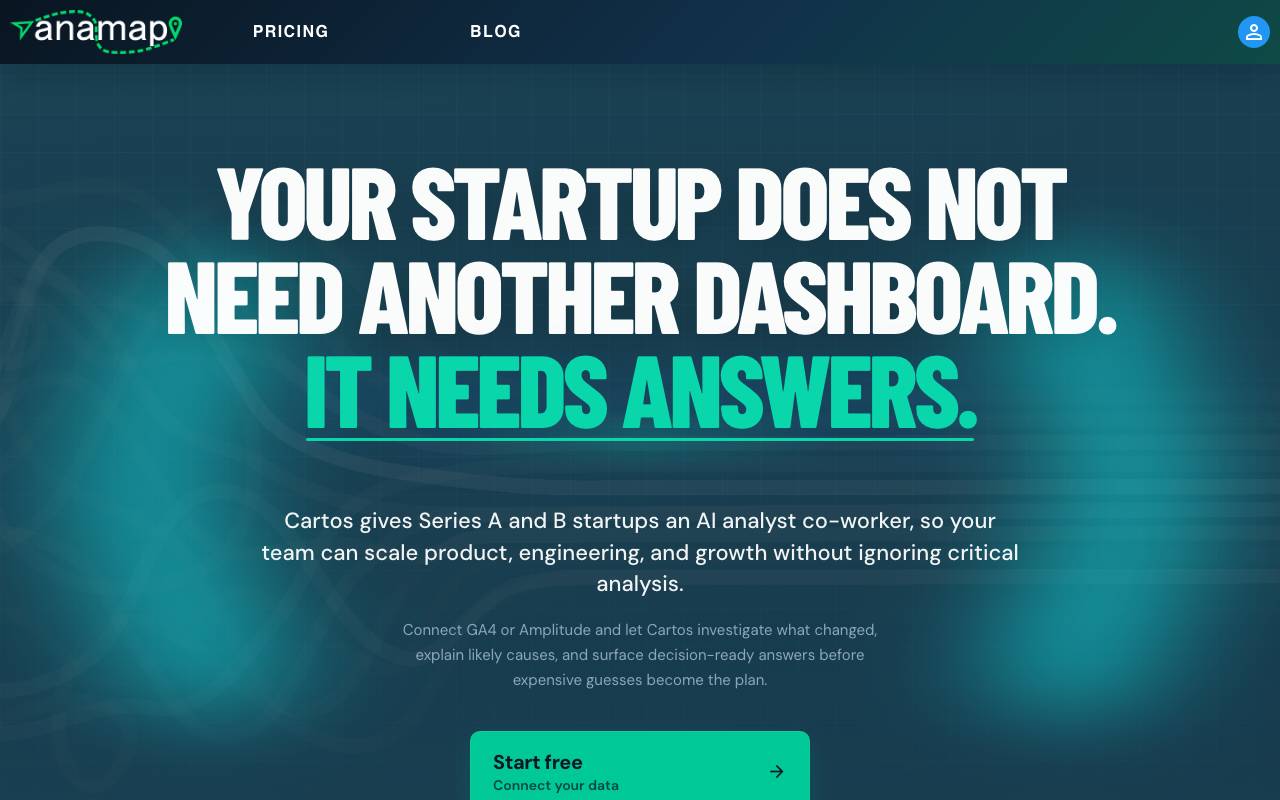
Anamap is an AI analytics tool built for product and growth teams who want explanations and decisions rather than more dashboards. Its central feature is Cartos, an "AI analyst co-worker" that connects to a team's web and product analytics, identifies meaningful shifts across the user journey — acquisition, activation, conversion, and retention — and packages them into decision-ready analyses. Rather than returning another chart or a vague summary, each Cartos investigation is structured around three deliverables: the change that matters (which metric, segment, channel, or journey step moved and its business impact), the likely cause (an evidence-backed explanation that includes competing hypotheses and caveats when the data is inconclusive), and a recommended next move tied directly to the finding. The result is shared as a brief that teams can drop into Slack, email, or the web app so stakeholders can align without rebuilding the analysis. The tool connects to GA4 or Amplitude as data sources and integrates with Slack, email, and a web app for delivering findings. Anamap positions itself for organizations that need to explain product and website performance but cannot easily justify or hire additional analyst headcount — founders, growth teams, product teams, and lean data teams where every question lands on the same overbooked analyst. A key part of Anamap's pitch is persistent context. Where a generic chatbot like ChatGPT or Claude requires you to export data and re-explain definitions with each prompt, Cartos is designed to retain "company memory": how KPIs are defined, what shipped in releases, which experiments ran, and what the team previously decided. The intent is that each investigation builds on prior context and ends with a relevant next step rather than starting cold. Pricing is positioned around teams rather than seats, with unlimited users and no per-seat charge, plus a free trial to investigate one real change. As an early-stage product (the site references helping 12+ businesses), it is best understood as a focused, opinionated alternative to building internal analytics-to-decision workflows or relying on scarce analyst time. Buyers should weigh its narrow current integration set (GA4 and Amplitude) and its small, emerging track record against the specificity of its decision-oriented output.
Criteria breakdown
- Cartos AI analyst that investigates product and web analytics
- GA4 and Amplitude data connections
- Detection of shifts across acquisition, activation, conversion, and retention
- Evidence-backed cause analysis with competing explanations and caveats
- Recommended next-step output tied to each finding
- Persistent company, KPI, release, and decision memory


Model ML is an AI-powered platform built for financial services teams, helping analysts accelerate research, due diligence and deal workflows. It consolidates documents, data and AI models into a single workspace so users can move from raw sources to structured insights without switching tools. The platform supports tasks such as company analysis, document review, comparable searches and report drafting, with AI assistants tailored to finance use cases. It is aimed at investment banks, private equity, asset managers and advisory firms that need to process large volumes of information under tight deadlines.
Criteria breakdown
- AI assistants tuned for financial research
- Document ingestion and analysis
- Due diligence and deal workflow support
- Report and memo drafting tools
- Collaborative workspace for deal teams
- Integration with financial data sources

MinusX is an AI agent that plugs directly into analytics platforms like Jupyter, Metabase, and Tableau, acting as a hands-on data analyst within the tools teams already use. Instead of exporting data or switching contexts, users can ask questions in natural language and have MinusX query data, build charts, and edit dashboards on their behalf. The agent can interpret schemas, write SQL or Python, explain its reasoning, and iterate on results based on follow-up prompts. It is aimed at analysts, data scientists, and business users who want to speed up exploratory analysis, reporting, and routine dashboard maintenance. By operating inside the host tool rather than as a standalone interface, MinusX fits into existing workflows and respects the permissions and connections already configured there.
Criteria breakdown
- Browser extension for analytics tools
- Natural language to SQL and Python
- Automated dashboard creation and edits
- Context-aware schema understanding
- Iterative chat-based analysis
- Support for Jupyter, Metabase, Tableau, and more