Past battle · 2026-04-28 UTC
Agent Development Showdown — April 28, 2026
From the Agent Development category. 13 marks placed across 6 fighters. Sierra took the crown.
Final standings





The line-up
The fighters
Profiles of every tool that competed in this battle, ranked by their final score.
Sierra
Conversational AI agents that handle customer service with brand-aligned empathy and accuracy.

Sierra is an enterprise platform for building AI agents that engage customers through natural conversation across chat, voice, and other channels. The agents are designed to resolve issues end-to-end, taking actions like updating orders, processing returns, or answering account-specific questions while staying grounded in a company's policies and tone. Companies configure each agent with their own knowledge, guardrails, and integrations, and Sierra provides tools to monitor performance, audit conversations, and continuously improve responses. The platform targets brands that want to scale support without sacrificing the quality of human interactions.
Criteria breakdown
- Conversational AI agents for support
- Action-taking via system integrations
- Brand and policy customization
- Voice and chat deployment
- Analytics and quality assurance tools
- Guardrails for safe responses

DeepOpinion
Enterprise AI platform for automating complex knowledge work and unstructured data tasks.
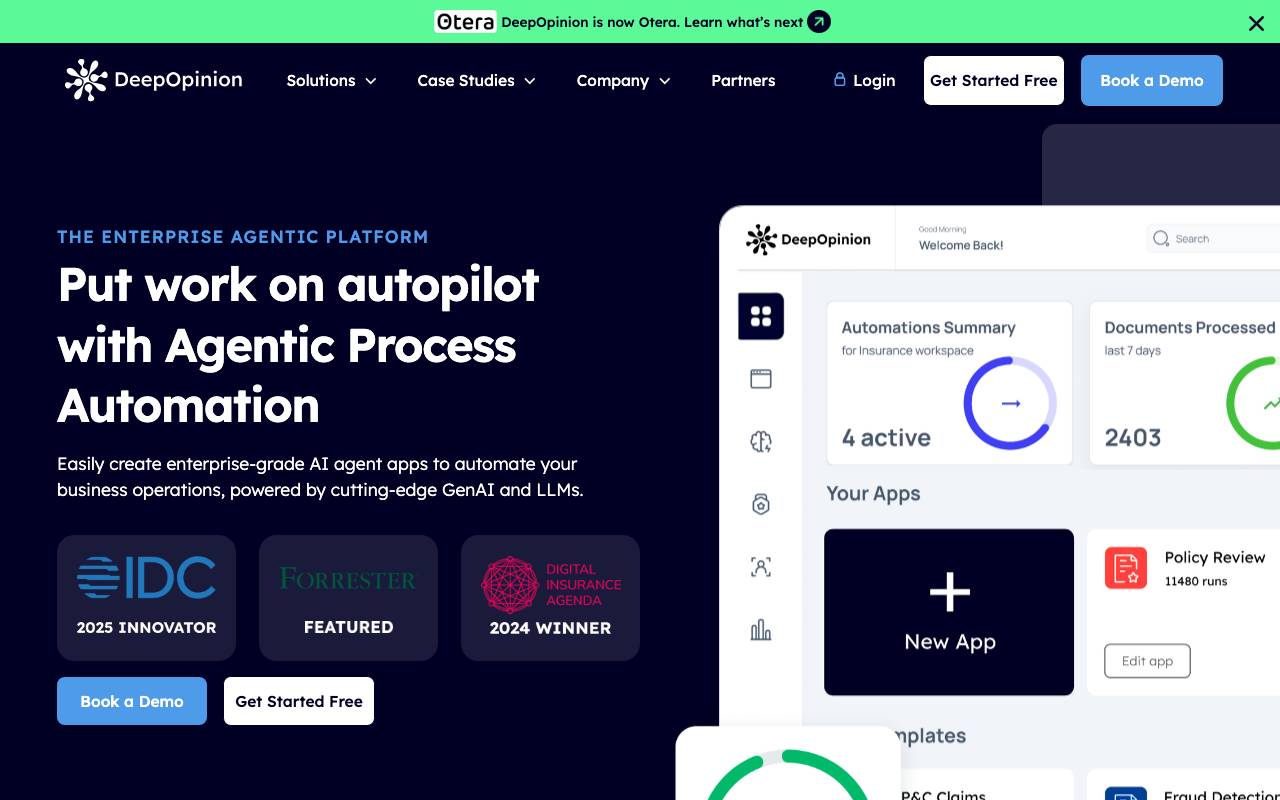
DeepOpinion is an enterprise-focused automation platform designed to handle the kind of complex, document-heavy knowledge work that traditional RPA tools struggle with. It combines large language models with workflow tooling to process unstructured inputs like emails, contracts, invoices, and support tickets at scale. The platform targets teams in finance, insurance, customer service, and operations that need reliable, auditable AI handling of business processes. It allows organizations to build and deploy AI agents that can read, classify, extract, and act on information without extensive custom development. With options for cloud or on-premise deployment, DeepOpinion aims to fit into regulated enterprise environments while reducing manual processing time for repetitive cognitive tasks.
Criteria breakdown
- AI agents for document and text processing
- Workflow automation for knowledge tasks
- Data extraction from unstructured sources
- Enterprise-grade security and deployment options
- Integration with existing business systems
- Human-in-the-loop review controls

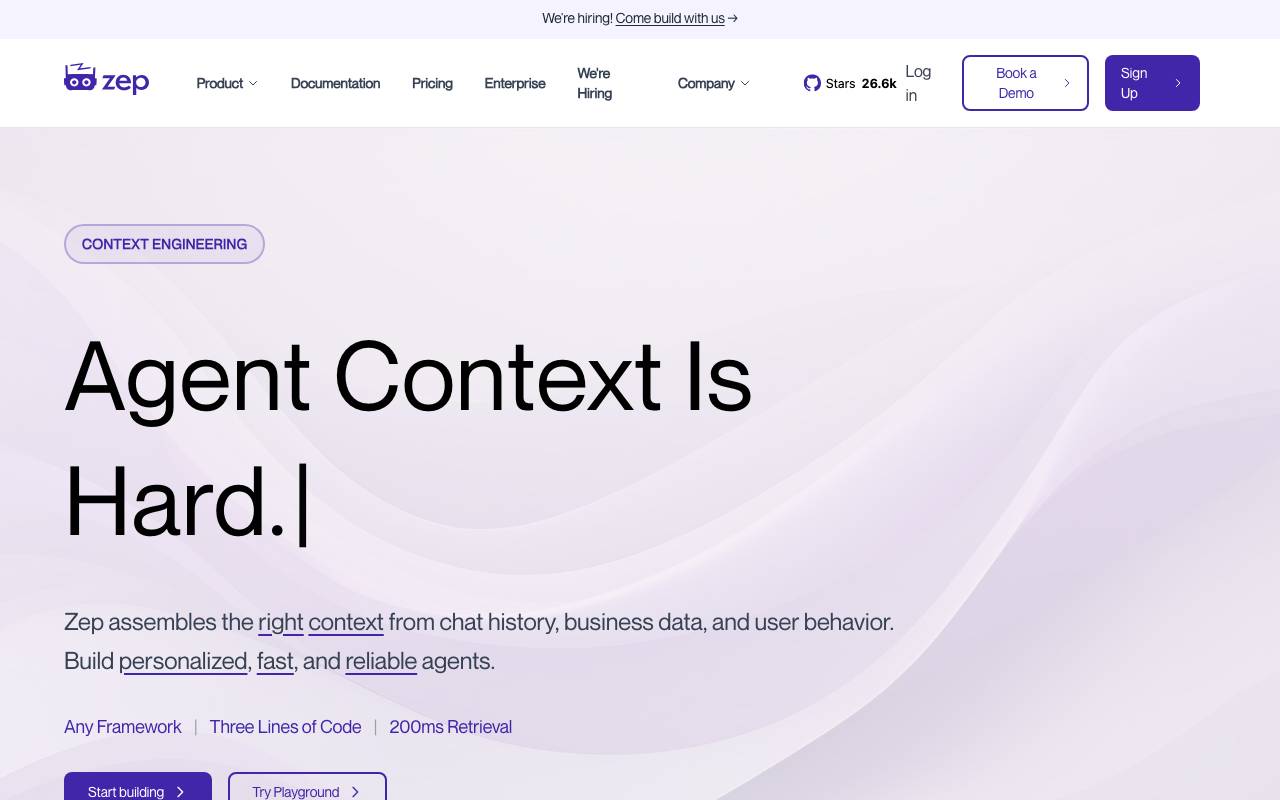
Zep AI Memory is a developer-focused memory service that gives AI agents persistent, structured recall across conversations and sessions. It captures chat history, extracts key facts, and organizes them into a knowledge graph so agents can retrieve relevant context on demand instead of stuffing entire histories into prompts. The platform handles summarization, entity extraction, and semantic search behind a simple API, letting teams add stateful memory to chatbots, copilots, and autonomous agents without building custom retrieval infrastructure. It is designed to scale with production workloads while keeping prompt sizes and token costs predictable. Zep integrates with common LLM frameworks like LangChain and LlamaIndex and provides SDKs for popular languages, making it straightforward to drop into existing agent stacks.
Criteria breakdown
- Long-term conversational memory
- Automatic fact and entity extraction
- Knowledge graph storage
- Semantic and hybrid search
- LangChain and LlamaIndex integrations
- Multi-language SDKs

Coval
Simulation and evaluation platform for testing AI voice and chat agents at scale
Coval is a testing and evaluation platform aimed at teams building conversational AI agents, particularly those operating across voice and chat modalities. It addresses a recurring problem in agent development: traditional unit tests and manual spot-checks don't capture the non-deterministic, multi-turn nature of agentic systems, making it hard to know whether a change improves or regresses real-world behavior. The platform's core idea is simulation. Rather than relying solely on static test cases, Coval generates simulated user interactions that exercise an agent across many scenarios and conversational paths. These simulated runs can then be scored against defined metrics and expectations, allowing teams to measure reliability before shipping changes and to catch regressions as agents and prompts evolve. Coval positions itself for both voice and text agents, which is notable because voice introduces additional layers — speech-to-text, latency, and turn-taking — that affect agent quality beyond the underlying language model. The company has drawn comparisons to the way autonomous-vehicle teams use large-scale simulation to validate behavior before deployment, applying a similar testing philosophy to AI agents. In a typical workflow, a team connects their agent, defines scenarios and evaluation criteria, runs simulations, and reviews results across runs to track performance over time. This supports use in development as well as ongoing monitoring and regression testing as part of a CI-style process. As a relatively young product in an evolving category, details of its pricing, integrations, and exact metric coverage are best confirmed directly, and teams should evaluate how well its simulated scenarios reflect their own production traffic. Its main differentiation from general LLM-evaluation tools is the emphasis on multi-turn, multi-modal agent simulation rather than single-prompt scoring.
Criteria breakdown
- Simulated user interactions for testing agents
- Evaluation metrics and scoring across runs
- Support for voice and text agents
- Regression detection across agent versions
- Scenario-based testing of conversational paths

Gretel AI
Synthetic data platform for generating privacy-safe, AI-ready datasets that mirror real-world data.
Gretel AI is a developer-focused platform for creating synthetic data that statistically resembles real datasets without exposing sensitive information. Teams use it to unblock AI and analytics projects when access to production data is restricted by privacy, compliance, or availability constraints. The platform offers APIs, SDKs, and pre-built models for generating tabular, text, and time-series data, along with tools for evaluating quality and privacy risk. It supports common use cases such as training machine learning models, augmenting underrepresented classes, sharing data across teams, and testing software with realistic but artificial records.
Criteria breakdown
- Generative models for synthetic tabular and text data
- Differential privacy and PII redaction controls
- Quality, accuracy, and privacy scoring reports
- Python SDK and REST API integration
- Pre-trained models and customizable templates
- Cloud and self-hosted deployment options

Theoriq AI
Decentralized protocol for building and governing multi-agent AI systems on-chain
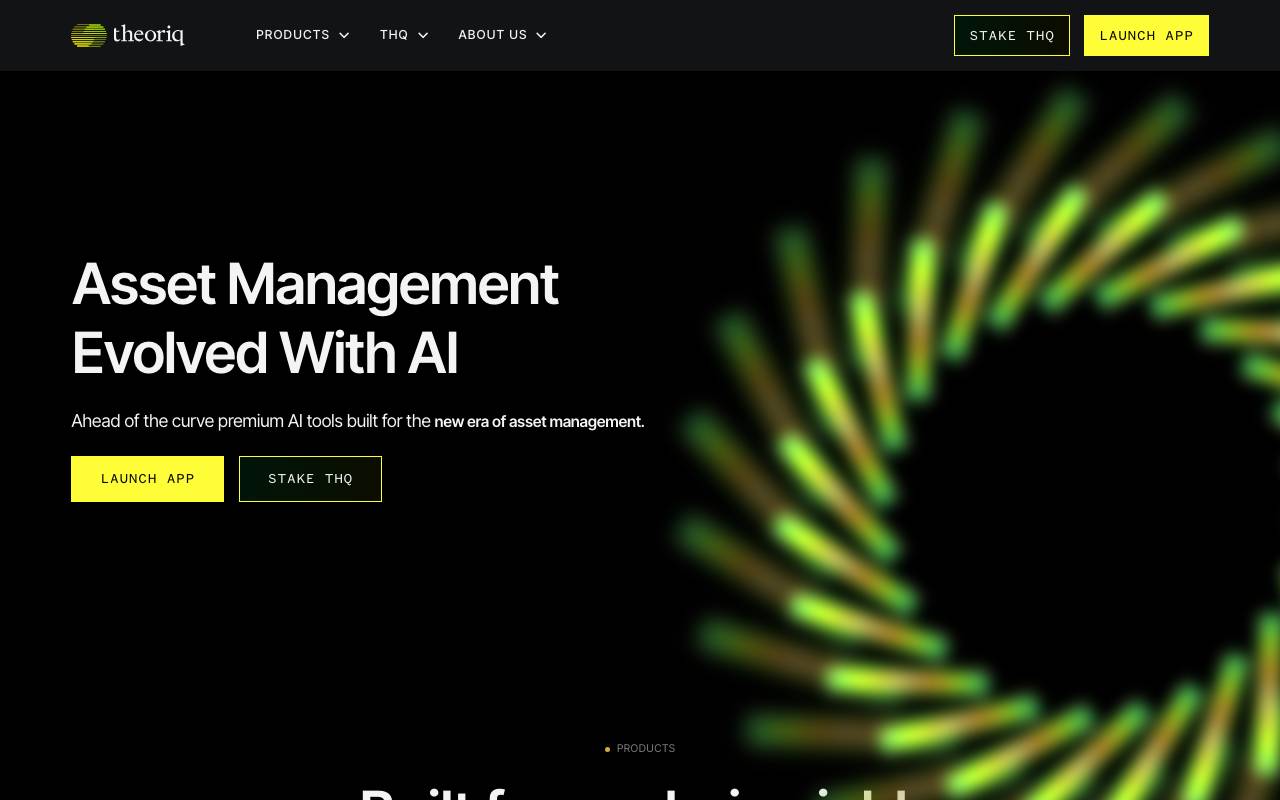
Theoriq AI is a blockchain-based protocol designed to coordinate networks of AI agents in a transparent and verifiable way. By combining decentralized infrastructure with multi-agent orchestration, it allows developers to compose specialized agents into larger collectives that can collaborate on complex tasks. The protocol provides on-chain governance, reputation tracking, and incentive mechanisms so that agent behavior, performance, and contributions can be measured and rewarded. This makes it possible to build open ecosystems where third-party agents can be discovered, evaluated, and integrated into broader workflows. Theoriq targets builders working at the intersection of crypto and AI, including teams creating autonomous DeFi strategies, research assistants, and other agent-driven applications that benefit from trust-minimized coordination.
Criteria breakdown
- Multi-agent orchestration framework
- Decentralized agent registry and discovery
- On-chain reputation and evaluation system
- Tokenized incentives for agent contributions
- Governance mechanisms for collective decision-making
- Developer tools for composing agent workflows