Past battle · 2026-06-15 UTC
AI security Showdown — June 15, 2026
From the AI security category. 13 marks placed across 6 fighters. brack took the crown.
Final standings



The line-up
The fighters
Profiles of every tool that competed in this battle, ranked by their final score.

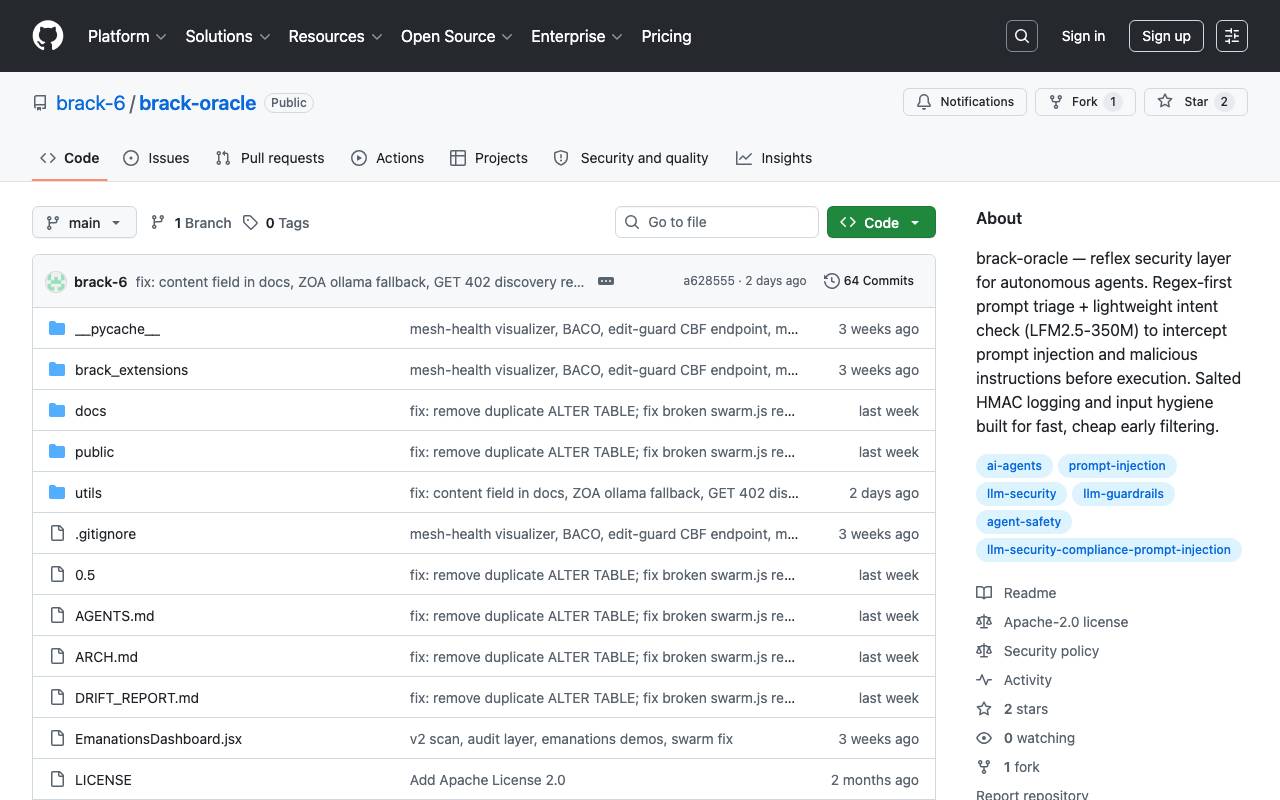
Brack is a runtime safety layer designed to sit between autonomous AI agents and the systems they act on. It monitors agent behavior as it happens, intercepting risky actions, tool calls, and outputs before they can cause harm, leak data, or violate policy. Rather than relying solely on prompt-level guardrails, Brack functions like a reflex: fast, deterministic checks that run alongside model reasoning. Teams can define policies, allow and deny rules, and escalation paths, giving security and platform owners control over what agents are permitted to do across tools, APIs, and environments. It is aimed at developers and security teams shipping agentic systems to production who need observability, containment, and auditability without slowing their agents down.
Criteria breakdown
- Reflex-style runtime action filtering
- Custom policy and rule definitions
- Audit logs of agent decisions and tool calls
- Escalation and human-in-the-loop hooks
- Coverage for multi-agent and tool-using workflows
- Integration with common agent frameworks
Amplify Security
Automated, context-aware fixes for code security flaws delivered as pull requests.
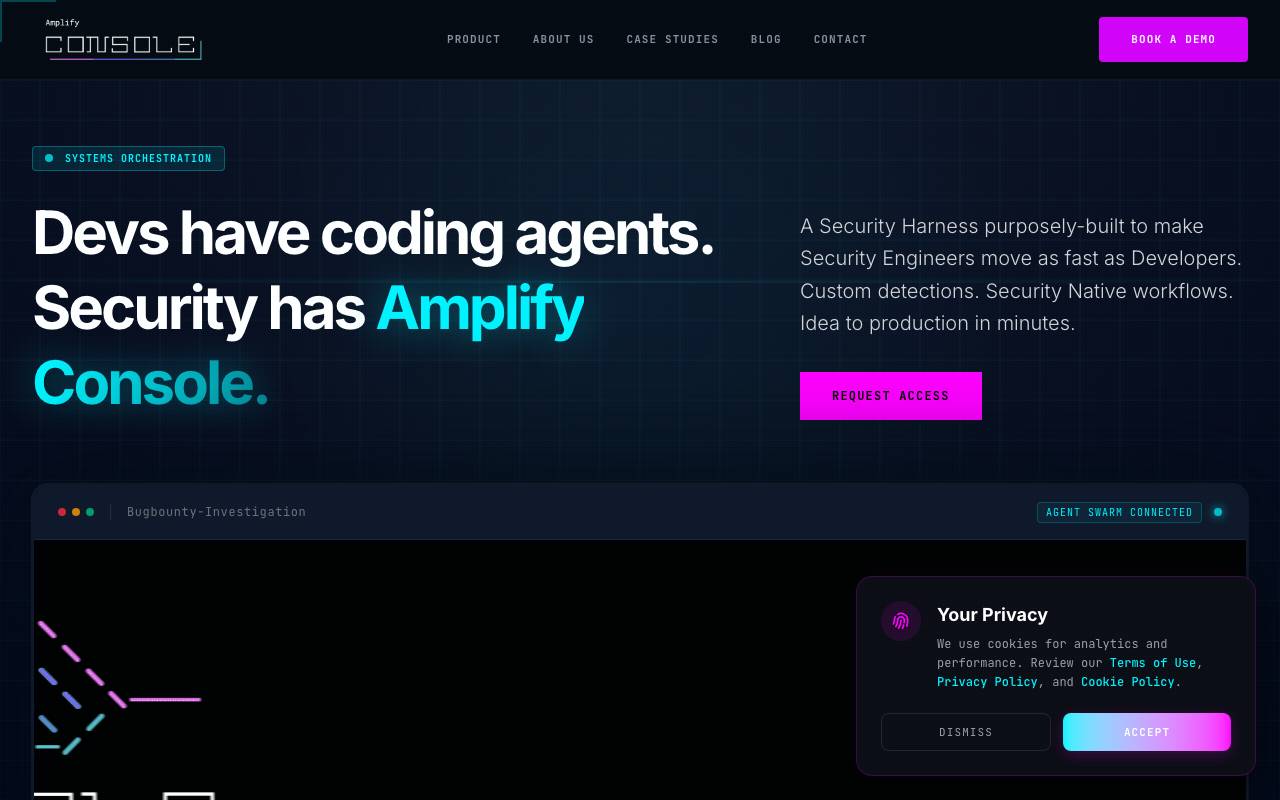
Amplify Security is a developer-focused application security tool that automatically detects vulnerabilities in source code and generates ready-to-review fixes. Instead of just flagging issues, it produces patch suggestions as pull requests, helping engineering teams remediate flaws without leaving their normal workflow. The platform integrates with common code hosting and CI systems, analyzing repositories for issues such as injection risks, insecure dependencies, and misconfigurations. By pairing detection with automated remediation, it aims to shrink the gap between identifying a vulnerability and shipping a fix. It is positioned for security and development teams that want to reduce backlog noise, speed up mean time to remediation, and embed security into everyday code review rather than treating it as a separate audit process.
Criteria breakdown
- Automated vulnerability detection in source code
- AI-generated remediation pull requests
- Integration with code repositories and CI pipelines
- Context-aware patch suggestions
- Support for common application security flaw classes
- Developer-centric review workflow

Harvest IQ provides AI-powered assistants designed to support cybersecurity teams across detection, investigation, and response tasks. The platform aims to reduce manual workload by handling routine analysis, correlating signals, and surfacing relevant context for human analysts. The assistants can be applied to areas like threat intelligence triage, alert investigation, and security operations support. By offloading repetitive work to AI agents, security teams can focus on higher-priority incidents and strategic decisions.
Criteria breakdown
- AI assistants for security operations
- Automated alert triage
- Threat intelligence analysis
- Investigation support workflows
- Integration with security tooling
- Context-aware recommendations

ResumeHQ
Conversational AI resume builder powered by Claude that generates ATS-optimized resumes from your description
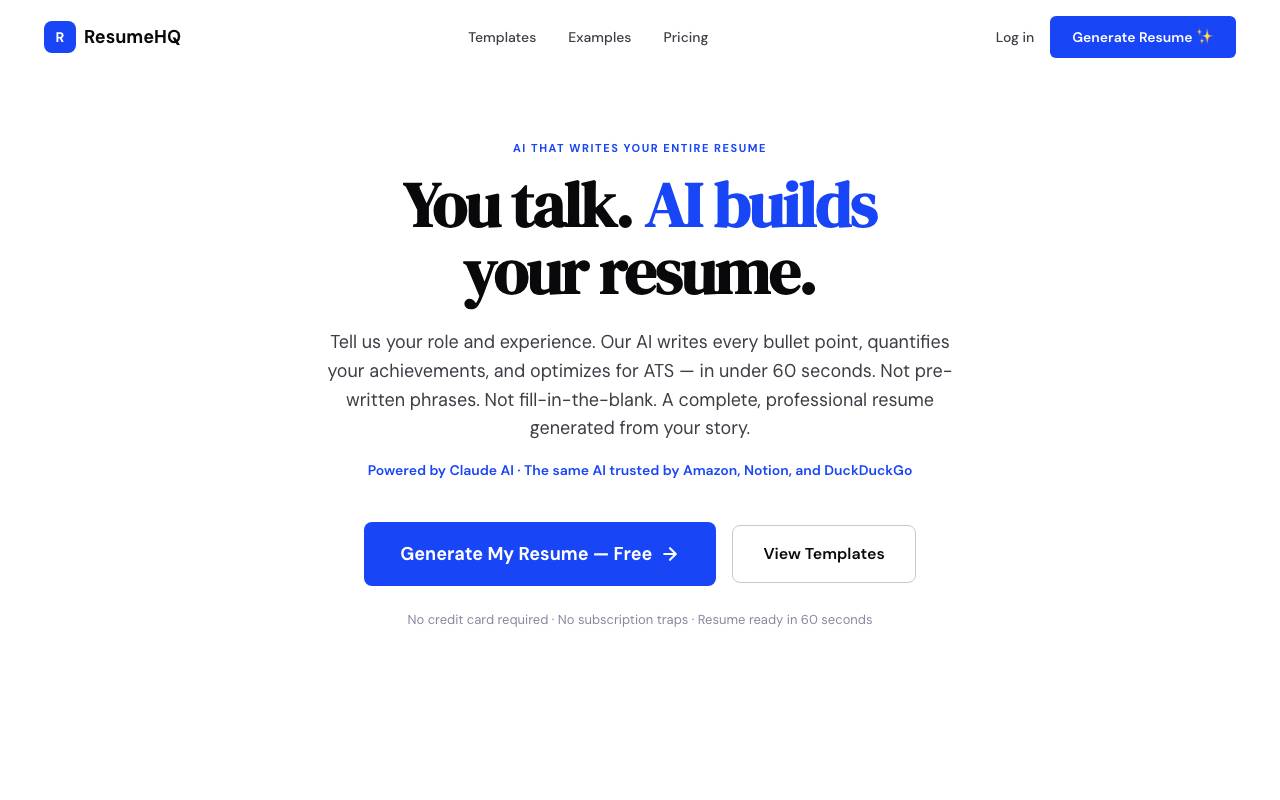
ResumeHQ is an AI-powered resume builder that generates a complete resume from a conversational description of your background. Instead of filling in templates or starting from a blank page, users describe their name, target role, and experience, and the tool produces a full resume — including a professional summary, achievement bullets, and ATS keywords — in roughly a minute. It is powered by Anthropic's Claude AI. The core idea is to transform vague, task-based descriptions into quantified, metric-driven achievement statements. For example, "managed team" is rewritten into bullets with action verbs, numbers, and relevant keywords intended to perform well with applicant tracking systems. The output appears in a live editor where users can edit text, switch templates, and export. ResumeHQ offers a set of professional templates spanning minimalist, modern, executive, technical, and creative styles, each labeled with an ATS-compatibility rating. Finished resumes can be downloaded as PDF or DOCX. The service advertises no required signup to start and a one-time or low monthly pricing model with one-click cancellation. The tool is aimed at job seekers across many roles and industries who want a fast, low-effort way to produce a polished resume. Its main trade-off is reliance on AI-generated phrasing, which produces specific metrics and claims that the user must verify for accuracy, since invented figures could misrepresent actual experience.
Criteria breakdown
- Conversational AI resume generation via Claude
- Automatic achievement bullet rewriting with metrics and keywords
- ATS keyword optimization and section ordering
- Live in-browser resume editor
- 12+ professional templates with ATS ratings
- PDF and DOCX export

Rivalz
Decentralized AI intelligence layer for secure data access and on-chain AI infrastructure.
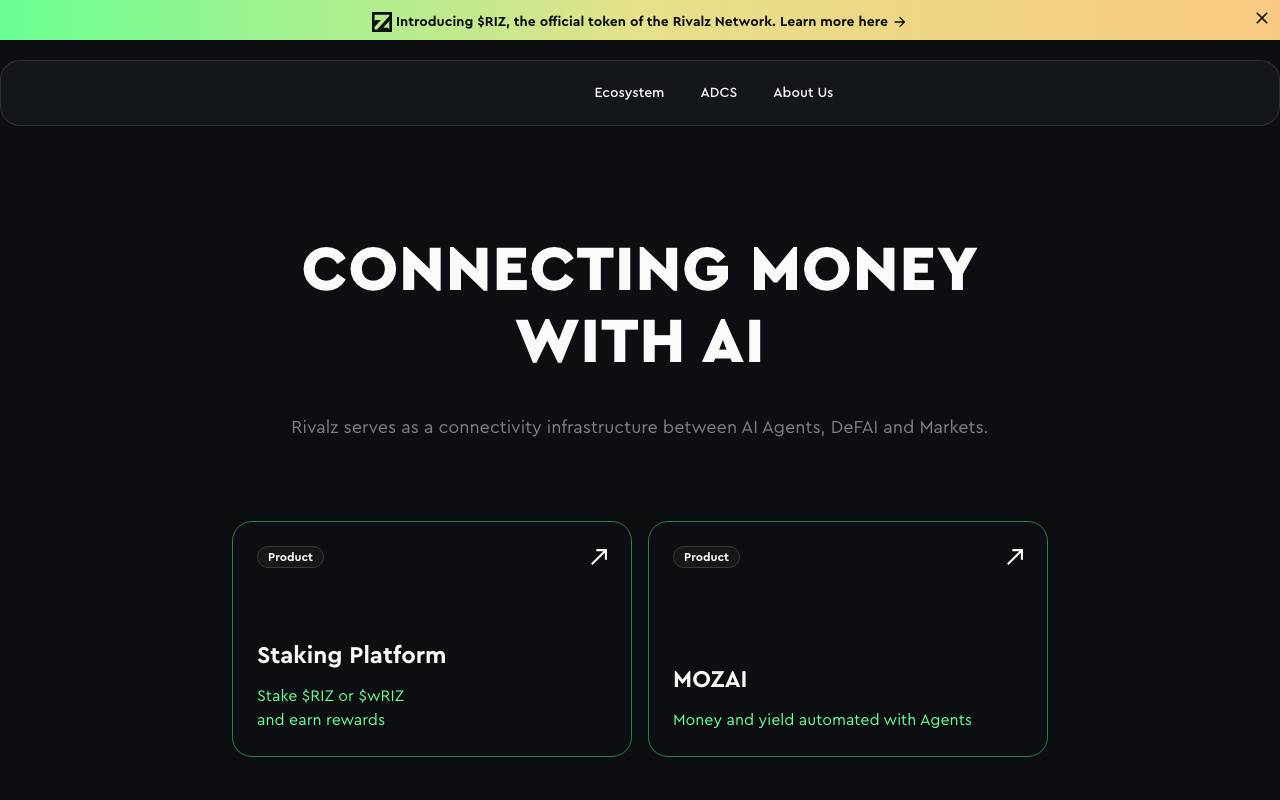
Rivalz is a decentralized AI infrastructure project that aims to connect AI agents and applications with verifiable data sources. It provides tooling for developers to build, deploy, and coordinate autonomous AI agents that can read, reason over, and act on both Web2 and Web3 data without relying on a single centralized provider. The platform combines decentralized compute, storage, and oracle-style data feeds into what it calls an AI Intel layer. This is designed to give agents secure, auditable access to information while keeping ownership of data and models distributed across the network. Typical use cases include trading agents, research copilots, and on-chain automation.
Criteria breakdown
- AI Intel layer for data access
- Agent orchestration framework
- Decentralized compute and storage integration
- Support for on-chain and off-chain data sources
- Tooling for autonomous AI agent deployment
- Verifiable data pipelines for AI workflows


Sherlock is an AI-powered platform designed to detect AI-assisted cheating and deepfakes during live interviews. It monitors for suspicious activity in real-time, providing alerts to interviewers if candidates attempt to use AI assistance. The platform uses a multimodal adversarial machine learning approach, combining signals from device activity, audio environments, and candidate behavior to detect interview fraud. Sherlock integrates with existing workflows, connecting to calendars such as Google, Apple, or Outlook, and can be enabled for interview meetings with a simple toggle. The platform also provides features such as AI fluency assessment, notetaking, and insights, allowing companies to evaluate candidates' skills and authenticity. Sherlock's detection accuracy has been refined to over 97% through continual retraining on adversarially enriched datasets. The platform is intended for use by interviewers at companies, particularly those conducting remote interviews, to ensure the integrity of the hiring process. By detecting AI-assisted cheating and deepfakes, Sherlock helps companies make more informed hiring decisions and protects the authenticity of candidate evaluations. While the platform's capabilities are robust, its effectiveness may depend on various factors, including the quality of the internet connection and the sophistication of the cheating methods used by candidates. As with any AI-powered tool, there may be limitations and potential biases in its detection algorithms, highlighting the need for ongoing evaluation and improvement. Overall, Sherlock is a valuable tool for companies seeking to maintain the integrity of their hiring processes in the face of evolving AI-assisted cheating tactics. Its features and capabilities make it a useful solution for detecting and preventing interview fraud, and its integration with existing workflows makes it a convenient addition to the hiring process. The platform's ability to observe and evaluate candidates' AI fluency is also a notable feature, as it allows companies to assess how effectively candidates can leverage AI tools in a problem-solving context. This capability can provide valuable insights into a candidate's ability to work with AI systems, which is becoming an increasingly important skill in many industries. In terms of workflow integration, Sherlock's ability to connect to popular calendar systems and generate secure meeting links makes it easy to incorporate into existing hiring processes. The platform's notetaking and insights features also help to streamline the evaluation process, providing interviewers with a comprehensive record of the interview and highlighting key points for consideration. One potential limitation of the platform is its reliance on machine learning algorithms, which can be vulnerable to bias and errors. However, the company's commitment to continually retraining and refining its algorithms helps to mitigate this risk, ensuring that the platform remains effective and accurate over time. Overall, Sherlock is a powerful tool for detecting and preventing AI-assisted cheating and deepfakes in live interviews. Its robust features, ease of integration, and commitment to ongoing improvement make it a valuable solution for companies seeking to maintain the integrity of their hiring processes. Sherlock's use of a multimodal adversarial machine learning approach is a key aspect of its detection capabilities. This approach allows the platform to combine multiple signals and detect subtle patterns that may indicate cheating or deepfake activity. The platform's ability to retrain its algorithms on adversarially enriched datasets also helps to ensure that it remains effective against evolving cheating tactics. In summary, Sherlock is a comprehensive platform for detecting and preventing AI-assisted cheating and deepfakes in live interviews. Its robust features, ease of integration, and commitment to ongoing improvement make it a valuable solution for companies seeking to maintain the integrity of their hiring processes. The platform's detection capabilities are designed to be highly accurate, with a detection accuracy of over 97%. This is achieved through the use of a multimodal adversarial machine learning approach, which combines multiple signals to detect subtle patterns that may indicate cheating or deepfake activity. Sherlock's features and capabilities make it a useful solution for a wide range of companies, from small startups to large enterprises. Its ease of integration and user-friendly interface make it easy to incorporate into existing hiring processes, and its comprehensive detection capabilities provide valuable insights and alerts to help interviewers make more informed hiring decisions. In terms of its limitations, Sherlock's reliance on machine learning algorithms may be a potential drawback. However, the company's commitment to continually retraining and refining its algorithms helps to mitigate this risk, ensuring that the platform remains effective and accurate over time. Overall, Sherlock is a powerful tool for detecting and preventing AI-assisted cheating and deepfakes in live interviews. Its robust features, ease of integration, and commitment to ongoing improvement make it a valuable solution for companies seeking to maintain the integrity of their hiring processes. The platform's ability to provide real-time commentary and alerts during the interview process is also a notable feature. This allows interviewers to focus on evaluating the candidate's skills and experience, while Sherlock handles the security and integrity of the interview process. In conclusion, Sherlock is a comprehensive platform for detecting and preventing AI-assisted cheating and deepfakes in live interviews. Its robust features, ease of integration, and commitment to ongoing improvement make it a valuable solution for companies seeking to maintain the integrity of their hiring processes. Sherlock's use of a multimodal adversarial machine learning approach is a key aspect of its detection capabilities. This approach allows the platform to combine multiple signals and detect subtle patterns that may indicate cheating or deepfake activity. The platform's features and capabilities make it a useful solution for a wide range of companies, from small startups to large enterprises. Its ease of integration and user-friendly interface make it easy to incorporate into existing hiring processes, and its comprehensive detection capabilities provide valuable insights and alerts to help interviewers make more informed hiring decisions. One potential limitation of the platform is its reliance on machine learning algorithms, which can be vulnerable to bias and errors. However, the company's commitment to continually retraining and refining its algorithms helps to mitigate this risk, ensuring that the platform remains effective and accurate over time. Overall, Sherlock is a powerful tool for detecting and preventing AI-assisted cheating and deepfakes in live interviews. Its robust features, ease of integration, and commitment to ongoing improvement make it a valuable solution for companies seeking to maintain the integrity of their hiring processes. The platform's ability to observe and evaluate candidates' AI fluency is also a notable feature, as it allows companies to assess how effectively candidates can leverage AI tools in a problem-solving context. This capability can provide valuable insights into a candidate's ability to work with AI systems, which is becoming an increasingly important skill in many industries. In terms of workflow integration, Sherlock's ability to connect to popular calendar systems and generate secure meeting links makes it easy to incorporate into existing hiring processes. The platform's notetaking and insights features also help to streamline the evaluation process, providing interviewers with a comprehensive record of the interview and highlighting key points for consideration. The platform's detection capabilities are designed to be highly accurate, with a detection accuracy of over 97%. This is achieved through the use of a multimodal adversarial machine learning approach, which combines multiple signals to detect subtle patterns that may indicate cheating or deepfake activity. In summary, Sherlock is a comprehensive platform for detecting and preventing AI-assisted cheating and deepfakes in live interviews. Its robust features, ease of integration, and commitment to ongoing improvement make it a valuable solution for companies seeking to maintain the integrity of their hiring processes. The platform's features and capabilities make it a useful solution for a wide range of companies, from small startups to large enterprises. Its ease of integration and user-friendly interface make it easy to incorporate into existing hiring processes, and its comprehensive detection capabilities provide valuable insights and alerts to help interviewers make more informed hiring decisions. In conclusion, Sherlock is a comprehensive platform for detecting and preventing AI-assisted cheating and deepfakes in live interviews. Its robust features, ease of integration, and commitment to ongoing improvement make it a valuable solution for companies seeking to maintain the integrity of their hiring processes. The platform's use of a multimodal adversarial machine learning approach is a key aspect of its detection capabilities. This approach allows the platform to combine multiple signals and detect subtle patterns that may indicate cheating or deepfake activity. The platform's ability to provide real-time commentary and alerts during the interview process is also a notable feature. This allows interviewers to focus on evaluating the candidate's skills and experience, while Sherlock handles the security and integrity of the interview process. One potential limitation of the platform is its reliance on machine learning algorithms, which can be vulnerable to bias and errors. However, the company's commitment to continually retraining and refining its algorithms helps to mitigate this risk, ensuring that the platform remains effective and accurate over time. Overall, Sherlock is a powerful tool for detecting and preventing AI-assisted cheating and deepfakes in live interviews. Its robust features, ease of integration, and commitment to ongoing improvement make it a valuable solution for companies seeking to maintain the integrity of their hiring processes. The platform's detection capabilities are designed to be highly accurate, with a detection accuracy of over 97%. This is achieved through the use of a multimodal adversarial machine learning approach, which combines multiple signals to detect subtle patterns that may indicate cheating or deepfake activity. The platform's features and capabilities make it a useful solution for a wide range of companies, from small startups to large enterprises. Its ease of integration and user-friendly interface make it easy to incorporate into existing hiring processes, and its comprehensive detection capabilities provide valuable insights and alerts to help interviewers make more informed hiring decisions. In terms of its limitations, Sherlock's reliance on machine learning algorithms may be a potential drawback. However, the company's commitment to continually retraining and refining its algorithms helps to mitigate this risk, ensuring that the platform remains effective and accurate over time. The platform's ability to observe and evaluate candidates' AI fluency is also a notable feature, as it allows companies to assess how effectively candidates can leverage AI tools in a problem-solving context. This capability can provide valuable insights into a candidate's ability to work with AI systems, which is becoming an increasingly important skill in many industries. In conclusion, Sherlock is a comprehensive platform for detecting and preventing AI-assisted cheating and deepfakes in live interviews. Its robust features, ease of integration, and commitment to ongoing improvement make it a valuable solution for companies seeking to maintain the integrity of their hiring processes. The platform's use of a multimodal adversarial machine learning approach is a key aspect of its detection capabilities. This approach allows the platform to combine multiple signals and detect subtle patterns that may indicate cheating or deepfake activity. The platform's features and capabilities make it a useful solution for a wide range of companies, from small startups to large enterprises. Its ease of integration and user-friendly interface make it easy to incorporate into existing hiring processes, and its comprehensive detection capabilities provide valuable insights and alerts to help interviewers make more informed hiring decisions. One potential limitation of the platform is its reliance on machine learning algorithms, which can be vulnerable to bias and errors. However, the company's commitment to continually retraining and refining its algorithms helps to mitigate this risk, ensuring that the platform remains effective and accurate over time. Overall, Sherlock is a powerful tool for detecting and preventing AI-assisted cheating and deepfakes in live interviews. Its robust features, ease of integration, and commitment to ongoing improvement make it a valuable solution for companies seeking to maintain the integrity of their hiring processes. The platform's detection capabilities are designed to be highly accurate, with a detection accuracy of over 97%. This is achieved through the use of a multimodal adversarial machine learning approach, which combines multiple signals to detect subtle patterns that may indicate cheating or deepfake activity. The platform's ability to provide real-time commentary and alerts during the interview process is also a notable feature. This allows interviewers to focus on evaluating the candidate's skills and experience, while Sherlock handles the security and integrity of the interview process. In terms of workflow integration, Sherlock's ability to connect to popular calendar systems and generate secure meeting links makes it easy to incorporate into existing hiring processes. The platform's notetaking and insights features also help to streamline the evaluation process, providing interviewers with a comprehensive record of the interview and highlighting key points for consideration. In summary, Sherlock is a comprehensive platform for detecting and preventing AI-assisted cheating and deepfakes in live interviews. Its robust features, ease of integration, and commitment to ongoing improvement make it a valuable solution for companies seeking to maintain the integrity of their hiring processes. The platform's features and capabilities make it a useful solution for a wide range of companies, from small startups to large enterprises. Its ease of integration and user-friendly interface make it easy to incorporate into existing hiring processes, and its comprehensive detection capabilities provide valuable insights and alerts to help interviewers make more informed hiring decisions. The platform's detection capabilities are designed to be highly accurate, with a detection accuracy of over 97%. This is achieved through the use of a multimodal adversarial machine learning approach, which combines multiple signals to detect subtle patterns that may indicate cheating or deepfake activity. In conclusion, Sherlock is a comprehensive platform for detecting and preventing AI-assisted cheating and deepfakes in live interviews. Its robust features, ease of integration, and commitment to ongoing improvement make it a valuable solution for companies seeking to maintain the integrity of their hiring processes. The platform's use of a multimodal adversarial machine learning approach is a key aspect of its detection capabilities. This approach allows the platform to combine multiple signals and detect subtle patterns that may indicate cheating or deepfake activity. The platform's ability to observe and evaluate candidates' AI fluency is also a notable feature, as it allows companies to assess how effectively candidates can leverage AI tools in a problem-solving context. This capability can provide valuable insights into a candidate's ability to work with AI systems, which is becoming an increasingly important skill in many industries. One potential limitation of the platform is its reliance on machine learning algorithms, which can be vulnerable to bias and errors. However, the company's commitment to continually retraining and refining its algorithms helps to mitigate this risk, ensuring that the platform remains effective and accurate over time. Overall, Sherlock is a powerful tool for detecting and preventing AI-assisted cheating and deepfakes in live interviews. Its robust features, ease of integration, and commitment to ongoing improvement make it a valuable solution for companies seeking to maintain the integrity of their hiring processes. The platform's features and capabilities make it a useful solution for a wide range of companies, from small startups to large enterprises. Its ease of integration and user-friendly interface make it easy to incorporate into existing hiring processes, and its comprehensive detection capabilities provide valuable insights and alerts to help interviewers make more informed hiring decisions. In terms of workflow integration, Sherlock's ability to connect to popular calendar systems and generate secure meeting links makes it easy to incorporate into existing hiring processes. The platform's notetaking and insights features also help to streamline the evaluation process, providing interviewers with a comprehensive record of the interview and highlighting key points for consideration. The platform's ability to provide real-time commentary and alerts during the interview process is also a notable feature. This allows interviewers to focus on evaluating the candidate's skills and experience, while Sherlock handles the security and integrity of the interview process. In conclusion, Sherlock is a comprehensive platform for detecting and preventing AI-assisted cheating and deepfakes in live interviews. Its robust features, ease of integration, and commitment to ongoing improvement make it a valuable solution for companies seeking to maintain the integrity of their hiring processes. The platform's use of a multimodal adversarial machine learning approach is a key aspect of its detection capabilities. This approach allows the platform to combine multiple signals and detect subtle patterns that may indicate cheating or deepfake activity. The platform's detection capabilities are designed to be highly accurate, with a detection accuracy of over 97%. This is achieved through the use of a multimodal adversarial machine learning approach, which combines multiple signals to detect subtle patterns that may indicate cheating or deepfake activity. The platform's features and capabilities make it a useful solution for a wide range of companies, from small startups to large enterprises. Its ease of integration and user-friendly interface make it easy to incorporate into existing hiring processes, and its comprehensive detection capabilities provide valuable insights and alerts to help interviewers make more informed hiring decisions.
Criteria breakdown
- AI assistant detection (e.g., ChatGPT, Copilot)
- Deepfake and face-swap detection
- Eye and gaze movement analysis
- Audio and background signal monitoring
- Post-interview integrity reports
- Integration with video interview platforms