Past battle · 2025-11-18 UTC
Research AI Agents Showdown — November 18, 2025
From the Research AI Agents category. 13 marks placed across 3 fighters. GLM-4.6V took the crown.
Final standings



The line-up
The fighters
Profiles of every tool that competed in this battle, ranked by their final score.

GLM-4.6V
Open-source multimodal GLM from Z.ai unifying vision, text, and tool calling for long-context reasoning, search, coding, and UI-to-code.
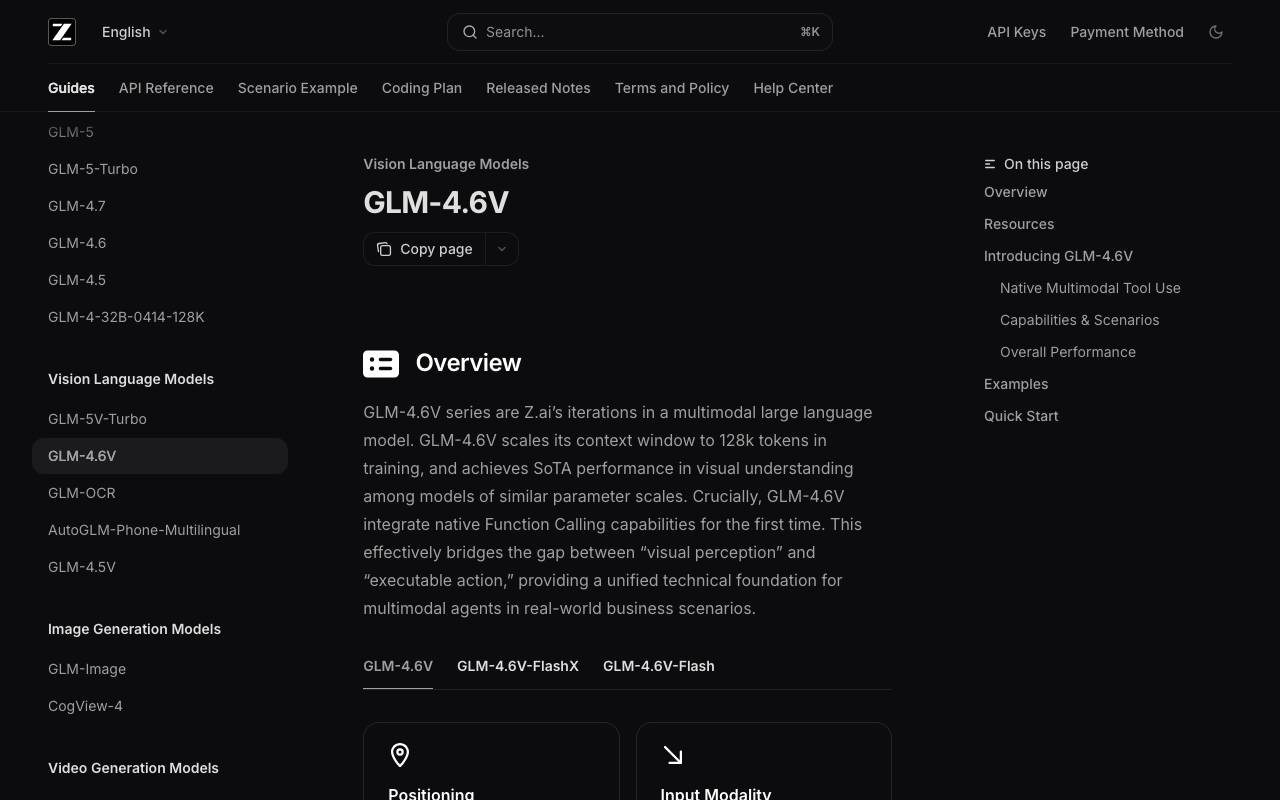
GLM-4.6V is a multimodal large language model that scales its context window to 128k tokens and achieves state-of-the-art performance in visual understanding. It integrates native Function Calling capabilities, enabling a unified technical foundation for multimodal agents in real-world business scenarios. GLM-4.6V can accept multimodal inputs and automatically generate high-quality, structured image-text interleaved content, perform complex document understanding, and perform visual search and retrieval. This model provides several capabilities and scenarios, including intelligent image-text content creation and layout, visual web search and rich media report generation, and long-context understanding. It can accept mixed text-image inputs, generate high-quality content, and perform a visual audit on candidate images. GLM-4.6V's multimodal search-and-analysis workflow enables seamless movement from visual perception to online retrieval and structured report generation. It maintains multimodal context awareness and performs reasoning grounded in both textual and visual information. This model provides several capabilities and scenarios, including intent recognition and search planning, multimodal results alignment, and reasoning with rich media report generation.
Criteria breakdown
- Multimodal input support (images, text, files)
- Native multimodal tool calling
- 128k context length
- Function Calling capabilities
- Long-context understanding
- Visual comprehension and tool retrieval

AMIE
A multimodal AI diagnostic agent that conducts clinical conversations and interprets medical images for accurate diagnoses.
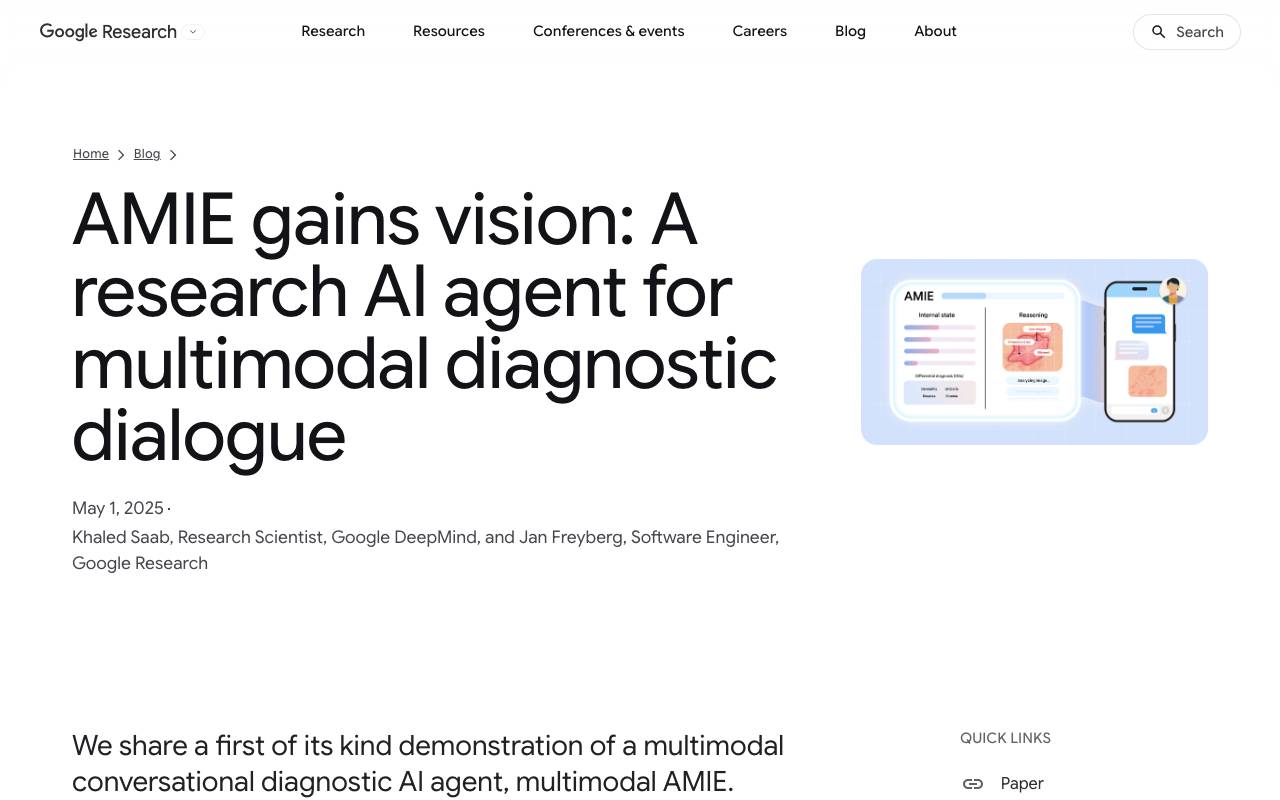
AMIE (Articulate Medical Intelligence Explorer) is a research AI diagnostic agent developed by Google DeepMind and Google Research. It is designed to conduct clinical conversations and interpret medical images for accurate diagnoses. Initially, AMIE was a text-based medical diagnostic conversational AI agent published in Nature. The latest advancement, multimodal AMIE, integrates the ability to intelligently request, interpret, and reason about visual medical information during clinical conversations. This development aims to improve diagnostic accuracy by incorporating multimodal data, such as images and documents, into the diagnostic process. AMIE uses a state-aware reasoning framework and is built on multimodal Gemini models. It has been evaluated through expert assessments, including Objective Structured Clinical Examinations (OSCEs), comparing its performance to primary care physicians (PCPs) in various patient scenarios.
Criteria breakdown
- Multimodal diagnostic dialogue
- Visual medical information interpretation
- State-aware reasoning framework
- Integration with Gemini models
- Simulation environment for dialogue evaluation

Table Agent
AI-powered data assistant for tabular research Automated data gathering on any topic Customizable data schemas AI agent-driven data search
Table Agent is an AI-powered data assistant designed to aid in tabular research. It is intended to automate the process of gathering data on any given topic, making research more efficient. The tool allows for customizable data schemas, which enables users to tailor their data collection to specific needs. This flexibility is beneficial for a wide range of applications and industries where data structure can vary significantly. At the core of Table Agent's functionality is its AI agent-driven data search capability. This means the tool utilizes artificial intelligence to actively seek out and compile relevant data, potentially reducing the time and effort required for manual searches. While the specifics of its workflow and integrations are not detailed, the concept of an AI-driven data assistant suggests it could seamlessly integrate with various data analysis tools, enhancing the overall research process. The strengths of Table Agent would likely include its ability to automate tedious data collection tasks and its adaptability to different data structures. However, without more specific information, it's challenging to determine its limitations or how it compares to alternative data assistant tools.
Criteria breakdown
- Automated data gathering
- Customizable data schemas
- AI agent-driven data search
- Quick and accurate data retrieval