Past battle · 2026-08-01 UTC
LLM Showdown — August 1, 2026
From the LLM category. 14 marks placed across 5 fighters. DeepSeek R1 took the crown.
Final standings



The line-up
The fighters
Profiles of every tool that competed in this battle, ranked by their final score.

DeepSeek R1
An open-source large language model excelling in reasoning, math, and coding tasks with MIT licensing for free use and modification.
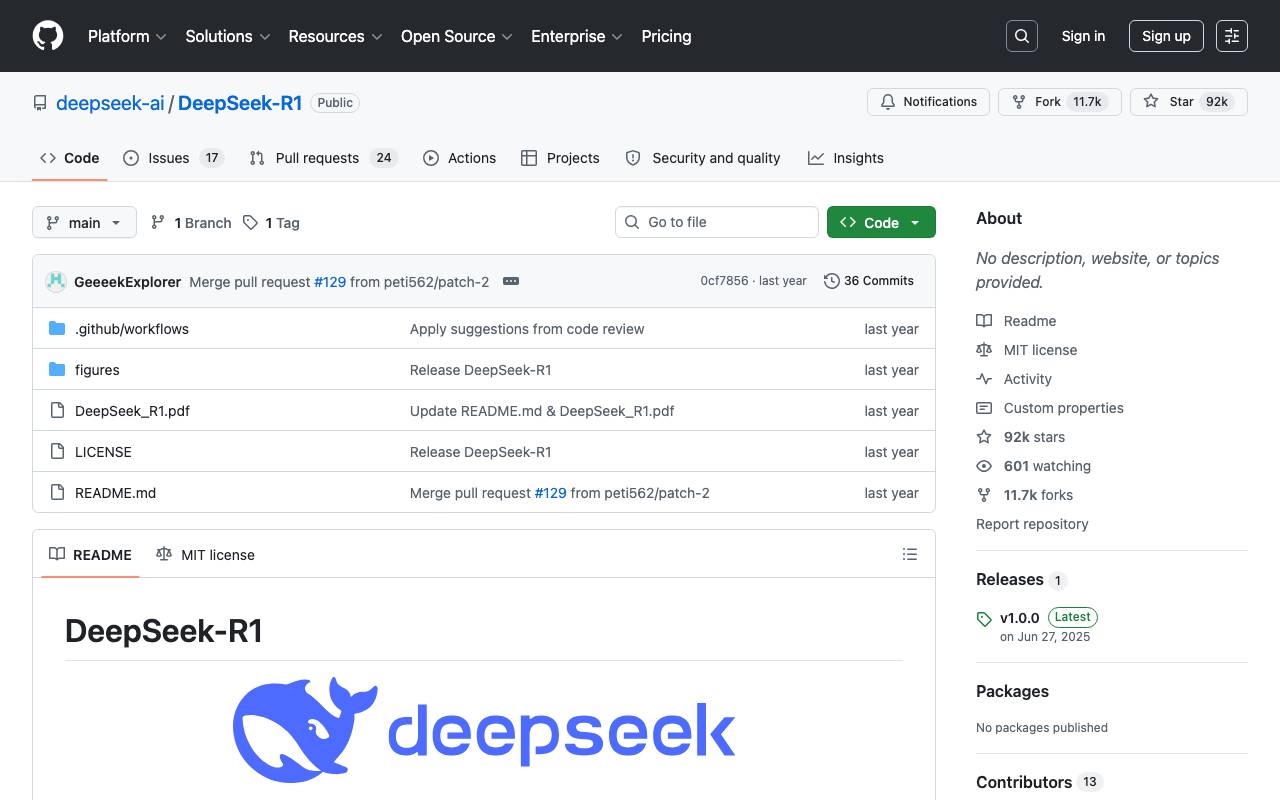
DeepSeek R1 is an open-source large language model that excels in reasoning, math, and coding tasks. It utilizes a Mixture of Experts (MoE) architecture with 37B active parameters and 671B total parameters, supporting 128K context length. The model incorporates advanced reinforcement learning techniques to achieve self-verification, multi-step reflection, and human-aligned reasoning capabilities. DeepSeek R1 has achieved state-of-the-art performance in various benchmarks, including 97.3% accuracy on MATH-500, 79.8% pass rate on AIME 2024, and outperforming 96.3% of Codeforces participants. The model is available in multiple variants, ranging from 1.5B to 70B parameters, and is licensed under MIT for free use and modification. DeepSeek R1 can be used online for free, and a WebGPU-accelerated version can run locally in a browser. The model is designed for complex problem-solving, multilingual understanding, and production-grade code generation. Its strengths include exceptional mathematical reasoning, code generation, and natural language understanding capabilities. However, as an open-source model, it may require technical expertise to deploy and fine-tune for specific use cases. DeepSeek R1 is positioned among the top-performing AI models globally, with capabilities comparable to leading proprietary solutions. Its open-source nature allows for community-driven development and continuous upgrades, including planned multimodal support, conversational enhancement, and distributed inference optimization. The model has a pure reinforcement learning development, which allows it to achieve GPT-4-level math performance at a significantly lower cost. The chain-of-thought visualization capability addresses AI "black box" challenges, providing insights into the model's reasoning process. DeepSeek R1's API offers an OpenAI-compatible endpoint for integration, priced at $0.14 per million tokens. The model's weights are open-source, allowing for commercial use and modification.
- Mixture of Experts (MoE) architecture
- Advanced reinforcement learning techniques
- Self-verification and multi-step reflection capabilities
- Human-aligned reasoning
- Support for 128K context length
- OpenAI-compatible API endpoint

Eye2.AI
Compare answers from top AI models side by side with a single prompt—free, no sign-up.
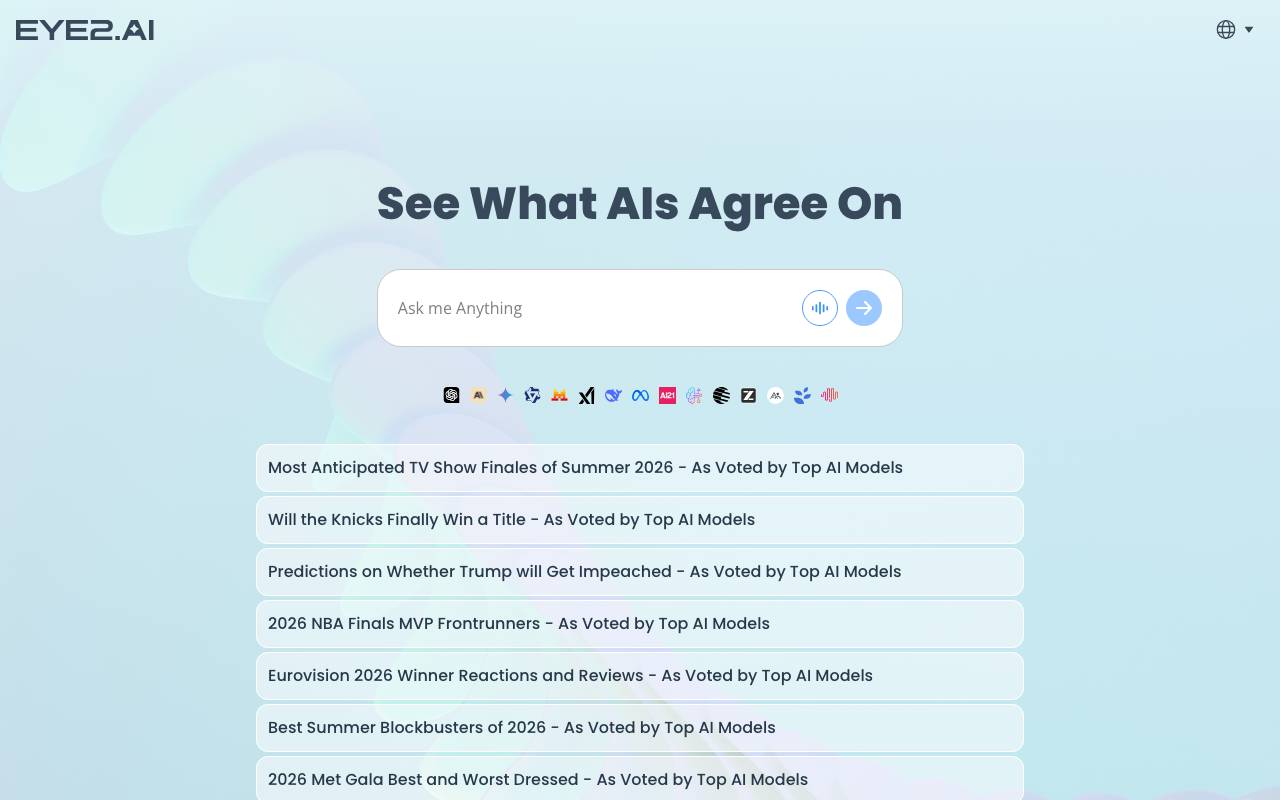
Eye2.AI is a multi-model AI comparison tool that lets users send one prompt to several leading large language models and view their responses side by side. By surfacing differences in tone, accuracy, depth, and reasoning, it helps users decide which model best fits a given task without paying for multiple subscriptions. The service is free to use and requires no account, lowering the barrier for casual experimentation, research, and quick fact-checking across models. It is particularly useful for writers, developers, students, and anyone curious about how different AI systems approach the same question.
- Single-prompt, multi-model querying
- Side-by-side response layout
- Access to top AI models in one place
- No account or login needed
- Free to use
- Quick prompt experimentation workflow

OpenAI o3 is a frontier reasoning model designed to tackle problems that require careful, step-by-step thinking. It builds on the o-series approach of spending more compute at inference time to plan, verify, and refine answers, making it well-suited for tasks in mathematics, coding, science, and logical analysis. Compared to general-purpose chat models, o3 emphasizes depth over speed. It can break down ambiguous prompts, evaluate multiple approaches, and produce more reliable outputs on benchmarks that stress reasoning and tool use. Developers can access it through the OpenAI API and ChatGPT, where it integrates with tools like web browsing, Python, and file analysis. The model is aimed at researchers, engineers, and power users who need stronger accuracy on hard problems and are willing to trade some latency and cost for higher-quality results.
- Extended chain-of-thought reasoning
- Tool use including code, web, and file inputs
- Large context window for long documents
- API and ChatGPT availability
- Improved accuracy on STEM benchmarks
- Supports complex agentic workflows

Pronoia
Arabic-first large language model fine-tuned for native-quality understanding and generation.
Pronoia is a large language model specifically fine-tuned for Arabic, aiming to deliver more accurate comprehension, generation, and reasoning in the language than general-purpose multilingual models. It is positioned as a leading Arabic-focused LLM, with optimizations for dialects, classical forms, and modern standard Arabic. The model can be used for tasks such as content creation, summarization, translation, customer support, and conversational AI in Arabic-speaking markets. By concentrating its training on Arabic data, Pronoia targets nuances like morphology, diacritics, and cultural context that broader models often handle inconsistently.
- Arabic-optimized language model
- Text generation and summarization
- Translation support
- Conversational and chatbot capabilities
- Suited for enterprise Arabic NLP
- Coverage of MSA and dialects

Gemini 2.0 Flash
Google's fast, multimodal AI model built for real-time agentic tasks with a 1M-token context window.
Gemini 2.0 Flash is Google DeepMind's next-generation model optimized for speed, scale, and multimodal reasoning. It accepts text, images, audio, and video as input and can generate text, images, and audio output, making it suitable for rich interactive applications. Designed with agentic workflows in mind, the model supports native tool use, function calling, and a 1M-token context window for handling large documents, codebases, or long-running sessions. Low latency makes it a practical choice for assistants, real-time analysis, and production-scale deployments. Developers can access Gemini 2.0 Flash through the Gemini API, Google AI Studio, and Vertex AI, with SDKs available across major languages.
- 1M-token context window
- Multimodal input: text, image, audio, video
- Native tool calling and code execution
- Real-time streaming responses
- Image and audio generation
- Available via Gemini API and Vertex AI