Past battle · 2025-02-28 UTC
Software Testing (QA) Agents Showdown — February 28, 2025
From the Software Testing (QA) Agents category. 22 marks placed across 6 fighters. CarbonCopies AI took the crown.
Final standings




The line-up
The fighters
Profiles of every tool that competed in this battle, ranked by their final score.

CarbonCopies AI
AI twins mimic user interactions to run automated UX/functional testing and detect bugs in apps/websites.
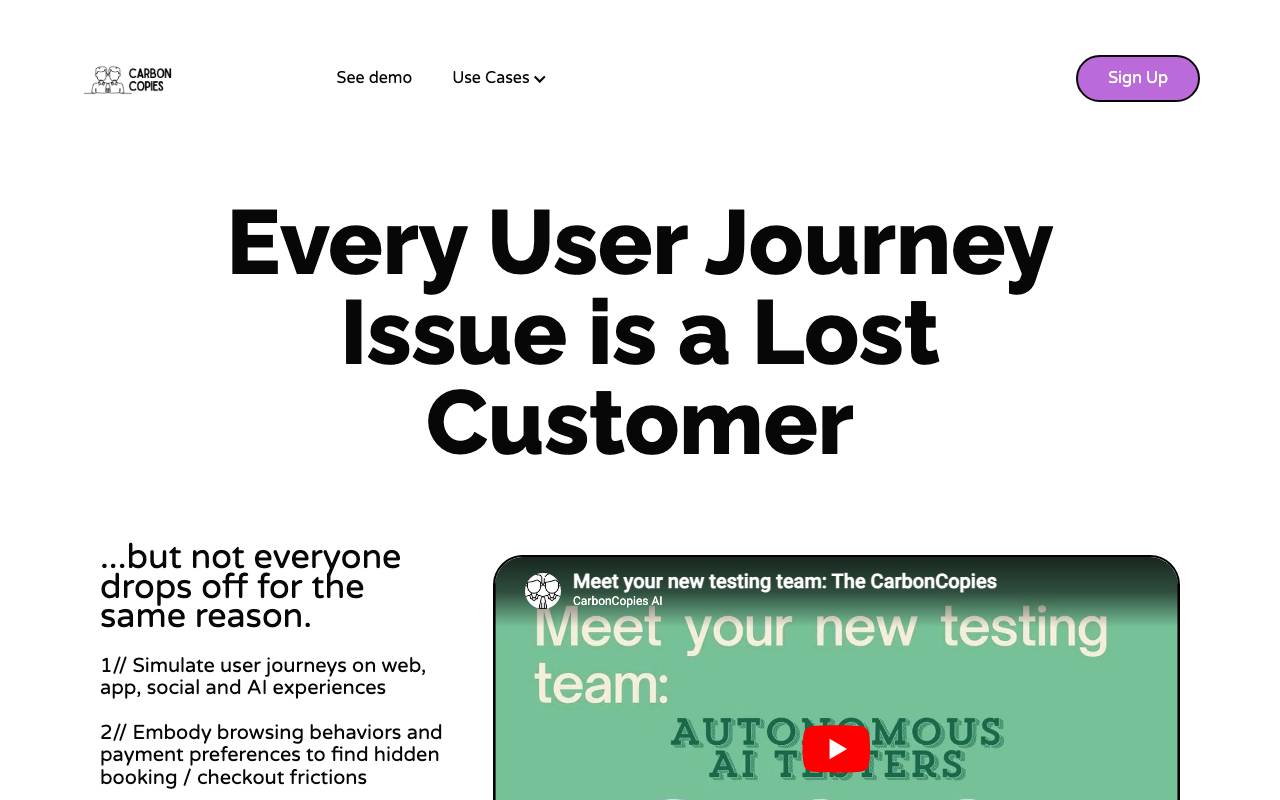
CarbonCopies AI is a tool that utilizes AI twins to mimic user interactions, allowing for automated UX and functional testing of apps and websites. This technology helps detect bugs and identify areas of friction that may cause users to abandon their journey, resulting in lost customers. The tool is designed to simulate user journeys on various platforms, including web, app, social, and AI experiences, and can embody browsing behaviors and payment preferences to find hidden issues. The primary problem that CarbonCopies AI aims to solve is the loss of revenue due to small UX misalignments and conversion roadblocks. These issues can compound over time, leading to significant losses if left unaddressed. The tool is particularly useful for identifying edge cases that may not be immediately apparent through traditional analytics, such as unique drop-off points for different user segments. CarbonCopies AI uses AI personas to replicate the behavior of real user segments, allowing businesses to catch frictions that may cause specific groups to abandon their journey. The tool can simulate various scenarios, including differences in payment preferences, such as BNPL vs. credit card, and loyalty status, such as first-time vs. loyalist buyers. This enables businesses to redesign their flows and lift conversion rates. One of the key features of CarbonCopies AI is its ability to integrate with third-party tools, such as JIRA, Asana, or Linear, and seamlessly exchange data with other business applications. The tool can automatically document screens, create flowcharts, and file bug tickets, all categorized by user persona and customer segments. This makes it an invaluable resource for product and digital teams looking to optimize their websites and apps. The benefits of using CarbonCopies AI are numerous, including the ability to identify and address UI/UX issues that can significantly impact user experience. The tool has been praised by various professionals, including product designers and CEOs, for its ability to deliver unparalleled excellence in optimizing digital platforms and driving engagement and results with precision. Overall, CarbonCopies AI is a powerful tool for businesses looking to streamline their user journey and improve conversion rates.
Criteria breakdown
- Automated user interaction testing
- UX and functional testing capabilities
- Bug detection and notification
- Real-time feedback and reporting
- Integration with development tools for smoother testing

PentAGI
Open-source autonomous penetration testing agents that run 20+ security tools in an isolated Docker sandbox with memory and web intelligence.
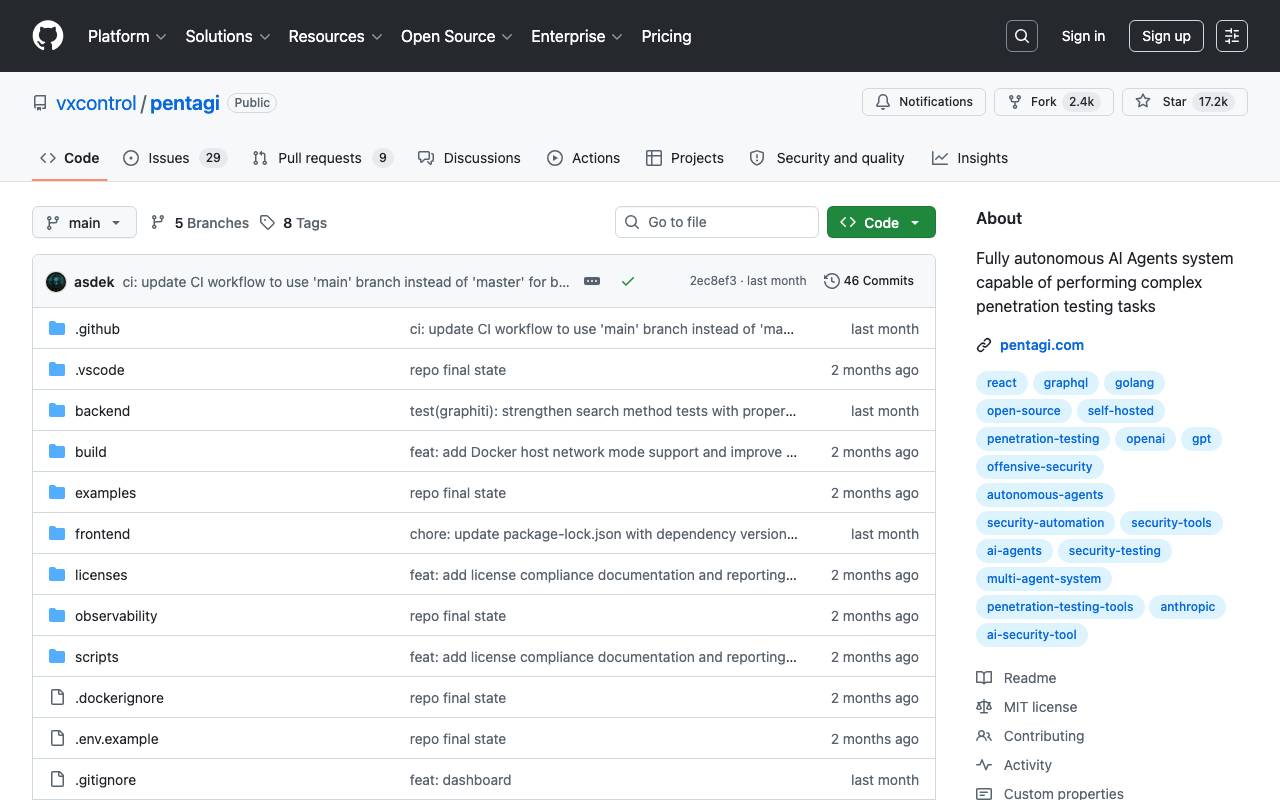
PentAGI is an open-source autonomous penetration testing agent that runs 20+ security tools in an isolated Docker sandbox. It leverages artificial intelligence technologies to automate security testing. The tool is designed for information security professionals and researchers who need a powerful and flexible solution for conducting penetration tests. Key features include a sandboxed environment, automated task planning, and integration with various tools and search systems. PentAGI also offers a delegation system, comprehensive monitoring, and detailed reporting.
Criteria breakdown
- Sandboxed Docker environment
- Built-in suite of 20+ professional security tools
- Smart Memory System for long-term storage
- Knowledge Graph Integration
- Web Intelligence via built-in browser
- External Search Systems integration

Keploy
An open‑source AI agent that auto‑generates and maintains unit, integration, and API tests with mocks.
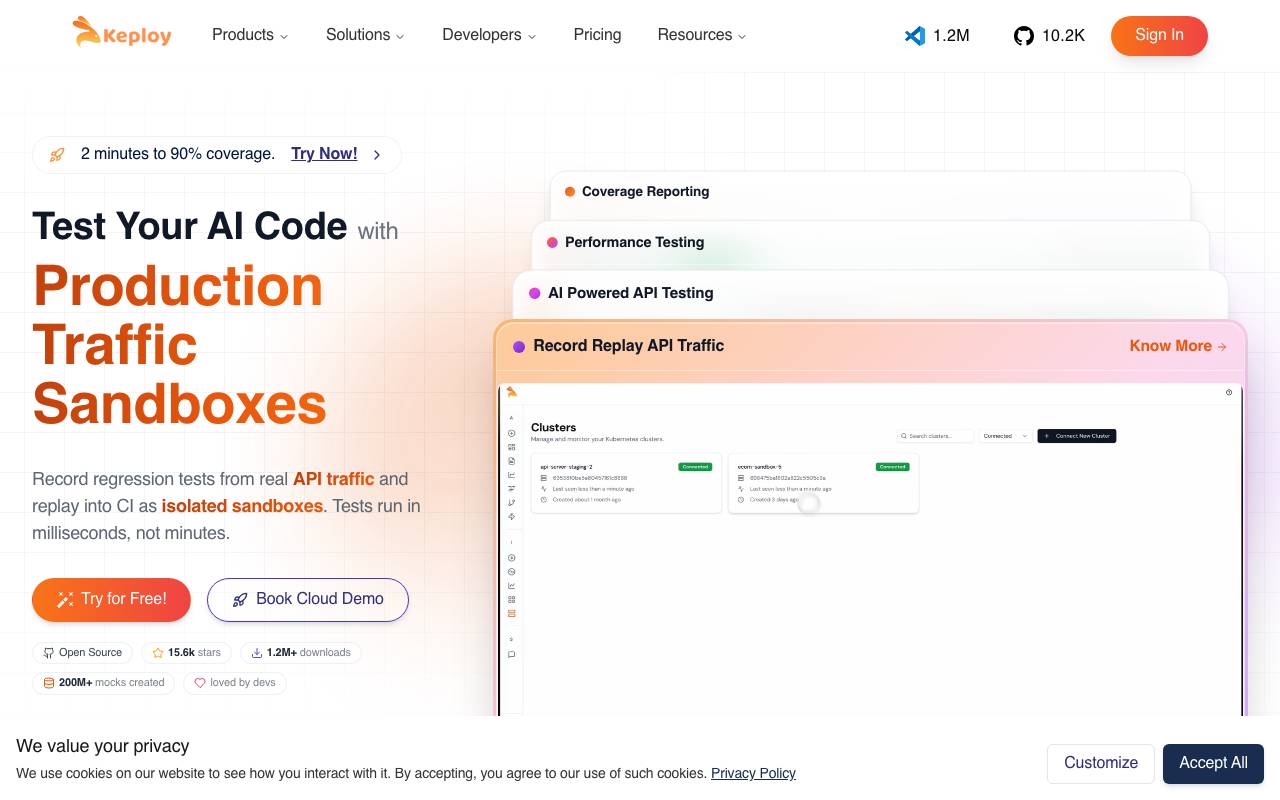
Keploy is an open-source, AI-powered testing platform that captures real API traffic with eBPF and replays it in CI as deterministic regression tests, auto-generated mocks, and production-like sandboxes with zero code changes. It supports any language (Go, Java, Python, Node.js, Rust, PHP, Ruby) and any framework. Advanced features are available through the managed cloud. Keploy offers a free tier where developers can try the platform with 30 test suites/month and 5 AI credits. The platform is also available in a Pro tier ($24 per user/month) and an Enterprise tier with custom support and SOC2/SLAs. The OSS core remains free to self-host indefinitely. The platform allows developers to record regression tests from real API traffic and replay them into CI as isolated sandboxes. This process takes milliseconds, making it much faster than traditional testing methods. Keploy's features include the ability to support any language and framework, generate auto-mocks, and maintain production-like sandboxes with zero code changes.
Criteria breakdown
- Auto-generated mocks
- Production-like sandboxes
- Regression tests
- API traffic capture with eBPF
- Support for any language and framework

Diffblue Cover
An autonomous AI agent that generates and maintains Java unit tests at scale with guaranteed accuracy.
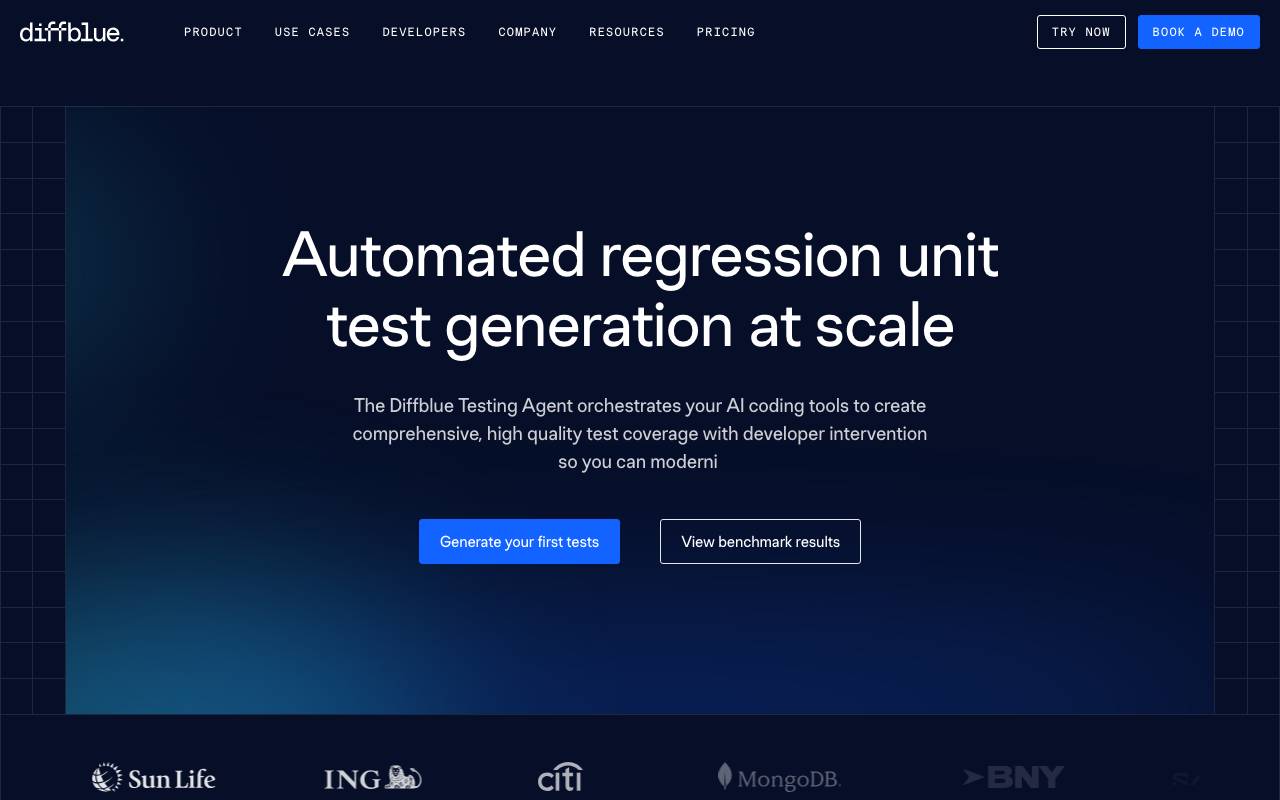
Diffblue Cover is an autonomous AI agent that generates and maintains Java unit tests at scale with guaranteed accuracy. It orchestrates AI coding tools to create comprehensive high-quality test coverage, reducing the need for developer intervention and manual test creation. The agent processes the entire codebase autonomously, including legacy codebases, to produce reliable tests without the need for continuous prompting or context switching. It offers outcome-based pricing that scales with the value generated, making it an attractive solution for enterprises looking to modernize legacy code with confidence.
Criteria breakdown
- Autonomous test generation
- Comprehensive test coverage
- Legacy codebase support
- Outcome-based pricing
- Platform compatibility with AI coding tools

Flowtest AI
AI agent that monitors websites by simulating real user interactions to detect issues and ensure uptime.
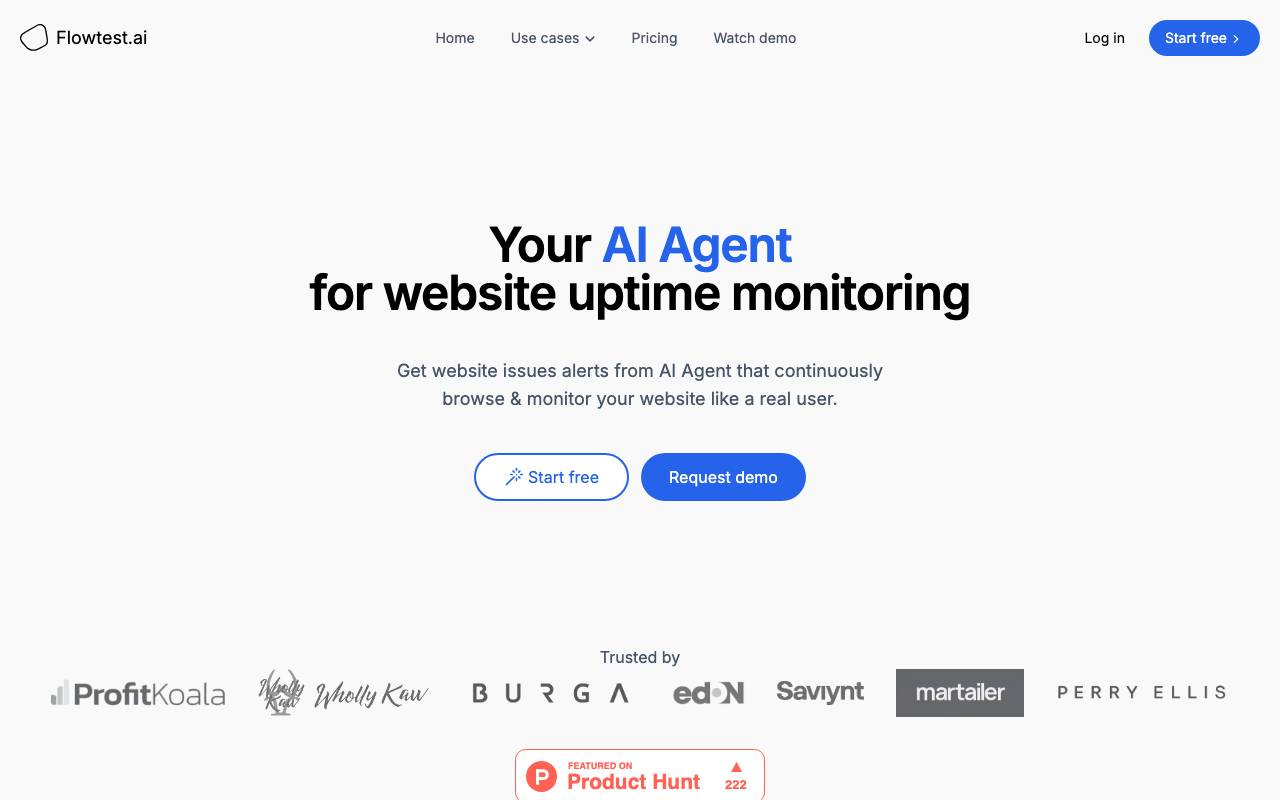
Flowtest AI is an artificial intelligence-powered monitoring tool designed to simulate real user interactions on websites. Its primary function is to detect issues and ensure the uptime of web applications by mimicking the ways users interact with websites. This approach allows for comprehensive testing that goes beyond traditional monitoring methods. Flowtest AI is likely targeted towards businesses and organizations that rely heavily on their online presence, providing them with insights into the performance and reliability of their websites. By identifying potential problems before they affect users, Flowtest AI helps in maintaining a seamless user experience. The tool operates by learning the behavior of real users and then replicating these interactions to test for errors, downtime, or other issues that might impact the user experience. In comparison to other monitoring solutions, Flowtest AI's use of AI to simulate user interactions offers a more nuanced understanding of website performance. However, the specifics of its capabilities and how it compares to other tools in the market are not well-documented. The potential benefits of using Flowtest AI include improved website reliability and performance, enhanced user experience, and proactive issue detection. On the other hand, the limitations and potential drawbacks of Flowtest AI are not clearly understood without more specific information about its features and operational mechanics. Despite this, tools like Flowtest AI represent an innovative approach to website monitoring, highlighting the growing importance of AI in ensuring the quality and reliability of online services.
Criteria breakdown

Skill Scanner
Open-source security scanner that audits AI agent skills for prompt injection and malicious patterns.
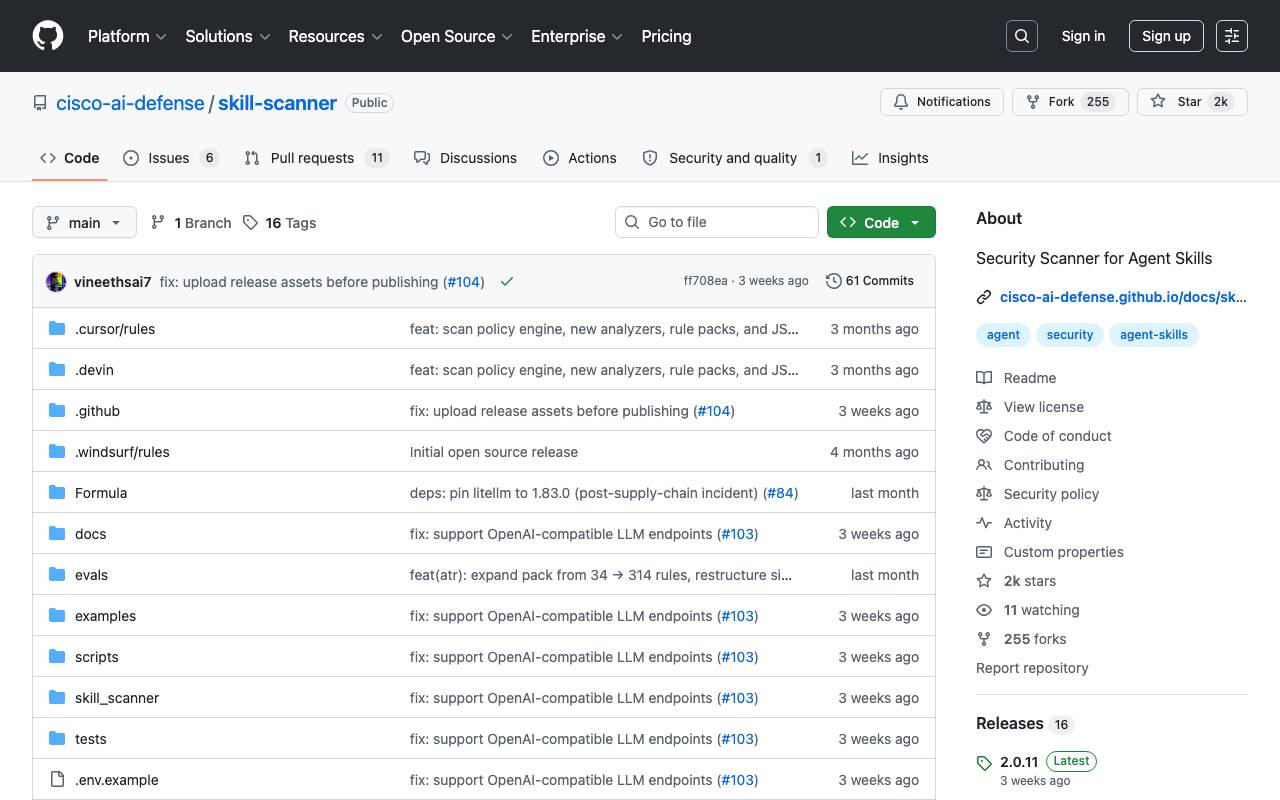
Skill Scanner is an open-source static analysis tool built to inspect AI agent skills and plugins for security risks before they are deployed. It scans skill manifests, instructions, and bundled code for signs of prompt injection, hidden data exfiltration attempts, and suspicious code patterns that could compromise an agent or its users. Results are emitted in SARIF format, making it straightforward to integrate findings into CI pipelines, code review workflows, or security dashboards like GitHub code scanning. Developers and security teams can use it to vet third-party skills, harden their own, and enforce baseline checks across an agent ecosystem. Because the project is open source, rules and detectors can be extended or customized to fit organization-specific threat models and policies.
Criteria breakdown
- Prompt injection pattern detection
- Data exfiltration heuristics
- Malicious code pattern scanning
- SARIF report output
- CI/CD pipeline integration
- Extensible rule set