Past battle · 2025-12-18 UTC
AI Data Analysts Showdown — December 18, 2025
From the AI Data Analysts category. 17 marks placed across 4 fighters. Together Open Data Scientist took the crown.
Final standings



The line-up
The fighters
Profiles of every tool that competed in this battle, ranked by their final score.

Together Open Data Scientist
Open-source ReAct agent that runs Python to explore data, build models, and generate analysis reports
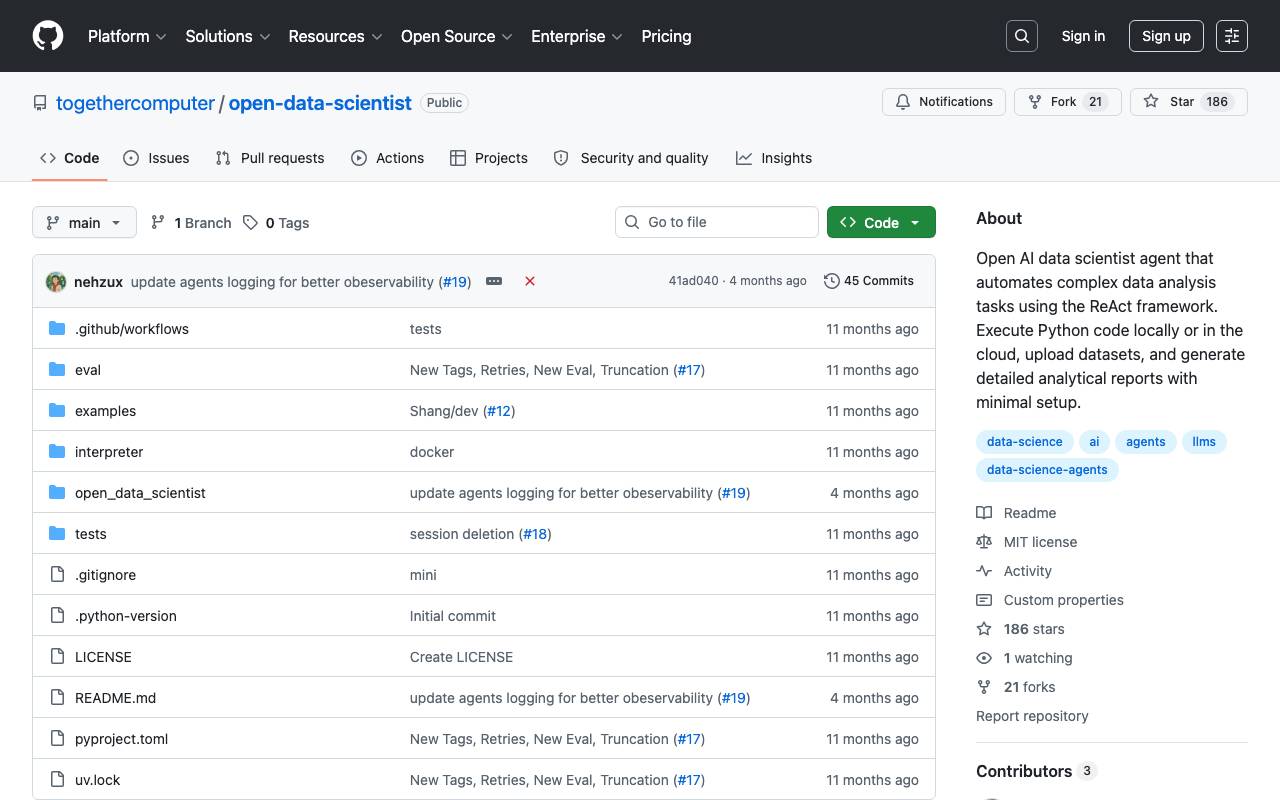
Together Open Data Scientist is an open-source, AI-powered data analysis agent released by Together AI on GitHub. It follows the ReAct (Reasoning + Acting) framework, alternating between language-model reasoning steps and concrete Python code execution to carry out end-to-end data science tasks such as exploring datasets, computing summary statistics, building models, and producing detailed written analysis reports. The agent can execute Python in one of two modes. The "internal" mode runs code locally inside a Docker container, which is suited to single-user local development, while the "tci" mode offloads execution to Together Code Interpreter (TCI), a cloud sandbox accessed through the Together AI API. Users can upload a data directory for automatic ingestion, set a maximum number of reasoning iterations, and pick which underlying model drives the agent — DeepSeek-V3 is the default, but Llama models and others available through Together's platform can be specified. It is distributed as a pip-installable package (open-data-scientist) and exposes both a command-line interface and a Python API. The CLI supports options such as --write-report to generate a Markdown analysis report, --save-trace to log the full query and execution trace, and session reuse via session IDs. The Python API centers on a ReActDataScienceAgent class that takes a natural-language task and returns results. The project is explicitly labeled experimental software. Because all code and analysis are AI-generated, outputs may contain errors or suboptimal approaches and are best treated as a starting point for exploration and learning rather than production decision-making. The maintainers stress that human oversight and validation are required, especially for critical business or research applications. Compared with commercial AI data-analysis assistants like ChatGPT's Advanced Data Analysis or notebook copilots, Together Open Data Scientist is differentiated by being fully open source, self-hostable, model-agnostic within Together's ecosystem, and capable of autonomously chaining many code-execution steps toward a complete report rather than a single one-shot answer.
Criteria breakdown
- ReAct reasoning-and-acting agent loop
- Two execution modes: local Docker or Together Code Interpreter cloud
- Automatic data directory upload for analysis
- Markdown report generation with --write-report
- Configurable model and maximum reasoning iterations
- Command-line interface and programmatic Python API

Shortcut (Excel AI)
AI Excel agent that builds and edits spreadsheets, models, and analyses through chat and a native Excel add-in
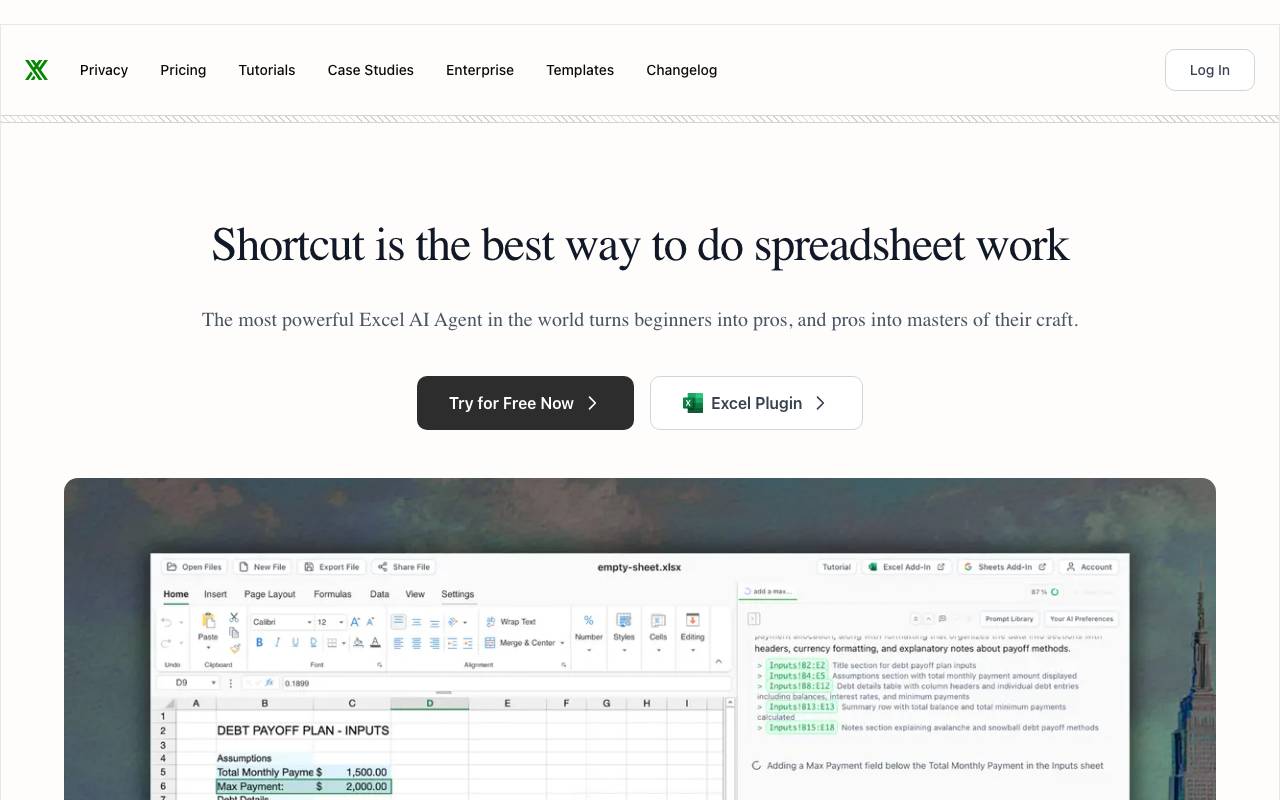
Shortcut is an AI agent purpose-built for spreadsheet work, designed to plan, build, and edit Excel models, analyses, and reports from natural-language instructions. It positions itself for finance professionals — analysts at hedge funds, asset managers, and similar institutions — where accuracy and auditability matter more than raw speed. The company markets it as deployed across large multi-strategy hedge funds and thousands of daily active seats. The tool can be used in two ways: a standalone web application and a native Excel plug-in. The web app is described as offering roughly 95% feature parity with Excel, while the plug-in is meant to deliver full parity by working directly inside the user's existing Excel environment, including macros, keyboard shortcuts, and large files. Files can be opened and exported in Excel format without loss of formatting, formulas, or features, which lowers the friction of fitting it into established workflows. There is also a terminal-first CLI (ShortcutXL) aimed at power users who want to build and edit multiple models in parallel inside desktop Excel. A central design emphasis is correctness. Shortcut claims its outputs are formula-driven rather than hard-coded, so results update dynamically with the underlying data instead of breaking when inputs change. It applies professional-grade formatting and is built to place edits precisely without overwriting existing data — a common failure mode of generic AI spreadsheet tools. The company points to SpreadsheetBench results and a reported 90% win rate against first-year analysts in head-to-head challenges as evidence of its accuracy claims. Auditability and trust are framed as first-class concerns. Shortcut shows every changed cell, indicates which values are hard-coded and why, and lets users revert, restore, or undo any step in the action sequence. On security, it advertises SOC 2 Type II compliance, AES-256 encryption at rest and TLS 1.3 in transit, role-based access controls, zero-retention agreements with its AI providers, and a policy that paid-plan data is never used for model training. Compared with general-purpose assistants like ChatGPT, Claude, or Microsoft Copilot in Excel, Shortcut is narrowly specialized for spreadsheet construction and claims meaningfully higher accuracy on benchmark tasks. Its differentiation rests on Excel-native operation, formula-driven outputs, and the auditability features that institutional finance users require. The trade-off of that specialization is a tight focus on Excel-centric finance and data work rather than broad office productivity, and many of its performance claims are vendor-reported benchmarks that prospective buyers will want to validate against their own workflows.
Criteria breakdown
- Native Excel plug-in plus standalone web app
- ShortcutXL terminal-first CLI for power users
- Formula-driven, dynamically updating outputs
- Cell-level change auditing with revert/restore/undo
- Professional industry-standard formatting
- Lossless Excel file import and export


Trinka AI is a writing assistant designed specifically for researchers, students, and technical professionals. Beyond standard grammar and spelling checks, it focuses on the conventions of scholarly writing, flagging issues like inconsistent terminology, unclear sentence structure, and tone problems common in academic manuscripts. The tool offers subject-aware suggestions across hundreds of disciplines and can help with tasks such as paraphrasing, consistency checks, and ensuring compliance with publication style guides. It integrates with Microsoft Word, browsers, and through cloud editors, making it usable across typical research workflows. Trinka also includes specialized features for manuscript preparation, such as journal-readiness checks, plagiarism detection, and citation verification, positioning it as more than a general-purpose grammar checker.
Criteria breakdown
- Advanced grammar and style checks
- Academic tone and clarity enhancements
- Paraphrasing and consistency tools
- Plagiarism and citation checking
- Journal submission readiness reports
- Browser, Word, and cloud integrations

Edexia
AI grading and feedback assistant for IB English and Australian curricula, trained on teachers' own marking standards
Edexia is an AI-powered grading and feedback assistant built specifically for secondary English assessment, with a primary focus on the International Baccalaureate (IB) English curriculum and Australian senior frameworks including VCE, HSC, QCE and WACE. Rather than offering generic essay scoring, it pre-loads the relevant rubrics, grade descriptors and study-design requirements, and is continuously trained and validated by a team of experienced educators against real marking standards. The tool's core premise is that AI grading should be calibrated to the way individual teachers and departments actually mark. Teachers blind-grade scripts, align their judgments in calibration meetings, and the system learns from this process so that its draft grades and feedback increasingly match a school's standards. According to the company, in a trial across 579 essays at St Bernard's College, Edexia matched teacher grades exactly 81.2% of the time and fell within one mark band 98.3% of the time. A central design principle is keeping teachers in control. Every AI-generated comment can be edited, rewritten or deleted before reaching a student, teachers can attach personal voice notes to feedback, and a teacher-review mode holds all output until a human reviews and releases it. This positions Edexia as an AI scribe and assistant that drafts detailed feedback for teachers to refine, rather than an autonomous grader. Beyond grading, the platform bundles a range of classroom workflow tools: AI detection with a replay of a student's writing process (showing pastes, tab-offs and AI-likelihood scores), cross-submission reports summarising each student's strengths and next steps, a searchable prompt and stimulus library, blind grading and moderation features with visualised score spreads, and handwriting transcription for scanned responses. It also builds per-text knowledge bases of themes, authorial intent and key quotes for works on the IB study list. For students, Edexia enables a rapid write–feedback–rewrite cycle, allowing them to draft an essay, receive instant feedback, and revise within a single evening. For teachers and departments, the emphasis is on time savings on marking and on improving consistency through moderation and calibration. The company stresses privacy and data governance: training data is siloed to individual or institutional accounts, remains the account holder's intellectual property, and is not used to train Edexia's models. Data is de-identified and stored on Australian-based servers, and the company holds SOC 2 Type II certification, ISO 27001 and ST4S accreditation. As of the captured site, Edexia is offered free to teachers and students with a waitlist, and it is narrowly scoped — strongest for IB and Australian English rather than a general-purpose grader across all subjects.
Criteria breakdown
- IB-aligned rubrics and grade descriptors with educator validation
- Teacher review mode with full editing and voice notes
- AI writing-process replay and AI-likelihood detection
- Blind grading, moderation and calibration analytics
- Prompt and stimulus library searchable by text, theme and command term
- Handwriting transcription of scanned responses