Past battle · 2025-09-24 UTC
Software testing Showdown — September 24, 2025
From the Software testing category. 31 marks placed across 10 fighters. KushoAI took the crown.
Final standings






The line-up
The fighters
Profiles of every tool that competed in this battle, ranked by their final score.
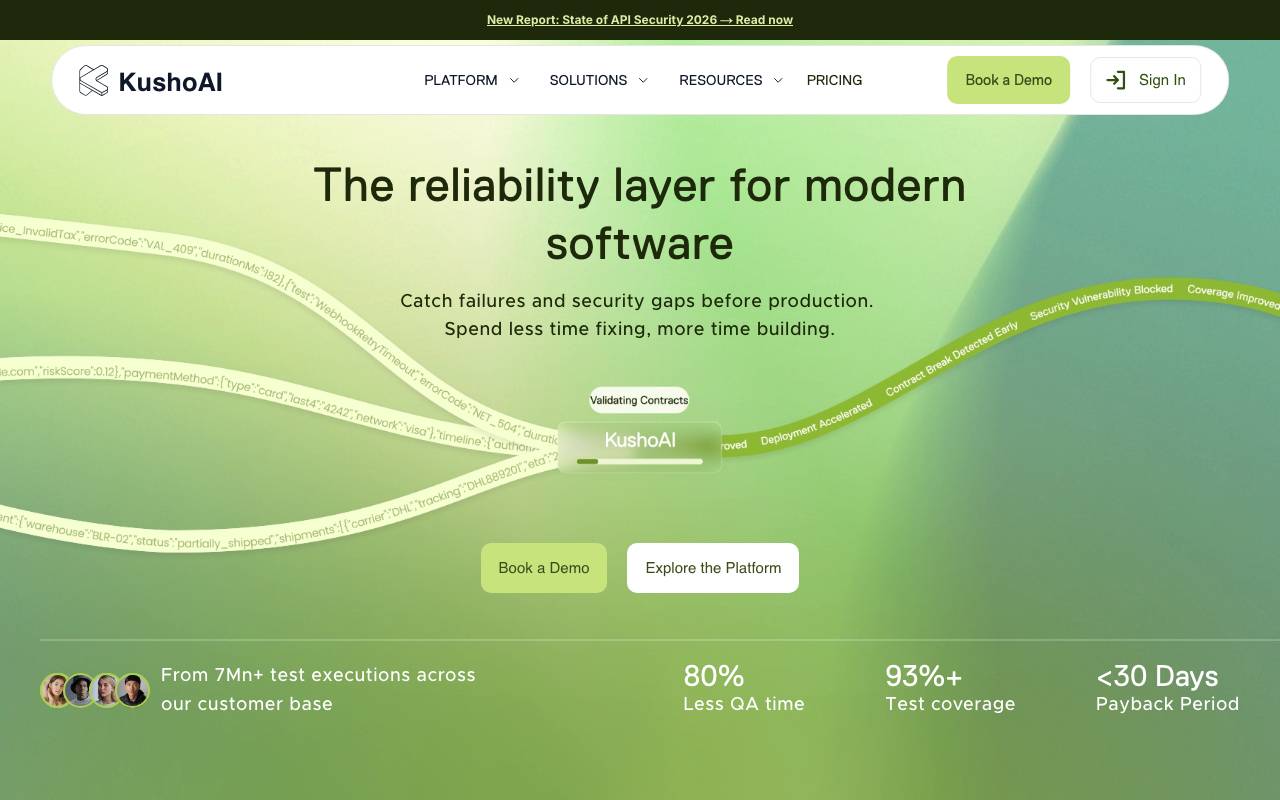
KushoAI is an AI-powered testing assistant designed to help developers and QA teams generate, run, and maintain API test suites without writing them by hand. By analyzing endpoints and request patterns, it produces exhaustive test cases covering edge conditions, validation failures, and unexpected payloads. The tool integrates into existing development workflows, allowing teams to surface bugs earlier in the cycle and reduce the manual effort traditionally required for thorough API coverage. Test runs produce clear reports highlighting failures, regressions, and potential issues that warrant investigation. KushoAI is aimed at engineering teams that want to shorten release cycles, improve reliability, and offload repetitive test-writing tasks to an AI agent while retaining control over what gets tested.
Criteria breakdown
- AI-generated API test suites
- Edge case and negative test coverage
- Automated test execution and reporting
- Bug detection and regression checks
- Integration with developer workflows
- Exportable test artifacts

Latta AI is a developer-focused tool that scans codebases to automatically identify bugs and suggest or apply fixes. It aims to shorten debugging cycles by surfacing root causes quickly rather than just flagging symptoms. Designed to integrate into existing development workflows, Latta AI helps teams catch issues earlier, reduce time spent on manual troubleshooting, and ship more reliable software. It works across common languages and frameworks, making it useful for both solo developers and engineering teams.
Criteria breakdown
- Automatic bug detection
- AI-generated fix recommendations
- Root cause analysis
- Workflow and IDE integration
- Support for multiple languages
- Continuous code monitoring

Nogrunt API Tester
AI-assisted API testing that turns plain-language intent into automated request suites.
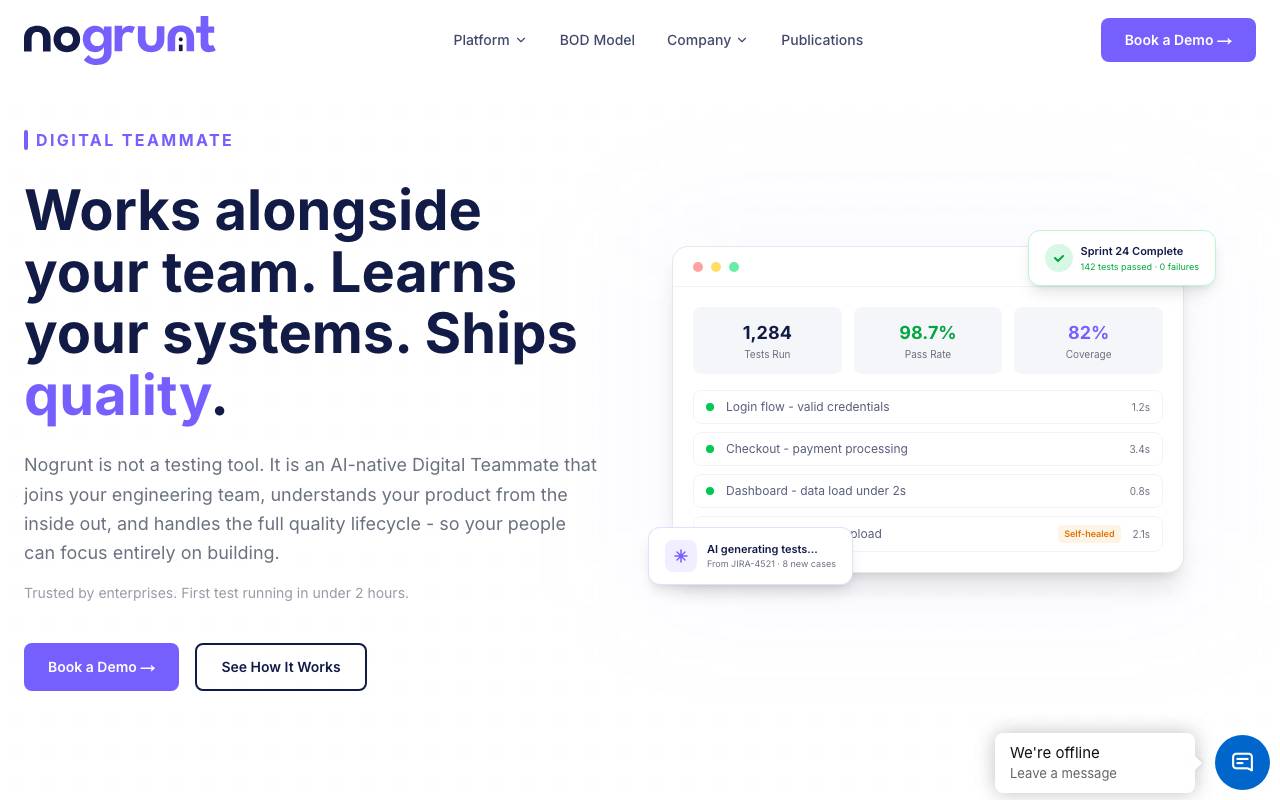
Nogrunt API Tester is an automation tool designed to streamline the process of building, running, and maintaining API test suites. It uses AI to interpret endpoint specs and natural-language descriptions, generating request flows, assertions, and edge-case checks without requiring testers to hand-write every scenario. The tool is aimed at backend developers, QA engineers, and small teams who need reliable API coverage but want to skip the boilerplate of traditional testing frameworks. It supports common authentication patterns, chained requests, and environment-based configuration, making it usable for both quick exploratory checks and scheduled regression runs. Results are presented with clear pass/fail breakdowns and diagnostic detail, helping users quickly trace failures back to specific requests or response fields.
Criteria breakdown
- AI-generated test cases from endpoint specs
- Support for auth flows and tokens
- Chained multi-step request scenarios
- Environment and variable management
- Detailed run reports with diff views
- Scheduling for regression runs
Posium is an AI-powered testing platform that uses autonomous agents to create, run, and maintain automated tests for web and mobile applications. Instead of writing brittle scripts, teams describe test scenarios in natural language and let the agents interact with the application like a human tester. The platform aims to reduce the engineering overhead typically associated with QA automation. By interpreting UI changes intelligently, Posium helps cut down on flaky tests and constant maintenance, allowing teams to ship faster with greater confidence in release quality.
Criteria breakdown
- AI agents for autonomous test execution
- Natural language test authoring
- Cross-platform support for web and mobile
- Self-healing tests that adapt to UI changes
- Automated test maintenance and updates
- Faster QA cycles for CI/CD workflows
AutoQA
AI agents that automatically test your software and catch flaky UI bugs before users do.
AutoQA uses AI agents to autonomously explore and test web and mobile applications, simulating real user behavior across critical flows. Instead of writing and maintaining brittle scripts, teams describe what to test in plain language and let the agents handle execution, regression checks, and reporting. The platform focuses on reducing flaky UI failures by adapting to interface changes, retrying intelligently, and distinguishing real defects from transient issues. Results are surfaced with screenshots, traces, and reproduction steps to speed up debugging. AutoQA fits into existing CI/CD pipelines, making it suitable for engineering teams that want broader test coverage without the maintenance overhead of traditional end-to-end frameworks.
Criteria breakdown
- Autonomous AI testing agents
- Natural language test authoring
- Self-healing selectors
- CI/CD integration
- Visual and functional regression checks
- Detailed failure traces and screenshots

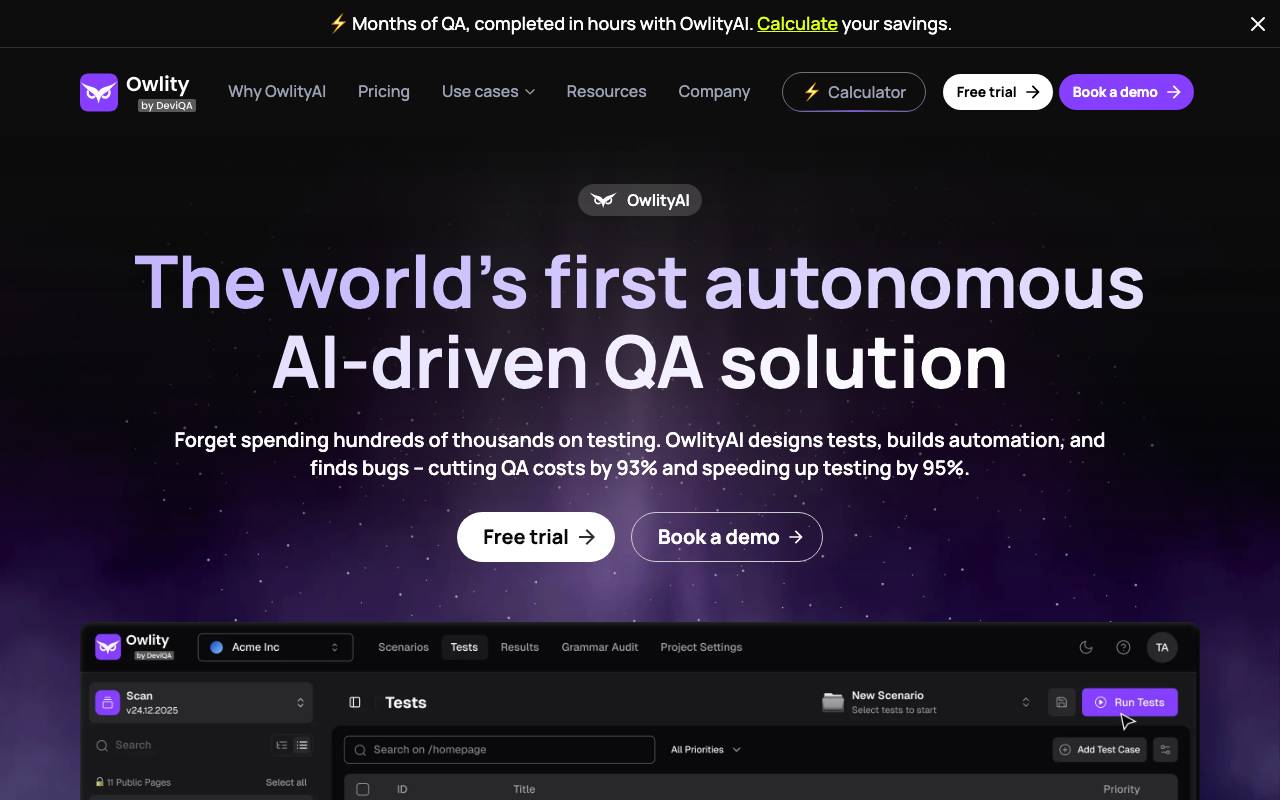
Owlity is an autonomous quality assurance solution that uses AI to explore, test, and validate web applications without requiring teams to write or maintain traditional test scripts. It aims to reduce the engineering overhead typically associated with QA by handling test generation, execution, and reporting automatically. The platform is designed for product, engineering, and QA teams that want continuous coverage of their applications as features evolve. By automating discovery and regression checks, Owlity helps catch issues earlier in the development cycle and frees human testers to focus on more complex, exploratory work.
Criteria breakdown
- Autonomous AI test generation
- Self-maintaining test coverage
- Automated bug detection and reporting
- Continuous QA monitoring
- Integration with development workflows
Bismuth is an autonomous AI agent designed to scan codebases, detect bugs, and automatically ship tested fixes. It addresses the problem of timely bug detection and efficient bug fixing, particularly in complex software projects. Bismuth is geared towards software development teams and organizations, aiming to streamline their debugging processes. Bismuth operates by analyzing codebases using artificial intelligence and machine learning algorithms to identify potential bugs and vulnerabilities. Once detected, the AI agent generates and tests fixes, ensuring that the codebase remains stable and secure. However, the specifics of its workflow and integrations remain unclear, making it difficult to directly compare it to alternative tools in the market. As of my understanding, Bismuth's strengths lie in its automated debugging capabilities, while its limitations include potential issues with AI model accuracy and codebase complexity. Further evaluation is necessary to fully assess its effectiveness in real-world scenarios.
Criteria breakdown
- Automated codebase scanning for bugs
- AI-generated patches with test verification
- Pull request creation for review
- Integration with source control systems
- Continuous monitoring of repositories
- Support for multiple programming languages

Credit Card Generator
Generate customizable random credit card numbers for testing and development.
Credit Card Generator (RandomoCard) is a utility that produces randomized, syntactically valid credit card numbers intended for software testing, form validation, and educational purposes. Users can customize parameters such as card type, prefix, or quantity to generate test data tailored to their needs. The tool is aimed at developers, QA engineers, and students who need placeholder card numbers to verify payment forms, Luhn-check algorithms, or e-commerce workflows without using real financial data. Generated numbers are not linked to real accounts and cannot be used for actual transactions.
Criteria breakdown
- Random credit card number generation
- Customizable card parameters
- Bulk generation support
- Luhn algorithm compliance
- Multiple card brand formats
- Developer-friendly output

TestDriver.ai
AI QA agent that adds end-to-end test coverage across web, mobile, and desktop apps
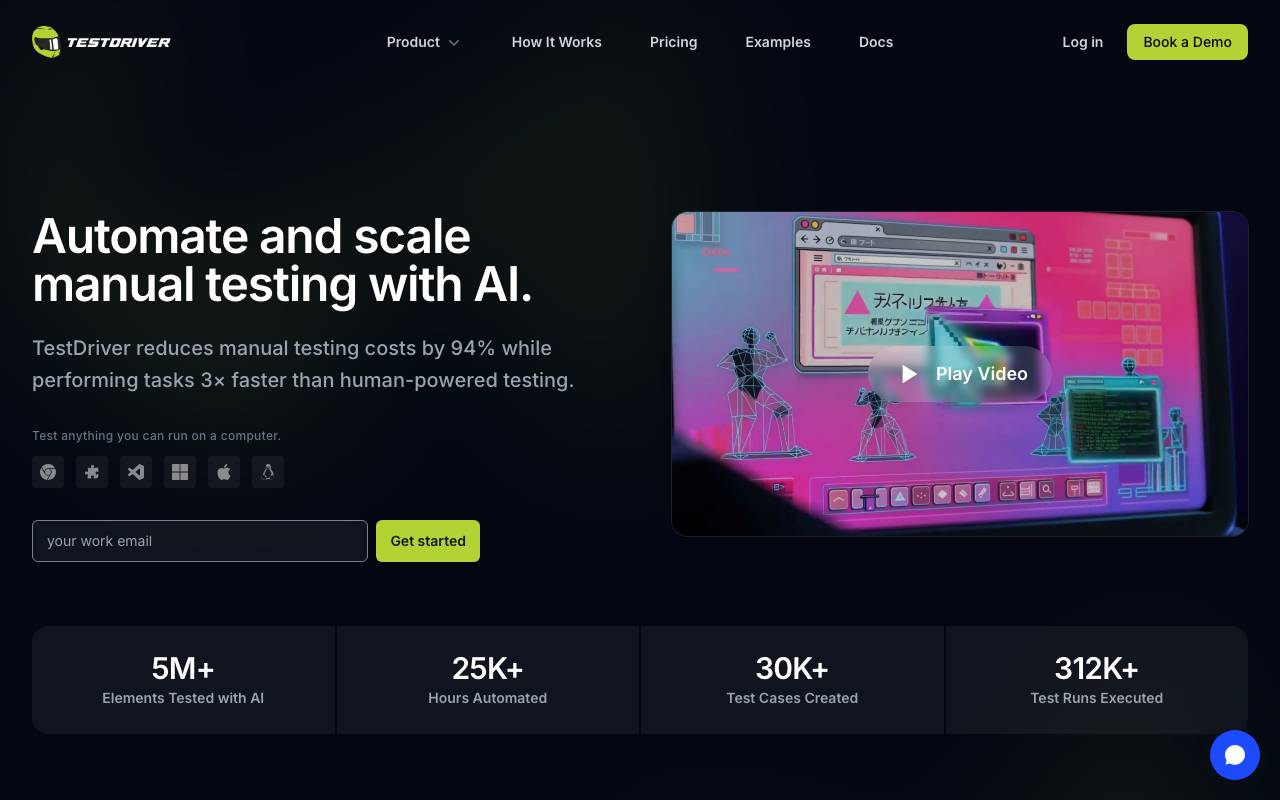
TestDriver.ai is an AI-powered quality assurance agent designed to help teams generate and run automated tests without writing extensive scripts. It interacts with applications the way a human tester would, exploring interfaces and creating coverage for web, mobile, and desktop targets. The tool aims to lower the barrier to comprehensive testing by letting engineers describe scenarios in natural language while the agent handles execution, assertions, and reporting. This makes it useful for fast-moving teams that want regression coverage without dedicated QA scripting. TestDriver fits into CI workflows and can flag regressions, visual changes, or broken flows as part of the development cycle.
Criteria breakdown
- AI QA agent for cross-platform testing
- Natural language scenario definitions
- Automated regression detection
- CI/CD integration
- Visual and functional assertions
- Coverage reporting

CodeBeaver
Automated unit testing and bug detection that keeps your test suite healthy on autopilot.
CodeBeaver is an AI-powered tool that generates, maintains, and updates unit tests for your codebase so engineering teams can ship faster without sacrificing coverage. It integrates into existing development workflows to write new tests as code evolves and to refresh outdated ones when implementations change. Beyond writing tests, CodeBeaver actively reviews code to surface potential bugs and edge cases that developers may overlook. By automating the repetitive parts of testing, it helps teams catch regressions earlier and focus their attention on building features rather than maintaining test infrastructure.
Criteria breakdown
- AI-generated unit tests
- Automatic test maintenance on code updates
- Bug and regression detection
- Repository and pull request integration
- Coverage tracking and improvement suggestions
- Support for popular testing frameworks