Past battle · 2026-06-29 UTC
Workflow Automation Agents Showdown — June 29, 2026
From the Workflow Automation Agents category. 7 marks placed across 3 fighters. Copado DevOps Automation Agent took the crown.
Final standings



The line-up
The fighters
Profiles of every tool that competed in this battle, ranked by their final score.

Copado DevOps Automation Agent
An AI DevOps agent for Salesforce teams that automates deployments, testing, and compliance checks across release workflows.
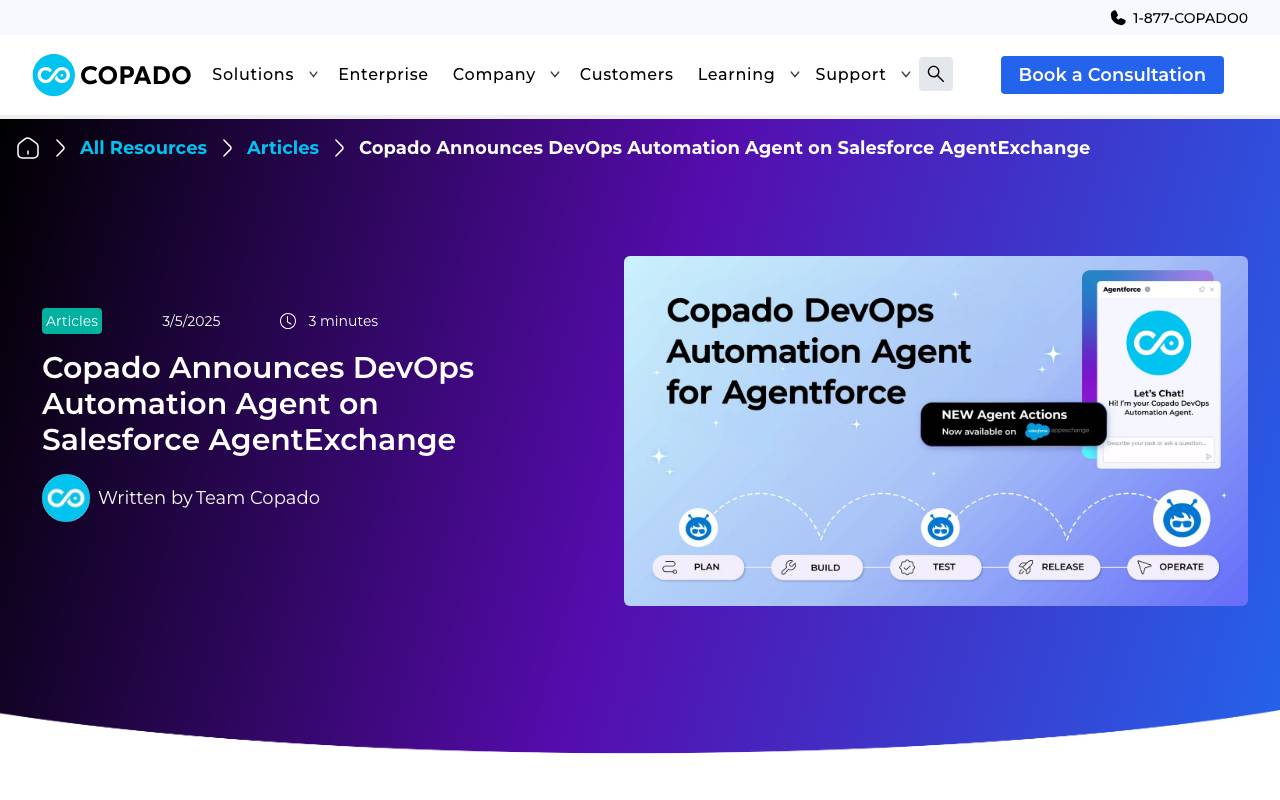
The Copado DevOps Automation Agent is an AI-powered DevOps tool designed for Salesforce teams, aiming to automate deployments, testing, and compliance checks across release workflows. It is built on more than a decade of DevOps expertise and is integrated into the Salesforce user interface. The agent combines the capabilities of the Copado AI platform into a single solution, guiding Salesforce developers and release managers through the entire software lifecycle. By leveraging AI, the Copado DevOps Automation Agent streamlines the DevOps process, offering intelligent automation for user story creation, release management, and deployment troubleshooting. This makes it easier to build and deploy applications on the Salesforce platform faster and with better quality. The agent is available on Salesforce's AgentExchange, a global ecosystem marketplace, and can also be found inside the Salesforce Agent Builder. This integration simplifies the discovery of partner-built agent actions and allows for guided exploration and instant expertise implementation. The Copado DevOps Automation Agent addresses critical pain points for developers and release managers, such as predicting deployment risks, resolving conflicts, and automating quality checks. It empowers teams to build faster, reduce deployment errors, and accelerate innovation while improving quality and productivity. In comparison to other DevOps tools, the Copado DevOps Automation Agent stands out with its AI-powered capabilities and seamless integration into the Salesforce ecosystem. However, its effectiveness may depend on the complexity of the projects and the specific needs of the teams. The agent's capabilities and limitations suggest that it is a powerful tool for Salesforce teams looking to improve their DevOps processes. While it offers significant advantages, it may not be suitable for all teams or projects, and its adoption should be carefully considered.
Criteria breakdown
- Intelligent Sprint Planning
- Automated Release Notes
- Test Automation
- AI-powered insights for deployment troubleshooting
- User story creation automation
- Release management automation

SRE.ai
An AI-powered DevOps platform where agents automate CI/CD workflows, incident detection, and context-driven recommendations.
SRE.ai is an AI-powered DevOps platform designed to automate CI/CD workflows, incident detection, and context-driven recommendations. It unifies control in a singular Command Center, allowing for streamlined collaboration and seamless integration across different environments. The platform is built to predict and prevent errors, de-risk deployments, and prepare for continuity and protect against loss. SRE.ai is intended for enterprise teams, particularly those building on platforms like Salesforce, ServiceNow, and Oracle. The platform provides a range of features to support DevOps teams, including auto-generating documentation from actions and changes, real-time guidance for clean and maintainable code, and automated testing and release orchestration. It also offers proactive issue detection and resolution, as well as intelligent safety nets to identify compliance issues and policy violations. SRE.ai aims to accelerate innovation by automating delivery and ensuring that work flows seamlessly between team members, regardless of their location or time zone. The platform processes and organizes incoming engineering processes, flagged bugs, deployment requests, and other DevOps elements to provide organized intelligence. One of the key benefits of SRE.ai is its ability to simplify complex enterprise systems, making it easier for teams to manage and maintain their systems without sacrificing reliability. The platform is backed by leading investors, including Salesforce Ventures, and is built by engineers for engineers. Overall, SRE.ai is a powerful tool for enterprise DevOps teams looking to automate and streamline their workflows, improve collaboration and communication, and reduce the risk of errors and downtime. SRE.ai's features and capabilities make it an attractive solution for teams looking to improve their DevOps practices and accelerate innovation. However, as with any complex platform, there may be a learning curve and potential limitations to consider. In terms of comparisons to alternative solutions, SRE.ai's focus on AI-powered automation and context-driven recommendations sets it apart from other DevOps platforms. Its ability to unify control in a singular Command Center and provide real-time guidance and proactive issue detection also make it a unique solution in the market. The platform's strengths include its ability to simplify complex systems, automate workflows, and provide intelligent safety nets. However, potential limitations may include the need for significant upfront investment, potential integration challenges with existing systems, and the potential for over-reliance on automation. Overall, SRE.ai is a powerful tool for enterprise DevOps teams looking to improve their workflows, accelerate innovation, and reduce risk. Its unique features and capabilities make it an attractive solution for teams looking to streamline their DevOps practices and improve collaboration and communication.
Criteria breakdown
- Auto-generate documentation from actions and changes
- Real-time guidance for clean and maintainable code
- Automated testing and release orchestration
- Proactive issue detection and resolution
- Intelligent safety nets for compliance and policy issues
- Seamless integration across different environments

String.com
A prompt‑driven AI agent builder that writes, runs, edits, and deploys agents via code in seconds.
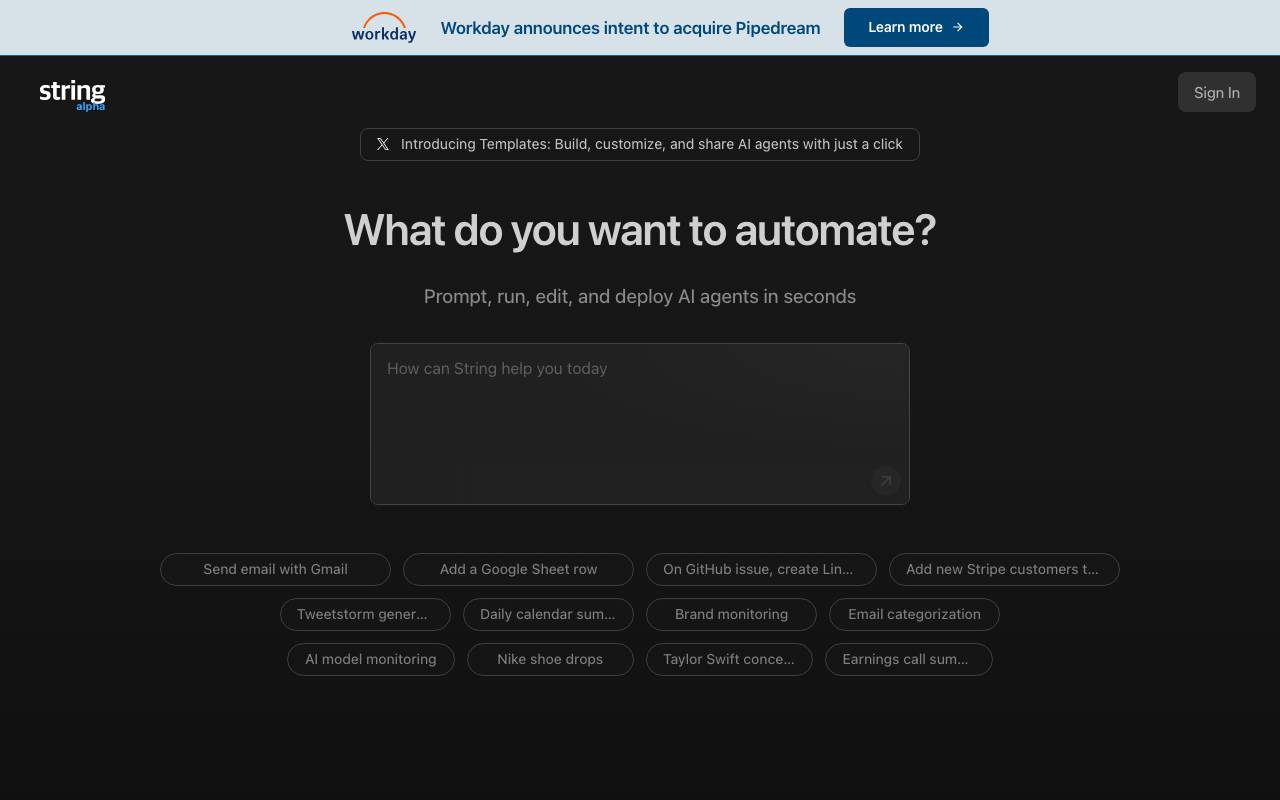
String.com is likely a platform designed to simplify the process of creating and deploying AI agents. It is probably geared towards developers and organizations seeking to automate tasks and workflows using artificial intelligence. The platform may utilize a prompt-driven approach, allowing users to define the behavior and capabilities of their AI agents through natural language inputs. This could enable rapid development and deployment of custom AI solutions, potentially integrating with various systems and services to enhance their functionality. String.com might provide a user-friendly interface for editing and refining agent code, as well as tools for monitoring and managing deployed agents. As an AI agent builder, it may support a range of applications, from chatbots and virtual assistants to more complex automation systems. The platform's goal is to streamline the development process, making it more accessible to a broader range of users, including those without extensive experience in AI or software development. By providing a straightforward way to create and deploy AI agents, String.com could help organizations leverage the benefits of artificial intelligence more efficiently. The platform's capabilities and features are likely designed to accommodate a variety of use cases, from customer service and support to data analysis and process automation. Overall, String.com seems to be a tool aimed at democratizing access to AI technology and facilitating the creation of custom AI-powered solutions. It may offer a range of tools and features to support the entire lifecycle of AI agent development, from initial creation to ongoing maintenance and refinement. The platform's prompt-driven approach could be particularly useful for users who are new to AI development, as it allows them to define the behavior of their agents using natural language. This could make it easier for non-technical users to create custom AI solutions, although it may also introduce some limitations in terms of the complexity and nuance of the agents that can be created. Additionally, the platform's focus on rapid development and deployment may prioritize speed and ease of use over more advanced features and capabilities. As a tool for building and deploying AI agents, String.com is likely to be compared to other platforms and frameworks that offer similar capabilities. Its unique features and strengths may lie in its user-friendly interface, prompt-driven approach, and rapid deployment capabilities. However, it may also face competition from more established players in the field, and its long-term success will depend on its ability to differentiate itself and provide value to its users. One potential area of differentiation for String.com could be its focus on supporting a wide range of use cases and applications. By providing a flexible and adaptable platform for building and deploying AI agents, it may be able to attract a broad range of users and organizations. Additionally, its prompt-driven approach and user-friendly interface could make it more accessible to users who are new to AI development, which could help to drive adoption and growth. In terms of its technical capabilities, String.com is likely to support a range of programming languages and frameworks, as well as integrations with various data sources and services. It may also provide tools and features for monitoring and managing deployed agents, such as analytics and logging capabilities. However, the specifics of its technical capabilities and features are not known, and would depend on the details of the platform's design and implementation. The platform's potential limitations and drawbacks are also not well understood, although it is likely that they will depend on the specifics of its design and implementation. For example, the prompt-driven approach may introduce limitations in terms of the complexity and nuance of the agents that can be created, and the focus on rapid development and deployment may prioritize speed and ease of use over more advanced features and capabilities. Additionally, the platform's ability to integrate with various systems and services may depend on the quality and availability of its APIs and other interfaces. Overall, String.com appears to be a platform designed to simplify the process of creating and deploying AI agents, with a focus on rapid development, ease of use, and flexibility. Its unique features and strengths may lie in its user-friendly interface, prompt-driven approach, and rapid deployment capabilities, although its potential limitations and drawbacks are not well understood. The platform's potential applications and use cases are likely to be varied, ranging from customer service and support to data analysis and process automation. It may be used by organizations of all sizes, from small startups to large enterprises, and could be particularly useful for users who are new to AI development. In conclusion, String.com is a platform that appears to be designed to simplify the process of creating and deploying AI agents, with a focus on rapid development, ease of use, and flexibility. Its unique features and strengths may lie in its user-friendly interface, prompt-driven approach, and rapid deployment capabilities, although its potential limitations and drawbacks are not well understood. Further information would be needed to provide a more detailed and accurate assessment of the platform's capabilities and potential applications.
Criteria breakdown
- Prompt-driven AI agent creation
- Rapid deployment of custom AI solutions
- User-friendly interface for editing and refining agent code
- Integration with various systems and services
- Tools for monitoring and managing deployed agents