Past battle · 2026-05-01 UTC
Computer Vision Showdown — May 1, 2026
From the Computer Vision category. 40 marks placed across 10 fighters. Cart AI – Smart Budget Tracker took the crown.
Final standings









The line-up
The fighters
Profiles of every tool that competed in this battle, ranked by their final score.

Cart AI – Smart Budget Tracker
Real-time cart total tracker that scans price tags to keep shopping within budget.

Cart AI – Smart Budget Tracker is a tool designed to scan price tags and track real-time cart totals, enabling users to stay within their budget during shopping. As users browse and add items to their cart, Cart AI automatically updates the total cost, providing users with a live view of their spending. This allows users to monitor their expenses and make informed purchasing decisions. Cart AI aims to help users manage their finances effectively by providing real-time budget tracking and alerts. The tool is particularly useful for individuals who regularly shop online or in-store and need to maintain control over their expenses. However, users should be aware that the tool may not account for all potential expenses, such as taxes and shipping fees, which could affect the overall shopping experience.
Criteria breakdown
- Real-time cart total calculation
- Price tag scanning via camera
- Customizable budget limits per trip
- Remaining budget alerts
- Mobile-first shopping companion

FemaleSwitch
AI face-swap tool focused on female face transformations for images and videos.

FemaleSwitch is an AI-powered face-swapping platform that lets users replace faces in photos and video clips, with a particular emphasis on female face transformations. It uses deep learning models to blend facial features, lighting, and expressions so the swapped result looks natural across different angles and scenes. The tool is aimed at creators experimenting with character design, entertainment content, cosplay previews, and visual effects. Users typically upload a source face and a target image or video, then let the system process the swap automatically without needing manual editing skills. As with any deepfake technology, responsible use is essential. FemaleSwitch outputs should respect consent, likeness rights, and platform policies, and are not intended for harassment, impersonation, or non-consensual content.
Criteria breakdown
- AI-driven face detection and alignment
- Image-to-image face swapping
- Video face swap processing
- Expression and lighting blending
- Browser-based workflow
- Batch or multi-frame handling


Qate AI is a generative AI–driven quality assurance platform that interacts with your application the way an actual user would. It follows a five-step workflow—Discover, Create, Run, Analyze, Fix—to automatically map application flows, generate test cases, execute them, surface issues, and recommend fixes. By combining autonomous exploration with AI-generated test logic, Qate reduces the manual effort needed to maintain test suites as products evolve. Teams can shorten regression cycles, catch UX and functional regressions earlier, and keep coverage aligned with real user behavior without writing extensive scripts. It is aimed at QA engineers, developers, and product teams who want faster feedback loops and less time spent on brittle test maintenance.
Criteria breakdown
- AI-driven app discovery and flow mapping
- Automated test case generation
- Autonomous test execution
- Failure analysis and root cause insights
- Fix recommendations for detected issues
- Continuous regression coverage

Self-Parking Car Evolution
Genetic algorithm demo that evolves virtual self-parking cars in the browser.
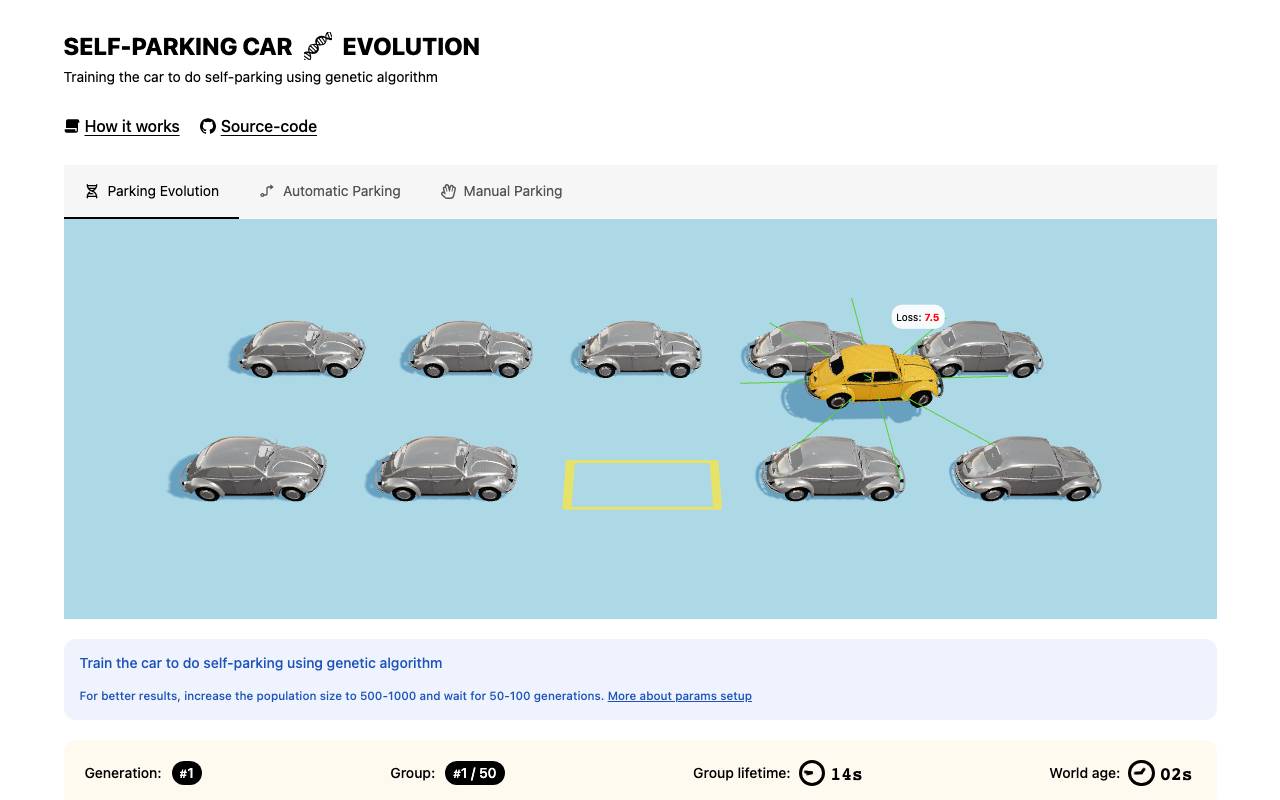
Self-Parking Car Evolution is an open educational project that uses a genetic algorithm to teach simulated cars how to park themselves in a 2D virtual environment. Each car is controlled by a small neural network whose weights are encoded as a genome, and successive generations are bred, mutated, and selected based on how close they get to the target parking spot. The simulation runs entirely in the browser, letting users watch the population improve over time as poorly performing cars are filtered out and stronger drivers pass on their parameters. It serves as a hands-on illustration of evolutionary computation, fitness functions, and emergent behavior rather than a production-ready autonomous driving system. Developers, students, and AI enthusiasts can explore the source code to learn how genetic algorithms work in practice, tweak parameters, or adapt the approach to other control problems.
Criteria breakdown
- Genetic algorithm-based training loop
- Neural network car controllers
- 2D parking simulation environment
- Configurable population and mutation parameters
- Live visualization of evolving generations
- Open-source codebase for experimentation

Restack.io
Developer platform for building, deploying, and scaling production AI agents and workflows.
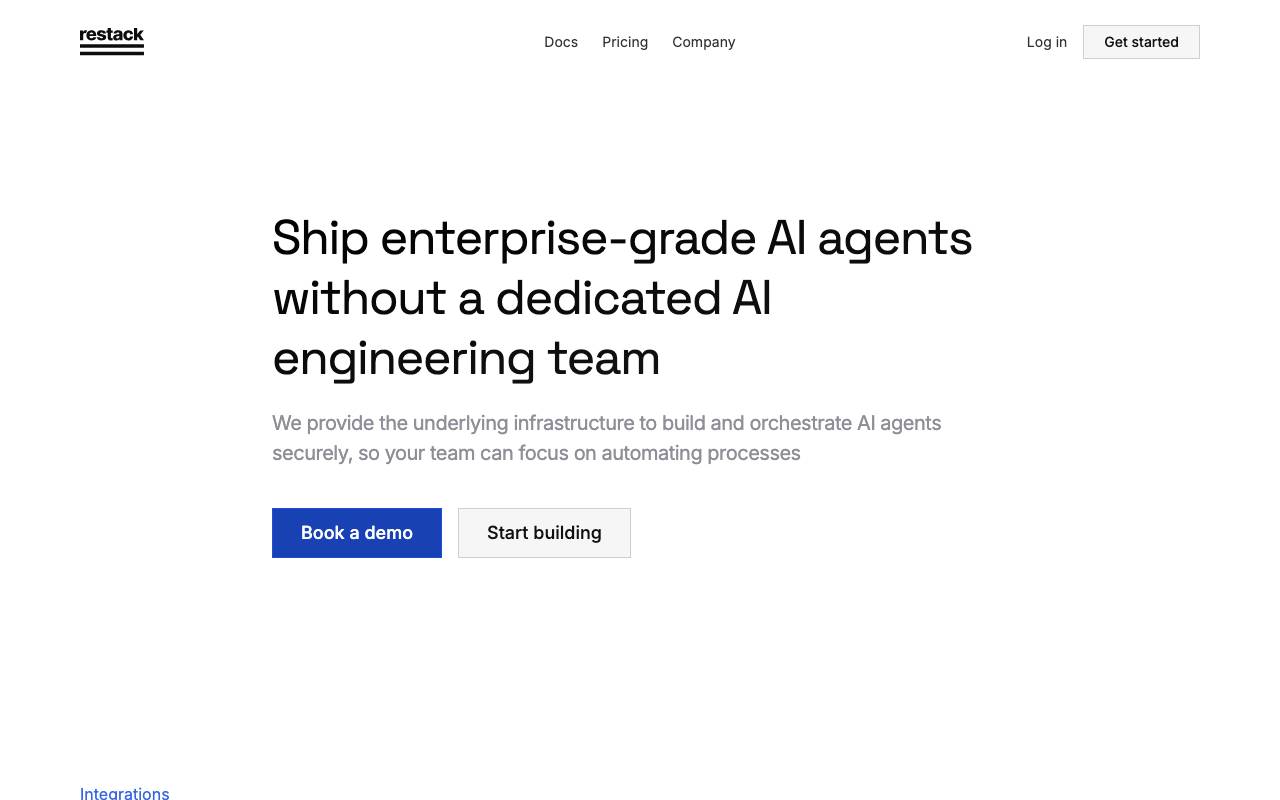
Restack.io is a developer-focused framework for orchestrating AI agents, workflows, and long-running processes. It provides primitives for reliability, observability, and scaling, helping teams move from experimental prompts to production-grade autonomous systems. The platform supports use cases ranging from multi-step agent pipelines to real-time perception tasks such as semantic segmentation for autonomous vehicles. Engineers can integrate custom models, manage state across distributed runs, and deploy across cloud or on-prem infrastructure with built-in retries, scheduling, and monitoring.
Criteria breakdown
- Agent and workflow orchestration
- Stateful execution with automatic retries
- Real-time inference support
- Observability dashboards and tracing
- Custom model and tool integration
- Scalable cloud or self-hosted deployment

PyTorch Vision (TorchVision)
PyTorch's official computer vision library with datasets, transforms, and pre-trained models.
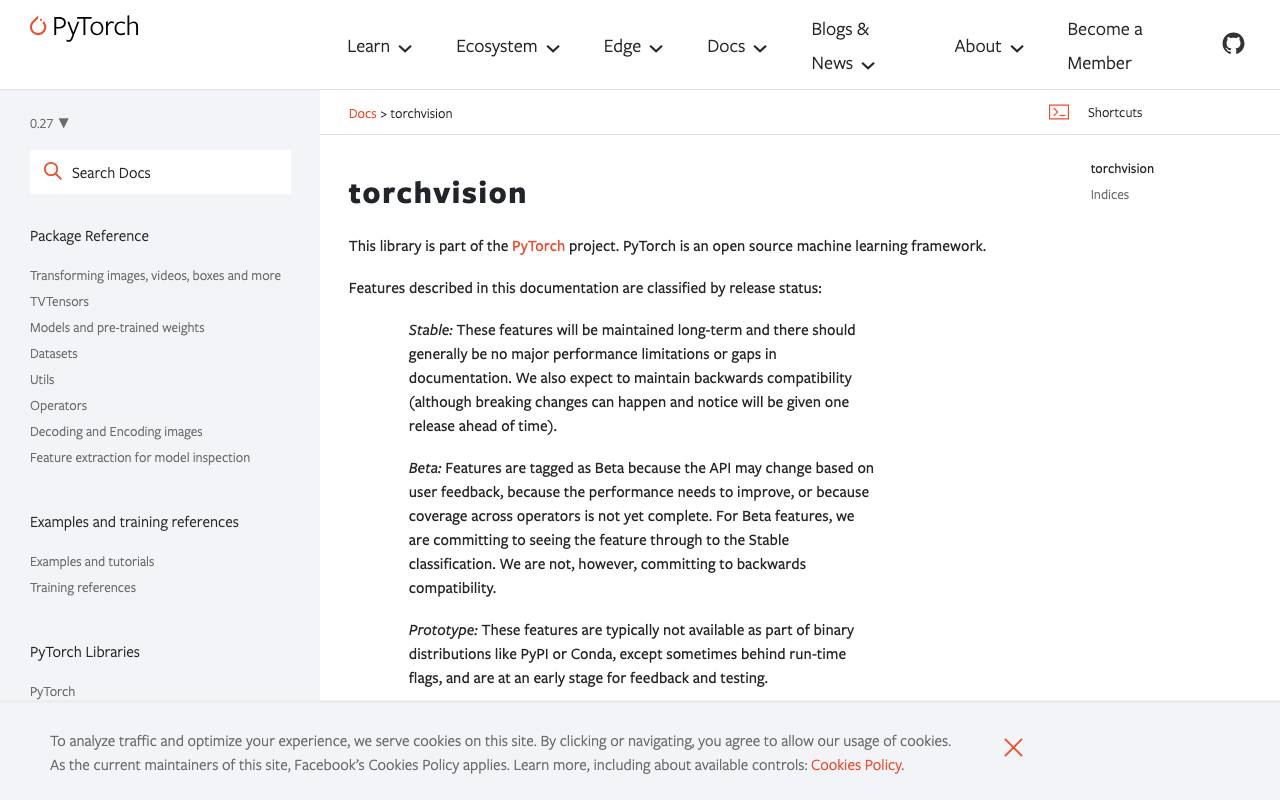
TorchVision is the computer vision companion library to PyTorch, providing a curated collection of popular datasets, image transformation utilities, and pre-trained model architectures. It serves as a foundational toolkit for researchers and developers building image classification, object detection, segmentation, and video understanding pipelines. The library includes ready-to-use implementations of well-known architectures such as ResNet, EfficientNet, Vision Transformers, Faster R-CNN, and Mask R-CNN, along with weights trained on standard benchmarks. It also offers efficient I/O operations, GPU-accelerated transforms, and seamless integration with the broader PyTorch ecosystem, making it easier to prototype and deploy vision workflows.
Criteria breakdown
- Pre-trained models for classification, detection, and segmentation
- Composable image and video transforms
- Loaders for datasets like COCO, ImageNet, and CIFAR
- Operators for NMS, RoI pooling, and bounding boxes
- Native support for reading and decoding images and video
- TorchScript and ONNX export compatibility


Magnific AI is an image enhancement and upscaling platform that uses generative AI to increase resolution while inventing plausible new detail in textures, skin, hair, foliage and fabrics. Unlike traditional upscalers that simply interpolate pixels, it can reimagine fine elements to make photos, illustrations and renders look sharper and more lifelike at larger sizes. Users control the output through sliders for creativity, resemblance and HDR, plus optional prompts that guide how the model fills in detail. This makes it popular with photographers, concept artists, 3D and product designers, and AI image creators who need to take low-resolution outputs from tools like Midjourney or Stable Diffusion up to print-ready sizes. Magnific is a web-based, subscription product with different plans based on monthly generation credits and maximum output resolution.
Criteria breakdown
- Generative AI upscaling up to high resolutions
- Creativity, resemblance and HDR controls
- Optional text prompts to guide enhancement
- Style presets for portraits, art, sci-fi and more
- Web-based interface with credit-based plans
- Works with photos and AI-generated imagery

ExpertDevTech
Custom software, AI, and digital solutions built to accelerate business growth.
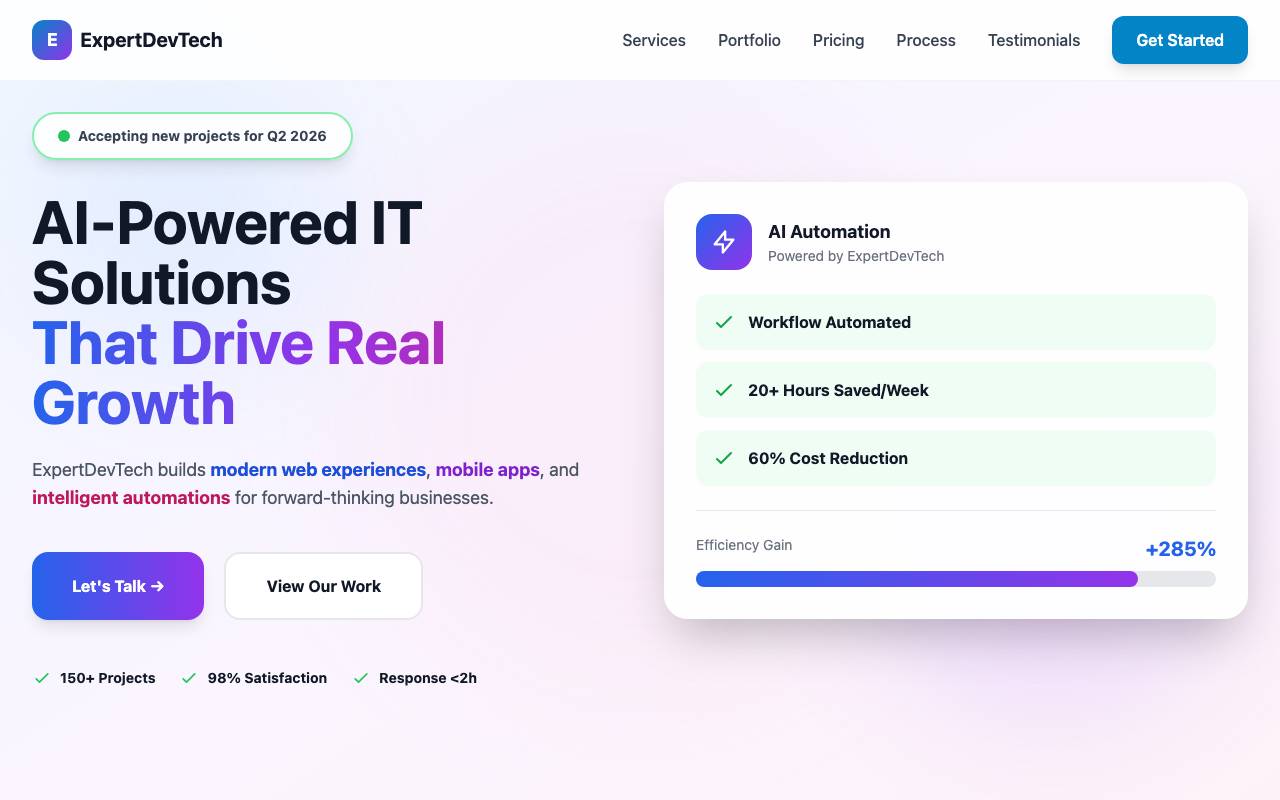
ExpertDevTech is a technology services provider that designs and develops tailored software, AI systems, and digital products for businesses of varying sizes. The company focuses on aligning engineering work with measurable business outcomes, covering areas such as web and mobile applications, automation, and data-driven tooling. Its offering typically spans discovery, design, development, and ongoing support, with AI integration available for teams looking to add intelligent features like predictive analytics, chatbots, or workflow automation. ExpertDevTech positions itself as a long-term build partner rather than a one-off vendor. The service is best suited to organizations that need bespoke solutions rather than off-the-shelf SaaS, including startups validating ideas and established companies modernizing legacy systems.
Criteria breakdown
- Custom software development
- AI and machine learning integration
- Web and mobile app engineering
- Digital transformation consulting
- UI/UX design services
- Ongoing maintenance and support


GoatAI is a video analytics platform that applies computer vision and machine learning to interpret human activity in physical spaces. It focuses on detecting movement patterns, interactions, and behavioral trends from camera feeds without storing personally identifiable information. The system is designed for organizations that need operational insights from video, such as retail, transportation hubs, workplaces, and public venues. By processing footage with privacy-preserving techniques like on-the-fly anonymization and edge computing, GoatAI aims to deliver analytics while reducing compliance risk under regulations like GDPR. Dashboards and APIs let teams turn raw camera data into structured metrics on occupancy, dwell time, flow, and engagement, supporting decisions around space planning, safety, and customer experience.
Criteria breakdown
- Human behavior and movement analysis
- Anonymization of personal data
- Real-time video processing
- Occupancy and dwell-time tracking
- Analytics dashboards and APIs
- Edge or on-premise deployment options

NVIDIA Omniverse (OSMO)
Cloud-native orchestration platform for distributed 3D simulation and robotics workflows
NVIDIA Omniverse OSMO is a cloud-native orchestration platform designed to coordinate complex, multi-stage workloads across heterogeneous compute environments. It helps teams schedule and manage jobs like synthetic data generation, robotics simulation, and AI model training across on-premises clusters, private data centers, and public cloud resources. Built to integrate with the broader Omniverse ecosystem, OSMO connects tools such as Isaac Sim, Replicator, and other simulation services so that distributed teams can collaborate on large-scale virtual environments. It abstracts infrastructure complexity, allowing engineers and researchers to focus on building robotics, autonomous systems, and 3D AI workflows rather than managing pipelines. OSMO is primarily aimed at enterprises and research groups working on robotics, autonomous vehicles, industrial digital twins, and large-scale synthetic data projects where reproducibility, scalability, and team collaboration are critical.
Criteria breakdown
- Cloud-native job orchestration across hybrid environments
- Workflow management for synthetic data and simulation
- Integration with NVIDIA Isaac Sim and Replicator
- Scalable scheduling of GPU-accelerated tasks
- Collaboration support for distributed engineering teams
- Reproducible pipelines for robotics and AI training