Past battle · 2026-04-10 UTC
LLM Showdown — April 10, 2026
From the LLM category. 30 marks placed across 9 fighters. Gemma 4 Local Hardware Matcher took the crown.
Final standings





The line-up
The fighters
Profiles of every tool that competed in this battle, ranked by their final score.

Gemma 4 Local Hardware Matcher
Find the right Gemma 4 model variant for your local hardware setup.
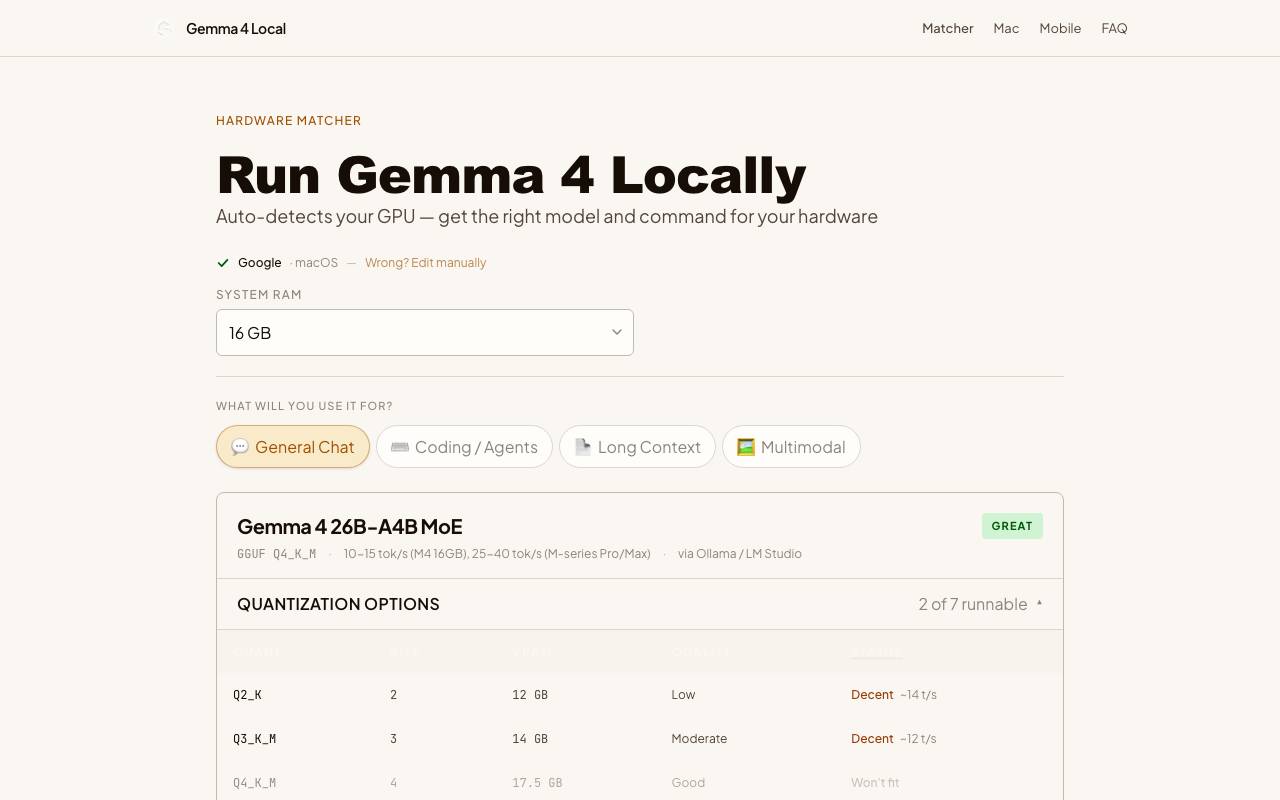
Gemma 4 Local Hardware Matcher is a utility that helps users identify which versions of Google's Gemma 4 model family can run effectively on their specific hardware. By analyzing factors like GPU VRAM, system RAM, CPU capabilities, and available storage, it recommends compatible model sizes and quantization levels. The tool is aimed at developers, hobbyists, and researchers who want to run Gemma 4 locally without trial-and-error testing. It removes guesswork around memory requirements and performance expectations, helping users pick a model variant that balances quality and speed for their machine.
Criteria breakdown
- Hardware detection and analysis
- Model size and quantization recommendations
- VRAM and RAM requirement estimates
- Performance expectations per variant
- Support for multiple Gemma 4 versions
- Guidance for CPU and GPU inference

Llama 3.3
Meta's multilingual open-weight LLM tuned for efficient, high-quality text generation.
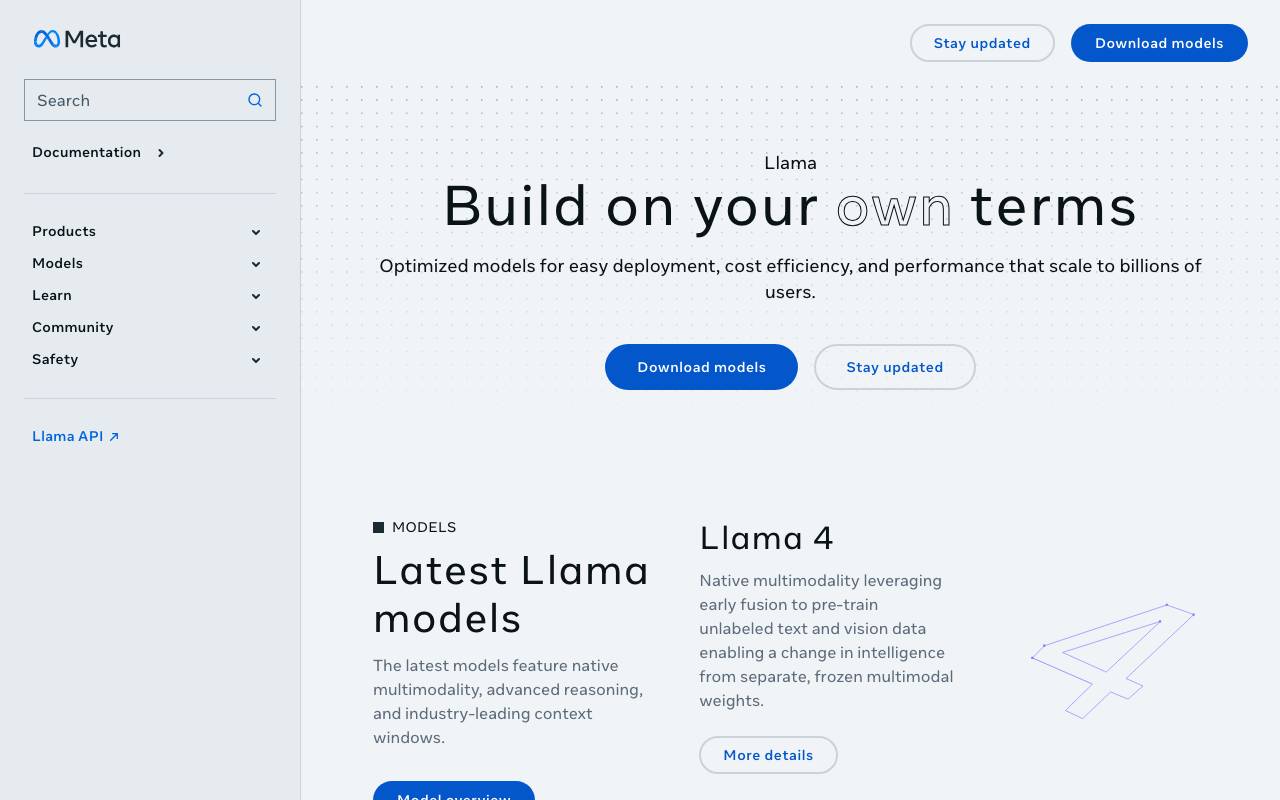
Llama 3.3 is a large language model from Meta designed to deliver strong reasoning, coding, and multilingual capabilities while being more efficient to run than earlier flagship models. It supports a wide range of languages and is suitable for chat assistants, content generation, summarization, and developer tooling. Released with open weights, it can be deployed on-premises or through major cloud and inference providers, giving teams flexibility over cost, latency, and data handling. Its instruction-tuned variant is optimized for following prompts accurately and producing helpful, conversational responses. Developers commonly use Llama 3.3 as a base for fine-tuning domain-specific applications, retrieval-augmented generation systems, and agentic workflows.
Criteria breakdown
- Multilingual text generation
- Instruction-tuned chat variant
- Long-context support
- Coding and reasoning capabilities
- Open weights for fine-tuning
- Compatible with major inference frameworks

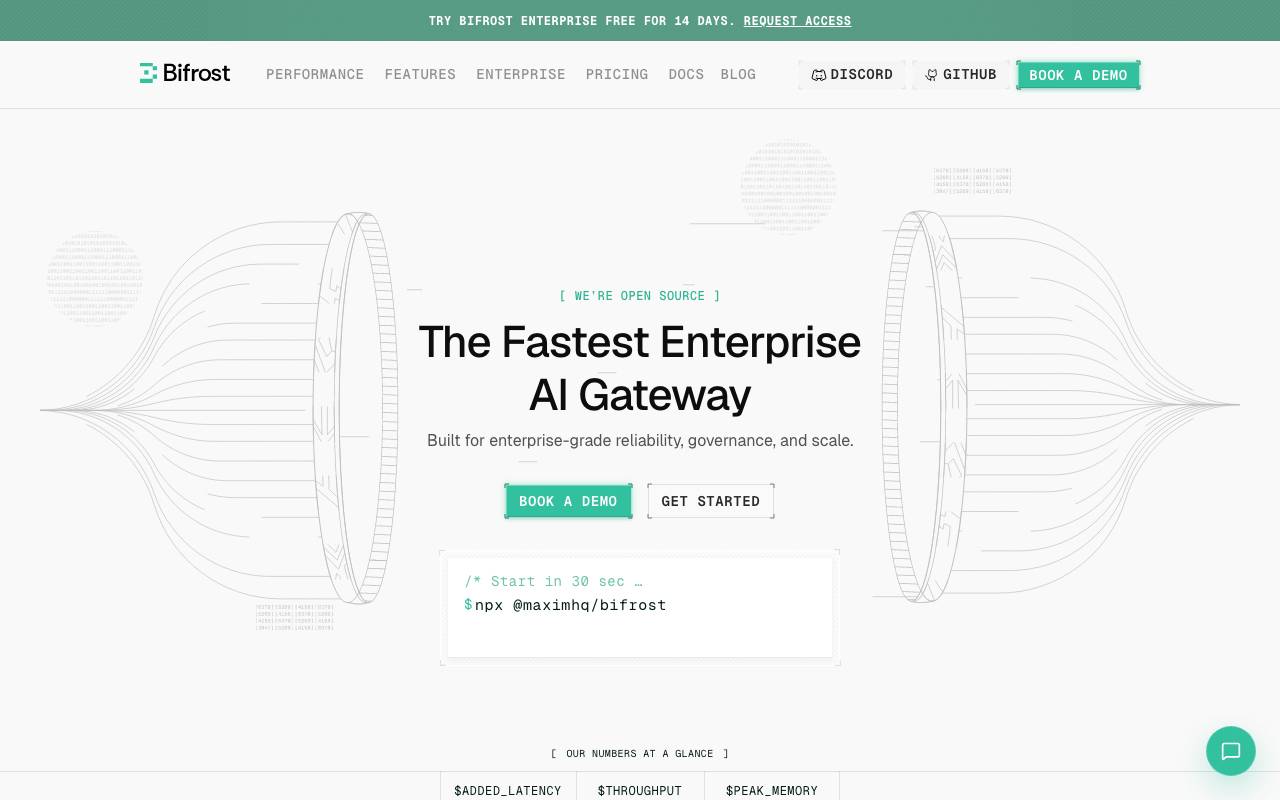
Bifrost is an LLM gateway designed to give developers one consistent API for accessing more than a thousand language models across different providers. Instead of integrating each vendor's SDK separately, teams can route requests through Bifrost and switch or combine models with minimal code changes. The platform focuses on speed and reliability, handling routing, failover, and provider abstraction so applications can stay responsive under load. It's aimed at engineering teams building production AI features who need flexibility in model choice without rewriting their integration layer each time.
Criteria breakdown
- Unified API across many LLM providers
- High-performance request routing
- Model switching without code rewrites
- Provider failover support
- Centralized access management
- Scales for production workloads

ASI:One
Agentic AI assistant that coordinates autonomous agents to complete multi-step tasks.
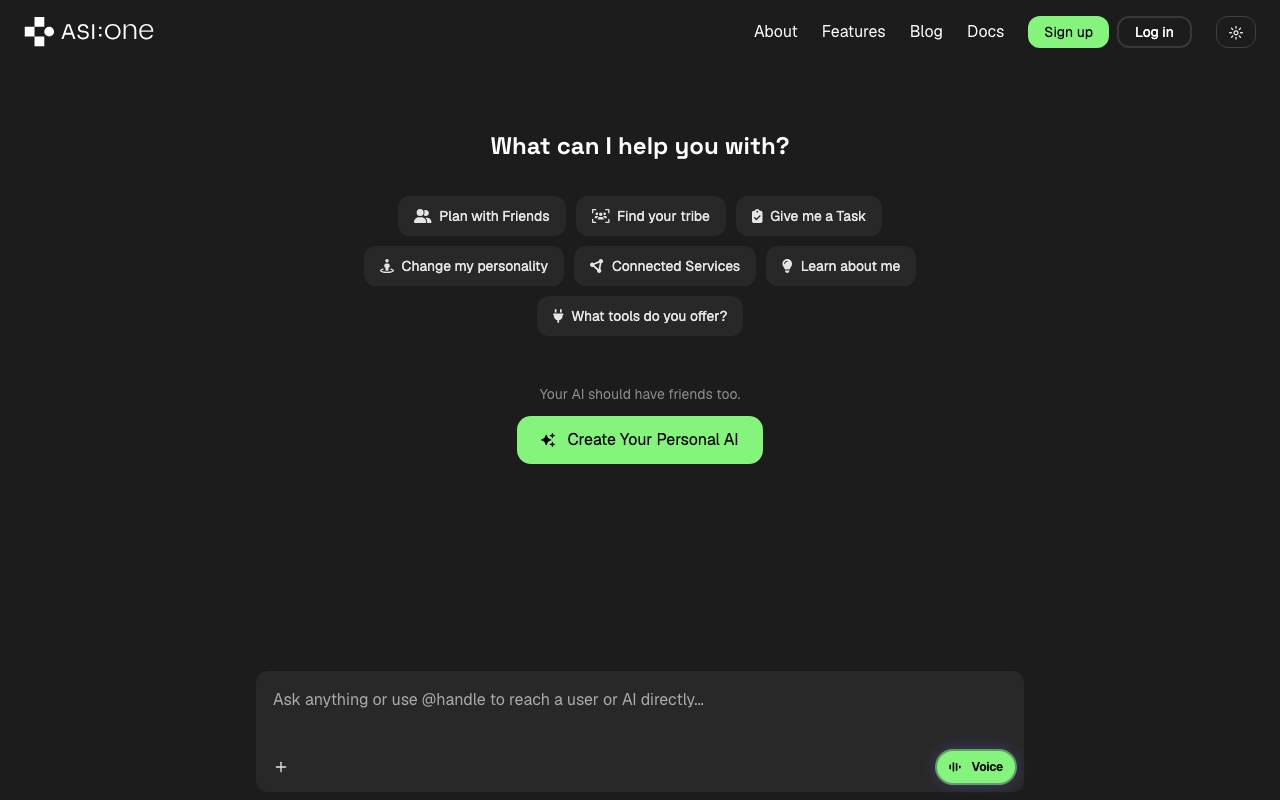
ASI:One is an AI assistant built around the idea of agentic intelligence, where a conversational interface can dispatch and coordinate specialized autonomous agents to handle complex requests. Instead of returning only text, it can plan, call tools, and execute workflows on a user's behalf. Developed within the Artificial Superintelligence Alliance ecosystem, it is positioned as a personal AI agent that integrates with decentralized agent networks. Users can chat with it for everyday questions or delegate longer tasks such as research, comparisons, scheduling, and data lookups across connected services.
Criteria breakdown
- Conversational chat interface
- Autonomous agent orchestration
- Multi-step task planning and execution
- Connectivity to external agents and services
- Personal assistant style memory and context
- Built on the ASI Alliance agent stack


Latest DeepSeek R2 is the successor to DeepSeek's R1 reasoning model, designed to deliver stronger step-by-step problem solving across math, coding, and analytical tasks. It aims to extend the open research approach that made earlier DeepSeek releases popular with developers and researchers. The model targets improved accuracy, longer context handling, and more efficient inference compared to its predecessor, making it suitable for technical assistants, agentic workflows, and integration into custom applications. Availability and exact specifications depend on DeepSeek's official release channels. Users can typically access the model via API, chat interface, or by running open weights where provided, allowing flexibility for both individual experimentation and production deployment.
Criteria breakdown
- Advanced chain-of-thought reasoning
- Extended context window
- Code generation and debugging support
- Multilingual understanding
- API and chat-based access
- Suitable for agentic applications

Pronoia
Arabic-first large language model fine-tuned for native-quality understanding and generation.
Pronoia is a large language model specifically fine-tuned for Arabic, aiming to deliver more accurate comprehension, generation, and reasoning in the language than general-purpose multilingual models. It is positioned as a leading Arabic-focused LLM, with optimizations for dialects, classical forms, and modern standard Arabic. The model can be used for tasks such as content creation, summarization, translation, customer support, and conversational AI in Arabic-speaking markets. By concentrating its training on Arabic data, Pronoia targets nuances like morphology, diacritics, and cultural context that broader models often handle inconsistently.
Criteria breakdown
- Arabic-optimized language model
- Text generation and summarization
- Translation support
- Conversational and chatbot capabilities
- Suited for enterprise Arabic NLP
- Coverage of MSA and dialects

Simple MP3 to Text
AI-powered MP3 to text converter for turning audio into clean, readable transcripts.
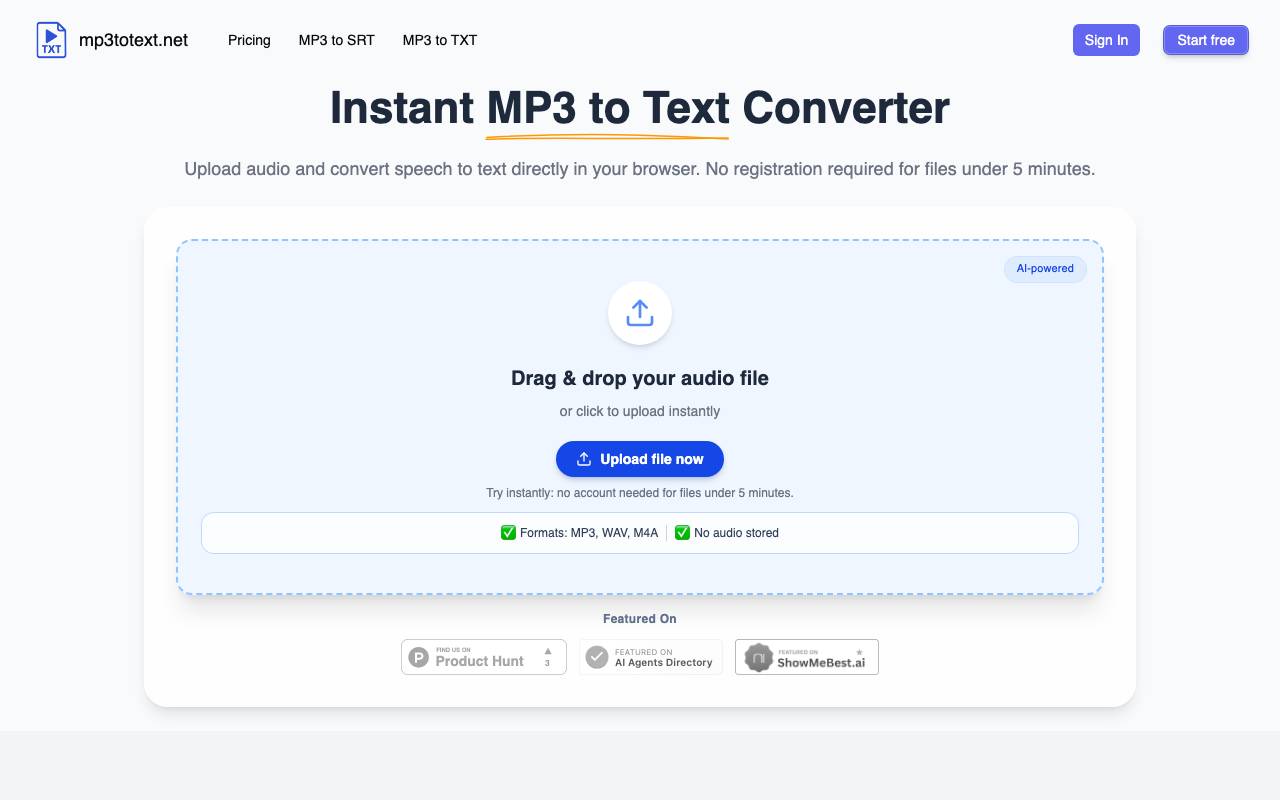
Simple MP3 to Text is a transcription tool that converts audio files such as lectures, podcasts, interviews, and voice notes into written text. It uses AI speech recognition to produce readable transcripts without requiring manual typing or specialized hardware. The service is designed for users who want a quick, low-friction way to extract text from spoken content. Uploaded MP3s are processed automatically, and the resulting text can be copied, edited, or saved for use in notes, articles, study materials, or content repurposing. It suits students, journalists, podcasters, researchers, and anyone who regularly works with recorded audio and prefers a straightforward workflow over more complex transcription platforms.
Criteria breakdown
- MP3 audio to text conversion
- AI-powered speech recognition
- Supports lectures, podcasts, and voice notes
- Clean, copy-ready transcripts
- Browser-based workflow
- Quick turnaround on uploads

DeepSeek V3
Open-source mixture-of-experts model offering GPT-4o-level reasoning at a fraction of the cost.
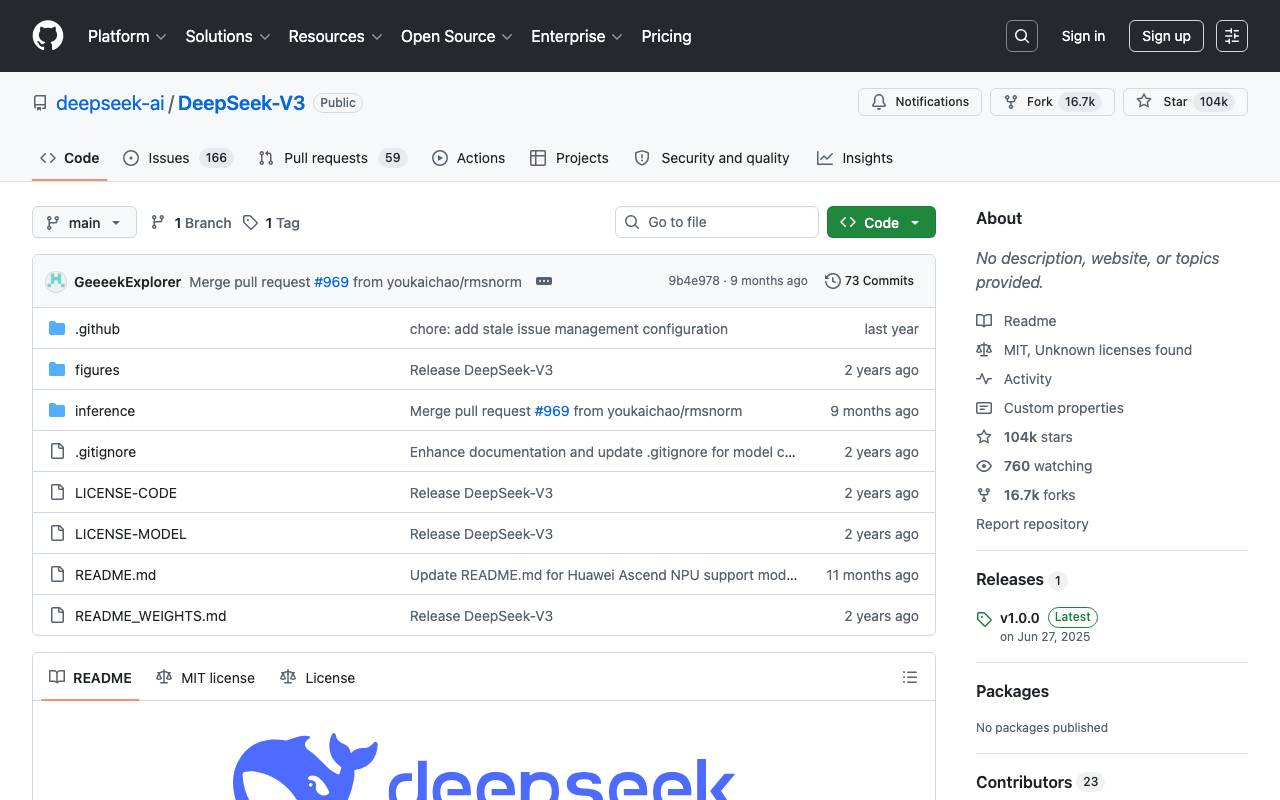
DeepSeek V3 is a large-scale mixture-of-experts (MoE) language model developed by DeepSeek AI. It activates only a subset of its total parameters per token, allowing it to deliver strong performance in reasoning, mathematics, and coding tasks while keeping inference costs significantly lower than comparable dense models. Released with open weights, DeepSeek V3 has become a popular choice for developers and researchers who need a capable foundation model they can self-host, fine-tune, or integrate via API. Benchmarks place it competitively against leading proprietary models like GPT-4o, particularly on math and logical reasoning evaluations. The model is well suited for technical assistants, code generation pipelines, research workflows, and any application where reasoning quality and budget efficiency both matter.
Criteria breakdown
- Mixture-of-experts architecture
- Competitive reasoning and math benchmarks
- Open-source model weights
- API access via DeepSeek platform
- Long context window support
- Fine-tuning friendly

Latest Grok 3 AI
Conversational AI from xAI built for reasoning, research, and real-time answers.
The Latest Grok 3 AI is a conversational AI tool developed by xAI designed to facilitate reasoning, research, and real-time answer retrieval. It is likely built to leverage the capabilities of a large language model, allowing users to pose complex inquiries and receive detailed responses. The tool may integrate with various data sources and knowledge graphs to provide accurate and up-to-date information. The Latest Grok 3 AI might be intended for users seeking an advanced research assistant, such as academics, scientists, or professionals looking to stay current in their respective fields. It could enable users to engage in exploratory discussions, receive explanations, or obtain in-depth analysis on a wide range of topics. While specific details about the tool's architecture and features are not available, it is likely to involve a user-facing interface, allowing individuals to interact with the AI model through natural language. The AI might employ natural language processing and generation techniques to comprehend and respond to user input. Given its potential capabilities and features, the Latest Grok 3 AI could stand out as a powerful research tool, but its actual strengths and limitations may depend on its implementation and the specific use cases it is designed to support. Without further information, it is challenging to assess its direct comparisons to other conversational AI tools or the exact scope of its research capabilities. Nonetheless, it has the potential to serve as a valuable resource for those seeking nuanced and in-depth information. It's worth noting that a key strength of the Latest Grok 3 AI could be its ability to handle complex, multi-step reasoning tasks. However, its performance might suffer in areas where data accuracy or up-to-date information is insufficient. In terms of workflow, the Latest Grok 3 AI may be designed to integrate with existing information systems and allow users to leverage external data sources. Its interface could include features for organizing and visualizing the output of its research, making it easier for users to analyze and understand the results.
Criteria breakdown
- Advanced reasoning mode
- Large context window
- Code generation and debugging
- Real-time information lookup
- Multi-turn conversation memory
- Natural language Q&A