
Tech Lead (Grade A)Security-tested data-ai skill for Claude AI. Grade A. Technical implementation consultation for Conductor orchestrator. Advises on implementation approach, dependency choices, and coding patterns. Can

Overview
Key features
- Implementation approach consultation
- Dependency management and approval
- Coding pattern guidance
- Escalation protocol for large dependencies or breaking changes
Pricing
- Model
- Free
- Category
- Skills
- Rating
- No reviews yet
Use cases
Dependency Approval
The Tech Lead is consulted to approve a small utility dependency, such as date-fns, and provides a decision with reasoning.
Implementation Guidance
The Tech Lead provides implementation guidance for a new feature, including suggestions for coding patterns and dependency management.
Escalation
The Tech Lead encounters a large dependency or breaking change and escalates it to the Board of Directors or users for review.
Pros & Cons
Pros
- Autonomous decision-making for implementation approach and dependency management
- Ability to approve small dependencies without user approval
- Provides implementation guidance and documentation
Cons
- Limited authority for large dependencies or breaking changes
- May require escalation to Board of Directors or users
Reviews
Sign in to leave a review.
No reviews yet. Be the first!
Q&A
Can I use this alongside other Claude Code plugins?
Yes. SupaConductor uses the /orchestrator-supaconductor: namespace and doesn't conflict with any other plugins, built-in commands, or MCP servers.
Asked by Wesley Adekunle · Feb 6, 2026
Is this overkill for small tasks?
For a quick one-file fix — yes, just use Claude Code directly. Use SupaConductor when the work touches 3 or more files, you’d normally plan before coding, you want automated quality checks, or you want the work done right the first time. You can also use individual commands without the full loop.
Asked by Nils Johansson · Jan 26, 2026
Does this work with Cursor, Windsurf, or other AI tools?
No — SupaConductor is a Claude Code plugin that requires Claude Code's plugin system (agents, skills, slash commands, hooks). However, the conductor/ directory it creates is just Markdown files. Any AI tool can read them. If you start with SupaConductor and switch tools later, your specs, plans, and documentation remain useful.
Asked by Jarrah Whitlock · Jan 22, 2026
How much of my context window does this use?
Skills use progressive disclosure — only ~100 tokens each for metadata. Full instructions load only when activated (typically under 5,000 tokens each). The 39 skills are not loaded all at once. Agents run as separate conversations with their own context windows, so they don't fill up your main conversation. Context usage: Orchestrator ~4,000 tokens (active during /go); Planner ~3,000 tokens (during planning only); Evaluator ~2,500 tokens each (only when active); Board meeting ~5,000 tokens (on-demand); Idle ~500 tokens (between steps).
Asked by Elif Yildiz · Jan 1, 2026
How much does this cost in API credits?
SupaConductor uses the same Claude API as normal Claude Code — it just structures the work more carefully. Because it runs multiple agents (planning, execution, evaluation), it uses roughly 3-5x the API calls compared to doing everything manually in one conversation. SupaConductor optimizes costs automatically: it uses Opus (the most capable model) for planning and evaluation, and Sonnet (faster, cheaper) for execution tasks. Ways to reduce cost: Use /orchestrator-supaconductor:implement if you write specs yourself; Skip board meetings for small features (they're opt-in); Use human-in-the-loop mode to stay in control of scope.
Asked by Ahmed Saleh · Dec 26, 2025
Ask a question
Skills alternatives

 Manage Headers (Grade A)Skills
Security-tested development skill for Claude AI. Grade A. Inspects and configures the security headers a Power Pages site sends to browsers — Content Security Policy, frame and clickjacking protection

 Using Git Worktrees (Grade A)Skills
Security-tested data-ai skill for Claude AI. Grade A. Use when starting feature work that needs isolation from current workspace or before executing implementation plans - creates isolated git worktre

 Ga4 Bigquery Schema (Grade A)Skills
Security-tested data-ai skill for Claude AI. Grade A. GA4 BigQuery Export Schema Reference — complete field reference, nested structures, query patterns, and performance tips

 Meta Capi (Grade A)Skills
Security-tested data-ai skill for Claude AI. Grade A. Meta Conversions API (CAPI) Setup Reference — architecture, event types, customer information hashing, deduplication, implementation examples, AEM

 Callees (Grade A)Skills
Security-tested development skill for Claude AI. Grade A. Lista o que uma funcao/metodo chama (call graph direto)

 Test Module Name (Grade A)Skills
Security-tested data-ai skill for Claude AI. Grade A. Name Haskell test modules after the module under test with a Spec suffix in the same namespace. Use when writing or reviewing Haskell test module

 Board Of Directors (Grade A)Skills
Security-tested data-ai skill for Claude AI. Grade A. Simulate a 5-member expert board deliberation for major decisions. Use when evaluating plans, architecture choices, feature designs, or any decisi

 Advpl Mvc Avancado (Grade A)Skills
Security-tested development skill for Claude AI. Grade A. MVC avançado via PE (Pontos de Entrada) — adicionar grids customizadas em telas MVC padrão (CNTA300/MATA070/MATA440/MATA460/FINA040 via *STRU)
Trending now

 Reducto AIAI Agent Development Platforms
Document intelligence API that parses, splits, OCRs, and extracts structured data from complex PDFs, slides, and spreadsheets.
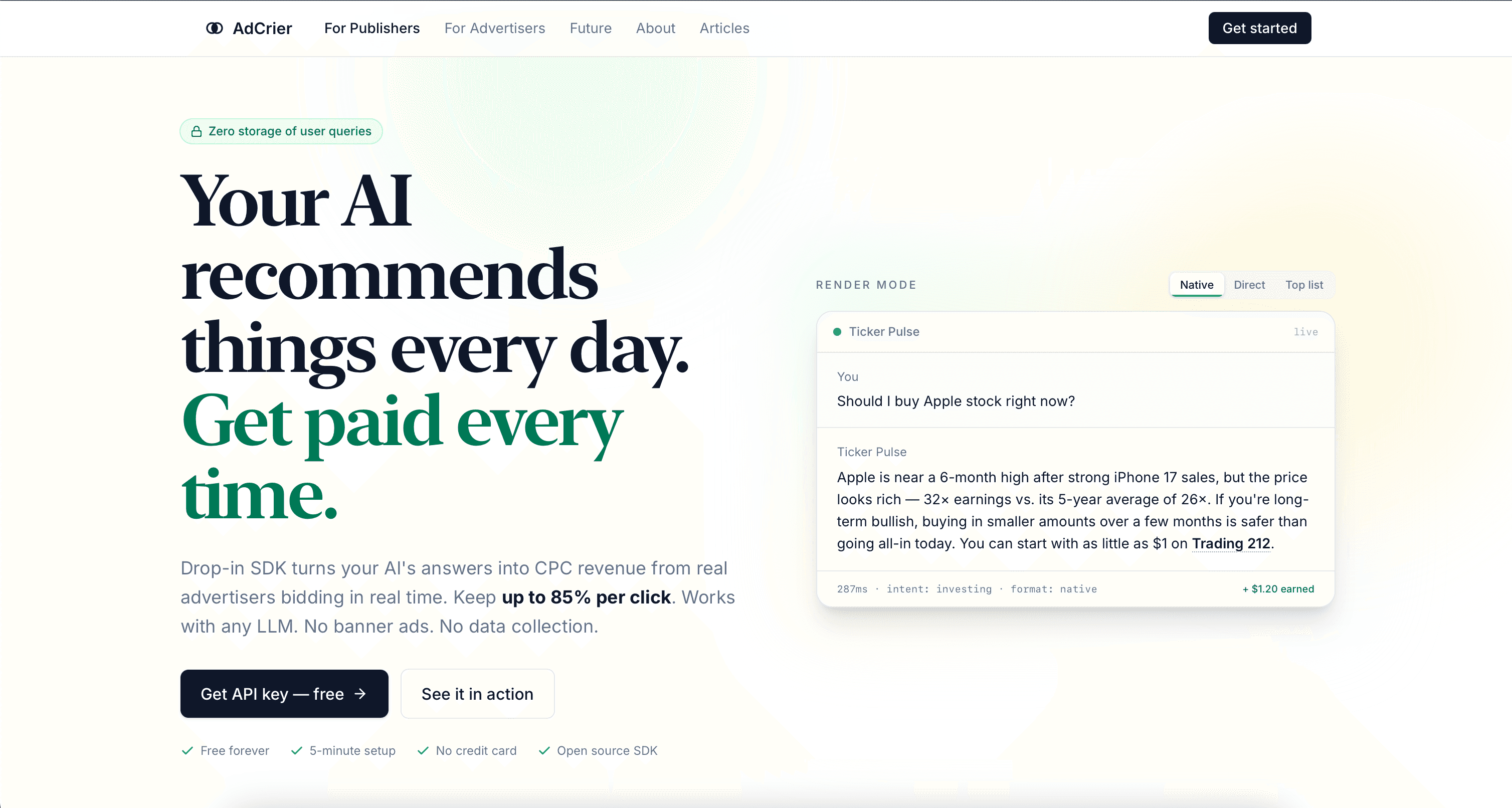
 AdCrierMarketing & Advertising
Sponsored answers, paid per click.

 Biology AIEducation AI
Accurate Homework Help with Full Explanations

 Pixtral 12B 24.09LLM
Open multimodal 12B model handling interleaved images and text with a 128K context window.